
Background Information
Anyone who has tried to stay focused on a dull task knows that attention fades. In the laboratory this shows up reliably as the
vigilance decrement
The vigilance decrement is the decline in performance as time goes on during a long, monotonous task that requires watching for rare targets, such as a radar operator looking for a blip. People typically miss more targets or make more false alarms after only a few minutes. It is the standard laboratory measure of how well sustained attention holds up.
More on Wikipedia
View in glossary
: when people watch for rare targets for half an hour, they get worse at telling targets from non-targets as the minutes pass. By 2010, practice on a particular vigilance task was known to help on that task, but no training had been shown to reduce the decline in general.
One explanation, the resource model, holds that keeping attention on a task draws on a limited supply of mental resources, and the harder each judgment is, the faster that supply runs down. Targets that are hard to see, for example, make the decline steeper. If something made the targets easier to perceive, attention might last longer.
Shamatha
Shamatha (Pali samatha, “calm abiding”) is a Buddhist family of concentration practices that train attention to settle and stay on a chosen object, such as the sensations of the breath. Practitioners notice when the mind has wandered and bring it back, aiming for attention that is both stable and vivid. It is often paired with vipassana, or insight, practice.
More on Wikipedia
View in glossary
meditation, a Buddhist concentration practice, is meant to train exactly this kind of attention. The authors describe it this way:
Shamatha practitioners learn to stabilize their attention on a chosen stimulus, such as the tactile sensation of breathing, and enhance the perceived detail of that stimulus in order to cultivate non-task-specific skill in regulating and controlling voluntary attention
Practitioners also learn to notice when their attention has drifted (
mind wandering
Mind wandering is the spontaneous shift of attention away from a current task or external environment to internally generated thoughts, memories, or fantasies. This common cognitive process is associated with default mode network activation and has been extensively studied in relation to meditation practices, which often aim to reduce mind wandering.
More on Wikipedia
View in glossary
) and bring it back. Traditional accounts say this training improves attention and perception in daily life. Earlier studies had found that long-term meditators did better on sustained-attention tasks than non-meditators, but that kind of one-time comparison can’t show that meditation caused the difference. This study set out to test it by following people through training.
What They Did
This paper comes from the Shamatha Project, the same three-month retreat study that produced the findings on telomerase and on controlled attention and inflammation summarized elsewhere on this site.
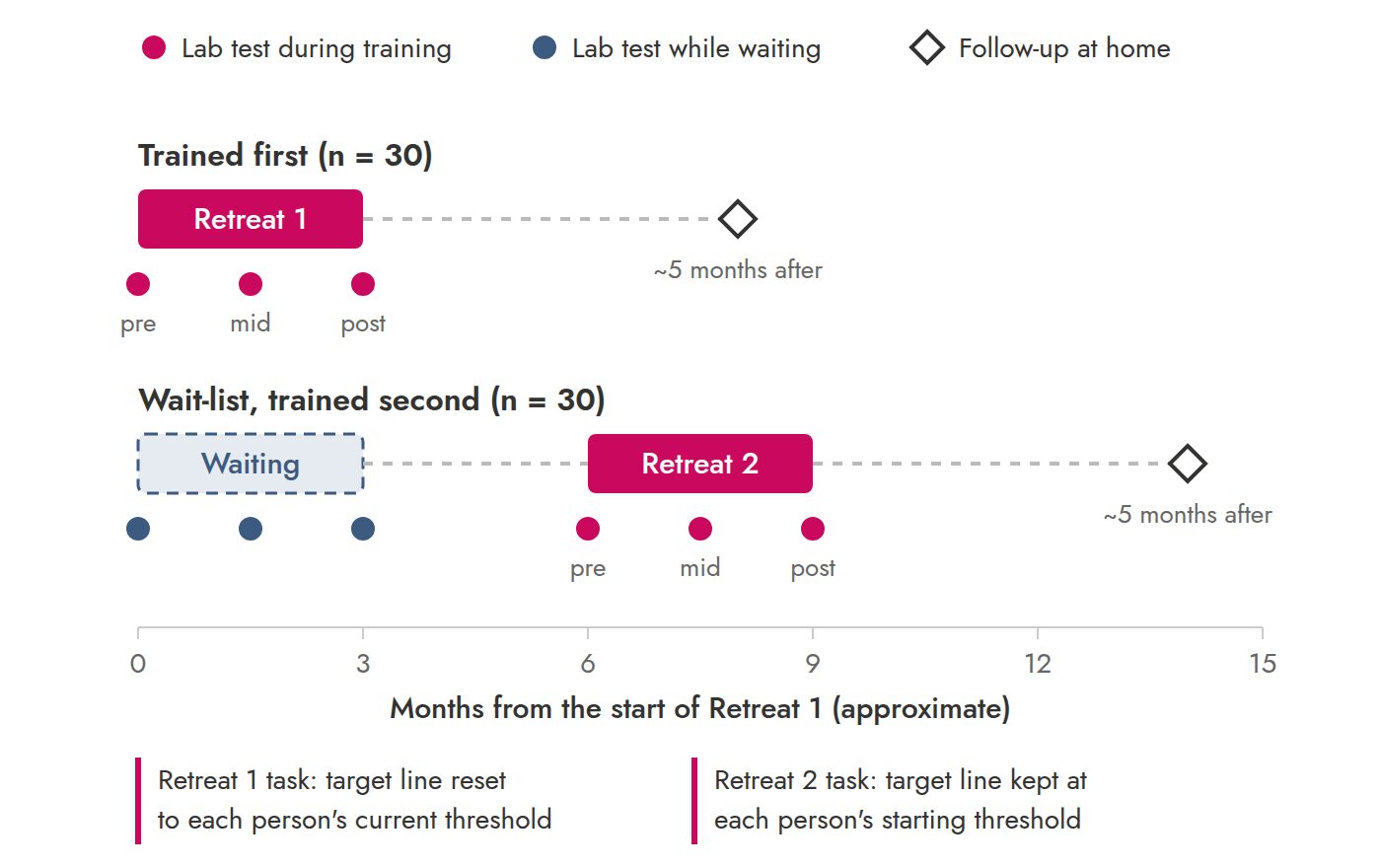
The researchers recruited 60 people aged 22 to 69 through magazine and online ads. All were already familiar with intensive meditation, having attended at least three five-day retreats (14 on average), and all had to be willing to go on either of two retreats. About half of the applicants were accepted. Participants were then randomly assigned, balanced for age, sex, handedness, ethnicity and meditation experience, either to the first retreat (30 people) or to a
wait-list control group
A wait-list control group is a comparison group that receives the program being studied only after the study period, so participants who are waiting can be compared with those already taking part. It controls for the passage of time and repeated testing, but not for the attention, expectations and setting that come with taking part in any program, which an active control group can address.
More on Wikipedia
View in glossary
(30 people). Before training, the two groups were well matched on age, education, nonverbal IQ, meditation experience, personality, anxiety, depression and well-being.
The retreat took place at the Shambhala Mountain Center in Red Feather Lakes, Colorado. For three months, participants lived on site and were taught by B. Alan Wallace, one of the paper’s co-authors. They practiced Shamatha for about 5 hours a day, plus about 45 minutes a day of practices that use imagery and concentration to develop compassion and kindness toward others. Each day included two group sessions with meditation and discussion, and each person met the teacher individually once a week. Participants paid for their own room and board (about $5,300) and were paid $20 an hour for testing.
The wait-list group wasn’t left out. They were flown to the retreat center to be tested at the same three points as the retreat group: at the start, halfway through and at the end of the first retreat. Three months after the first retreat ended, the wait-list group began a retreat of their own, and the researchers tested them again at its start, middle and end. Both groups also did a shorter test at home, on a laptop sent to them, about five months after their retreat.
The Line Task
The test involved no meditation. A single vertical line flashed for 150 milliseconds in the center of a screen, followed by a mask. Most lines were long; occasionally a slightly shorter one appeared, and participants had to click as quickly and accurately as they could whenever they saw a short line.
There were two parts:
- A threshold procedure (about 10 minutes). The short line’s length was adjusted trial by trial to find the smallest difference from the long line each person could reliably detect. A smaller threshold means sharper discrimination. The researchers call this measure discrimination.
- A sustained-attention task (32 minutes). Only 1 line in 10 was a short target. The researchers scored how well each person told targets from non-targets, combining correct clicks with false alarms into a measure called A′ (A-prime), where 1 is perfect and 0.5 is guessing. They looked at A′ averaged over the whole task (average sensitivity) and at how quickly it fell during the first half of the task, when the decline was steepest (vigilance).
A design choice matters for everything that follows. In the first retreat, the short target in the 32-minute task was set to each person’s own threshold, measured afresh at every test. As someone’s discrimination improved, their target got closer in length to the long line, so the task stayed about equally difficult for everyone. In the second retreat, the researchers kept the target at the length each person could just detect at the start of their retreat. Participants weren’t told about the change. If their discrimination improved, the fixed target would become easier for them to see.
One Big Result: Both Retreats Sharpened Visual Discrimination, and the Gain Lasted Months
At the start of the first retreat, the two groups’ thresholds didn’t differ (p = .57). By the middle and again at the end of the retreat, the retreat group could detect significantly smaller differences in line length than the wait-list group. The
effect sizes
Effect size is a statistical concept that quantifies the magnitude or strength of a relationship, difference, or intervention outcome. Unlike p-values which only indicate statistical significance, effect sizes measure how meaningful a result is in practical terms. Common measures include Cohen’s d (standardized mean difference), correlation coefficients (r), and odds ratios. In meditation research, effect sizes help quantify the practical impact of different meditation practices on psychological or physiological outcomes.
More on Wikipedia
View in glossary
were modest: group membership accounted for about 8–9% of the variation in thresholds (partial eta squared = .08 at midtraining and .09 at posttraining).
The wait-list group then showed the same pattern during their own retreat. Their thresholds didn’t change significantly while they were waiting, through the last two tests of the first retreat and the first test of their own (all p > .21). Once they started training, their discrimination improved significantly from the start to the middle of their retreat (partial eta squared = .23), with no further gain in the second half. The improvements held up after the researchers accounted for differences in eyesight, and age, sex, nonverbal IQ and previous meditation experience didn’t predict who improved.
The gains also lasted. About five months after the first retreat, the people who had trained first still had lower thresholds than the wait-list group had at the start of its retreat (29 people in each group; partial eta squared = .08). Five months after the second retreat, the wait-list group’s thresholds were lower than they had been before it began (27 people; partial eta squared = .39).
The improvement seems to come from perception rather than from trying harder or clicking faster. The measures took false alarms into account, and neither group’s reaction times or willingness to click changed during either retreat. Shamatha trains attention on the breath, not on sight, so the authors note that the training appears to have carried over to a different sense.
Miscellaneous Interesting Takeaways
Attention Held Up Better Only When the Task Stayed the Same
The study’s title promises improved sustained attention, and the picture there is more indirect.
In the first retreat, with the target reset to each person’s threshold at every test, the task stayed equally hard, and the groups’ average A′ was the same at every point (about .95 at the start, .90 midway and .89–.90 at the end). Everyone’s accuracy declined over the course of the task, and the retreat group’s decline was no smaller than the wait-list group’s. The authors conclude that their method of setting the target “precluded observation” of any change in vigilance.
In the second retreat, with the target fixed at each person’s starting threshold, things changed. While the wait-list group were still waiting, the rate at which their accuracy declined during the task didn’t change from one test to the next, so simply repeating the task didn’t help. During their retreat, average A′ rose significantly from the start to the middle (partial eta squared = .24), and the decline over the first half of the task became significantly shallower as training went on (p = .012). This is the study’s evidence that training improved vigilance.
The authors’ explanation follows the resource model. As discrimination sharpened, the fixed target became easier to see, so each judgment took less effort and more was left over for keeping attention on the task:
These results suggest that training-related improvements in perception reduced the resources required to discriminate an unchanging target, which in turn increased the resources available for sustaining voluntary attention.
They are candid that this is an indirect route, and that they did not find what the contemplative tradition would predict:
However, we did not find compelling evidence to suggest that our meditation training led to direct beneficial changes either in the ability to sustain attention or in the qualitative nature and efficiency of metacognitive processes, even though such changes would be expected to occur eventually if the traditional literature of Shamatha meditation (Wallace, 1999) is correct.
So the abstract’s “improved vigilance” is real but specific: it appeared when the task did not get harder as people improved, it came from one group of 27 people compared with their own waiting period rather than with a separate control group, and the authors attribute it to sharper perception rather than to a stronger capacity to sustain attention.
More Daily Practice After the Retreat Went With Sharper Discrimination
Combining both retreats, the researchers looked at 54 people who reported how much they meditated each day after going home (on average 129 minutes a day for the first group and 112 for the second). Those who meditated more had lower thresholds at the five-month follow-up (r = −.36). The authors take this as a sign that keeping up regular, less intensive practice helps the gains last. Because it is a correlation measured once, it could also reflect other differences between people who keep meditating and people who don’t. Interestingly, how much people meditated during the retreat itself (about 6 hours a day on average) didn’t predict their results at the end of it.
What the Design Can’t Rule Out
Random assignment and a group that later did the same retreat are real strengths: they rule out the possibility that people who chose to meditate were different to begin with, and the wait-list’s own retreat replicated the discrimination result. But a wait-list controls only for time and repeated testing. The wait-list group didn’t live at a remote mountain retreat center or spend three months with a committed teacher, and the study had no
active control group
An active control group is a comparison group that takes part in a different program designed to be just as engaging as the one being tested. In meditation research, it might involve exercise, music, or education classes with the same time commitment, teachers, and expectations of benefit. Comparing against an active control helps separate the effects of meditation itself from the general effects of joining a course.
More on Wikipedia
View in glossary
doing some other demanding activity in the same setting.
The authors discuss these possibilities. They argue that the altitude (about 2,500 meters) is unlikely to affect perception and vigilance, and that gains which lasted months after people went home don’t depend on the retreat setting. On motivation, they note that both groups were strongly committed (everyone had paid for a retreat) and that the wait-list group’s results were stable while waiting. They still call for future studies comparing meditation with an active control taught by the same teacher in the same place.
The participants were also experienced meditators willing to commit three months and pay for the privilege, so the results may not apply to beginners or to everyday practice. The samples were small, especially in the second retreat, and the five-month follow-up tested only discrimination, at home rather than in the lab, so it says nothing about whether the vigilance gain lasted.
Final Reflection
This study randomly assigned meditators to intensive training or a wait-list and followed both groups through a retreat, and its main finding is solid within those limits: three months of concentration practice sharpened a basic visual skill, the effect was replicated when the wait-list group did its own retreat, and it was still there five months later.
The finding on sustained attention is subtler than the title suggests. Attention held up better only when the task stayed fixed while perception improved, which the authors read as perception freeing up resources rather than attention itself growing stronger. That fits a pattern in other retreat studies on this site. A three-month Vipassana retreat shrank the attentional blink, which was also explained by the brain spending fewer resources on the first target, and a later analysis of the Shamatha Project found that the retreat strengthened deliberate, controlled attention without reducing the automatic pull of distractions.
Whether these gains come from meditation itself, rather than from three months of retreat life with a dedicated teacher, still needs studies with an active comparison group doing something equally demanding in the same setting.
Citation
MacLean, K. A., Ferrer, E., Aichele, S. R., Bridwell, D. A., Zanesco, A. P., Jacobs, T. L., King, B. G., Rosenberg, E. L., Sahdra, B. K., Shaver, P. R., Wallace, B. A., Mangun, G. R., & Saron, C. D. (2010). Intensive meditation training improves perceptual discrimination and sustained attention. Psychological Science, 21(6), 829–839. 10.1177/0956797610371339
Get the next summary by email
One or two new paper summaries every couple of weeks, sent to your inbox when they go up.
No spam, and you can unsubscribe at any time. Prefer a feed reader? Use the RSS feed.