
Background Information
Psoriasis
Psoriasis is a long-lasting immune-related skin disease in which skin cells multiply far faster than normal, building up into raised, red, scaly patches called plaques, often on the elbows, knees, scalp and trunk. It tends to come and go in flare-ups, which many patients say stress can trigger. It affects roughly 1–3% of people and can be treated, but not cured, with creams, ultraviolet light therapy and drugs that act on the immune system.
More on Wikipedia
Read more in the glossary
is a common skin disease in which skin cells multiply too quickly and pile up into raised, red, scaly patches. The paper puts its prevalence at 1% to 3% of the world’s population, and in moderate to severe cases the patches can be itchy, uncomfortable and disfiguring. Stress has long been suspected of making it worse: the authors cite studies linking psychological distress to the severity of psoriasis in 32% to 70% of patients, and case reports of improvement with hypnosis, biofeedback and meditation.
People with widespread psoriasis are often treated with ultraviolet
phototherapy (uvb and puva)
Ultraviolet phototherapy treats skin diseases such as psoriasis by exposing the skin to controlled doses of ultraviolet light, usually in a booth several times a week, slowing the overgrowth of skin cells and calming inflammation. UVB therapy uses ultraviolet B light alone. PUVA (psoralen plus UVA) combines a light-sensitizing drug, psoralen, with ultraviolet A light and is often used for more severe or stubborn cases. Long courses raise the risk of skin cancer.
More on Wikipedia
Read more in the glossary
. Three times a week, they stand naked in a light booth while ultraviolet light slows the overgrowth of skin cells. UVB treatment uses ultraviolet B light alone; PUVA adds a light-sensitizing drug, psoralen, to ultraviolet A light and is usually kept for severe cases or those that haven’t responded to UVB. Both treatments control the disease rather than cure it, and the doses climb from session to session.
A team from the Stress Reduction Clinic at the University of Massachusetts Medical Center, led by Jon Kabat-Zinn, whose own writings are the paper’s sources on
Mindfulness-Based Stress Reduction (MBSR)
Mindfulness-Based Stress Reduction (MBSR) is a program designed to help individuals cope with stress, pain, and illness. Developed by Jon Kabat-Zinn in the 1970s, it combines meditation and yoga to promote awareness and stress management. The eight-week program teaches participants to focus on the present moment non-judgmentally, enhancing their ability to manage difficulties.
More on Wikipedia
Read more in the glossary
, saw an opportunity in that booth. The patient stands alone with nothing to do, sometimes for many minutes, and the disease is plain to see, so any change in how fast it clears can be tracked. A small pilot study by the same group had found faster clearing in patients who meditated during their light treatments. This trial set out to test that more rigorously. The authors explain their reasoning:
We hypothesized that the focused attention characteristic of a mindfulness meditation-based stress reduction exercise (see Methods) would enhance relaxation and a sense of participatory agency on the part of the patients during their treatments, and might result in the reduction or reversal of possible stress-related emotional and cognitive factors contributing to the exacerbation of the subject’s condition.
What They Did
Between October 1991 and October 1994, referring dermatologists recruited 70 patients with moderate to severe psoriasis, covering at least 15% of the body, who were about to start light treatment. Thirty declined to take part, and three were dropped (two were treated elsewhere and one had enrolled twice). That left 37 people (20 women, 17 men), averaging 43 years old, who had had psoriasis for about 11 years on average. Their dermatologists had already chosen their treatment: 21 were starting UVB and 16 PUVA.
In this
randomized controlled trial
A Randomized Controlled Trial is a scientific study design that randomly assigns participants to either an experimental group receiving an intervention or a control group, allowing researchers to measure the true effect of the intervention while minimizing bias.
More on Wikipedia
Read more in the glossary
, each of those two groups was randomly split, separately, into a tape group and a no-tape group: 11 tape and 10 no-tape patients for UVB, and 8 and 8 for PUVA. The study was presented to patients as a test of whether relaxation tapes made treatment more pleasant, and the researchers say nothing was said to suggest the tapes might help the skin.
The tape group. For the first three sessions, patients heard a 5-minute introductory tape on a chair outside the booth. Inside the booth, they listened to a guided meditation recorded for their type of treatment. The instructions led them through
mindfulness
Mindfulness is the psychological process of purposely bringing one’s attention to experiences occurring in the present moment without judgment. It involves maintaining awareness of thoughts, feelings, bodily sensations, and surrounding environment with an attitude of curiosity and acceptance. In meditation contexts, mindfulness practices typically involve focusing attention on the breath or body sensations as anchors to the present moment while acknowledging and releasing distracting thoughts.
More on Wikipedia
Read more in the glossary
of the breath, then of body sensations (including the warmth of the lights and air moving over the skin), sounds, thoughts and feelings. In later parts of the tape, they were asked to imagine the ultraviolet light (and, for PUVA patients, the psoralen they had swallowed) slowing down the growth and division of their skin cells. A bell sounded every 1.5 to 3.5 minutes, and patients kept meditating after the lights went off until the next bell. Exposure grew from about 30 seconds in the first session to about 10 minutes for UVB and 13.5 for PUVA, so patients heard more of the tape as treatment went on. After 20 sessions, they could switch to practicing on their own while listening to harp music, and most did at least once. They weren’t asked to meditate at home and couldn’t take the tapes home.
The no-tape group had the same light treatment with no tape, no music and no other stand-in activity.
Treatment continued until a patient’s skin cleared, they dropped out, or their prescription changed; it was usually complete within about 40 sessions, or 13 weeks. Before each session, trained clinic nurses inspected each patient’s whole body and recorded when they reached four milestones:
- First response: the first visible change in the scaling, redness or thickness of two chosen “target” patches.
- Turning point: psoriasis patches began to shrink in area.
- Halfway point: about half the original area of psoriasis remained.
- Clearing point: less than about 5% of the original psoriasis remained.
The nurses knew which group each patient was in. So clearing, the clearest milestone, was checked in two ways by dermatologists who did not know: the notes of the physicians who examined patients every 4 weeks and within a week of when the nurses judged them clear, and ratings of Polaroid photographs of the two target patches, taken every five sessions and judged at the end of the study by two dermatologists who didn’t know who the patients were. The photographs were also used to check the turning point.
Not everyone stayed. Of the 37, 19 reached clearing, 4 finished treatment without clearing, and 14 left early: 12 dropped out and 2 were taken out of the study when steroids were added to their treatment. The analyses kept all 37, counting each person’s time in the study up to when they reached a milestone or left. This is a form of survival analysis, which compares how quickly an event happens in two groups even when not everyone is followed to the end. The authors report that dropouts were spread evenly across the four groups and left at similar times.
One Big Result: The Tape Group Reached the Halfway and Clearing Points Faster
The main analysis (a Cox proportional hazards model) compared how quickly the two groups reached each milestone, adjusting for how many years each patient had had psoriasis and for their level of distress at the start, and with UVB and PUVA analyzed together. The result is a
Hazard Ratio
A hazard ratio compares how fast an event happens in two groups over time, such as recovery or death, at any given moment among the people it hasn’t happened to yet. A hazard ratio of 2 means the event is happening at twice the rate in one group as in the other; 1 means no difference. It comes from survival analysis (often a Cox proportional hazards model), which can include people who leave a study early by counting the time they were followed.
More on Wikipedia
Read more in the glossary
: the rate at which tape patients reached a milestone divided by the rate for no-tape patients, counting at each point only those who hadn’t reached it yet.
- Halfway point: hazard ratio 3.88 (95% confidence interval 1.34 to 11.25, p = .013).
- Clearing point: hazard ratio 3.75 (95% confidence interval 1.11 to 12.65, p = .033).
In plain words, at any stage of treatment, tape patients who hadn’t yet cleared were reaching clearing at nearly four times the rate of comparable no-tape patients. The wide confidence intervals matter, though: with so few patients, the data are consistent with anything from a slight speed-up to a twelvefold one.
The two earlier milestones pointed the same way but weren’t statistically significant: the hazard ratio was 2.16 for first response (0.90 to 5.17, p = .083) and 2.02 for the turning point (0.80 to 5.12, p = .139). The type of light mattered more than the tape: PUVA patients reached every milestone faster than UVB patients, with hazard ratios between 4.4 and 6.2, reflecting PUVA’s greater strength.
Translated into days, the model estimated that half of UVB patients would clear after 83 days with the tape and 113 days without it, and half of PUVA patients after 48.5 days with the tape and 85 days without. These are adjusted estimates from the model, describing what would be expected if every patient had stayed in treatment; the authors stress that their figures of these curves “are not plots of the observational data themselves.” The simpler, unadjusted medians from the patients actually observed are shown below.
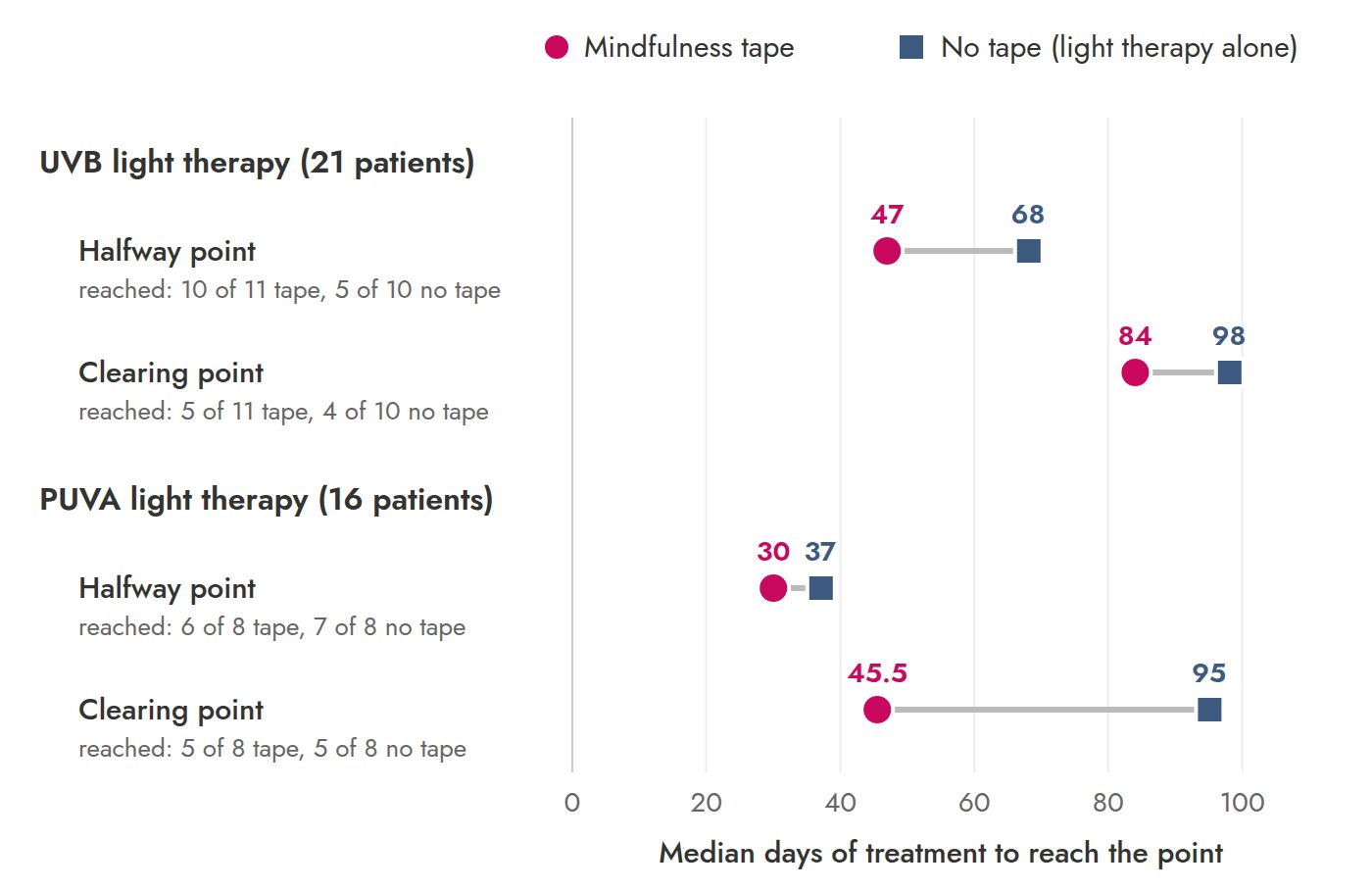
The tape group was faster at every one of these points, but by very different margins: 14 days to clearing with UVB, nearly 50 days with PUVA. Looked at separately, the two light groups tell an uneven story. With UVB, the tape group reached the turning point and the halfway point significantly faster (p = .005 and .002), but its faster clearing was not significant (p = .83). With PUVA, only the clearing difference came close (p = .06). The abstract’s statement that the tape group cleared faster “for both UVB and PUVA treatments” rests on the combined model, which assumes the tape had the same effect with both kinds of light; neither group on its own showed a statistically significant difference in clearing.
The authors are frank about how far this goes:
These results must be interpreted cautiously, however, in light of the small numbers of patients.
Miscellaneous Interesting Takeaways
How Blind Were the Skin Assessments?
The abstract describes three kinds of assessment, two of them blinded, which is a strength for a study of this period. But the blinded checks covered only part of the data. The milestone dates in the analysis came from the nurses, who knew each patient’s group. The blinded doctors confirmed the clearing judgments: for 17 of the 19 patients who cleared, their notes and photo ratings agreed with the nurses, and for the other 2 the doctors’ later dates (25 and 45 days later) were used instead. The halfway point, one of the two significant results, had no blinded check that the paper describes. The doctors’ examinations were also partly timed by the nurses’ judgments, since they took place within a week of when a nurse rated a patient clear. This doesn’t mean the nurses were biased, but it does mean the most favorable result rests on unblinded ratings.
A Control Group With No Tape
Because the no-tape group got nothing in place of the tapes, the comparison can’t separate mindfulness from simply having something calming to listen to, from the attention the study paid to tape patients, or from what patients expected. The authors say so directly:
Until further studies are performed to control for additional variables, we cannot rule out the possibility that expectancy effects (ie, enthusiasm and/or disappointment about tape group assignment) may have played a role in the observed differences, inasmuch as the control group did not make use of placebo instructional or music audiotapes.
A related point: patients were told the tapes were meant to make treatment more pleasant, but the tapes themselves asked them to picture the light slowing the growth of their skin cells. So the intervention was mindfulness plus healing imagery, and the study can’t say which part, if either, mattered. An
active control
An active control group is a comparison group that takes part in a different program designed to be just as engaging as the one being tested. In meditation research, it might involve exercise, music, or education classes with the same time commitment, teachers, and expectations of benefit. Comparing against an active control helps separate the effects of meditation itself from the general effects of joining a course.
More on Wikipedia
Read more in the glossary
, such as a relaxation or music tape, would have helped; the authors suggest “pseudo-meditation” instructions and placebo wavelengths of light for future studies.
Four Milestones, Two Significant
The study tracked four milestones and found significant differences for two of them, with no adjustment for testing several (see
multiple comparisons
The multiple comparisons problem arises when researchers run many statistical tests at once. Each test has a small chance of a false positive, so across thousands of tests, such as one for every point in a brain scan, some “significant” results will turn up by chance alone. Corrections raise the bar for significance to keep the overall false-positive rate down, at the cost of making small real effects harder to detect.
More on Wikipedia
Read more in the glossary
). The milestones aren’t independent of one another, since patients pass through them in order, and the direction was the same for all four, which makes chance a less likely explanation. But the p-values for the clearing point (.033) and the halfway point (.013) aren’t far below the usual threshold, in a trial with 18 or 19 patients per group.
About Half of Each Group Cleared
Over the course of the study, 10 of the 19 tape patients and 9 of the 18 no-tape patients reached the clearing point. That’s not a fair test of the tape on its own, because people left at different times. The finding is about speed: among patients still in treatment, those with the tape tended to get there sooner. Whether that would hold over a full course of treatment for everyone, or how long the clearing lasted, the study can’t say.
Distress Fell a Little in the Tape Group, Not Significantly
Among the 22 patients who finished the protocol and filled in questionnaires before and after, overall distress on the Symptom Checklist-90-R fell by 35% in the tape group (from 0.360 to 0.233) and didn’t change in the no-tape group (0.296 to 0.290). That difference was not significant (p = .18), and anxiety didn’t change in either group. Ratings taken during treatment hinted that tape patients felt more positive about their sessions and more confident the treatment was helping, but none of these trends was significant either. So the study doesn’t show that the tapes reduced stress, the route by which they were supposed to work.
A Mix-Up in the Text
The paper’s text, discussing the unadjusted medians, labels the UVB clearing medians “tape (98 days) versus no-tape (84 days)” and the PUVA ones “tape (95 days) and no-tape (45.5 days).” Its Table 2, and its own statement that the PUVA tape group responded fastest, show the reverse: the tape groups’ medians were 84 and 45.5 days. The chart above follows the table.
Why Faster Clearing Could Matter
The authors point to two possible practical benefits. Fewer sessions would mean less ultraviolet exposure, and so possibly a lower risk of the skin cancers linked to long courses of phototherapy, especially PUVA. And fewer sessions would cost less. Neither was measured here; both depend on the speed-up being real.
Final Reflection
This was one of the first randomized trials to ask whether a mental practice could change the course of a visible physical disease, and its setup is clever: a light booth where patients have time on their hands and the outcome can be seen. Patients who heard mindfulness and imagery tapes during their light treatment reached the halfway and clearing points at roughly four times the rate of those who had light treatment alone, a large effect.
But it is a small trial with a weak control. Only 37 patients took part, 14 left early, and the comparison group had no tape at all, so the result can’t be pinned on mindfulness rather than on listening to something, on the healing imagery, or on expectations. The milestones were timed by nurses who knew each patient’s group, only clearing was checked blind, and the light groups taken separately didn’t show a significant difference in clearing. The authors themselves called the attribution to the intervention “preliminary and tentative.”
The study is still cited as evidence that stress-reduction practices can affect the skin. A later randomized trial on this site, which compared MBSR with a carefully matched health program, points back to this one and found something narrower: both courses eased stress equally, and the difference that remained was a smaller rise in a nerve-driven skin flare after MBSR. Read together, they suggest that mind–skin links are worth pursuing, and that firm conclusions need larger trials with a credible comparison, such as a tape of relaxing music or instructions without the meditation.
Citation
Kabat-Zinn, J., Wheeler, E., Light, T., Skillings, A., Scharf, M. J., Cropley, T. G., Hosmer, D., & Bernhard, J. D. (1998). Influence of a mindfulness meditation-based stress reduction intervention on rates of skin clearing in patients with moderate to severe psoriasis undergoing phototherapy (UVB) and photochemotherapy (PUVA). Psychosomatic Medicine, 60(5), 625–632. 10.1097/00006842-199809000-00020
Get the next summary by email
One or two new paper summaries every couple of weeks, sent to your inbox when they go up.
No spam, and you can unsubscribe at any time. Prefer a feed reader? Use the RSS feed.