
Background Information
A
near-death experience
A near-death experience (NDE) is a pattern of vivid experiences that some people report after coming close to death, for example during a cardiac arrest, or believing they were. Common features include a sense of leaving the body, moving through a tunnel, meeting a being of light or people who have died, reviewing one’s life and losing the sense of time and space. Researchers usually identify NDEs with questionnaires such as Greyson’s Near-Death Experience Scale, and what causes them is still debated.
More on Wikipedia
Read more in the glossary
(NDE) is a pattern of vivid experiences that some people report after coming close to death, for example during a cardiac arrest, or believing they were. Common features include a sense of leaving the body, moving through a tunnel, meeting a being of light or people who have died, reviewing one’s life and losing all sense of time and space. About 4% of adults in Western countries are thought to have had one, though the authors note that the estimate relies on people being willing to say so. Because NDEs come unexpectedly, often in medical emergencies, researchers have almost always studied them after the fact, by asking survivors what they remember.
Buddhist traditions describe a way around this. The authors point to Tibetan texts such as the Tibetan Book of the Dead, which set out stages the mind is said to pass through during and after death, and to the Tibetan delog, a person said to undergo a near-death experience lasting hours or even days and to return to share it with other practitioners. In Theravada Buddhism, contemplations of a body decaying after death are used to loosen attachment to one’s own body. Some advanced meditators, the authors write, can induce a near-death experience at a time of their choosing. If so, NDEs could be studied as they happen rather than only remembered.
The authors also connect the idea to brain research. A 2013 study recorded a short burst of fast
gamma
Gamma brain waves are a type of brainwave pattern that oscillate at approximately 25 to 100 Hz. Gamma waves are associated with states of heightened perception, problem-solving, and consciousness. Gamma waves play a crucial role in cognitive functioning, including memory, and information processing, and are thought to integrate thoughts and information from different parts of the brain.
More on Wikipedia
Read more in the glossary
activity in the brains of rats in the seconds after their hearts stopped, and long-term Buddhist meditators have been found to produce unusually strong gamma waves. This study recorded no brain activity, though. It is a first attempt to describe these “meditation-induced near-death experiences” (MI-NDEs) and to see how they compare with ordinary NDEs on the standard questionnaire.
What They Did
William Van Gordon and colleagues, at UK universities, a Spanish hospital and a meditation research center in Italy, looked for meditators who said they could induce an NDE. They argue that there is no reliable test of who is an advanced meditator, so instead of advertising they picked participants deliberately (purposive sampling). They contacted people whom two members of the team knew to be advanced or to do the practice, and asked Buddhist teachers in lay and monastic communities to pass their details on to suitable people. The first two authors, the paper notes, have over 40 years’ combined experience as Buddhist meditation teachers. Recruitment was worldwide and stayed open for 12 months.
Of 38 people who expressed interest, 26 were excluded: 11 because their most recent MI-NDE scored below 7 on the Near-Death Experience Scale (the usual cut-off for an NDE), 8 because they didn’t speak or read English, and 7 because they didn’t plan to do the practice at least once a year for three years. That left 12 participants:
- 10 men and 2 women, with an average age of 54
- 8 monks or nuns and 4 lay practitioners
- an average of 28 years of meditation (15 to 51)
- Theravada, Mahayana and Vajrayana (Tibetan and Japanese) traditions, several practicing in more than one
- from Sri Lanka (4), Britain (2), Thailand, Nepal, India, Tibet, Japan and Italy
- doing the practice about three times a year on average (one to five)
Two dropped out, one in the second year and one in the third, without giving a reason.
The paper doesn’t describe how the practice is done. It was the participants’ own practice, and the ethics procedure made clear that no one would be asked to induce an NDE just for the study.
Within 24 hours of their first MI-NDE of each year, for three years, participants filled in the Near-Death Experience Scale. Its 16 questions ask about features such as joy and peace, a sense of unity with the universe, leaving the body and seeing scenes from the future, each rated 0 (absent), 1 (mild or ambiguous) or 2 (definitely present), for a total of 0 to 32. People who have had an NDE score 15 on average. Participants also timed each session with a watch or clock. In the first year they also rated
mystical experience
A mystical experience is an experience, often described as religious or spiritual, of unity with everything, loss of the usual sense of self, timelessness, deep positive feeling and a sense of having glimpsed a deeper truth, which is typically felt to be hard to put into words. Researchers measure it with questionnaires such as Hood’s Mysticism Scale. Such experiences are reported in meditation and prayer, and after taking psychedelic drugs.
More on Wikipedia
Read more in the glossary
(on Hood’s 32-item Mysticism Scale) and
non-attachment
In Buddhist psychology, non-attachment is freedom from clinging: being able to engage with experiences, people and things without needing to hold on to them, and to let them go when they change or end. It is not the same as indifference or emotional detachment. Researchers measure it with questionnaires such as the Non-Attachment Scale, on which higher scores mean less clinging.
More on Wikipedia
Read more in the glossary
(on the 30-item Non-Attachment Scale) before and after the practice.
For comparison, in the first year the same people filled in the questionnaires after two kinds of ordinary seated meditation of at least 45 minutes, focused on concentration and mindfulness: one with no thought of death, and one that included reflecting on death. With so few people able to do the practice, there was no separate control group. Each person served as their own comparison.
Finally, each participant gave one interview soon after an MI-NDE, by video call if needed, about what happened, how aware they were, how much control they had and why they did the practice. The team analyzed the transcripts with grounded theory, building themes up from participants’ own words. A second team member repeated the analysis as a check, and participants commented on the summary of themes.
One Big Result: The Meditators’ Reports Scored Far Higher on a Near-Death Scale Than After Ordinary Meditation
After the MI-NDE practice, participants’ Near-Death Experience Scale scores ranged from 24 to 30 out of 32. That is far above the NDE cut-off of 7, and above the average of 15 for people who have had an NDE. After the two ordinary meditations, scores ranged from 6 to 10, averaging 7.2 without reflection on death and 8.0 with it. The two sets of scores didn’t overlap at all: every MI-NDE score was higher than every ordinary-meditation score.
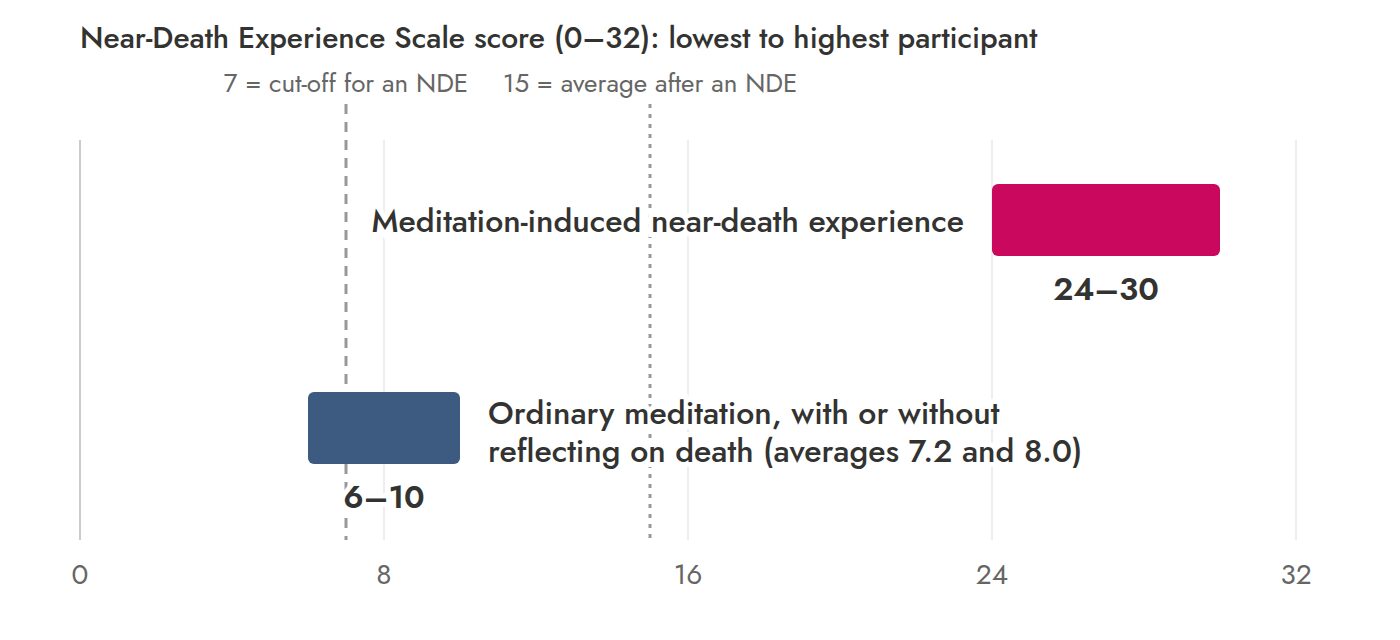
The before-and-after changes in the first year followed the same pattern: mystical experience and non-attachment rose more across the MI-NDE practice than across either ordinary meditation. The paper reports these comparisons only as rank-based statistics, without the scores themselves, so it isn’t possible to say by how much.
Scores on the near-death scale also rose over the three years (again reported only as ranks). Participants with more years of meditation tended to score higher, strongly in years 2 and 3 (correlations of 0.80 and 0.73), though not significantly in year 1. How long a session lasted was not related to how profound it was. The paper doesn’t report how long the sessions actually were.
The authors read the main result strongly:
… this suggests that participants experienced a genuine form of NDE and that outcomes relating to the MI-NDE condition were not simply the product of a standard or profound form of meditation.
What the scale can show is that what participants reported after this practice had the features of an NDE as the questionnaire defines them, and far more of them than after ordinary meditation. The scale asks about the content of an experience. It can’t show that anyone’s body was near death, and nothing in the study measured the body. The scale’s cut-off also proved loose here: ordinary meditation averaged just over it. The authors suggest that participants may have over-rated their ordinary meditations, and they acknowledge that the scale wasn’t designed for meditation:
However, the scale may not have adequate specificity in terms of differentiating between experiences arising during meditation versus those arising during NDEs.
Miscellaneous Interesting Takeaways
Participants Described the Experience Unfolding in Stages
The interviews yielded four main themes. The first was that the experience unfolded in phases, which the authors present in the order participants reported them:
- Letting go of the body. All participants said it began with deliberately loosening their connection to the physical body, which they called “gradual dissolution”, “letting go of body” or “becoming untied”. They tied this to sensations they attributed to the body’s five elements coming undone in turn: feeling stuck or unable to move (earth), drowning (water), being too hot or too cold (fire), breathlessness and weightlessness (air), and finally being without a body (space).
- Losing time and space. All said they stopped experiencing time and space, which they understood as showing that time and space are relative. Ten said they saw scenes from the past and future, which they treated as “normal” or “no big deal”.
- Other realms and beings. All described visiting realms they called hells, realms of torture or “hungry ghost realms”, other realms of humans and animals, and heavens or “godly realms” whose inhabitants were made partly or wholly of light. All but one also described meeting beings who had recently died, demonic beings and liberated beings, and ten said they met their own spiritual teacher, living or dead, who guided them.
- Emptiness. Despite this vivid content, participants described it as “emptiness”, “voidness” or “non-self”, and five called it “mind-made”.
Participant 6 explained how they related to what they saw:
You experience something or someone [during the MI-NDE] and you’re fully involved in the experience. But you pull back and recognise that it’s like a dream.
The study reports these accounts as the participants gave them. It can’t say anything about whether such realms exist, and the participants themselves described them as empty and made by the mind.
They Said They Stayed Aware and in Control
In medical NDEs, people are usually unconscious and realize only afterwards what they went through. Here every participant said they knew throughout that they were having an NDE. They described keeping a “partial” or “distant” awareness of their physical body, enough to notice cold, pain or a sudden loud noise, while their attention stayed mainly on the experience. Paying attention to the body, they said, could disturb or even end it. One described leaving “a small thread” to stay in contact with the body and return to it.
All said they could start and end the experience, and choose which realm or being to visit and for how long, though not what happened in an encounter. Five said that people without long meditative experience couldn’t keep such control. Being induced at a chosen time, being controlled, keeping partial awareness of the body, the phase of the elements dissolving, scenes from past lives and the sense that everything was empty are the features the authors propose set an MI-NDE apart from an ordinary NDE.
Why They Did It
Participants gave several reasons for the practice: “preparing for death” (six of them), “preparing for life”, “letting go of body”, “advancing spiritually”, “helping [non-worldly] beings” and “letting go” in general. All said it gave them insights that ordinary meditation couldn’t. Nine said it sometimes let them find “treasures” or “gifts of wisdom” that, one said, had been “placed in their mind” by their spiritual teacher.
Two Features of Ordinary NDEs Were Missing
Almost every item on the near-death scale was endorsed by most participants, with two exceptions. No one said their thoughts sped up, and no one gave full marks to coming to “a border or point of no return”. The authors suggest that, for meditators trained to see beyond time and space, speeding up and borders no longer apply. It could also simply be a way in which this experience differs from NDEs near actual death.
What the Study Can’t Say
The authors list several limits themselves: everything was self-reported, the sample was very small, and because everyone was Buddhist, religious expectations weren’t controlled for. Other points are worth adding:
- No physical measures. Nothing measured heart rate, breathing or brain activity, so the study can’t say whether these experiences involve anything like the body’s state near death. The authors’ main suggestion for future research is to record brain activity during an MI-NDE, which they argue would be feasible and ethical, unlike recording people as they nearly die.
- A hand-picked sample. The 12 were chosen by the researchers and by Buddhist teachers, partly through the contacts of two authors who are themselves Buddhist meditation teachers, and they had to score as having had an NDE to take part. The paper doesn’t say whether any were the authors’ own students. The authors declared no conflicts of interest, and the same team ran the interviews and analysis, with a second analyst as a check.
- Expectations. Participants knew which practice they were rating, belonged to traditions with texts that describe what this practice should involve, and knew the study was about near-death experiences. Such
demand characteristics
Demand characteristics are cues in an experiment that hint at what the researchers expect, which can lead participants to behave the way they think they are supposed to rather than how they normally would. Researchers reduce them by disguising the study’s purpose, measuring behavior unobtrusively, or using comparison conditions that seem just as plausible.
More on Wikipedia
Read more in the glossary could push ratings apart even if the experiences were less different than the numbers suggest. - Few numbers. The paper gives no average near-death score for the practice, no mysticism or non-attachment scores, and no session lengths, only ranks and test results. Its comparisons also used a test meant for separate groups of people, although the same people did all three practices. Since the scores didn’t overlap at all, the difference itself is not in doubt.
- The rise over three years. The authors put it down to practice making perfect, but growing familiarity with the questionnaire, or with what the study was looking for, could also play a part.
Final Reflection
This is, as far as the authors know, the first empirical study of a practice described in Buddhist texts for over a thousand years. Its main contribution is a careful record of what a rare group of practitioners say happens when they deliberately go through something like dying: dissolving, timelessness, other realms, all held lightly as “empty”. Their accounts matched the standard near-death questionnaire far more closely than accounts of ordinary meditation did, and they consistently described staying aware and in control, which ordinary NDEs rarely allow.
The authors go further, concluding that the study “appears to confirm the existence of the MI-NDE referred to in ancient Buddhist texts”. What it confirms is that some practitioners reliably report such experiences and can say in advance when they will have one. Whether anything about them resembles the dying brain is the question the authors hope future studies, recording brain activity during the practice, will be able to answer.
Citation
Van Gordon, W., Shonin, E., Dunn, T. J., Sheffield, D., Garcia-Campayo, J., & Griffiths, M. D. (2018). Meditation-induced near-death experiences: A 3-year longitudinal study. Mindfulness, 9(6), 1794–1806. 10.1007/s12671-018-0922-3
Get the next summary by email
One or two new paper summaries every couple of weeks, sent to your inbox when they go up.
No spam, and you can unsubscribe at any time. Prefer a feed reader? Use the RSS feed.