
Background Information
Slow, deep breathing is part of many contemplative and movement practices, from meditation to yoga and tai chi. In
diaphragmatic breathing
Diaphragmatic breathing, also called belly or abdominal breathing, is breathing driven mainly by the diaphragm, the dome-shaped muscle under the lungs. As it contracts, the belly rather than the chest rises, and breaths become deeper and slower. It is taught in yoga, tai chi and many relaxation and meditation practices, and is often used as a way to calm the body.
More on Wikipedia
Read more in the glossary
, sometimes called belly breathing, the diaphragm contracts and the belly expands, so each breath is deeper and breathing slows down. Earlier studies had linked breathing practices to less anxiety, depression and stress, and to better attention, but the authors of this 2017 study, based mainly at Beijing Normal University and the Chinese Academy of Sciences, saw three gaps in that work.
First, most studies had tested people with a particular problem, such as pregnant women or office clerks with job burnout, rather than healthy adults. Second, they rarely measured how people actually breathed, so it was hard to know whether participants had done the technique as intended. Third, they had looked at the body, emotions and thinking separately. The authors wanted to look at all three in the same people: mood, attention, and
cortisol
Cortisol is a hormone released by the adrenal glands, especially in response to stress. It mobilizes energy and helps regulate the immune system. Because it can be measured in saliva, researchers often use it to gauge how strongly someone reacts to a stressful task, such as timed mental arithmetic. Levels also follow a daily rhythm, so studies try to test everyone at the same time of day.
More on Wikipedia
Read more in the glossary
, a hormone released by the body’s main stress system, the
HPA Axis
The hypothalamic–pituitary–adrenal (HPA) axis is the body’s main hormonal stress system. When the brain registers a threat, the hypothalamus signals the pituitary gland, which in turn signals the adrenal glands above the kidneys to release cortisol. Cortisol then feeds back to the brain to switch the response off. Because cortisol is its end product, researchers often measure cortisol in saliva to gauge how strongly the HPA axis reacts to a stressful task.
More on Wikipedia
Read more in the glossary
.
They described their study as a pilot
randomized controlled trial
A Randomized Controlled Trial is a scientific study design that randomly assigns participants to either an experimental group receiving an intervention or a control group, allowing researchers to measure the true effect of the intervention while minimizing bias.
More on Wikipedia
Read more in the glossary
in a working population, and predicted that eight weeks of breathing training would improve cognitive performance and reduce negative mood and physiological stress.
What They Did
The participants were employees of an IT company in Beijing. Anyone with a history of heart, lung, autoimmune or other serious illness, or of drug or alcohol abuse, was excluded, as was anyone with experience of yoga, tai chi, qigong or other mind–body training. To spare people the stress of rushing to a laboratory, everything took place at their workplace, in a sunny, soundproof conference room, with participants sitting in leather armchairs.
The paper’s abstract says the 40 participants “were randomly assigned” to the two groups. Its methods describe something different: they were placed in a breathing group or a control group, 10 women and 10 men in each, “by alternating the order of their registration.”
The breathing group first learned the technique from a coach, whom the paper later describes as a senior yoga coach, breathing in as deeply as possible and then slowly breathing out almost all the air in the lungs. They were told to focus on their breathing and the sensations it produced in the body, with their eyes closed. They then had 20 sessions over eight weeks, every other weekday. Each began with 15 minutes of ordinary resting breathing, followed by 15 minutes of diaphragmatic breathing, led by the coach speaking slowly:
During diaphragmatic breathing, they were instructed to inhale as deeply as they could while their abdomen expanded, and to exhale as slowly as they could while their abdomen contracted, in a self-paced rhythm, under the instruction of a breathing training coach and with feedback via a recording device.
A sensor on each person’s chest or belly sent their breathing to a computer, where it appeared as a continuous wave. The participants kept their eyes closed, so it was the research assistants, each watching two people, who followed the waves; if someone was still breathing faster than 6 breaths a minute two minutes in, the coach gave them extra guidance.
The control group received only an introduction to breathing and rest, and took the same tests. Their breathing was recorded on the first and last days. Both groups were told the purpose of the study only after training.
Before and after the eight weeks, everyone filled in the
PANAS
The Positive and Negative Affect Schedule (PANAS) is a widely used questionnaire with two short lists of feeling words, one for positive feelings and one for negative ones. People rate how strongly they feel each, and the ratings are added up into separate positive affect and negative affect scores, each from 10 to 50. The two scores are largely independent of each other, and when it asks about the present moment it can be given just before and just after a single session.
More on Wikipedia
Read more in the glossary
, rating their positive and negative feelings over the past week, and did a number cancellation test of
sustained attention
Sustained attention is the ability to keep focusing on a task over a period of time, such as watching for rare targets or working steadily through a repetitive test, without drifting off or slipping up. It is usually measured by how accurately and quickly people keep responding as the task goes on, and it tends to suffer with fatigue, boredom and stress.
More on Wikipedia
Read more in the glossary
: four one-minute sheets of 200 digits, on which they crossed out as many target 9s as they could, following rules about the symbols around them. Saliva samples for cortisol were taken between 11:00 and 12:00 to limit the effect of its daily rhythm, before and after a diaphragmatic breathing session, once before training and once after it.
One Big Result: Cortisol Fell in the Breathing Group but Not in the Controls
Over the eight weeks, cortisol changed differently in the two groups (F(3,111) = 9.06, p < .001, partial eta squared = 0.20). In the breathing group, both samples taken after training were significantly lower than both samples taken before it, with reported differences of 1.32 to 1.66. In the control group, cortisol did not change significantly. Averaged over all four samples, the two groups did not differ.
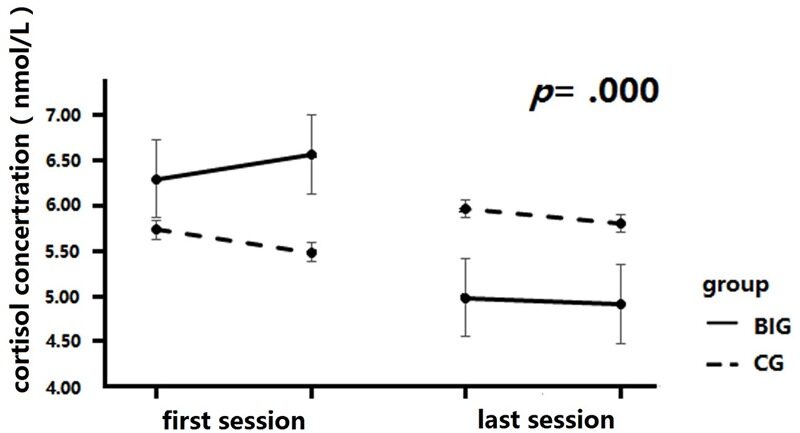
The figure shows two things that the text doesn’t discuss. The breathing group’s cortisol started above the controls’ and ended below it, and the paper doesn’t report whether the groups differed at the start. And within each test day, the samples before and after the 15 minutes of belly breathing were close together, so the change is between the start and end of the eight weeks, not within a session.
What this measures is also narrower than the paper’s title suggests. Cortisol was sampled at rest in late morning, on two days, not in response to a stressful task, so the result speaks to everyday cortisol levels at that time of day, not to how people react to stress. The authors flag a related limit themselves:
Moreover, in terms of the neuroendocrine response, the cortisol levels were reduced after a 20 interventions, but no reference criteria were provided to demonstrate whether this decrease resulted in a real physiological benefit or was only statistically significant.
Miscellaneous Interesting Takeaways
Breathing Slowed From About 10 to About 3.5 Breaths a Minute
The breath recordings show the training working as intended. During the belly-breathing part of the first session, the group averaged 9.95 breaths a minute. By the fourth session it was 4.91, and in the 20th it was 3.45. During the resting part of each session, the same people breathed about 15 to 20 times a minute, a normal adult
respiratory rate
Respiratory rate is the number of breaths a person takes per minute. At rest, adults typically breathe around 12 to 20 times a minute. Breathing tends to speed up with stress, effort and strong emotion and to slow down with relaxation and sleep, and slow, deliberate breathing is a common feature of meditation and breathing practices.
More on Wikipedia
Read more in the glossary
, and belly breathing was significantly slower than resting breathing at every session.
The controls, who tried belly breathing only on the first and last days, slowed down much less. Compared with resting breathing on those days, belly breathing was 9.19 breaths a minute slower in the breathing group, a significant difference, and 2.50 slower in the controls, which wasn’t significant.
Both Groups Did Better on the Attention Test
On the number cancellation test, the breathing group improved more than the controls (F(1,37) = 9.68, p = .004, partial eta squared = 0.21). But both groups improved significantly: the breathing group by 6.73 points and the controls by 4.19. So only the difference between those gains, about 2.5 points, can be credited to the training. The paper’s figure caption for this test notes that “there was no significant difference between these two groups after training.”
The authors read the controls’ gain as “an immediate improvement in the CG,” an effect of the belly breathing the controls did on the test days. The design can’t tell that apart from simply having taken the same test before.
Negative Mood Fell, but Not Significantly More Than in Controls
The abstract reports that the breathing group’s negative mood fell significantly. It did, within that group: its negative affect score dropped by 2.55 points (p = .02), while the controls’ barely moved. But the test of whether the two groups changed differently fell short of significance (p = .07), so the study doesn’t show that the breathing did better than no training. Positive mood didn’t change significantly.
The Authors’ Conclusion
The authors end on a hopeful note:
The present study illustrates the potential for diaphragmatic breathing practice to improve cognitive performance and reduce negative subjective and physiological consequences of stress in healthy adults.
“Potential” is the right word. Of the three outcomes, only cortisol shows a clear difference between the groups’ changes, and the attention gain was mostly shared with the controls.
Some Questions the Design Leaves Open
The biggest limit is the comparison. The breathing group spent 20 half-hour sessions sitting quietly with their eyes closed in a calm room at work, guided by a coach and watched over by research assistants. The control group did nothing. Any benefit could come from the slow breathing itself, or from regular rest, attention from the research team, or the expectation of feeling better, and this design can’t tell them apart. A comparison group that rested or relaxed for the same time would be needed for that.
Other details also call for caution. Assignment by alternating registration order isn’t the same as assignment by chance, despite the abstract’s description. The paper says 40 people took part, but its tables list 19 in the breathing group and 20 controls, without explaining the missing person. In its discussion, the paper summarizes the cortisol results in a way that is hard to square with its own results section, saying there was a significant effect of time “although no group differentially influence cortisol.” The study measured mood by self-report, included only healthy office workers in one company, and stopped at the end of training, with no follow-up. The authors also note that they analyzed mood, attention and cortisol separately, so the study can’t say whether, for example, calmer people did better on the attention test. The study was funded by Chinese government research grants, and the authors declare no conflicts of interest.
Final Reflection
This small pilot study tested a simple idea: teach healthy office workers to breathe slowly from the belly, check with a monitor that they are really doing it, and see whether their stress hormones, mood and attention change. The monitoring worked well, showing breathing slow to about three or four breaths a minute over the eight weeks. The outcomes are more modest. Late-morning cortisol fell in the breathing group and not in the controls, the attention gain was largely matched by a group that had no training, and the drop in negative mood wasn’t significantly larger than the controls’ change.
It fits with other short-practice studies on this site. In a remote trial, five minutes a day of cyclic sighing, a breathing exercise with a long exhale, lowered daily breathing rate and raised positive mood more than
mindfulness
Mindfulness is the psychological process of purposely bringing one’s attention to experiences occurring in the present moment without judgment. It involves maintaining awareness of thoughts, feelings, bodily sensations, and surrounding environment with an attitude of curiosity and acceptance. In meditation contexts, mindfulness practices typically involve focusing attention on the breath or body sensations as anchors to the present moment while acknowledging and releasing distracting thoughts.
More on Wikipedia
Read more in the glossary
meditation did, and five days of integrative body–mind training, which includes breathing adjustment, improved attention and mood compared with relaxation training. Both of those studies had an active comparison, which this one lacked.
Taken alone, this study is best read as a sign that slow breathing practice may lower cortisol in healthy adults, worth testing in larger trials that assign people by chance and compare breathing with an equally restful alternative.
Citation
Ma, X., Yue, Z.-Q., Gong, Z.-Q., Zhang, H., Duan, N.-Y., Shi, Y.-T., Wei, G.-X., & Li, Y.-F. (2017). The effect of diaphragmatic breathing on attention, negative affect and stress in healthy adults. Frontiers in Psychology, 8, 874. 10.3389/fpsyg.2017.00874
Get the next summary by email
One or two new paper summaries every couple of weeks, sent to your inbox when they go up.
No spam, and you can unsubscribe at any time. Prefer a feed reader? Use the RSS feed.