
Background Information
Psychological stress, the kind that comes from feeling judged, out of control or socially threatened, is one of the main health burdens of modern life. When it becomes chronic, it is thought to do much of its damage through two systems: the
HPA Axis
The hypothalamic–pituitary–adrenal (HPA) axis is the body’s main hormonal stress system. When the brain registers a threat, the hypothalamus signals the pituitary gland, which in turn signals the adrenal glands above the kidneys to release cortisol. Cortisol then feeds back to the brain to switch the response off. Because cortisol is its end product, researchers often measure cortisol in saliva to gauge how strongly the HPA axis reacts to a stressful task.
More on Wikipedia
Read more in the glossary
, which ends in the release of the hormone
cortisol
Cortisol is a hormone released by the adrenal glands, especially in response to stress. It mobilizes energy and helps regulate the immune system. Because it can be measured in saliva, researchers often use it to gauge how strongly someone reacts to a stressful task, such as timed mental arithmetic. Levels also follow a daily rhythm, so studies try to test everyone at the same time of day.
More on Wikipedia
Read more in the glossary
, and the sympathetic nervous system, which drives the fast “fight or flight” response.
Meditation programs such as
MBSR
Mindfulness-Based Stress Reduction (MBSR) is a program designed to help individuals cope with stress, pain, and illness. Developed by Jon Kabat-Zinn in the 1970s, it combines meditation and yoga to promote awareness and stress management. The eight-week program teaches participants to focus on the present moment non-judgmentally, enhancing their ability to manage difficulties.
More on Wikipedia
Read more in the glossary
and
MBCT
Mindfulness-based cognitive therapy (MBCT) is an 8-week group program that combines mindfulness meditation, adapted from Mindfulness-Based Stress Reduction (MBSR), with elements of cognitive behavioral therapy. It was developed to help people who have recovered from depression avoid relapse, by learning to notice and step back from patterns of negative thinking. Classes usually meet weekly, with daily meditation practice at home.
More on Wikipedia
Read more in the glossary
are often taught as a way to handle stress. But when this study was published, the evidence that they change the body’s stress response, rather than just how stressed people say they feel, was mixed. Earlier studies had found changes in self-reported stress, heart and nervous-system measures and immune markers, but cortisol results were inconsistent. One lab had reported a smaller cortisol response to acute stress after integrative body–mind training, but other studies found no change, and one found a larger cortisol response after a 3-day
mindfulness
Mindfulness is the psychological process of purposely bringing one’s attention to experiences occurring in the present moment without judgment. It involves maintaining awareness of thoughts, feelings, bodily sensations, and surrounding environment with an attitude of curiosity and acceptance. In meditation contexts, mindfulness practices typically involve focusing attention on the breath or body sensations as anchors to the present moment while acknowledging and releasing distracting thoughts.
More on Wikipedia
Read more in the glossary
training.
Part of the problem, the authors argue, is that mindfulness programs mix many practices, so it is hard to tell which ingredient does what. Veronika Engert, Tania Singer and colleagues at the Max Planck Institute in Leipzig instead compared three kinds of training head to head. They predicted that practices aimed at relating to other people, through compassion or by understanding others’ minds, would protect against social stress better than practices focused on attention and body awareness. Their reasoning was that a social threat may lose some of its sting when it is met with a sense of shared humanity rather than ego-involvement.
What They Did
The study was part of the ReSource Project, the same nine-month training study behind our summaries of Valk et al. 2017, which tracked changes in the brain’s cortex, and Kok and Singer 2017, which looked at how each meditation changed people’s state of mind. The training was split into three 3-month modules:
- Presence trained present-moment attention and
interoception
Interoception is the sense of the body’s internal state: feeling your heartbeat, breathing, hunger, warmth, tension and other sensations from inside the body. Interoceptive awareness is how much attention a person pays to these signals. Practices such as the body scan, which moves attention through the body part by part, aim to strengthen it.
More on Wikipedia
Read more in the glossary (awareness of the body’s inner signals) with breathing meditation and the body scan The body scan is a meditation practice in which attention is moved slowly through the body, part by part, noticing whatever sensations are present without trying to change them. It is a core exercise in mindfulness programs such as MBSR.
More on Wikipedia
Read more in the glossary . The authors note that it resembles typical mindfulness programs such as MBSR. - Affect cultivated compassion, gratitude and kindness and worked with difficult emotions, using
loving-kindness meditation
Loving-kindness meditation (mettā in Pali) is a Buddhist practice of deliberately cultivating warm, unconditional goodwill. Practitioners silently repeat wishes such as “may you be happy” or picture a person, usually starting with themselves or someone close and then extending the wishes to acquaintances, strangers, difficult people and all beings. It is one of the four brahmaviharas.
More on Wikipedia
Read more in the glossary and a daily 10-minute partner exercise. Paired through a website or phone app, one person spent 2.5 minutes describing a difficult situation from the past day and 2.5 minutes on one that made them grateful, while the other listened without responding; then they swapped. - Perspective trained metacognition (noticing one’s own thinking) and perspective-taking on oneself and others, a skill psychologists call
theory of mind
Theory of mind is the ability to work out what another person thinks, believes or intends. It is also called mentalizing or cognitive perspective-taking. It is usually distinguished from empathy, which involves sharing another person’s feelings rather than reasoning about their thoughts.
More on Wikipedia
Read more in the glossary . It used an observing-thoughts meditation and a partner exercise in which the speaker described their day from the viewpoint of one of their “inner parts,” such as “the judge” or “the manager,” and the listener tried to work out which part was speaking.
Participants were asked to practice for at least 30 minutes, 5 days a week, for example a 10-minute partner exercise and 20 minutes of meditation. Two training cohorts did Presence first, then Affect and Perspective in opposite orders. A third cohort did 3 months of Affect alone. A retest cohort did no training but took part in all the testing. The volunteers had been screened by a clinical psychologist and excluded if they had a recent psychiatric disorder or took medication affecting the HPA axis.
The stress test. Everyone took the
Trier Social Stress Test
The Trier Social Stress Test (TSST) is a standard laboratory stressor. After a few minutes to prepare, a person gives a short speech, often a mock job interview, and then does mental arithmetic aloud, in front of a panel of unsmiling judges and often a camera. The mix of public evaluation and lack of control reliably raises stress hormones such as cortisol, so researchers use it to compare how strongly people react to stress.
More on Wikipedia
Read more in the glossary
(TSST): after 15 minutes to anticipate it, they gave a 5-minute mock job talk and then did 5 minutes of difficult mental arithmetic, recorded on audio and video, while two people presented as behavioral analysts questioned and evaluated them. Because the test only works if people don’t know what’s coming, nobody could take it twice. So instead of testing each person before and after training, the researchers tested different people at different stages:
- No training: 130 people (84 from the retest cohort, tested at the start, 3 months or 6 months; 46 from the training cohorts, tested before training began)
- Presence (3 months): 46
- Affect alone (3 months): 46
- Presence then Affect (6 months): 44
- Presence then Perspective (6 months): 47
That made 313 of the project’s 332 participants (185 women, aged 20 to 55, average 41). The groups were matched on factors that can affect stress responses, including sex, hormonal status in women, city, smoking, age, depressed mood, trait anxiety and chronic stress.
All sessions ran between noon and 6 p.m., because cortisol follows a daily rhythm. Over 130 minutes the researchers collected:
- Saliva six times, for cortisol (the HPA axis) and
alpha-amylase
Alpha-amylase is an enzyme in saliva that starts the digestion of starch. Its release rises quickly under stress, driven by the sympathetic (“fight or flight”) nervous system, so stress researchers measure it in saliva samples as a marker of sympathetic activity, alongside cortisol as a marker of the hormonal stress response.
More on Wikipedia
Read more in the glossary (a marker of sympathetic activity) - Heart recordings, for heart rate and
heart rate variability
Heart rate variability (HRV) is the natural variation in time between one heartbeat and the next, calculated from an ECG or a pulse sensor. Higher HRV at rest usually reflects a stronger parasympathetic (“rest and digest”) influence on the heart and is generally linked to relaxation, better health and more flexible responses to stress.
More on Wikipedia
Read more in the glossary (a marker of the calming parasympathetic system) - Blood three times, for the
inflammation
Inflammation is a biological response of the immune system to injury, infection, or stress, characterized by the release of signaling molecules called cytokines. Chronic inflammation is linked to impaired cognitive function, increased risk of disease, and accelerated aging.
More on Wikipedia
Read more in the glossary markers IL-6 Interleukin-6 (IL-6) is a signaling protein (a cytokine) that immune cells release to coordinate inflammation. It is measured from a blood sample, usually in picograms per milliliter. Persistently elevated IL-6 is associated with chronic stress, aging and a higher risk of cardiovascular disease, which makes it a common marker in studies of whether meditation affects health.
More on Wikipedia
Read more in the glossary and high-sensitivity CRP C-reactive protein (CRP) is a protein made by the liver that rises in the blood during inflammation. A high-sensitivity test (hsCRP) can detect the low levels found in healthy people, and modestly raised levels are linked to a higher risk of heart disease. Researchers use it as a general marker of inflammation in the body.
More on Wikipedia
Read more in the glossary - Self-reported stress five times, on the
state anxiety scale
The State Anxiety Inventory is the half of the State-Trait Anxiety Inventory (STAI) that asks how anxious someone feels right now, rather than how anxious they tend to be in general. People rate 20 statements such as “I feel worried” from 1 (not at all) to 4 (very much so), giving a score from 20 to 80. Because it captures the moment, researchers can give it just before and just after a single session.
More on Wikipedia
Read more in the glossary of the State-Trait Anxiety Inventory
The test worked: 75% of the untrained participants had a cortisol rise above the threshold usually taken to mark a real physiological stress response.
One Big Result: Compassion and Perspective-Taking Training Shrank the Cortisol Response, but Attention Training Didn’t
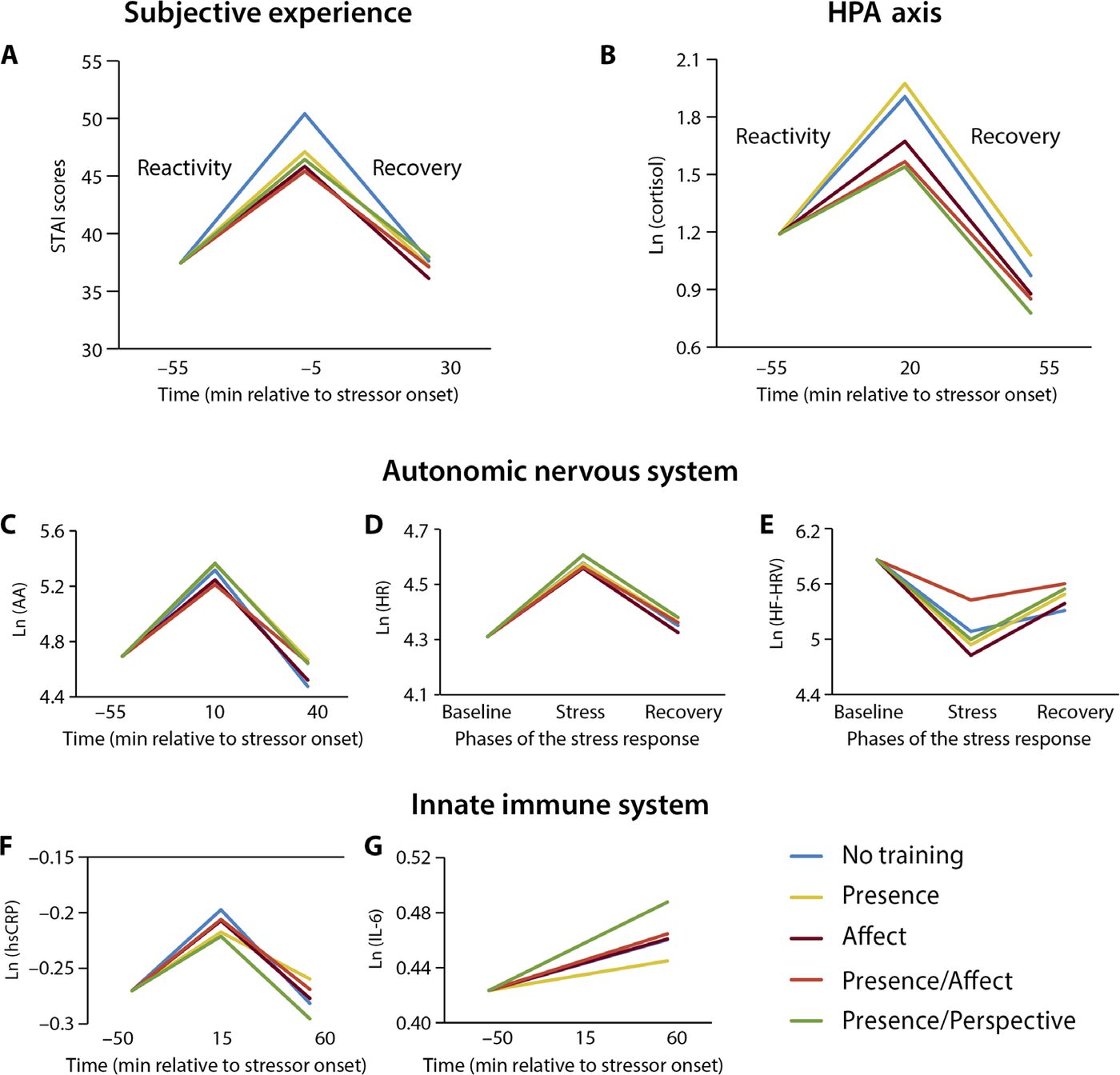
Every training group reported a smaller rise in stress than the untrained group, and the training groups didn’t differ from one another. The rise in self-reported stress was 26% smaller after Presence, 36% after Affect, 39% after Presence then Affect, and 31% after Presence then Perspective.
Cortisol told a different story. Three months of Presence made no difference to the cortisol response compared with no training. But the groups that had trained in the two social modules had smaller cortisol rises from before the test to its peak:
- Affect alone (3 months): 32% smaller than untrained (p ≤ .05)
- Presence then Affect (6 months): 48% smaller (p ≤ .01)
- Presence then Perspective (6 months): 51% smaller (p ≤ .001)
Affect and Perspective didn’t differ from each other. The cleanest comparison of practice types is between the two 3-month groups, Presence and Affect alone, which had the same training time: the Affect group had the lower cortisol response (p ≤ .05). So the missing cortisol effect after Presence wasn’t simply a matter of too little practice.
The headline percentages sound large, but by the conventional rule of thumb for
effect size
Effect size is a statistical concept that quantifies the magnitude or strength of a relationship, difference, or intervention outcome. Unlike p-values which only indicate statistical significance, effect sizes measure how meaningful a result is in practical terms. Common measures include Cohen’s d (standardized mean difference), correlation coefficients (r), and odds ratios. In meditation research, effect sizes help quantify the practical impact of different meditation practices on psychological or physiological outcomes.
More on Wikipedia
Read more in the glossary
(0.2 small, 0.5 medium) the differences were small: Cohen’s d of 0.24 for Affect, 0.34 for Presence then Affect and 0.37 for Presence then Perspective, against the untrained group. The abstract’s phrase that all three practices “markedly reduced” self-reported stress also deserves a gentle note; those differences were of similar size (d = 0.27 to 0.41).
Why would partner exercises matter? The authors point out that what set the two social modules apart from Presence, and from most mindfulness programs, was the daily partner practice, in which people regularly disclosed something personal to a fellow trainee. Because the TSST is stressful mainly as a threat to the social self, they offer this explanation:
We suggest that regular self-disclosure and consequent exposure to the potential evaluations of their fellow trainees within the daily dyadic practice … may have “immunized” participants against the fear of social shame and judgment by others.
That is the authors’ hypothesis, not something the study tested.
Miscellaneous Interesting Takeaways
Lower Self-Reported Stress Alone Isn’t Proof
The authors are candid about why they put more weight on cortisol than on questionnaires. People who have put months into a demanding practice may want to report that it helped, a form of
social desirability bias
Social desirability bias is the tendency of people answering questionnaires or interviews to present themselves in a favorable light, for example by reporting more of what they think is good and less of what they think is bad. In meditation studies it can make people who have committed to a training report more benefit than they actually experienced, which is one reason researchers look for measures that don’t rely on self-report.
More on Wikipedia
Read more in the glossary
:
Because reduced subjective stress experience after committing to effortful mental practice may result from social desirability response bias (the tendency to present oneself in a favorable light) …, we argue that claims of stress reduction based solely on self-reports (without a physiological basis) should be considered with more caution.
By that standard, the authors conclude, the benefit of Presence training stayed at the level of self-report. They don’t dismiss it, though: they note that longer practice might eventually carry over into cortisol, and that real mindfulness programs such as MBSR include more than Presence did, including kindness and thought-observing practices.
Training Made Feelings and Cortisol Line Up More Closely
How stressed people say they feel and how much cortisol they release often don’t match. In the untrained group, the two were essentially unrelated (r = 0.04). After Presence, and after Presence then Perspective, the link between a person’s rise in self-reported stress and their rise in cortisol was significantly stronger than in the untrained group; after Presence then Affect it was only marginally so, and after Affect alone there was no change. The training groups didn’t differ from each other on this. The authors link this to the long-standing idea that meditation sharpens awareness of one’s own inner states, and here, for once, attention training did as well as the social modules.
Heart, Saliva Enzyme and Inflammation Markers Didn’t Change
None of the training groups differed from the untrained group on alpha-amylase, heart rate, heart rate variability, IL-6 or CRP. That contrasts with some smaller earlier studies. The authors argue that because their study was larger, trained people for longer and used a more sensitive analysis, failing to replicate those findings suggests the link between mental training and these markers is less clear-cut than presumed. They also note two earlier studies that differ in instructive ways. In Pace et al. 2009, compassion training made no overall difference either, and an IL-6 link appeared only with the amount people practiced. And Rosenkranz et al. 2013 combined the TSST with a chili-pepper cream on the skin, which the authors suggest was likely more sensitive to subtle immune changes than blood markers.
Doing Presence First May Have Helped Compassion Training
After Affect alone, the cortisol rise was 32% smaller than untrained; when Presence came first, it was 48% smaller. That difference between the two Affect groups was not statistically significant, but the authors suggest that cultivating attention and body awareness first may make compassion training more effective, in line with the order in which these practices are traditionally taught.
Untrained People Didn’t Get Used to the Test
Because the trained groups were tested later in the study than some untrained people, one worry is that simply being in the study longer made the test less stressful. The researchers checked: untrained participants tested at the start, 3 months or 6 months in had similar self-reported and cortisol responses.
What Can’t Be Separated
The social modules each paired a partner exercise with a classic meditation, so the study can’t say which one mattered. As the authors put it:
Future research will need to isolate the specific effects of contemplative dyadic exercises and classic meditation techniques that were coupled as daily core exercises in the two social modules of the ReSource Project …
The authors applied a stricter significance threshold to the autonomic and immune markers, but didn’t correct the pairwise group comparisons for
multiple comparisons
The multiple comparisons problem arises when researchers run many statistical tests at once. Each test has a small chance of a false positive, so across thousands of tests, such as one for every point in a brain scan, some “significant” results will turn up by chance alone. Corrections raise the bar for significance to keep the overall false-positive rate down, at the cost of making small real effects harder to detect.
More on Wikipedia
Read more in the glossary
, explaining that their statistical model already pulls group estimates toward a common average. Perspective was never tested on its own, only after Presence. And the participants were healthy adults without recent psychiatric disorders.
Final Reflection
This study gave one of the clearest early answers to whether “meditation” is one thing when it comes to the body’s stress response. Three months of attention and body-awareness practice made people say they felt less stressed during a public-speaking ordeal, but their cortisol rose just as much as in untrained people. Training that centered on relating to others, through compassion and gratitude or through taking other perspectives, was followed by cortisol rises up to half the size.
The design has a built-in limit: because the stress test can’t be repeated, no one was measured before and after their own training, so the comparisons are between different, matched groups of people. The differences were also small by conventional effect-size standards, and the study can’t say whether the partner exercises, the meditations or their combination did the work. Still, with over 300 participants, an untrained comparison group, two similar-length trainings compared directly and a hormone measure that doesn’t depend on what people say, it suggests that when the stress is social, practices that work on how we relate to others may help the body more than attention training alone.
Citation
Engert, V., Kok, B. E., Papassotiriou, I., Chrousos, G. P., & Singer, T. (2017). Specific reduction in cortisol stress reactivity after social but not attention-based mental training. Science Advances, 3(10), e1700495. 10.1126/sciadv.1700495
Get the next summary by email
One or two new paper summaries every couple of weeks, sent to your inbox when they go up.
No spam, and you can unsubscribe at any time. Prefer a feed reader? Use the RSS feed.