
Background Information
High blood pressure rarely appears overnight. Before it reaches the level that calls for medication, many people spend years in the range the paper calls
prehypertension
Prehypertension is blood pressure that is higher than ideal but below the level counted as high blood pressure (hypertension): a systolic reading of 120–139 mm Hg or a diastolic reading of 80–89 mm Hg, a category introduced by US guidelines in 2003. Systolic pressure is the peak pressure in the arteries as the heart beats, and diastolic the pressure between beats. At this level, guidelines recommend lifestyle changes such as exercise, weight loss and diet rather than medication.
More on Wikipedia
Read more in the glossary
: a systolic pressure (the peak, as the heart beats) of 120–139 mm Hg or a diastolic pressure (between beats) of 80–89 mm Hg. The authors note that nearly 60 million American adults are in that range. Guidelines at the time recommended lifestyle changes for them, such as exercise, weight loss and a healthier diet, and medication only if their pressure kept rising.
Stress-management programs had long been tried for high blood pressure, with mixed results. Among meditation techniques, the best studied was
Transcendental Meditation
Transcendental Meditation (TM) is a trademarked form of mantra meditation taught through a standardized course by certified teachers. Practitioners sit with eyes closed for about 20 minutes twice a day, silently repeating a mantra (a sound or word) in a way meant to be effortless, letting the mind settle rather than holding attention on an object. Researchers usually group it with other mantra-based techniques, separate from mindfulness meditation.
More on Wikipedia
Read more in the glossary
: a meta-analysis the authors cite found it lowered systolic pressure by 5.0 mm Hg and diastolic by 2.8 mm Hg compared with control conditions.
Mindfulness-Based Stress Reduction (MBSR)
Mindfulness-Based Stress Reduction (MBSR) is a program designed to help individuals cope with stress, pain, and illness. Developed by Jon Kabat-Zinn in the 1970s, it combines meditation and yoga to promote awareness and stress management. The eight-week program teaches participants to focus on the present moment non-judgmentally, enhancing their ability to manage difficulties.
More on Wikipedia
Read more in the glossary
had been claimed to lower blood pressure too, but according to the authors only one controlled trial of a similar
mindfulness
Mindfulness is the psychological process of purposely bringing one’s attention to experiences occurring in the present moment without judgment. It involves maintaining awareness of thoughts, feelings, bodily sensations, and surrounding environment with an attitude of curiosity and acceptance. In meditation contexts, mindfulness practices typically involve focusing attention on the breath or body sensations as anchors to the present moment while acknowledging and releasing distracting thoughts.
More on Wikipedia
Read more in the glossary
practice had tested it, in 73 middle-school students with normal blood pressure.
Joel Hughes and colleagues at Kent State University and Summa Health System in Ohio set out to test MBSR in adults whose blood pressure was creeping up. Rather than compare it with no treatment, they chose a comparison that would look just as convincing to participants:
progressive muscle relaxation
Progressive muscle relaxation (PMR) is a relaxation technique in which a person tenses and then releases groups of muscles in turn, noticing the contrast between tension and relaxation. With practice, fewer and larger muscle groups are used, until relaxation can be brought on by recall alone. It was developed by the physician Edmund Jacobson in the early 20th century and is often used as a comparison treatment in meditation trials.
More on Wikipedia
Read more in the glossary
(PMR), in which people tense and release groups of muscles in turn. An earlier pooled analysis of 12 trials had found that relaxation gave little or no benefit for high blood pressure, which made it a fair test for MBSR:
For this trial, the PMR control intervention was chosen because, although it is not considered an effective treatment for high BP, it was a very credible placebo.
What They Did
The team advertised for healthy adults aged 30 to 60 who weren’t taking blood pressure medication, didn’t smoke, and had no meditation experience. To qualify, a person’s blood pressure had to fall in the prehypertensive range at three separate screenings, about a week apart, each with three readings taken after 10 minutes of quiet rest. The 56 people enrolled (24 men and 32 women, average age 50, 91% white) were on average overweight, with an average
body mass index
Body mass index (BMI) is a person’s weight in kilograms divided by the square of their height in meters. Adults with a BMI of 25 to 29.9 are classed as overweight and 30 or more as obese. It is a quick screening measure that does not distinguish fat from muscle.
More on Wikipedia
Read more in the glossary
of 30. All of them received the standard lifestyle advice for prehypertension.
In this
randomized controlled trial
A Randomized Controlled Trial is a scientific study design that randomly assigns participants to either an experimental group receiving an intervention or a control group, allowing researchers to measure the true effect of the intervention while minimizing bias.
More on Wikipedia
Read more in the glossary
, 28 people were randomly assigned to MBSR and 28 to PMR, an
active control
An active control group is a comparison group that takes part in a different program designed to be just as engaging as the one being tested. In meditation research, it might involve exercise, music, or education classes with the same time commitment, teachers, and expectations of benefit. Comparing against an active control helps separate the effects of meditation itself from the general effects of joining a course.
More on Wikipedia
Read more in the glossary
. Both programs ran for eight weekly group sessions of 2.5 hours, and both asked for at least 45 minutes of home practice a day, six days a week, with recordings to guide it.
- MBSR taught three skills: the
body scan
The body scan is a meditation practice in which attention is moved slowly through the body, part by part, noticing whatever sensations are present without trying to change them. It is a core exercise in mindfulness programs such as MBSR.
More on Wikipedia
Read more in the glossary , sitting meditation with attention on the breath, and gentle yoga, along with discussion of stress and coping. Participants were encouraged to bring the same attention to everyday activities like walking and eating. The program followed the standard design except for one omission: it had no all-day retreat, which usually comes in the sixth week. - PMR worked down from 16 muscle groups to 7, then 4, and finally to “relaxation by recall,” with explicit instruction in using relaxation in stressful situations.
The same therapist led both programs: a licensed clinical psychologist with a longtime personal meditation practice, formally trained in MBSR by Jon Kabat-Zinn and Saki Santorelli. An independent researcher rated recordings of 45 of the 112 sessions for how closely they followed the treatment manuals, giving MBSR an average of 4.4 and PMR 4.3 on a 5-point scale. To keep groups large enough, each group also included 13 people who had been ineligible for the trial but still wanted the course. They weren’t randomized and their blood pressure wasn’t measured.
Before and after the eight weeks, each participant’s blood pressure was measured in two ways. The main outcome was clinic blood pressure: three readings from an automated cuff, 5 minutes apart, after 10 minutes of rest in a quiet room. The secondary outcome used
ambulatory blood pressure monitoring
Ambulatory blood pressure monitoring measures blood pressure automatically at regular intervals, usually over 24 hours, with a cuff on the arm and a small recorder worn on the body while the person goes about their day and sleeps. Averaging dozens of readings, awake and asleep, gives a picture of everyday blood pressure that a few readings taken in a clinic can miss.
More on Wikipedia
Read more in the glossary
: participants wore a monitor for 24 hours that took readings two or three times an hour, giving averages for waking hours and for sleep. The staff who took the measurements didn’t know who was in which group, and when asked to guess, they did no better than chance.
The analysis was
intention-to-treat
An intention-to-treat analysis counts every randomized participant in the group they were assigned to, whether or not they completed or even started the treatment. It keeps the benefit of randomization, since dropping people who didn’t follow their plan can leave groups that differ in other ways, and it estimates what happens when a treatment is offered in practice rather than when it is taken exactly as intended.
More on Wikipedia
Read more in the glossary
: everyone randomized was counted, and for people who dropped out, their starting values were used in place of their final ones. The authors repeated the analysis using only those who completed.
One Big Result: MBSR Lowered Clinic Blood Pressure More Than Muscle Relaxation Did
In the clinic, systolic pressure fell by an average of 4.9 mm Hg in the MBSR group (4.8 in the paper’s abstract), compared with 0.7 mm Hg in the PMR group (p = .016). Diastolic pressure fell by 1.9 mm Hg with MBSR and rose by 1.2 mm Hg with PMR (p = .008). Group membership explained about 10% of the variation in how much systolic pressure changed, and about 13% for diastolic.
Among those who completed the course, the gap was a little larger: systolic pressure fell 6.5 mm Hg with MBSR versus 1.1 with PMR, and diastolic fell 2.6 mm Hg with MBSR while rising 2.0 with PMR. The drop was also widespread rather than driven by a few people: 18 of 21 MBSR completers had systolic pressure at least 1 mm Hg lower than at the start, compared with 7 of 17 in the PMR group.
The 24-hour readings told a different story. Both groups’ ambulatory pressures fell slightly, and MBSR did not lower them more than PMR, either while awake or asleep, for systolic or diastolic pressure.
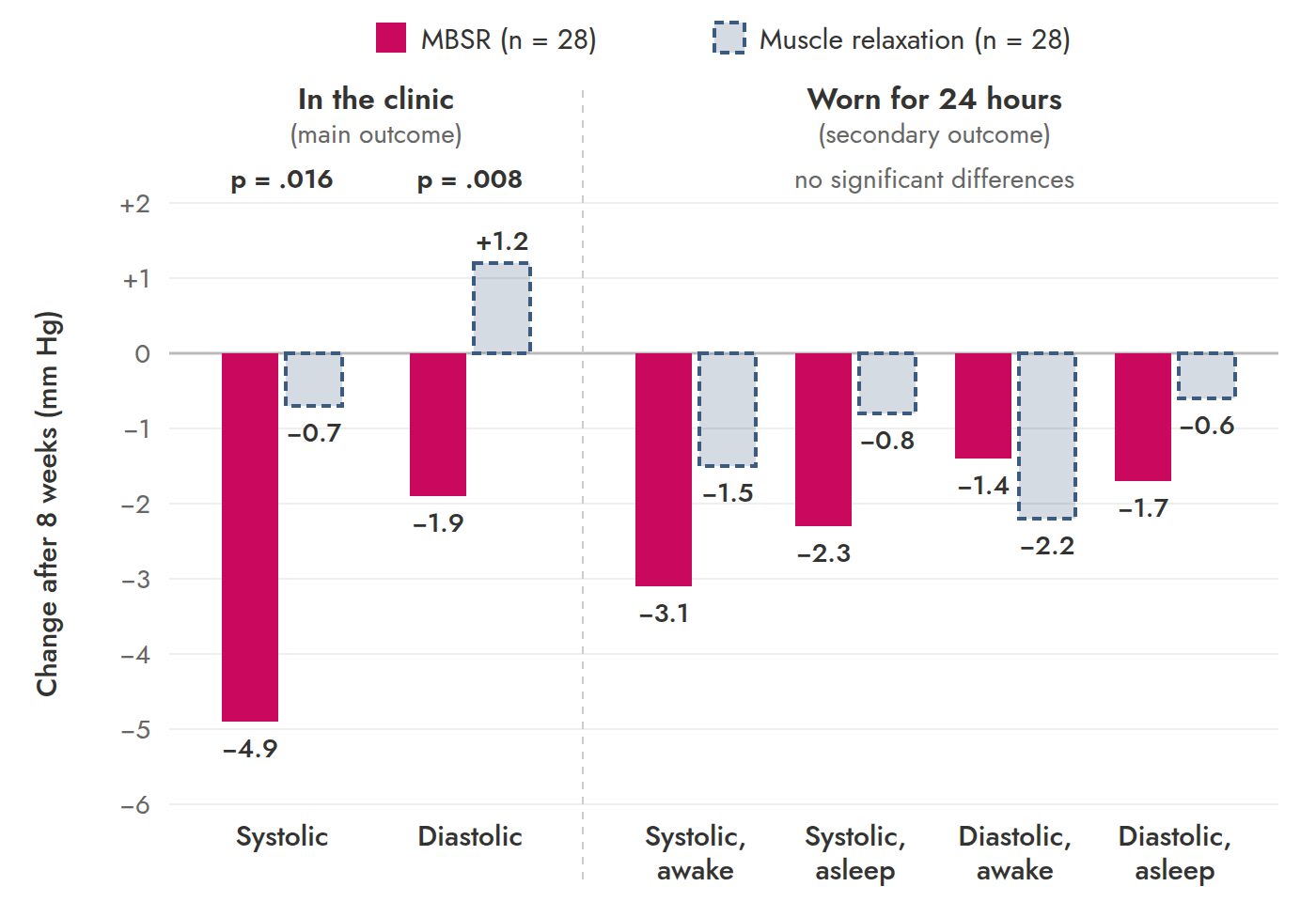
Why would MBSR lower clinic readings but not everyday ones? The authors say this study can’t tell. It might reflect
white coat hypertension
White coat hypertension is blood pressure that is raised when measured in a clinic or by a health professional but normal in everyday life, likely because of the alertness or anxiety the setting brings. It is usually detected by comparing clinic readings with readings taken at home or with a 24-hour ambulatory monitor.
More on Wikipedia
Read more in the glossary
, the tendency for blood pressure to read higher in a clinic, or the influence of daily activity on 24-hour readings. They also offer a more intriguing possibility:
One intriguing possibility is that patients were more able to apply the principles learned in the intervention during seated resting BP assessments in a controlled room than they were when going about their daily lives.
Participants hadn’t been coached to meditate or relax during the measurements, though, and the authors note that people in either group could have used their skills while wearing the 24-hour monitor, so this may not fully explain the gap.
Miscellaneous Interesting Takeaways
A Benefit Comparable to Other Approaches, if It Lasts
The authors point out that the clinic drop was similar in size to the effect of Transcendental Meditation in the meta-analysis they cite, and to the difference between groups in PREMIER, a trial of comprehensive lifestyle changes for high blood pressure. Drops of this size matter for public health, they write, and if sustained might reduce heart attacks, strokes and deaths from heart disease. The “if” is important: blood pressure was measured only once after the course, with no follow-up.
After Treatment, Only Diastolic Pressure Was Clearly Lower
Comparing the groups’ readings after treatment, rather than how much they changed, diastolic pressure was lower in the MBSR group (75.4 vs. 79.4 mm Hg, p = .023), but systolic pressure was not significantly different (p = .208). The paper gives those systolic averages as 128.1 for MBSR and 125.3 for PMR, which doesn’t fit its own starting averages and reported changes (130.2 − 4.9 = 125.3 for MBSR; 128.8 − 0.7 = 128.1 for PMR). Either way, the difference wasn’t significant.
Dropouts and an Uneven Start
Seven of the 28 MBSR patients and 11 of the 28 PMR patients didn’t finish the post-course assessment; five people never started, because the group times clashed with their schedules. The authors call the MBSR group’s 75% completion rate “at the low end” for such trials, and say scheduling groups at convenient times was a challenge. Attendance at sessions was about 90% in both groups, and home-practice logs were handed in 74% of the time in each.
Randomization also left the groups a little uneven on the secondary measure. Clinic pressures were similar at the start, but the MBSR group’s 24-hour readings were lower: for example, 113.8 vs. 120.6 mm Hg for systolic pressure during sleep (p = .019).
Why MBSR and Not Relaxation?
The two programs were matched for time, therapist and homework, but the authors note that they differ in aim. PMR is designed to bring on a
relaxation response
The relaxation response is a term coined by the cardiologist Herbert Benson in the 1970s for a state of physical rest, the opposite of the stress response, that can be brought on by sitting quietly, breathing slowly and repeating a word or phrase. It is marked by slower breathing and heart rate and lower oxygen use. Researchers sometimes ask whether meditation’s benefits come from this general calming rather than from anything specific to the practice.
More on Wikipedia
Read more in the glossary
, which may not last beyond the exercise, while MBSR encourages a way of living, such as mindful eating, that might help people follow lifestyle advice. They list other possible routes too: less stress, calmer activity in the nervous system’s fight-or-flight branch, or changes in how the body regulates blood pressure. The study didn’t measure any of these, so how MBSR lowered clinic readings remains open.
Limits the Authors Acknowledge
The authors describe the study as a pilot-and-feasibility trial and list its limits: a modest sample, high dropout, home-practice logs of questionable accuracy, the non-randomized extra participants in the groups, and no long-term follow-up. The results were also not corrected for
multiple comparisons
The multiple comparisons problem arises when researchers run many statistical tests at once. Each test has a small chance of a false positive, so across thousands of tests, such as one for every point in a brain scan, some “significant” results will turn up by chance alone. Corrections raise the bar for significance to keep the overall false-positive rate down, at the cost of making small real effects harder to detect.
More on Wikipedia
Read more in the glossary
. They are clear about what the design can’t show:
No conclusions about the ability of meditation to prevent hypertension can be drawn from this design, as firm conclusion would require prevention trials with incident hypertension as the primary outcome.
Final Reflection
This was one of the first randomized trials of MBSR for raised blood pressure, and its design was stronger than many in the field: a credible active control matched for time and teacher, screening at three visits so that only people with consistently raised pressure took part, and assessors who couldn’t guess who had meditated. Against that comparison, eight weeks of MBSR lowered clinic blood pressure by about 5 mm Hg systolic and 2 mm Hg diastolic more than muscle relaxation did.
The result comes with real caveats. It was a small trial with many dropouts, especially in the relaxation group, and the effect appeared only in clinic readings, not in the 24-hour readings that reflect blood pressure in daily life. It is a pattern seen elsewhere on this site: in a trial comparing MBSR with a matched health program, mindfulness made a difference on one physical measure but not on related ones.
The authors present MBSR as a possible complement to lifestyle changes for people with prehypertension, not a replacement for them, and they warn that evidence that meditation lowers blood pressure “should not be taken as a recommendation to neglect needed health behavior changes.” Larger trials with longer follow-up would be needed to show whether the clinic drop holds up over time and shows up in daily life.
Citation
Hughes, J. W., Fresco, D. M., Myerscough, R., van Dulmen, M. H. M., Carlson, L. E., & Josephson, R. (2013). Randomized controlled trial of mindfulness-based stress reduction for prehypertension. Psychosomatic Medicine, 75(8), 721–728. 10.1097/PSY.0b013e3182a3e4e5
Get the next summary by email
One or two new paper summaries every couple of weeks, sent to your inbox when they go up.
No spam, and you can unsubscribe at any time. Prefer a feed reader? Use the RSS feed.