
Background Information
Slow breathing is part of many contemplative practices, from yoga to breath-focused meditation, and it is also the heart of a clinical technique called
heart rate variability biofeedback
Biofeedback uses sensors to show people a body signal they can’t normally perceive, such as heart rate, breathing or muscle tension, on a screen in real time, so they can learn to change it. In heart rate variability biofeedback, people watch their heart rhythm while slowing their breathing, usually to around 6 breaths a minute, until the rises and falls in heart rate become as large as possible. Courses typically run over several weekly sessions with practice at home.
More on Wikipedia
Read more in the glossary
(HRVB). In HRVB, sensors on the skin show people their heartbeat and breathing on a screen in real time, and they learn to breathe in a way that makes their
heart rate variability
Heart rate variability (HRV) is the natural variation in time between one heartbeat and the next, calculated from an ECG or a pulse sensor. Higher HRV at rest usually reflects a stronger parasympathetic (“rest and digest”) influence on the heart and is generally linked to relaxation, better health and more flexible responses to stress.
More on Wikipedia
Read more in the glossary
(HRV), the natural variation in time between heartbeats, swing as widely as possible. The paper describes typical protocols as ten 30-minute sessions, with benefits reported for anxiety, depression, panic disorder, heart problems and asthma.
The key ingredient is breathing pace. Heart rate naturally rises a little as we breathe in and falls as we breathe out, a rhythm called
respiratory sinus arrhythmia
Respiratory sinus arrhythmia is the natural rise in heart rate as we breathe in and fall as we breathe out. Despite the name, it is normal and healthy, not a disorder. It is driven largely by the vagus nerve, which slows the heart, so its size is often used as a marker of parasympathetic (“rest and digest”) activity. Slow breathing, at around 6 breaths a minute, makes these swings much larger.
More on Wikipedia
Read more in the glossary
. As people slow their breathing toward about 6 breaths a minute, the paper explains, heart rate and breathing synchronize and the swings in heart rate grow much larger. Each person’s best pace, their resonance frequency (RF), is slightly different, usually between 4.5 and 7 breaths a minute, so HRVB practitioners first test each client at several paces to find it and then teach them to breathe at that exact rate.
Patrick Steffen and colleagues at Brigham Young University noticed that this careful tailoring had never been put to the test:
Although breathing at RF is a key part of HRVB training, there are no published studies to date that have examined if RF breathing is essential.
Other studies had found benefits simply from slow breathing at a fixed pace, such as 6 breaths a minute in yoga. So the question was whether breathing at your own resonance rate does more than breathing slowly at a nearby rate, or than simply sitting still. The team predicted that resonance breathing would lift mood and lower anxious arousal, shift heart rate variability in the direction HRVB aims for, and make blood pressure rise less during a stressful task.
What They Did
The participants were 95 undergraduate psychology students (60% women, average age 20) who took part for course credit. Anyone who reported a history of heart disease or took medicines affecting blood pressure or heart rate was excluded. Each student was randomly assigned to one of three groups:
- Resonance (RF): breathe for 15 minutes at their own resonance rate.
- RF + 1: breathe for 15 minutes at one breath a minute faster than their resonance rate.
- Control: sit quietly with eyes open for 15 minutes.
Everyone first filled in questionnaires on mood and anxious arousal, and was fitted with ECG sensors on the wrists and forearm, a breathing belt and a blood pressure cuff. Then everyone’s resonance rate was found: a pacer guided them through 7, 5, 6.5, 5.5 and 6 breaths a minute, two minutes at each pace with a minute’s rest between. (The usual slowest pace of 4.5 breaths a minute was left out because, the paper says, earlier studies hadn’t found students breathing at that rate.) The pace that produced the biggest heart rhythm response became that person’s resonance rate.
After the 15 minutes of breathing or sitting, all three groups took the
Paced Auditory Serial Addition Task (PASAT)
The Paced Auditory Serial Addition Test (PASAT) is a demanding mental arithmetic task. People hear a stream of single digits and must add each new digit to the one before it and say the answer aloud, while the next digit is already coming. Originally developed to assess attention and processing speed, it is also used in research as a brief laboratory stressor, because it reliably raises heart rate, blood pressure and frustration.
More on Wikipedia
Read more in the glossary
for 8 minutes as a brief laboratory stressor, and then sat quietly for a 10-minute recovery period.
Heart rate variability was measured in two ways. The first splits the heart’s rhythm into speeds: a high-frequency (HF) band of 0.15–0.4 cycles a second, where the breathing-linked ripple usually sits at normal breathing rates and which the paper treats as a measure of parasympathetic (“rest and digest”) activity, and a low-frequency (LF) band of 0.04–0.15. The LF/HF ratio, LF divided by HF, is the number HRVB practitioners track. The second way uses two overall measures of beat-to-beat variation, SDNN and RMSSD. Blood pressure was the average of two cuff readings at each stage. Mood was rated on the Scale of Positive and Negative Emotions (SPANE), and anxious arousal (physical symptoms such as shortness of breath, cold hands or trembling muscles) on a 10-item questionnaire.
One Big Result: Only Resonance Breathing Lifted Positive Mood and the LF/HF Ratio
The groups didn’t differ in age, sex, mood or physical distress at the start. Over the session as a whole, everyone’s positive mood fell during the stress test and recovered somewhat afterward, while negative mood and anxious arousal rose during the test and then eased.
The groups differed in only one of the three mood measures, positive mood (p < 0.01). From the start to the end of the breathing period, positive mood rose in the resonance group but not in the other two (p < 0.001). Negative mood and anxious arousal didn’t differ between groups, and there were no group differences in mood during the stress test or recovery.
The heart rhythm results followed a similar pattern. From the start to the end of breathing practice, the LF/HF ratio rose in the resonance group, stayed about the same in the RF + 1 group and fell in the control group (p = 0.01). In the paper’s words:
Only the RF group was significantly higher than the control group, with the RF + 1 not being different from either group, indicating that a key therapeutic goal of HRV-B was most clearly achieved in the RF group
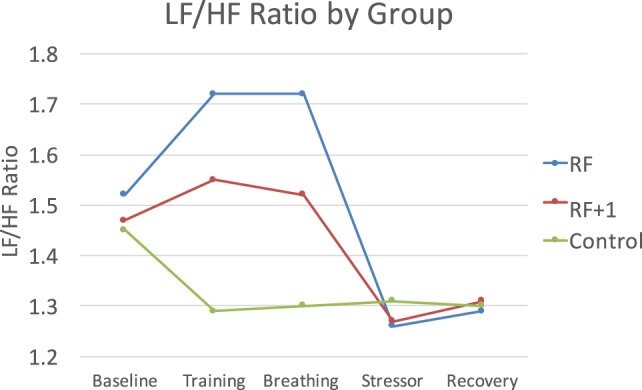
It helps to know what this ratio does and doesn’t show. By the paper’s own numbers, breathing at about 6 breaths a minute is a rhythm of 0.1 cycles a second, inside the LF band rather than the HF band where the breathing-linked ripple usually sits. Both breathing groups, not just the resonance group, raised LF and lowered HF during practice. And the two overall measures of heart rate variability, SDNN and RMSSD, didn’t change over the session or differ between groups. So the “improved HRV” in this study means a shift toward the low-frequency band, largest in the resonance group, rather than more beat-to-beat variation overall.
Miscellaneous Interesting Takeaways
Blood Pressure: Lower During Slow Breathing, Less Clear Under Stress
Systolic blood pressure (the peak pressure as the heart beats), diastolic pressure (the pressure between beats) and heart rate all fell during breathing practice and rose during the stress test. During the breathing period, both breathing groups had lower systolic and diastolic pressure than the control group, so here the exact pace didn’t seem to matter.
During the stress test, the paper describes the result two different ways. The results section says “the RF group showed lower SBP compared to both the RF + 1 and control groups,” which the authors read as resonance breathing buffering the stress response. The abstract says the RF group had lower systolic pressure than the control group “during the PASAT and during the recovery period,” “with the RF + 1 group not being significantly different from either group.” The results section reports no comparison of the groups’ pressure during recovery. With the two descriptions disagreeing, the blood pressure result under stress is the least clear finding in the paper.
A Higher Ratio Went With a Smaller Blood Pressure Response
The team also asked whether people whose LF/HF ratio was higher at the end of the breathing period, allowing for their starting level, had lower blood pressure afterward. They did: a higher ratio predicted lower systolic pressure during the stress test (β = −0.21) and during recovery (β = −0.28), and the link was strongest within the resonance group (β = −0.43 during recovery). Diastolic pressure showed a similar link during recovery only (r = −0.26), again strongest in the resonance group (r = −0.64). This is an association across people, so it can’t show that the ratio itself lowered blood pressure. The authors suggest the
baroreflex
The baroreflex is the body’s automatic control loop for blood pressure. Stretch sensors in the walls of major arteries detect when pressure rises or falls, and the brainstem responds within a heartbeat or two by slowing or speeding the heart and relaxing or tightening blood vessels. Its sensitivity tends to be lower in chronic stress and in heart disease, and slow breathing is thought to exercise it.
More on Wikipedia
Read more in the glossary
, the body’s automatic blood pressure control loop, as a possible pathway, but they didn’t measure it.
Exact Pace or Simply Slow?
The RF + 1 group is the study’s most useful feature. Those students did everything the resonance group did, with the same equipment and paced breathing, at a rate just one breath a minute faster. That makes it a much closer comparison than sitting quietly.
Against that comparison, though, the evidence for the exact pace is thinner than the authors’ conclusion, “A key finding of this study is that breathing at RF does matter,” might suggest. On the LF/HF ratio, the RF + 1 group wasn’t significantly different from the resonance group, and during the breathing period both breathing groups had lower blood pressure than the control group. The clearest difference between the two was in positive mood, which rose only in the resonance group, though the paper doesn’t report a direct test of the resonance group against the RF + 1 group on mood. The control group, meanwhile, had no task at all, so differences from it can’t separate the breathing pace from simply doing a guided exercise.
Other Limits
The authors note three limitations themselves:
A limitation of this study is the cross-sectional design. While positive changes were seen with only one session, it is unknown what would happen over the course of weeks as HRVB is typically administered.
They also point out that all the participants were college students and that they didn’t measure the baroreflex. Beyond those, the paper doesn’t report how many people were in each group, mood was self-rated by students who knew which condition they were in, and the study tested many outcomes (three mood measures, five heart rate variability measures, blood pressure and heart rate at several stages) without reporting any correction for
multiple comparisons
The multiple comparisons problem arises when researchers run many statistical tests at once. Each test has a small chance of a false positive, so across thousands of tests, such as one for every point in a brain scan, some “significant” results will turn up by chance alone. Corrections raise the bar for significance to keep the overall false-positive rate down, at the cost of making small real effects harder to detect.
More on Wikipedia
Read more in the glossary
. The paper also gives few raw numbers: the text reports test statistics and p-values, but not the groups’ average mood scores, LF/HF ratios or blood pressures.
Final Reflection
This small experiment asks a practical question about a widely taught technique: does it matter whether you breathe at your own resonance rate, or is slow breathing near it good enough? After one 15-minute session, breathing at the resonance rate was the only condition that lifted positive mood and raised the LF/HF ratio above sitting quietly. Breathing one breath a minute faster mostly landed in between, not clearly different from either, and both breathing groups lowered blood pressure while they breathed.
The findings fit with other breathing studies on this site, which also suggest that how you breathe can shift how you feel. In a month-long remote trial, 5 minutes a day of cyclic sighing, with its long, slow exhale, lifted positive mood more than
mindfulness
Mindfulness is the psychological process of purposely bringing one’s attention to experiences occurring in the present moment without judgment. It involves maintaining awareness of thoughts, feelings, bodily sensations, and surrounding environment with an attitude of curiosity and acceptance. In meditation contexts, mindfulness practices typically involve focusing attention on the breath or body sensations as anchors to the present moment while acknowledging and releasing distracting thoughts.
More on Wikipedia
Read more in the glossary
meditation, though daily resting heart rate and heart rate variability didn’t differ between the groups (Balban et al., 2023). In a small workplace trial, eight weeks of coached slow belly breathing lowered late-morning
cortisol
Cortisol is a hormone released by the adrenal glands, especially in response to stress. It mobilizes energy and helps regulate the immune system. Because it can be measured in saliva, researchers often use it to gauge how strongly someone reacts to a stressful task, such as timed mental arithmetic. Levels also follow a daily rhythm, so studies try to test everyone at the same time of day.
More on Wikipedia
Read more in the glossary
(Ma et al., 2017), and in Tibetan
g-tummo
g-Tummo, often written tummo and known in English as “inner fire” or “psychic heat,” is a meditation practice of Tibetan Buddhism and Bön associated with sensations of intense bodily heat. It combines a breath-holding technique with muscle contractions (“vase breathing”) and visualization of flames in the body, and it is traditionally taught in long retreats.
More on Wikipedia
Read more in the glossary
practice a forceful breathing technique on its own was enough to warm practitioners’ bodies (Kozhevnikov et al., 2013).
Still, this was a single session with healthy students, a heart rhythm ratio that both breathing groups shifted, overall heart rate variability that didn’t change, and blood pressure results the paper itself describes in two different ways. It supports the idea that tailoring the pace may add something to slow breathing, especially for mood in the moment, but whether that holds over weeks of practice, in older people or in people with anxiety or depression, are questions the authors leave for future studies.
Citation
Steffen, P. R., Austin, T., DeBarros, A., & Brown, T. (2017). The impact of resonance frequency breathing on measures of heart rate variability, blood pressure, and mood. Frontiers in Public Health, 5, 222. 10.3389/fpubh.2017.00222
Get the next summary by email
One or two new paper summaries every couple of weeks, sent to your inbox when they go up.
No spam, and you can unsubscribe at any time. Prefer a feed reader? Use the RSS feed.