
Background Information
Cardiovascular disease is the leading cause of death in the United States, and African Americans have disproportionately high rates of it. Studies link psychological stress, depression, anger and hostility to heart attacks and deaths from heart disease, and the authors suggest that higher levels of social and environmental stress may help explain the racial gap.
Earlier trials of
Transcendental Meditation
Transcendental Meditation (TM) is a trademarked form of mantra meditation taught through a standardized course by certified teachers. Practitioners sit with eyes closed for about 20 minutes twice a day, silently repeating a mantra (a sound or word) in a way meant to be effortless, letting the mind settle rather than holding attention on an object. Researchers usually group it with other mantra-based techniques, separate from mindfulness meditation.
More on Wikipedia
Read more in the glossary
(TM), many by the same research group, had reported improvements in cardiovascular risk factors such as blood pressure, and in some cases lower mortality. The question in this trial was bigger: could TM reduce actual deaths, heart attacks and strokes in people who already had heart disease? Doctors call this secondary prevention, preventing further events in people already diagnosed. The paper describes the technique like this:
The TM technique is described as a simple, natural, effortless procedure that is practiced 20 minutes twice a day while sitting comfortably with the eyes closed.
The research team was led by Robert Schneider of the Institute for Natural Medicine and Prevention at Maharishi University of Management in Fairfield, Iowa, which also coordinated the trial and managed its data. The clinical site was the Medical College of Wisconsin in Milwaukee.
What They Did
The participants were 201 African American men and women with
coronary heart disease
Coronary heart disease (also called coronary artery disease) is a narrowing of the arteries that supply the heart muscle with blood, usually by fatty plaques that build up in the artery walls. It can cause chest pain (angina) and heart attacks, and it is a leading cause of death worldwide. The narrowing is usually confirmed by angiography, an X-ray of the arteries taken after injecting a dye.
More on Wikipedia
Read more in the glossary
, confirmed by angiography showing at least one coronary artery narrowed by 50% or more. People who had had a heart attack, stroke or a procedure to reopen an artery in the previous three months were excluded, as were people with severe heart failure, cognitive impairment or another life-threatening illness. The group was 42% women, with an average age of 59, and half reported household incomes under $10,000 a year.
In this
randomized controlled trial
A Randomized Controlled Trial is a scientific study design that randomly assigns participants to either an experimental group receiving an intervention or a control group, allowing researchers to measure the true effect of the intervention while minimizing bias.
More on Wikipedia
Read more in the glossary
, 99 people were assigned to TM and 102 to cardiovascular health education, an
active control
An active control group is a comparison group that takes part in a different program designed to be just as engaging as the one being tested. In meditation research, it might involve exercise, music, or education classes with the same time commitment, teachers, and expectations of benefit. Comparing against an active control helps separate the effects of meditation itself from the general effects of joining a course.
More on Wikipedia
Read more in the glossary
designed to match TM for instruction time, instructor attention, expectations of benefit and social support. TM was taught by a certified instructor in a 7-step course of six 1.5–2 hour meetings, followed by follow-up meetings that became monthly. The health education group was taught by professional health educators from standard published materials, and asked to spend at least 20 minutes a day on heart-healthy activities such as exercise, healthy cooking and general relaxation. Both groups continued their usual medical care, and the two groups met separately. The investigators and data staff didn’t know who was in which group, but participants obviously did, so the trial was single-blind.
The main outcome was the time until a participant first died from any cause or had a nonfatal heart attack or stroke. Deaths were traced through death certificates and the National Death Index, nonfatal events were confirmed from hospital records, and every event was judged by an independent reviewer who didn’t know the group assignments. A secondary outcome added cardiovascular hospitalizations and procedures to reopen arteries. Blood pressure, weight and practice were checked at 3 months and every 6 months, and diet, exercise, smoking, alcohol, depression, hostility and anger once a year.
A Trial in Two Phases
The trial’s history matters for reading its result. It ran from March 1998 to July 2007 in two phases. The first ended in April 2003. After a gap in funding, a second phase ran from March 2004 to July 2007. All first-phase participants were invited back, and 143 re-enrolled. The other 58 didn’t, because they had died, dropped out or didn’t consent again, and 25 of them had already had a primary event.
The trial was originally planned around a different outcome. The phase 1 power calculation called for 374 participants to detect a 36% reduction in the broader combination of cardiovascular deaths, heart attacks, strokes, artery-reopening procedures and hospitalizations for heart failure or ischemic heart disease. That is the combination reported here as the secondary outcome. Only 201 people had been recruited by the end of phase 1, and the authors describe what happened next:
With review and approval of the DSMB, a single interim analysis determined that with 201 subjects and an additional 6 years of follow up to accrue the required number of events, the trial had 80% power to detect a 50% risk reduction in the DSMB-approved endpoint of all-cause mortality, nonfatal MI and nonfatal stroke.
The DSMB is the trial’s independent data and safety monitoring board, and MI stands for myocardial infarction, a heart attack. So the narrower combination of death, heart attack and stroke became the primary outcome partway through the trial.
One Big Result: 20 Deaths, Heart Attacks or Strokes in the TM Group vs 32 With Health Education
Participants were followed for an average of 5.4 years (up to 9.3). There were 52 primary events in all: 20 in the TM group and 32 in the health education group. Counting each person’s first event, most were deaths:
- Deaths from any cause: 17 in the TM group (of 99) vs 24 in health education (of 102).
- Nonfatal heart attacks: 1 vs 4.
- Nonfatal strokes: 2 vs 4.
In the trial’s main analysis, the TM group’s
hazard ratio
A hazard ratio compares how fast an event happens in two groups over time, such as recovery or death, at any given moment among the people it hasn’t happened to yet. A hazard ratio of 2 means the event is happening at twice the rate in one group as in the other; 1 means no difference. It comes from survival analysis (often a Cox proportional hazards model), which can include people who leave a study early by counting the time they were followed.
More on Wikipedia
Read more in the glossary
was 0.52 (95%
confidence interval
A confidence interval is the range of values that a study’s data are consistent with, given the uncertainty that comes from measuring a limited sample. A 95% confidence interval for an effect of 0.30 running from 0.00 to 0.59, for example, means the true effect could plausibly be anywhere from nothing to moderate. Narrower intervals mean more precise estimates; an interval that includes zero means the study can’t rule out no effect.
More on Wikipedia
Read more in the glossary
0.29–0.92, P = .025), which the authors report as a 48% reduction in risk. That analysis adjusted for age, sex and whether people took cholesterol-lowering drugs, the three factors used to balance the groups at randomization. The paper explains the choice:
Multivariate models covaried for the stratification factors of age, sex, and lipid-lowering medication status since this is recommended to improve the precision and power of the analyses
Without that adjustment, the hazard ratio was 0.64 (0.37–1.12, P = .12), which the authors call a nonsignificant trend. They cite statistical guidance that adjusting for the factors used in randomization gives a more efficient comparison, especially when, as here, those factors predicted the outcome. Two further checks gave similar results. Adjusting also for education and depression, where the groups differed at the start, gave 0.54 (0.30–0.98). Adding 11 deaths that occurred after some participants’ enrollment had ended (7 in TM, 4 in health education) gave 27 events vs 36 and a hazard ratio of 0.57 (0.34–0.96). An independent statistician at the University of Massachusetts reanalyzed the survival data and, the paper reports, got identical results.
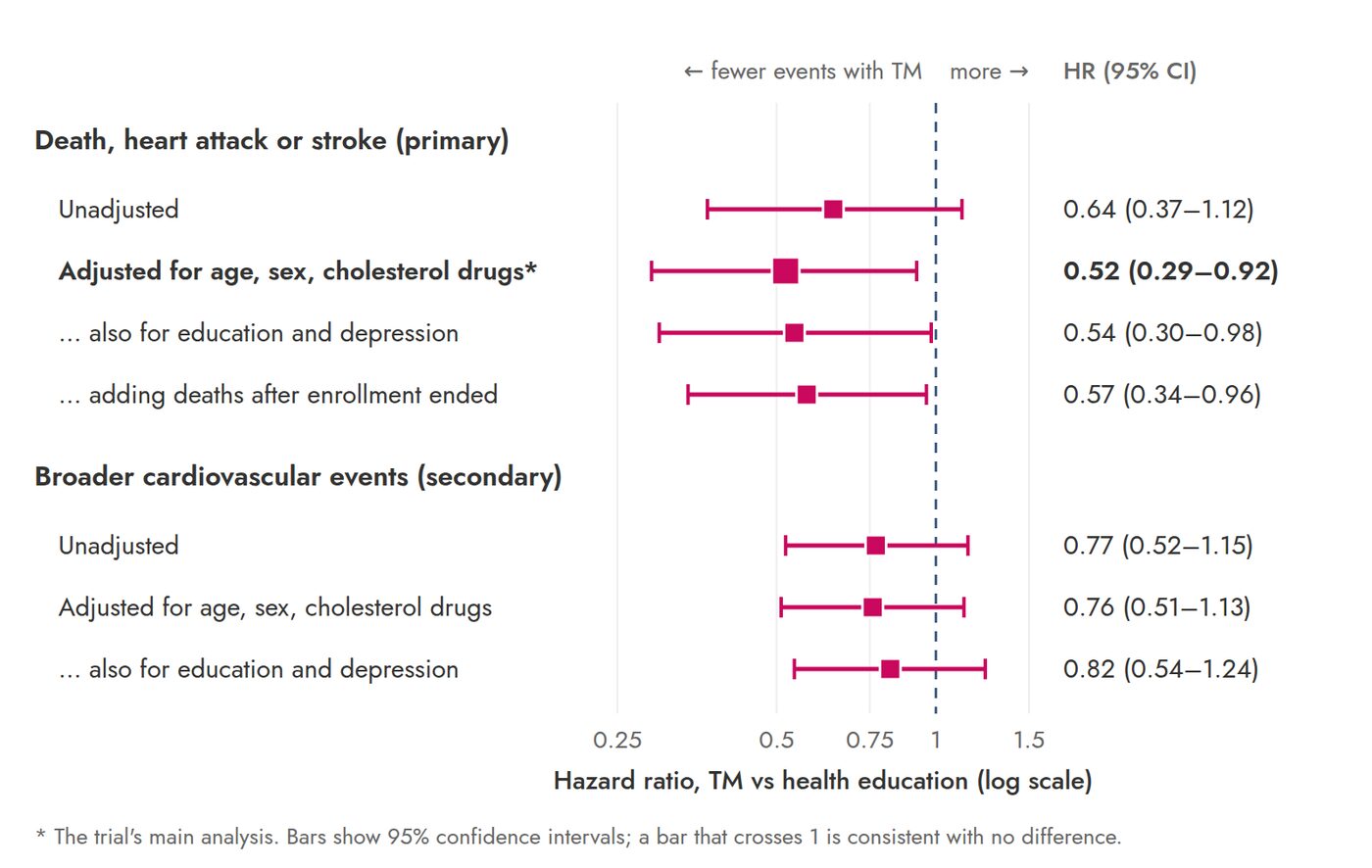
The broader secondary outcome, which included 98 events (44 in TM, 54 in health education), leaned the same way but wasn’t significant: hazard ratio 0.76 (0.51–1.13, P = .17). Procedures to reopen arteries were about even (17 vs 15). The authors suggest that how often local hospitals used such procedures and admissions varied, which may have blurred this comparison.
Miscellaneous Interesting Takeaways
Blood Pressure Differed Because the Control Group’s Rose
Averaged over the trial, systolic blood pressure (the top number) was 4.9 mm Hg lower in the TM group than in the health education group (95% CI −8.3 to −1.5, P = .01). The table of changes shows how that gap arose: the TM group’s systolic pressure was essentially unchanged (+0.02 mm Hg), while the health education group’s rose by 4.9 mm Hg. Diastolic pressure (the bottom number) didn’t differ significantly (−1.6 mm Hg, P = .27). The authors note that a reduction of this size has been linked to about 15% fewer cardiovascular events, and propose it as one possible route to the result. Resting heart rate also differed slightly, rising by about 0.7 beats per minute more in the TM group (P = .01), a difference the text doesn’t discuss.
Anger Improved, Depression and Hostility Didn’t
TM participants improved more than controls on three of the four anger scales: anger held in, anger control and total anger. Outward anger, depression and hostility didn’t differ between groups. The abstract summarizes the anger result as “P < .05 for all scales,” but the results section and table show the outward anger scale wasn’t significant (P = .87). Weight, exercise, alcohol, smoking and diet didn’t differ either.
Practice and Attendance
TM participants reported practicing 8.5 times a week on average, short of the prescribed twice a day, and controls did their heart-healthy activities 8.6 times a week. Both groups attended 48% of follow-up meetings over the 5.4 years. More TM participants than controls never took part in their program (19% vs 10%, P = .07). Because the analysis was by
intention-to-treat analysis
An intention-to-treat analysis counts every randomized participant in the group they were assigned to, whether or not they completed or even started the treatment. It keeps the benefit of randomization, since dropping people who didn’t follow their plan can leave groups that differ in other ways, and it estimates what happens when a treatment is offered in practice rather than when it is taken exactly as intended.
More on Wikipedia
Read more in the glossary
, these people still counted in their assigned group, which the authors argue would make the estimate of TM’s effect more conservative.
People who practiced at least once a day (141 across both groups) showed a larger difference, a hazard ratio of 0.34 (0.16–0.69). Within the TM group, more frequent practice went with fewer events (P = .04). The authors read this as some evidence of a dose-response relationship. But how much people practiced wasn’t randomly assigned, and the test of whether the TM effect really differed between regular and irregular practicers fell short of significance (P = .08).
Who Ran the Trial
Six of the nine authors, including the lead author, were at Maharishi University of Management or its research institute, which also served as the trial’s administrative and data coordinating center. The paper describes TM as “the principal mind-body technique of Maharishi Ayurveda,” and the TM instructors were certified by Maharishi Foundation-USA. The paper states that “the authors report no relevant financial disclosures.” The trial was funded by the US National Heart, Lung, and Blood Institute and monitored by an independent safety board, and the clinical events were judged by an outside reviewer who didn’t know the group assignments. Preliminary findings were presented at the American Heart Association’s 2009 meeting, and the full paper appeared in November 2012, five years after the trial ended.
Smaller Points From the Paper
- The groups started out similar on most measures, but the TM group had more years of education (11.3 vs 9.9) and lower depression scores (18.2 vs 30.7).
- The authors write that the trial was too small to analyze deaths, heart attacks and strokes separately, and that cardiovascular deaths were a smaller share of deaths than national averages, perhaps because of the small sample or because death certificates are often inaccurate about the cause.
- In one place the paper’s discussion says the main analysis was adjusted for “age, gender and antihypertensive medications,” while the methods and results tables say lipid-lowering (cholesterol) medications.
- The trial didn’t compare TM with any other kind of meditation, so it can’t say whether the effect is specific to TM.
Final Reflection
This is an ambitious trial: deaths, heart attacks and strokes, tracked for over five years on average, in a high-risk, low-income group of patients with established heart disease, against a control program matched for time and attention. The authors believe it is the first randomized trial to show fewer of these events with an individual mind-body practice. Most meditation trials, such as the 47 in a review of trials with active controls, measure symptoms like anxiety, depression and pain instead.
The result points in a hopeful direction, but it rests on a small number of events. The 12-event difference was significant only in the planned adjusted analysis, the primary outcome was settled partway through the trial after recruitment fell short of its target, and the broader cardiovascular outcome the trial was first designed around was not significant. Follow-up was uneven because of the funding gap, and most of the investigators were based at Maharishi University of Management, which coordinated the trial and managed its data. The authors call TM potentially “clinically useful” for secondary prevention. A fair reading is that this trial is encouraging but not conclusive. Showing that learning TM prevents deaths, heart attacks and strokes would take larger trials, ideally run by researchers outside the TM tradition.
Citation
Schneider, R. H., Grim, C. E., Rainforth, M. V., Kotchen, T., Nidich, S. I., Gaylord-King, C., Salerno, J. W., Kotchen, J. M., & Alexander, C. N. (2012). Stress reduction in the secondary prevention of cardiovascular disease: Randomized, controlled trial of Transcendental Meditation and health education in Blacks. Circulation: Cardiovascular Quality and Outcomes, 5(6), 750–758. 10.1161/CIRCOUTCOMES.112.967406
Get the next summary by email
One or two new paper summaries every couple of weeks, sent to your inbox when they go up.
No spam, and you can unsubscribe at any time. Prefer a feed reader? Use the RSS feed.