
Background Information
Controlled breathing is part of many yoga and meditation traditions, and in recent years it has also become a popular stress tool on its own. By 2020 there was evidence that slow breathing lowers heart rate and blood pressure in people with high blood pressure, and that the way we breathe affects emotion, but, as the authors point out, little was known about how different breathing techniques compare with one another, or how much practice is needed to make a difference.
A Stanford team led by Melis Yilmaz Balban, David Spiegel and Andrew Huberman set out to compare three breathing patterns that differ mainly in the balance between breathing in and breathing out:
- Cyclic sighing emphasizes the exhale: a slow inhale, a second short inhale to fill the lungs completely, then a long, slow exhale (ideally in through the nose and out through the mouth).
- Box breathing, used in the military for stress control, keeps everything equal: inhale, hold, exhale and hold, each for the same few seconds.
- Cyclic hyperventilation with retention emphasizes the inhale: rounds of 30 deep breaths in, letting each breath “fall out” of the mouth, then a full exhale and 15 seconds of waiting with empty lungs.
They chose
mindfulness
Mindfulness is the psychological process of purposely bringing one’s attention to experiences occurring in the present moment without judgment. It involves maintaining awareness of thoughts, feelings, bodily sensations, and surrounding environment with an attitude of curiosity and acceptance. In meditation contexts, mindfulness practices typically involve focusing attention on the breath or body sensations as anchors to the present moment while acknowledging and releasing distracting thoughts.
More on Wikipedia
Read more in the glossary
meditation as the comparison. Their reasoning was that mindfulness, as they describe it, involves passively observing the breath, whereas controlled breathing changes breathing rate directly and gives people a sense of control over their own body. Since perceived loss of control is a hallmark of anxiety, they predicted that all three breathing exercises would reduce anxiety and calm the body more than mindfulness, and that the exhale-focused cyclic sighing would do best of all. They also note that mindfulness is usually practiced for 20 minutes or more a day; here, every group got just 5.
What They Did
The study ran entirely online between June and September 2020, during the COVID-19 pandemic. Of 140 people who consented, 108 adults enrolled, most of them from an undergraduate psychology class at Stanford and a few through word of mouth. People with moderate to severe psychiatric or medical conditions, such as heart disease, a history of seizures,
psychosis
Psychosis is a state in which a person loses touch with reality in important ways, most often through hallucinations (perceiving things that aren’t there, such as hearing voices) and delusions (fixed false beliefs, such as being persecuted). It is a feature of several conditions, including schizophrenia, bipolar disorder and severe depression, and can also be brought on by drugs, extreme sleep loss or physical illness. It is usually treated with antipsychotic medication and psychological support.
More on Wikipedia
Read more in the glossary
or
substance use disorders
A substance use disorder is the clinical term for addiction to alcohol or other drugs: continued use despite harm, with problems such as craving, loss of control over how much is used, and failed attempts to cut down. It ranges from mild to severe, and relapse after treatment is common.
More on Wikipedia
Read more in the glossary
, were excluded, as were pregnant people.
Participants were randomly assigned to four groups: 24 to mindfulness meditation, 30 to cyclic sighing, 21 to box breathing and 33 to cyclic hyperventilation with retention. The groups are uneven because, while mailing out the wristbands, the team found that some participants lived together, and to keep housemates from mixing up practices, eight households were assigned to the same group.
Each person was sent instructional videos, pre-recorded by Andrew Huberman, and asked to do their practice once a day for 5 minutes for 28 days, with a daily text message reminder. The mindfulness instructions were to sit or lie down, close the eyes and focus attention on the forehead between the eyes, returning attention first to the breath and then to the forehead whenever it drifted.
Right before and right after each day’s session, participants rated their mood on the
Positive and Negative Affect Schedule (PANAS)
The Positive and Negative Affect Schedule (PANAS) is a widely used questionnaire with two short lists of feeling words, one for positive feelings and one for negative ones. People rate how strongly they feel each, and the ratings are added up into separate positive affect and negative affect scores, each from 10 to 50. The two scores are largely independent of each other, and when it asks about the present moment it can be given just before and just after a single session.
More on Wikipedia
Read more in the glossary
, which gives a positive affect score and a negative affect score, and their current anxiety on the
State Anxiety Inventory
The State Anxiety Inventory is the half of the State-Trait Anxiety Inventory (STAI) that asks how anxious someone feels right now, rather than how anxious they tend to be in general. People rate 20 statements such as “I feel worried” from 1 (not at all) to 4 (very much so), giving a score from 20 to 80. Because it captures the moment, researchers can give it just before and just after a single session.
More on Wikipedia
Read more in the glossary
. They also wore a WHOOP wristband for the whole month. From it the team took daily summaries of resting heart rate,
heart rate variability
Heart rate variability (HRV) is the natural variation in time between one heartbeat and the next, calculated from an ECG or a pulse sensor. Higher HRV at rest usually reflects a stronger parasympathetic (“rest and digest”) influence on the heart and is generally linked to relaxation, better health and more flexible responses to stress.
More on Wikipedia
Read more in the glossary
and
respiratory rate
Respiratory rate is the number of breaths a person takes per minute. At rest, adults typically breathe around 12 to 20 times a minute. Breathing tends to speed up with stress, effort and strong emotion and to slow down with relaxation and sleep, and slow, deliberate breathing is a common feature of meditation and breathing practices.
More on Wikipedia
Read more in the glossary
(the paper says the device calculates heart rate and heart rate variability during deep sleep), along with hours of sleep,
sleep efficiency
Sleep efficiency is the share of time in bed actually spent asleep: total sleep time divided by time in bed, given as a percentage. It can be measured in a sleep lab or estimated from sleep diaries or wrist-worn devices. Taking a long time to fall asleep or lying awake during the night lowers it, and values below about 85–90% are often taken as a sign of disturbed sleep.
More on Wikipedia
Read more in the glossary
and the device’s sleep score. Before and after the month, everyone filled in questionnaires on trait anxiety (how anxious they generally are) and on daytime problems caused by poor sleep.
To compare the groups on daily mood, the team used a
mixed-effects model
A mixed-effects model is a statistical method for data in which the same people are measured many times, such as a daily rating over a month. It separates effects that apply to everyone, such as which group a person was in, from each person’s own baseline and ups and downs, so that people who contributed more days don’t count as extra independent evidence and people who skipped days can still be included.
More on Wikipedia
Read more in the glossary
, which handles many measurements from each person and included how many days each person had practiced so far. For the body measures, they fitted a line through each person’s daily values and compared the slopes, a measure of how much each one drifted up or down over the month.
One Big Result: Cyclic Sighing Raised Positive Mood More Than Mindfulness, but Anxiety Fell Equally in Every Group
Every practice helped in the moment. Averaged across the month, state anxiety and negative affect dropped significantly from before to after each session in all four groups. Positive affect rose in all three breathing groups; in the mindfulness group it rose too, but not quite significantly (p = 0.06).
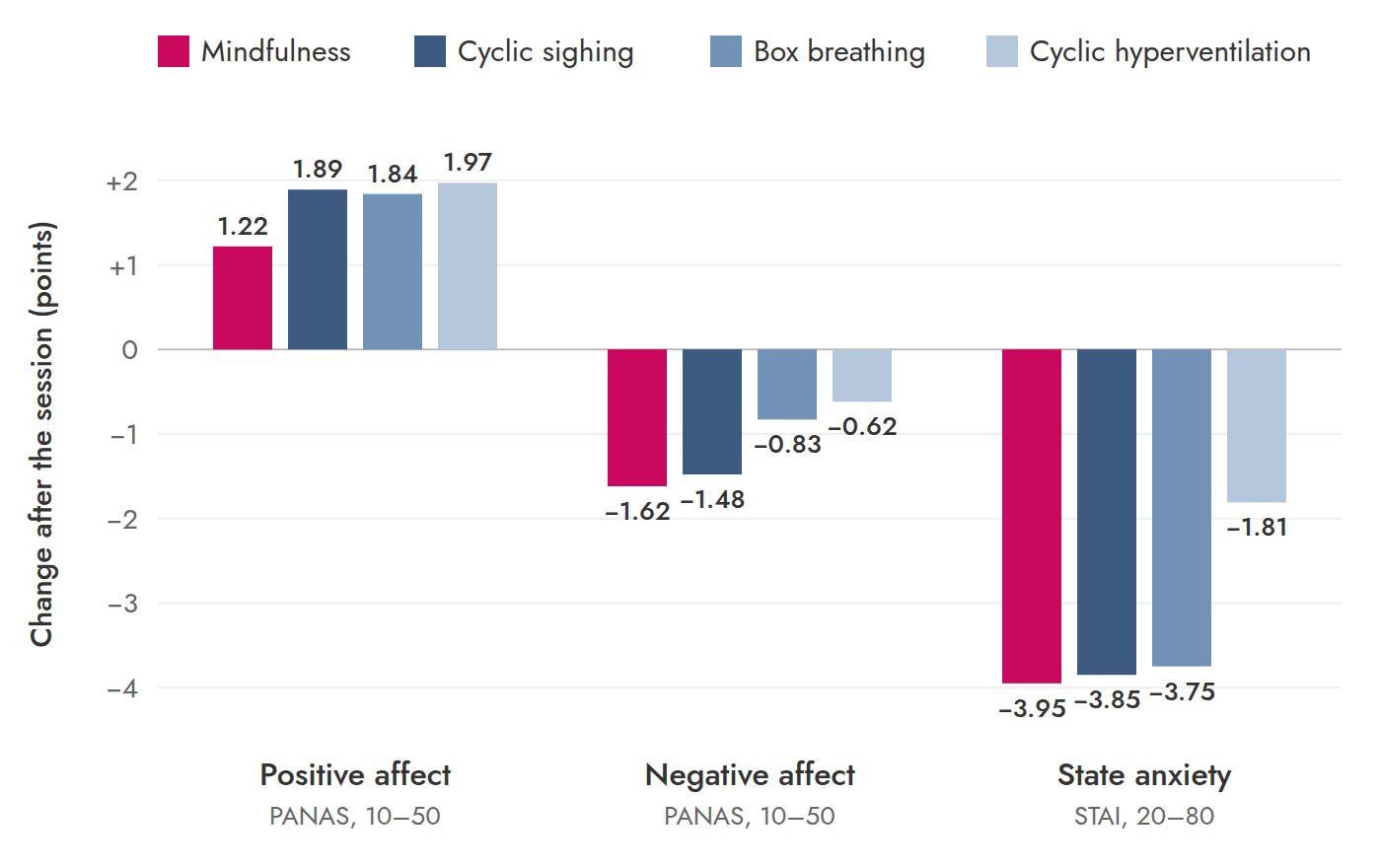
The groups differed in only one of these three measures. On state anxiety and negative affect, the breathwork groups combined did no better than mindfulness. In fact the mindfulness group had the largest average drop in both, though the differences weren’t significant.
The difference was in positive affect. In the mixed-effects model, the breathwork groups combined increased their positive affect more than the mindfulness group did (p < 0.05, according to the abstract), and the gap widened the more days people had practiced. Comparing each breathing group with mindfulness separately, only cyclic sighing was significantly better; box breathing and cyclic hyperventilation were higher than mindfulness, but not significantly. Cyclic sighing was also the only one whose advantage grew significantly with more days of practice.
The authors’ summary:
Daily 5-min cyclic sighing has promise as an effective stress management exercise.
So the first hypothesis, that controlled breathing would reduce anxiety more than mindfulness, wasn’t supported: both reduced anxiety by similar amounts. What the study did find is that breathwork, and cyclic sighing in particular, gave a bigger lift to positive feelings. The three breathing groups were never compared with one another, so the study can’t say that cyclic sighing beat box breathing or hyperventilation, only that it was the one to clear the bar against mindfulness.
Miscellaneous Interesting Takeaways
Breathing Slowed Over the Month, but Heart Rate and HRV Didn’t Change
Of the body measures, only respiratory rate differed between the groups. The daily breathing rate recorded by the wristband fell more over the month in the breathwork groups combined than in the mindfulness group (p < 0.05), and among the breathing groups, the difference from mindfulness was significant for cyclic sighing. People whose breathing rate fell more also tended to have bigger daily lifts in positive affect, a modest
correlation
A correlation measures how closely two things rise and fall together across people or over time. Pearson’s r runs from −1 to +1: values near +1 mean that people high on one measure tend to be high on the other, values near −1 mean the reverse, and values near 0 mean no straight-line relationship. A correlation alone can’t show that one thing causes the other.
More on Wikipedia
Read more in the glossary
(r = −0.24).
Resting heart rate and heart rate variability, two common markers of the body’s stress state, didn’t change significantly over the month in any group and didn’t differ between groups. Sleep didn’t change either, by the wristband’s measures or by the daytime sleepiness questionnaire, and trait anxiety stayed the same in every group, which the authors expected over a month.
That makes the paper’s title, which says the practices “reduce physiological arousal,” broader than its results. The one body measure that differed between groups was respiratory rate, which, as the paper’s introduction notes, controlled breathing influences directly.
How Much People Actually Practiced
Adherence was imperfect but similar across groups. The mindfulness group completed the daily practice on an average of 17.7 of the 28 days and the breathwork groups on 19.6, at about 6 minutes a session; the groups didn’t differ on either. Practice was counted only when someone filled in both the before and after surveys, since there was no other way to check it from a distance. In an optional survey at the end, 90% of participants described positive experiences during the exercises and 10% described negative ones, and 74% found their exercise very or somewhat easy.
An Exploratory Study, Registered Afterward
The authors are open about the study’s status:
This study was originally intended as an exploratory study in preparation for a larger clinical trial and thus was not pre-registered as a clinical trial.
They registered it on ClinicalTrials.gov only after it was done and say they plan a larger, pre-registered confirmatory trial. They also note that the groups were small, which limited the power to compare the breathing groups with one another, though they say the study had enough power to compare all breathwork combined with mindfulness. The study had no follow-up after the four weeks, so it can’t say how long the effects last.
The Comparison Was a Particular Kind of Mindfulness
The introduction describes mindfulness as “passive observation of breath,” but the instructions given to the mindfulness group asked people to rest their attention on the forehead between the eyes, using the breath only as a step back when their mind wandered. Five minutes is also short for mindfulness practice by the paper’s own account. So the study compares these breathing exercises with one short, specific form of mindfulness meditation, not with mindfulness practice in general.
Other Limits Worth Knowing
All the mood measures were self-ratings made right before and right after a practice the person knew they were doing, so expectations could shape them, and there was no group that did no practice at all. Most participants were Stanford students. The wristbands were donated by WHOOP, which the paper says had no role in designing or analyzing the study, and participants who finished kept the device (worth about $350) and a six-month subscription in place of payment. Andrew Huberman, who recorded the instruction videos, became an advisor to WHOOP in June 2022, after the study but before the paper was published, a link the paper declares.
Final Reflection
This study asks a practical question: if you have five minutes a day, does it matter whether you spend it on controlled breathing or on meditation? Its answer is that both lowered anxiety and negative feelings right after each session by similar amounts, and that the exhale-focused cyclic sighing gave a somewhat bigger and growing boost to positive mood, along with a larger drop in daily breathing rate.
That fits with other work on this site suggesting that much of the immediate calm from a short session may not depend on mindfulness itself. Beginners given four 20-minute mindfulness sessions felt much less anxious straight after each one, but their overall mood improved no more than that of students who listened to an audiobook (Zeidan et al., 2010). In a pain study, a “sham” meditation of sitting with eyes closed and taking a deep breath every few minutes cut the unpleasantness of lab heat by about a quarter, and sham meditators whose breathing slowed more felt less unpleasantness, though real mindfulness training eased the pain more (Zeidan et al., 2015). And in Tibetan
g-tummo
g-Tummo, often written tummo and known in English as “inner fire” or “psychic heat,” is a meditation practice of Tibetan Buddhism and Bön associated with sensations of intense bodily heat. It combines a breath-holding technique with muscle contractions (“vase breathing”) and visualization of flames in the body, and it is traditionally taught in long retreats.
More on Wikipedia
Read more in the glossary
practice, a forceful breath-holding technique on its own was enough to warm practitioners’ bodies (Kozhevnikov et al., 2013).
Still, this was a small, exploratory study of mostly students screened for serious health problems, with groups of 21 to 33 people, self-rated mood, unverified home practice and no follow-up. Its clearest finding is a modest difference in positive affect for one breathing exercise against one short form of meditation. Cyclic sighing is simple to try, but whether it reliably beats meditation, or other breathing exercises, awaits the larger, pre-registered trial the authors plan.
Citation
Balban, M. Y., Neri, E., Kogon, M. M., Weed, L., Nouriani, B., Jo, B., Holl, G., Zeitzer, J. M., Spiegel, D., & Huberman, A. D. (2023). Brief structured respiration practices enhance mood and reduce physiological arousal. Cell Reports Medicine, 4(1), 100895. 10.1016/j.xcrm.2022.100895
Get the next summary by email
One or two new paper summaries every couple of weeks, sent to your inbox when they go up.
No spam, and you can unsubscribe at any time. Prefer a feed reader? Use the RSS feed.