
Background Information
By 2015, several small studies had shown that a few short lessons in
mindfulness
Mindfulness is the psychological process of purposely bringing one’s attention to experiences occurring in the present moment without judgment. It involves maintaining awareness of thoughts, feelings, bodily sensations, and surrounding environment with an attitude of curiosity and acceptance. In meditation contexts, mindfulness practices typically involve focusing attention on the breath or body sensations as anchors to the present moment while acknowledging and releasing distracting thoughts.
More on Wikipedia
Read more in the glossary
meditation could make painful heat hurt less. In an earlier study from the same lab, 15 beginners who had four 20-minute lessons rated lab heat 40% less intense and 57% less unpleasant while meditating, with matching changes in brain activity. But that study had no control group, and critics raised an obvious objection: maybe meditation works like a sugar pill.
Pain is one of the things most sensitive to the
placebo effect
A placebo is an inactive treatment, such as a sugar pill or a cream with no drug in it, made to look like a real one. The placebo effect is the improvement people feel after receiving it, driven by their expectations, by learning from past experiences of real treatment, and by the setting of care. Pain is especially responsive: placebo pain relief is well documented in the lab and has been linked to prefrontal brain areas and the brain’s own opioids.
More on Wikipedia
Read more in the glossary
. If people expect relief, they often get some, and the effect can grow when past experience has taught them that a treatment works. Meditation also comes with plenty that has nothing to do with mindfulness itself: a calm room, an attentive instructor, sitting still with your eyes closed, slow breathing, and the belief that you’re doing something that helps. Any of these could ease pain.
Fadel Zeidan, Robert Coghill and colleagues at Wake Forest School of Medicine designed this study to pull those pieces apart. They compared mindfulness with three alternatives: a placebo cream, which captures expectation and conditioning; a “sham” meditation that looked and felt like meditation but left out the mindfulness instructions; and an audiobook, which matched the time and attention but offered no pain relief strategy at all. They predicted that mindfulness would relieve more pain than placebo, and would do it through different brain areas.
What They Did
Eighty healthy, pain-free, right-handed volunteers with no meditation experience completed every session. Scanner artifacts spoiled the data from five, leaving 75 (average age 27; 38 men and 37 women). They had been randomly assigned, with the sexes balanced, to one of four groups: mindfulness (17 people in the final analysis), sham mindfulness (20), placebo cream (19) or audiobook (19). People taking pain or psychiatric medication were excluded, as were followers of meditation-based religions.
Painful heat. As in the lab’s other studies, a small probe on the back of the right calf alternated between 12-second pulses of 49°C (about 120°F) and harmless 35°C warmth, ten pulses in a run of just under four and a half minutes. Some runs used only the neutral warmth. After each run, people rated how intense the pain had been and, separately, how unpleasant it was, on sliding scales from 0 to 10. The researchers explained the difference with an analogy: intensity is like the loudness of a radio, while unpleasantness also depends on other things.
A first scan. In an early session, everyone rated heat in the scanner before any training. The four groups’ pain ratings didn’t differ.
Four 20-minute sessions on separate days, each group with its own:
- Mindfulness. People learned to focus on the changing sensations of the breath, first at the tip of the nose and then the full flow of breathing, to acknowledge thoughts and feelings “without judgment or emotional reaction,” and to return to the breath. They were taught that sensations and feelings were “momentary” and “fleeting” and needed no further interpretation. Guidance tapered off over the sessions, and there was no practice at home.
- Sham mindfulness. People were told they had been assigned to mindfulness meditation. They sat in the same room, in the same posture, with the same facilitator, but their only instruction was to close their eyes and, every two to three minutes, to “take a deep breath as we sit here in meditation.” As the authors put it:
The main purpose of the sham mindfulness meditation intervention was to lead subjects to believe they were practicing mindfulness meditation without the instructions related to mindfully attending to the breath in a nonevaluative manner.
- Placebo cream. People were told they were testing a new formulation of the local anesthetic lidocaine, “proven effective at progressively reducing pain after multiple applications.” A technician in a white lab coat and blue medical gloves applied the cream, which was actually petroleum jelly, to the calf and removed it 10 minutes later. Then came a second heat run on the treated skin, and to build up the expectation of relief, the researchers secretly lowered its temperature, from 49°C to 48°C in the first session and down to 46.5°C by the last. This is conditioning: people learn from experience that the cream “works.”
- Audiobook. People listened to a recording of The Natural History and Antiquities of Selborne, an 18th-century nature book used in earlier studies as a neutral comparison, without sleeping, talking or using their phones.
The other three groups got the same heat runs as the placebo group, with the same hidden drops in temperature, but not paired with their strategy. All four groups practiced in the last sessions with a recording of scanner noise, lying down for the final one.
The final scan. Everyone first lay with eyes closed through two heat runs and two neutral runs. Then the placebo group had the cream applied and removed, the two meditation groups were told to “begin meditating” and continue until the end, and the audiobook group was told to keep still with eyes closed. Four more runs followed. Brain blood flow was measured with
arterial spin labeling
Arterial spin labeling (ASL) is a kind of MRI scan that measures blood flow in the brain by magnetically tagging the water in blood flowing up the neck and imaging it as it arrives. It needs no injected tracer, and unlike standard fMRI it gives blood flow in absolute units, which makes it suited to comparing slow, steady states that last for minutes.
More on Wikipedia
Read more in the glossary
, a kind of
fMRI
An fMRI (functional Magnetic Resonance Imaging) measures changes in blood flow related to neural activity in the brain, offering insights into brain function and activity patterns.
More on Wikipedia
Read more in the glossary
suited to steady states that last minutes, and breathing and heart rate were recorded. The key measure was how much each group’s pain ratings changed from the first half of the scan to the second.
One Big Result: Mindfulness Relieved More Pain Than Sham Meditation or the Placebo Cream
Every active strategy reduced pain, and the audiobook group’s pain went up:
- Mindfulness lowered pain intensity ratings by 27% and unpleasantness by 44%.
- Sham mindfulness lowered intensity by 8% and unpleasantness by 27%.
- The placebo cream lowered intensity by 11% and unpleasantness by 13%, though the drop in unpleasantness fell just short of significance on its own (p = .054).
- The audiobook group, simply lying in the scanner for longer, rated the heat 14% more intense and 18% more unpleasant.
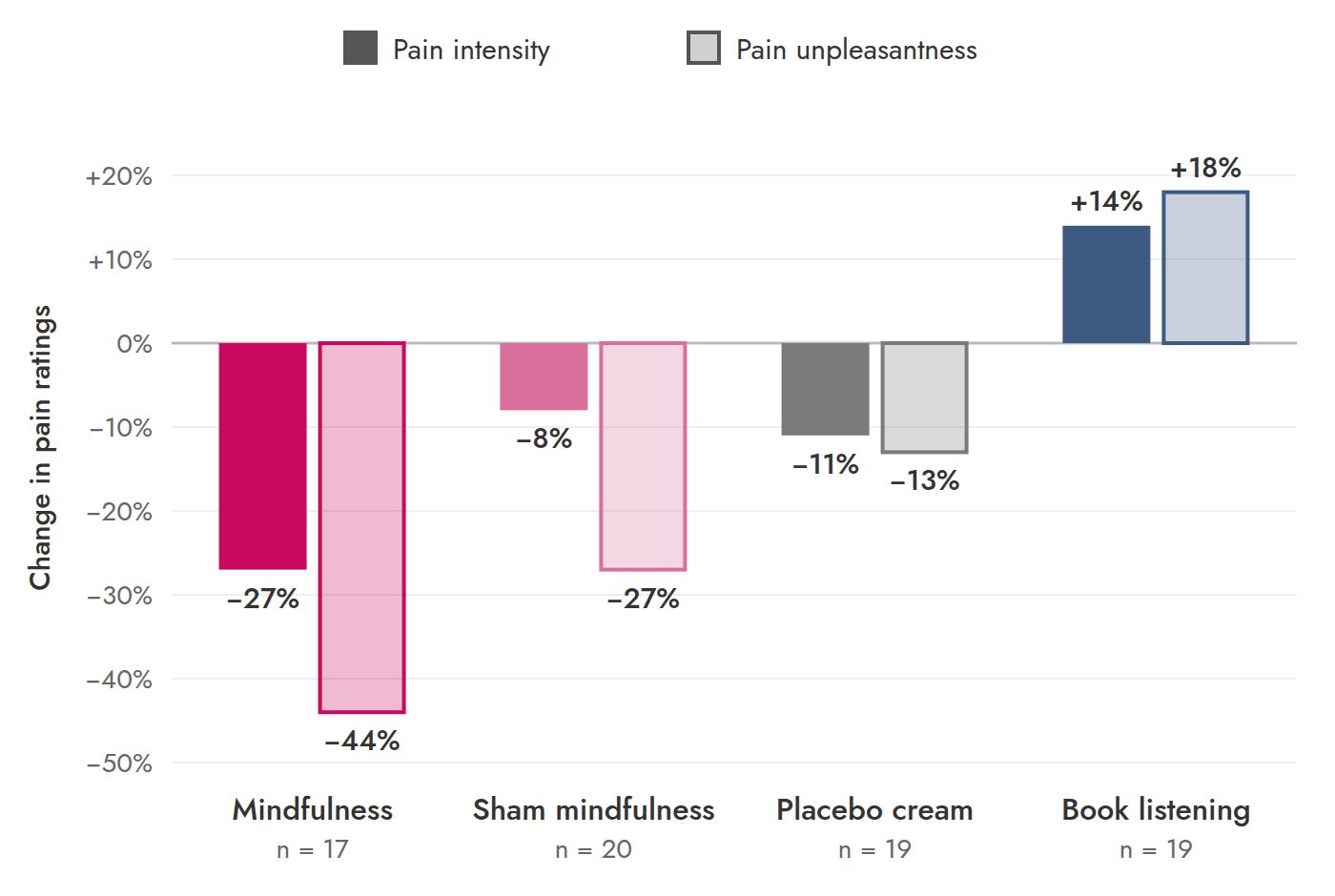
The comparisons the study was built for all favored mindfulness. Its drop in pain intensity was larger than placebo’s (p = .032) and sham meditation’s (p = .030), and its drop in unpleasantness was larger than placebo’s (p < .001) and sham meditation’s (p = .043). All three strategies beat the audiobook on both ratings. The paper reports these as percentages; the average ratings themselves appear only in a figure.
Several of those p-values are close to the .05 line. The paper treats these as planned comparisons and doesn’t adjust them for the number of tests. The edge over placebo on unpleasantness is much clearer. So the strongest result is that mindfulness eased how unpleasant the heat felt far more than a conditioned placebo cream did; its advantage over a convincing fake meditation points the same way but is statistically weaker.
Mindfulness also changed the two parts of pain differently. It cut unpleasantness much more than intensity, while the placebo cream cut both by similar amounts. The paper doesn’t test that difference statistically, but it echoes a study in which expert meditators practicing open awareness found heat less unpleasant than novices did, while their intensity ratings changed less.
Miscellaneous Interesting Takeaways
The Sham Was Convincing, and It Wasn’t Mindfulness
A sham only works as a control if people believe it. After each session, both meditation groups were asked, “How effectively did you meditate in this session?”, and their answers didn’t differ (p > .88). Yet only the real mindfulness group became more mindful: its scores on the Freiburg Mindfulness Inventory, a short questionnaire, rose 16%, while the other groups’ barely moved. So the sham group believed it was meditating, but wasn’t practicing mindfulness, which is what makes its smaller relief informative.
The placebo group’s belief in its cream grew fastest of all. Asked how well the “lidocaine” was working, its ratings climbed from 1.9 out of 10 after the first session to 6.1 after the fourth, higher than any other group’s ratings of its own intervention by then. Yet the cream gave less relief than mindfulness. The questions differed between groups, though (“how effective was the cream” versus “how effectively did you meditate”), so this is a rough comparison of expectations, not a direct one.
Different Brain Patterns for Each Kind of Relief
The brain results are complex, but three patterns stand out. Each map was corrected for the thousands of points tested across the brain, but the paper ran many such analyses with no correction across them.
Mindfulness. Compared with rest, meditating lowered activity in the
thalamus
The thalamus is a pair of egg-shaped structures deep in the middle of the brain that relay sensory signals (from everything except smell) and motor signals to the cerebral cortex. It acts as a gatekeeper, helping decide which information reaches the cortex, and also plays a part in regulating sleep, wakefulness and attention.
More on Wikipedia
Read more in the glossary
, the relay station for incoming sensory signals, and the
periaqueductal gray
The periaqueductal gray (PAG) is a small column of gray matter in the midbrain, surrounding the narrow canal that carries cerebrospinal fluid through the brainstem. It is a key part of the body’s built-in pain control system: signals from the PAG travel down to the spinal cord and can dampen incoming pain signals, partly through the brain’s own opioids. It is also involved in defensive responses to threat.
More on Wikipedia
Read more in the glossary
, a midbrain area that helps control pain signals, and it lowered them more than either the placebo or the sham did. It raised activity in the anterior
insula
The insula is a region of cortex folded deep inside each side of the brain. It helps represent the body’s internal state (interoception) and is involved in emotion, empathy and compassion. Its front part, the anterior insula, comes up often in meditation research.
More on Wikipedia
Read more in the glossary
and in the parts of the
somatosensory cortex
The somatosensory cortex is the part of the brain’s surface that receives touch, temperature, pain and body-position signals. The primary somatosensory cortex (S1), a strip behind the central groove at the top of the brain, holds a map of the body, with each body part in its own spot; the secondary somatosensory cortex (S2), lower down on each side, helps tell what a sensation is and how strong it feels.
More on Wikipedia
Read more in the glossary
that map the nose and face, consistent with attention to the breath. And within the mindfulness group, the people whose pain intensity fell most showed the most activity in the
orbitofrontal cortex
The orbitofrontal cortex (OFC) is the part of the frontal lobes just above the eye sockets. It helps judge how rewarding or unpleasant something is in its context, updates those judgments as circumstances change, and is involved in regulating emotions.
More on Wikipedia
Read more in the glossary
on both sides, the
subgenual anterior cingulate cortex
The subgenual anterior cingulate cortex (sgACC) is the lowest part of the anterior cingulate cortex, lying beneath the bend (genu) at the front of the corpus callosum, next to the ventromedial prefrontal cortex. It is involved in emotion and mood: it is overactive in depression, where it has been a target of deep brain stimulation. Brain-imaging studies have also found it more active when smokers see cigarette cues and crave.
More on Wikipedia
Read more in the glossary
, the right anterior insula and the right putamen, part of the
striatum
The striatum is a group of structures deep in the brain that is central to reward, motivation and habit. Its lower part, the ventral striatum (which includes the nucleus accumbens), responds to pleasures and to cues that predict them, and is strongly activated by addictive drugs. Its upper part, the dorsal striatum, is involved in movement and in habits that run automatically.
More on Wikipedia
Read more in the glossary
, a pattern the authors call largely consistent with their 2011 study. The authors read the orbitofrontal link as a sign that meditators were reappraising the heat, changing how they evaluated it in context.
Placebo. During heat, the cream increased activity in the
anterior cingulate cortex
The anterior cingulate cortex (ACC) is a strip of cortex on the inner surface of each frontal lobe, curving around the front of the corpus callosum. It is involved in monitoring conflicts and errors, regulating attention and emotion, and processing pain, and it often turns up in brain-imaging studies of meditation.
More on Wikipedia
Read more in the glossary
and the
dorsolateral prefrontal cortex
The dorsolateral prefrontal cortex (dlPFC) is a region on the upper outer sides of the frontal lobes. It is a core part of the brain’s executive control network, supporting working memory, directing attention and regulating emotion. Stronger dlPFC activity and connectivity have been associated with lower pain, negative emotion and stress.
More on Wikipedia
Read more in the glossary
, areas tied to expectation in earlier placebo research. It reduced the pain response in sensory areas such as the posterior insula and secondary somatosensory cortex, and the people whose pain intensity dropped most showed the biggest drop in the secondary somatosensory area on the side of the brain receiving the signal.
Sham meditation. Its overall pattern looked a lot like real mindfulness, with overlapping activity in the anterior insula, putamen and anterior cingulate and quieter activity in the
posterior cingulate
The posterior cingulate cortex (PCC) is a region toward the back of the brain’s midline. It is a central hub of the default mode network and tends to be active during self-related thought and mind-wandering. Many meditation studies track PCC activity or connectivity as a window onto the DMN.
More on Wikipedia
Read more in the glossary
and
medial prefrontal cortex
The medial prefrontal cortex (mPFC) is the part of the frontal lobes along the brain’s midline, just behind the forehead. It is a core part of the default mode network and is consistently active when people think about themselves, judge their own traits, or recall and plan events in their own lives.
More on Wikipedia
Read more in the glossary
, both hubs of the
default mode network
The default mode network (DMN) is a system of connected brain areas that show increased activity when a person is not focused on what is happening around them, such as during daydreaming and mind-wandering. It can also be active when the individual is thinking about others or themselves, remembering the past, and planning for the future.
More on Wikipedia
Read more in the glossary
. But no brain area tracked how much pain relief each person got. What did track it was breathing: the more a sham meditator’s breathing slowed, the less unpleasant the heat felt.
Two cautions apply. First, the authors themselves note that the differences between conditions often reflected one of them reducing activity more, not the other increasing it:
It is important to note that many differences between mindfulness meditation and placebo were the result of greater deactivation in one condition compared with the other …
Second, the links between brain activity and relief are
correlations
A correlation measures how closely two things rise and fall together across people or over time. Pearson’s r runs from −1 to +1: values near +1 mean that people high on one measure tend to be high on the other, values near −1 mean the reverse, and values near 0 mean no straight-line relationship. A correlation alone can’t show that one thing causes the other.
More on Wikipedia
Read more in the glossary
across 17 to 20 people per group. Not finding a brain correlate of sham relief in 20 people doesn’t show there isn’t one. The abstract’s claim that the study is the first to show mindfulness pain relief is “mechanistically distinct” from placebo rests on these different patterns, which is suggestive rather than conclusive.
Both Meditations Slowed Breathing, but Only the Sham’s Relief Depended on It
Both meditation groups breathed far more slowly once they started: from 17 to about 9 breaths a minute in the mindfulness group during heat, and from about 17 to 11 in the sham group, a difference between them that wasn’t significant. Among sham meditators, slower breathing during the session predicted lower unpleasantness ratings (p = .040). Among mindfulness meditators it didn’t (p = .426). The authors take this as evidence that the sham worked like Herbert Benson’s
relaxation response
The relaxation response is a term coined by the cardiologist Herbert Benson in the 1970s for a state of physical rest, the opposite of the stress response, that can be brought on by sitting quietly, breathing slowly and repeating a word or phrase. It is marked by slower breathing and heart rate and lower oxygen use. Researchers sometimes ask whether meditation’s benefits come from this general calming rather than from anything specific to the practice.
More on Wikipedia
Read more in the glossary
, a general calming, while mindfulness did something more.
The slow breathing had a technical side effect. Breathing slowly lowers carbon dioxide in the blood, which reduces blood flow to the brain, and overall brain blood flow fell 21% during mindfulness (7% during sham meditation). Since this kind of scan measures blood flow, the team had to adjust its analysis to keep the drop from creating spurious activations, which adds some uncertainty to the brain maps.
Who Knew What
The study couldn’t be double-blind. The researchers running the sessions necessarily knew who was in which group, and the placebo and audiobook groups knew which group they were in (though the placebo group believed its cream was a real anesthetic). Only the two meditation groups were unaware which version they were getting. The authors argue that the equal ratings of how well people meditated make it unlikely that
demand characteristics
Demand characteristics are cues in an experiment that hint at what the researchers expect, which can lead participants to behave the way they think they are supposed to rather than how they normally would. Researchers reduce them by disguising the study’s purpose, measuring behavior unobtrusively, or using comparison conditions that seem just as plausible.
More on Wikipedia
Read more in the glossary
, the urge to give the answers the researchers hope for, explain the difference between the real and sham meditation.
Small Discrepancies and Missing Details
The Results give the audiobook group’s rise in pain intensity as 14%, while the Discussion gives 16%. The paper says 80 people completed the study but not how many were enrolled or dropped out along the way.
What This Says About Chronic Pain
Nothing directly, as the authors acknowledge:
However, given that the present study examined healthy, pain-free volunteers, we cannot explicitly generalize our findings to chronic pain patients.
They also note that the relief came from the state of meditating and probably wouldn’t last beyond it. For people with long-term pain, mindfulness courses have so far shown small benefits, backed by low-quality evidence.
Final Reflection
This study took the most common objection to meditation research seriously and built a design to test it. A placebo cream with conditioning, a convincing sham meditation and a time-matched audiobook each captured part of what meditation might be riding on: expectation, learning, the ritual of sitting and breathing, and attention from researchers. All three active strategies eased pain a little. Real mindfulness eased it more, especially how unpleasant the heat felt, and it went with a brain pattern of its own, including quieter activity in the thalamus and periaqueductal gray and, in those who got the most relief, more activity in orbitofrontal and subgenual cingulate areas.
The sham meditation result may be the most useful for anyone who meditates. Simply sitting with eyes closed, breathing deeply and believing you’re meditating cut the unpleasantness of the heat by more than a quarter. The instructions that make up mindfulness, attending to the breath and letting sensations come and go without judging them, added more on top, and in this study that extra didn’t depend on breathing more slowly.
The limits are real. The groups were small, the advantage over the sham was statistically modest, and the brain findings rest on correlations within groups of 17 to 20 people. A later randomized study from the same lab found similar relief, about a third, and linked it to the thalamus falling out of step with a self-related brain hub, but it compared meditation only with an audiobook group that rested. What this study adds is a strong reason to think that mindfulness’s effect on pain in the lab isn’t just a placebo, and a clear next question: whether the same holds for people whose pain doesn’t stop when the probe is lifted.
Citation
Zeidan, F., Emerson, N. M., Farris, S. R., Ray, J. N., Jung, Y., McHaffie, J. G., & Coghill, R. C. (2015). Mindfulness meditation-based pain relief employs different neural mechanisms than placebo and sham mindfulness meditation-induced analgesia. The Journal of Neuroscience, 35(46), 15307–15325. 10.1523/JNEUROSCI.2542-15.2015
Get the next summary by email
One or two new paper summaries every couple of weeks, sent to your inbox when they go up.
No spam, and you can unsubscribe at any time. Prefer a feed reader? Use the RSS feed.