
Background Information
Chronic pain
Chronic pain is pain that lasts longer than about three months, or beyond the time tissues normally take to heal. It can follow an injury or illness, accompany conditions such as arthritis or fibromyalgia, or have no clear cause. Because the nervous system can become more sensitive over time, chronic pain often persists even when the original damage has healed, and it is frequently accompanied by depression, poor sleep and reliance on pain medication.
More on Wikipedia
Read more in the glossary
, usually defined as pain lasting more than three months or past the normal time for tissues to heal, is one of medicine’s most stubborn problems. The paper cites an Institute of Medicine estimate that pain costs the United States at least $560–635 billion a year in health care and lost productivity. Chronic pain often comes with depression and with dependence on pain medication, which has pushed interest toward treatments that can be used alongside drugs or instead of them.
Mindfulness meditation is one of those treatments, most often taught through 8-week courses such as mindfulness-based stress reduction (
MBSR
Mindfulness-Based Stress Reduction (MBSR) is a program designed to help individuals cope with stress, pain, and illness. Developed by Jon Kabat-Zinn in the 1970s, it combines meditation and yoga to promote awareness and stress management. The eight-week program teaches participants to focus on the present moment non-judgmentally, enhancing their ability to manage difficulties.
More on Wikipedia
Read more in the glossary
). Earlier reviews had found encouraging results, but their authors kept running into the same problem: many trials were small or poorly run, and they concluded that better research was needed before mindfulness could be recommended for chronic pain.
Lara Hilton and colleagues at the RAND Corporation, in a review funded by the US Department of Defense, set out to bring the evidence together with a registered protocol and a formal rating of how much it could be trusted.
What They Did
The team searched four research databases for English-language
randomized controlled trials
A Randomized Controlled Trial is a scientific study design that randomly assigns participants to either an experimental group receiving an intervention or a control group, allowing researchers to measure the true effect of the intervention while minimizing bias.
More on Wikipedia
Read more in the glossary
published up to June 2016. To qualify, a trial had to enroll adults with chronic pain, test a program that involved formal mindfulness meditation, and report pain or the use of pain medication. Programs such as yoga, tai chi and transcendental meditation were excluded unless they referred to mindfulness, and so was
acceptance and commitment therapy
Acceptance and commitment therapy (ACT) is a form of psychotherapy that combines mindfulness and acceptance with values-based action. Rather than trying to change or get rid of difficult thoughts and feelings, people learn to notice and make room for them, clarify what matters to them, and commit to acting on those values.
More on Wikipedia
Read more in the glossary
, which teaches mindfulness skills without requiring formal meditation. Two reviewers independently screened the studies and extracted the data, and each trial’s quality was rated good, fair or poor.
From 755 records, 38 trials met the criteria. Together they randomized 3,536 people, with trials ranging from 19 to 342 participants. The most common conditions were
fibromyalgia
Fibromyalgia is a long-term condition marked by widespread pain across the body, along with fatigue, poor sleep and problems with memory and concentration. Its cause is not fully understood; it is thought to involve heightened sensitivity to pain in the central nervous system rather than damage to muscles or joints. It is diagnosed more often in women, and treatment usually combines exercise, psychological therapies and medication.
More on Wikipedia
Read more in the glossary
and back pain (eight trials each), followed by headache or migraine, arthritis, irritable bowel syndrome and cancer. Twenty-one trials tested MBSR, six tested mindfulness-based cognitive therapy (
MBCT
Mindfulness-based cognitive therapy (MBCT) is an 8-week group program that combines mindfulness meditation, adapted from Mindfulness-Based Stress Reduction (MBSR), with elements of cognitive behavioral therapy. It was developed to help people who have recovered from depression avoid relapse, by learning to notice and step back from patterns of negative thinking. Classes usually meet weekly, with daily meditation practice at home.
More on Wikipedia
Read more in the glossary
), and eleven tested other mindfulness programs. Most programs lasted 8 weeks.
The comparison groups varied. Nineteen trials compared mindfulness with treatment as usual, thirteen with passive controls such as a
wait-list control group
A wait-list control group is a comparison group that receives the program being studied only after the study period, so participants who are waiting can be compared with those already taking part. It controls for the passage of time and repeated testing, but not for the attention, expectations and setting that come with taking part in any program, which an active control group can address.
More on Wikipedia
Read more in the glossary
, and ten with education or support groups; a handful used other treatments such as massage, stress management or cognitive behavioral therapy (
CBT
Cognitive behavioral therapy (CBT) is a structured, usually short-term talk therapy that helps people notice and change unhelpful patterns of thinking and behavior. It is one of the most thoroughly tested psychological treatments and a first-line option for depression, anxiety disorders and many other conditions.
More on Wikipedia
Read more in the glossary
). Some trials had more than one comparison group.
The team then ran a
meta-analysis
A meta-analysis statistically combines the results of many earlier studies on the same question. Pooling the data can estimate an overall effect more precisely than any single study and show whether results agree across studies. Its conclusions are only as good as the studies it includes and how similar they are.
More on Wikipedia
Read more in the glossary
, pooling each trial’s result at its longest follow-up (a median of 12 weeks, ranging from 4 to 60 weeks). The results are given as standardized mean differences, a kind of
effect size
Effect size is a statistical concept that quantifies the magnitude or strength of a relationship, difference, or intervention outcome. Unlike p-values which only indicate statistical significance, effect sizes measure how meaningful a result is in practical terms. Common measures include Cohen’s d (standardized mean difference), correlation coefficients (r), and odds ratios. In meditation research, effect sizes help quantify the practical impact of different meditation practices on psychological or physiological outcomes.
More on Wikipedia
Read more in the glossary
that puts different pain scales on a common footing; by common rules of thumb, 0.2 is a small difference and 0.5 a medium one. Finally, they rated the overall quality of the evidence for each outcome as high, moderate, low or very low using the
GRADE
GRADE (Grading of Recommendations Assessment, Development and Evaluation) is a widely used system for rating how much confidence to place in a body of evidence. Reviewers rate each finding as high, moderate, low or very low certainty, downgrading it for problems such as risk of bias in the studies, inconsistent results, imprecise estimates, indirect evidence and signs that unfavorable results went unpublished. Low certainty means the true effect may be substantially different from the estimate.
More on Wikipedia
Read more in the glossary
system.
One Big Result: Mindfulness Reduced Pain Slightly, but the Evidence Was Rated Low Quality
Eight of the 38 trials couldn’t be pooled because they didn’t report usable pain data. Among them was the largest trial in the review, a 342-person study of MBSR for back pain that reported only adjusted results. The remaining 30 trials, with 2,292 participants, showed that mindfulness reduced pain more than the comparison groups did, with a standardized mean difference of 0.32 (95%
confidence interval
A confidence interval is the range of values that a study’s data are consistent with, given the uncertainty that comes from measuring a limited sample. A 95% confidence interval for an effect of 0.30 running from 0.00 to 0.59, for example, means the true effect could plausibly be anywhere from nothing to moderate. Narrower intervals mean more precise estimates; an interval that includes zero means the study can’t rule out no effect.
More on Wikipedia
Read more in the glossary
0.09 to 0.54). That is a small effect.
The authors put it in more familiar terms by averaging each group’s percentage change in pain from the start of the trial. Pain fell by about 19% in the mindfulness groups and about 8% in the comparison groups. (The paper prints these as −0.19% and −0.08%, but they appear to be proportions, since individual trials’ changes in pain ranged up to nearly 48%.)
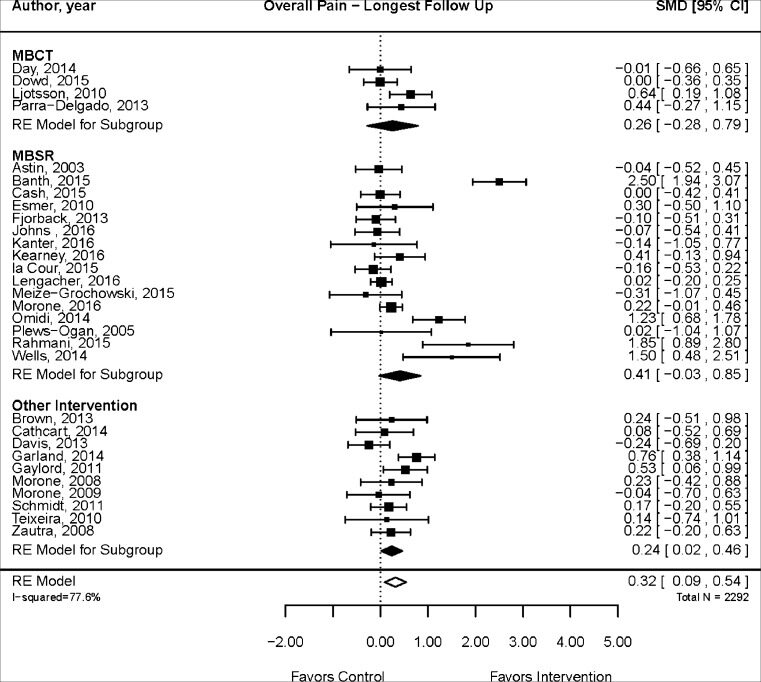
The figure shows why the authors were cautious. Most trials found little or no difference, while a few found very large ones, and the gap between them was far bigger than chance would explain (
heterogeneity
In a meta-analysis, heterogeneity is how much the results of the pooled studies differ from one another beyond what chance alone would produce, for example because they enrolled different people or compared the treatment with different things. It is often summarized by the I² statistic, the share of the variation due to real differences between studies; values of 50% or more are usually read as substantial. High heterogeneity makes a single pooled number harder to interpret.
More on Wikipedia
Read more in the glossary
, I² = 77.6%). The four largest effects ranged from 1.23 to 2.50, and three of those four trials had been rated poor quality. When the team kept only the 19 trials rated fair or good, the benefit was still statistically significant but shrank to 0.19 (0.03 to 0.34), and the trials agreed more closely.
Timing mattered too. At follow-ups of 12 weeks or less, the effect was not statistically significant (0.25, 15 trials); beyond 12 weeks it was (0.31, 14 trials). The main analysis showed no sign of
publication bias
Publication bias arises when studies with positive or striking results are more likely to be published than studies that find nothing. A meta-analysis that pools only published studies can then overestimate how well a treatment works. Researchers check for it with tools such as funnel plots and Egger’s test, which need a reasonable number of studies to be informative.
Read more in the glossary
, but in these timing analyses one of two tests suggested it. Taking inconsistency, heterogeneity and possible publication bias together, the authors rated the evidence for pain as low quality at both short and long follow-up. Their summary:
In sum, mindfulness meditation was associated with a small effect of improved pain symptoms compared with treatment as usual, passive controls, and education/support groups in a meta-analysis of 30 randomized controlled trials. However, there was evidence of substantial heterogeneity among studies and possible publication bias resulting in a low quality of evidence.
Low quality, in GRADE’s terms, means the true effect could be substantially different from the estimate.
Miscellaneous Interesting Takeaways
Depression and Quality of Life Also Improved
The secondary outcomes told a similar story, with some differences in how far they could be trusted:
- Depression (12 trials): a small improvement of 0.15 (0.03 to 0.26). The trials agreed closely, so the authors rated this evidence high quality. It is good evidence for a small effect.
- Mental health-related quality of life (16 trials): 0.49 (0.22 to 0.76), rated moderate quality.
- Physical health-related quality of life (16 trials): 0.34 (0.03 to 0.65), rated low quality, with results again varying widely between trials.
- Disability (4 trials): 0.30 (−0.02 to 0.62), which fell just short of statistical significance and was rated low quality because there were so few participants.
The Type of Program and Condition Didn’t Seem to Matter
The authors checked whether the effect on pain depended on the kind of program, the condition, the length or frequency of sessions, whether mindfulness was given alone or alongside other treatment, or the type of comparison group. None of these made a statistically significant difference. MBSR did no better than MBCT or the other programs, and back pain, headache and fibromyalgia did no better or worse than other conditions. With only a few trials in some of these groups, though, real differences could have gone undetected.
Most Control Groups Weren’t Matched for Time and Attention
Because the main analysis pooled usual care, waitlists and education or support groups, it can’t separate the effect of meditation itself from the general benefits of joining a weekly group, getting attention from an instructor and expecting to improve. The authors make this point in their call for better trials:
In order to detect intervention specific effects, studies need to have attention-matched controls.
An earlier review by Goyal and colleagues did restrict itself to trials with an
active control group
An active control group is a comparison group that takes part in a different program designed to be just as engaging as the one being tested. In meditation research, it might involve exercise, music, or education classes with the same time commitment, teachers, and expectations of benefit. Comparing against an active control helps separate the effects of meditation itself from the general effects of joining a course.
More on Wikipedia
Read more in the glossary
and reached a similar figure for pain (0.33), but that estimate came from just four trials, and the benefit varied by condition. A later and much larger review by Goldberg and colleagues found mindfulness better than no treatment for pain conditions but no different from other therapies. Hilton’s review cites Goyal’s only in passing, for stress, and doesn’t say how far the trials overlap.
Little Is Known About Pain Medication or Side Effects
Only four trials reported on the use of pain medication, and the results were mixed. One trial of MBSR for pain after failed back surgery found that participants cut their use of painkillers more than the control group did, while two back-pain trials found no difference. The fourth was an early trial of Mindfulness-Oriented Recovery Enhancement (
MORE
Mindfulness-Oriented Recovery Enhancement (MORE) is an 8-week group program developed by the social work researcher Eric Garland for addiction, stress and chronic pain, including opioid misuse. It combines mindfulness meditation with reappraisal (reframing unhelpful thoughts, a technique from cognitive behavioral therapy) and savoring (deliberately dwelling on pleasant experiences). Its aim is to shift the brain’s reward system from valuing drugs back toward valuing natural rewards.
More on Wikipedia
Read more in the glossary
) in people with chronic pain who were misusing prescribed opioids. Right after treatment, MORE participants were more likely to no longer meet criteria for
opioid use disorder
Opioid use disorder is the medical term for opioid addiction: a pattern of opioid use, whether of prescribed painkillers, heroin or other opioids, that a person struggles to control and that causes significant harm or distress. Signs include strong cravings, needing more to get the same effect, and continuing to use despite problems at home, work or with health. It is usually treated with medications such as buprenorphine or methadone, often alongside counseling.
More on Wikipedia
Read more in the glossary
, but the difference had faded three months later. A later, larger trial of MORE followed people for nine months.
Side effects were barely measured. Four trials said no adverse events occurred. In one, two participants felt temporary strong anger toward their pain condition and two felt more anxious, and two others recorded mild side effects from yoga and progressive muscle relaxation. The authors are blunt about what this does and doesn’t show:
However, only 7 of the 38 included RCTs mentioned whether adverse events were monitored and collected. Thus quality of evidence for adverse events reported in RCTs is inadequate for a comprehensive assessment.
They note published reports of adverse events during meditation, including psychosis, and they ask future trials to collect this information actively.
The Trials Had Many Weaknesses
Thirteen of the 38 trials were rated poor quality, mostly because they didn’t analyze everyone who was randomized (
intention-to-treat analysis
An intention-to-treat analysis counts every randomized participant in the group they were assigned to, whether or not they completed or even started the treatment. It keeps the benefit of randomization, since dropping people who didn’t follow their plan can leave groups that differ in other ways, and it estimates what happens when a treatment is offered in practice rather than when it is taken exactly as intended.
More on Wikipedia
Read more in the glossary
), lost too many participants to follow-up or described their methods poorly. Fifteen trials randomized fewer than 50 people, ten described themselves as underpowered pilot studies, and ten more didn’t report a power calculation. Pain was measured with scales and questionnaires that participants filled in themselves. The review itself relied on published data only, without contacting trial authors, and included only English-language papers.
Final Reflection
This review gives a fair snapshot of mindfulness for chronic pain as of 2016. Across 30 trials, mindfulness programs reduced pain a little more than usual care, waitlists or education groups did, and they improved depression and mental health-related quality of life too. But the pain effect was small, it shrank when the weakest trials were set aside, and it rested on trials that disagreed widely with one another. The authors’ own verdict is that the quality of evidence for pain is low.
That doesn’t mean mindfulness fails people in pain. The evidence that it eases depression, if only slightly, was rated high quality, many trials gave it alongside usual care rather than instead of it, and, as the authors note, people with chronic pain increasingly seek it out. What the review can’t yet say is how much of the benefit comes from meditation itself, rather than from joining a supportive weekly group, or whether mindfulness does better than established psychological treatments for pain. Answering those questions needs the large, well-controlled trials with long follow-up that the authors call for.
Citation
Hilton, L., Hempel, S., Ewing, B. A., Apaydin, E., Xenakis, L., Newberry, S., Colaiaco, B., Maher, A. R., Shanman, R. M., Sorbero, M. E., & Maglione, M. A. (2017). Mindfulness meditation for chronic pain: Systematic review and meta-analysis. Annals of Behavioral Medicine, 51(2), 199–213. 10.1007/s12160-016-9844-2
Get the next summary by email
One or two new paper summaries every couple of weeks, sent to your inbox when they go up.
No spam, and you can unsubscribe at any time. Prefer a feed reader? Use the RSS feed.