
Background Information
Back pain is one of the most common problems of old age. The paper cites a national survey of Americans 65 and older in which 52.9% reported pain, most often in the back, and those in pain had poorer physical function than those without. Treating it is hard at that age. Anti-inflammatory drugs and opioids carry side effects that older adults tolerate poorly, and with few options, doctors may turn to invasive procedures that may be “of limited benefit.” More treatments that don’t rely on drugs are needed.
mindfulness
Mindfulness is the psychological process of purposely bringing one’s attention to experiences occurring in the present moment without judgment. It involves maintaining awareness of thoughts, feelings, bodily sensations, and surrounding environment with an attitude of curiosity and acceptance. In meditation contexts, mindfulness practices typically involve focusing attention on the breath or body sensations as anchors to the present moment while acknowledging and releasing distracting thoughts.
More on Wikipedia
Read more in the glossary
meditation is one candidate. A 2014 review of randomized trials found that mindfulness programs eased pain a little more than programs matched for time and attention, but mostly visceral pain, such as that of irritable bowel syndrome; for musculoskeletal pain, the benefit was not clinically significant (Goyal et al., 2014). As the authors point out, that verdict rested on only two small studies, one of them their own pilot trial in older adults with back pain.
The team’s earlier pilot studies had shown that an 8-week mindfulness program was workable for older adults and hinted that it might reduce pain and improve function. This trial was the full-size test. The team predicted that, compared with a health education course, mindfulness would bring a clinically meaningful improvement in physical function by the end of the program, with less pain and better psychological well-being, and that these gains would still be there 6 months later.
What They Did
Between 2011 and 2014, the researchers screened 1,160 people in and around Pittsburgh, Pennsylvania, and enrolled 282. To take part, people had to be 65 or older, live independently, pass a test of memory and thinking, and have had moderate back pain daily or almost daily for 3 months or more. The pain also had to limit their daily lives: a score of 11 or more out of 24 on the Roland and Morris Disability Questionnaire (RMDQ), which asks about everyday tasks that back pain makes harder. People were excluded if they had done a mindfulness program before, if a serious illness such as cancer was causing their pain, if they had worse pain elsewhere in the body, or if they had moderate to severe symptoms of depression.
The participants averaged 74.5 years old and had lived with back pain for about 11 years on average. Two-thirds were women, and 80 (28.4%) were African American, which the authors note is unusual for mind–body studies that don’t specifically set out to recruit minorities.
In this
randomized controlled trial
A Randomized Controlled Trial is a scientific study design that randomly assigns participants to either an experimental group receiving an intervention or a control group, allowing researchers to measure the true effect of the intervention while minimizing bias.
More on Wikipedia
Read more in the glossary
, 140 people were assigned to the mindfulness program and 142 to an
active control
An active control group is a comparison group that takes part in a different program designed to be just as engaging as the one being tested. In meditation research, it might involve exercise, music, or education classes with the same time commitment, teachers, and expectations of benefit. Comparing against an active control helps separate the effects of meditation itself from the general effects of joining a course.
More on Wikipedia
Read more in the glossary
. The paper calls the mindfulness program a “mind-body program.” Modeled on
Mindfulness-Based Stress Reduction (MBSR)
Mindfulness-Based Stress Reduction (MBSR) is a program designed to help individuals cope with stress, pain, and illness. Developed by Jon Kabat-Zinn in the 1970s, it combines meditation and yoga to promote awareness and stress management. The eight-week program teaches participants to focus on the present moment non-judgmentally, enhancing their ability to manage difficulties.
More on Wikipedia
Read more in the glossary
, it met in groups for 90 minutes once a week for 8 weeks and taught four practices: the
body scan
The body scan is a meditation practice in which attention is moved slowly through the body, part by part, noticing whatever sensations are present without trying to change them. It is a core exercise in mindfulness programs such as MBSR.
More on Wikipedia
Read more in the glossary
, sitting meditation, walking meditation and mindful stretching. Six monthly 60-minute booster sessions followed, each with a meditation and a discussion.
The control group took an 8-week group course based on the 10 Keys to Healthy Aging, a curriculum on health topics for older adults, such as managing high blood pressure. It was matched to the mindfulness program for time, group size, attention, homework and instructor time, and it had its own monthly booster classes. Both groups learned the same chair stretches. The course included nothing about pain, which the researchers deliberately left out so that the control group wouldn’t be getting a treatment for pain of its own.
The main outcome was the RMDQ score. On this scale, an improvement of 2.5 to 5.0 points counts as a
clinically meaningful change
The minimal clinically important difference is the smallest change in a score that patients would notice and consider worthwhile. It is set separately for each questionnaire or scale, often by asking patients whether they feel better and seeing how much their scores changed. A result can be statistically significant yet smaller than this threshold, which means it may be real but too small to matter much in daily life.
More on Wikipedia
Read more in the glossary
, and the trial was sized to detect a difference of 2.5 points between the groups. Participants also rated their current pain, their average pain over the past week and their worst pain over the past week, on a scale from 0 to 20 (rather than the more common 0 to 10). Secondary measures included quality of life, depressive symptoms,
pain self-efficacy
Self-efficacy is a person’s confidence in their ability to do what a situation calls for, a concept developed by the psychologist Albert Bandura. In pain research it usually means confidence in being able to manage pain and keep up daily activities despite it. People with chronic pain who have higher self-efficacy tend to be less disabled and less distressed by their pain.
More on Wikipedia
Read more in the glossary
(confidence in being able to manage pain), pain catastrophizing (a tendency to dwell on pain and feel helpless about it) and a questionnaire measure of everyday mindfulness. Everyone was assessed before the programs, when they ended at 8 weeks, and again 6 months after that, by staff who didn’t know who was in which group. The analyses were
intention-to-treat
An intention-to-treat analysis counts every randomized participant in the group they were assigned to, whether or not they completed or even started the treatment. It keeps the benefit of randomization, since dropping people who didn’t follow their plan can leave groups that differ in other ways, and it estimates what happens when a treatment is offered in practice rather than when it is taken exactly as intended.
More on Wikipedia
Read more in the glossary
.
One Big Result: A Small Edge in Daily Function at 8 Weeks That Was Gone by 6 Months
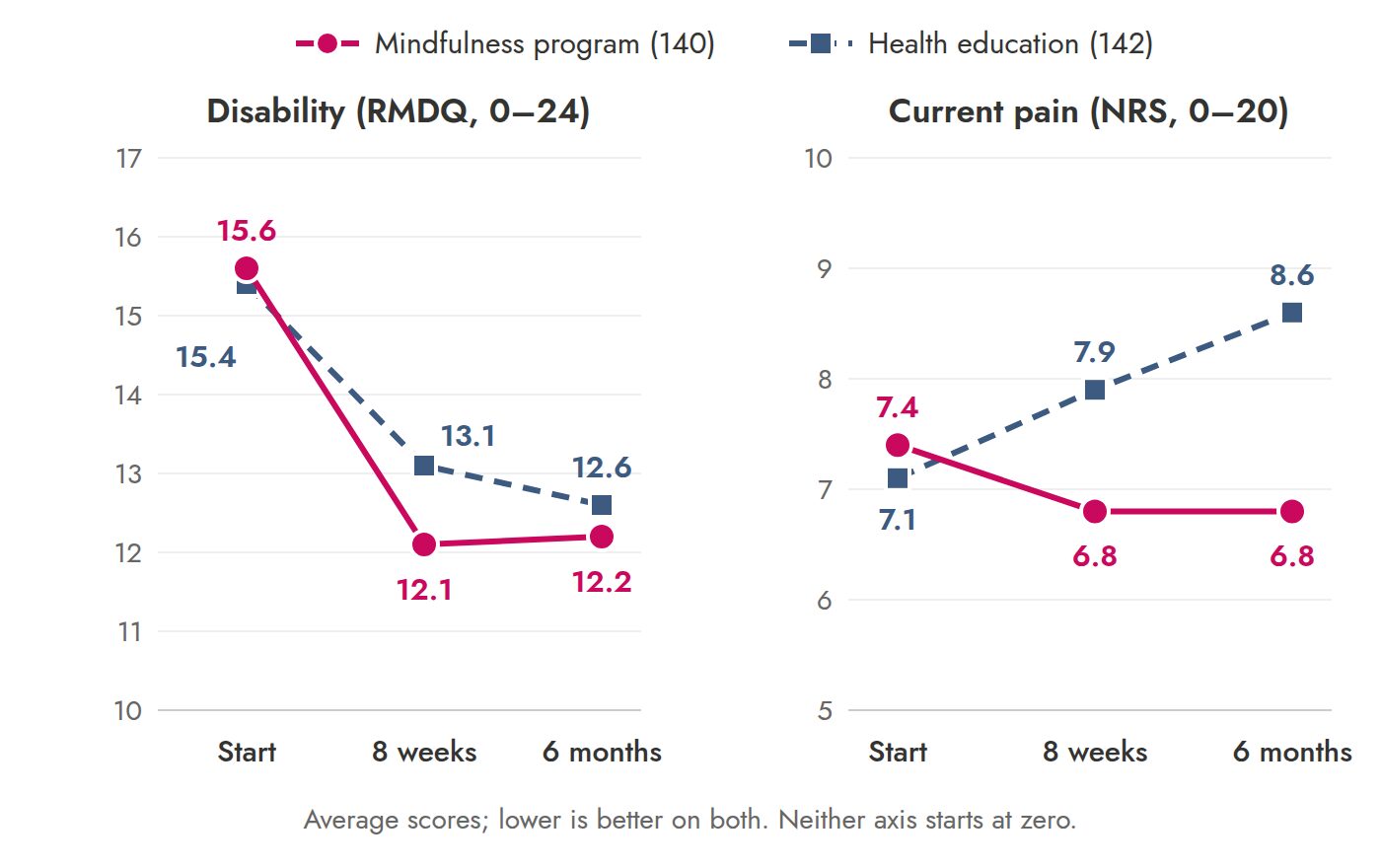
Both groups started with similar RMDQ scores (15.6 in the mindfulness group and 15.4 in the control group), and both improved. By the end of the 8-week programs, the mindfulness group’s score had fallen by 3.5 points and the control group’s by 2.3. In the trial’s adjusted analysis, the mindfulness group had improved 1.1 points more (95%
confidence interval
A confidence interval is the range of values that a study’s data are consistent with, given the uncertainty that comes from measuring a limited sample. A 95% confidence interval for an effect of 0.30 running from 0.00 to 0.59, for example, means the true effect could plausibly be anywhere from nothing to moderate. Narrower intervals mean more precise estimates; an interval that includes zero means the study can’t rule out no effect.
More on Wikipedia
Read more in the glossary
−2.1 to −0.01), a statistically significant but small difference (
effect size
Effect size is a statistical concept that quantifies the magnitude or strength of a relationship, difference, or intervention outcome. Unlike p-values which only indicate statistical significance, effect sizes measure how meaningful a result is in practical terms. Common measures include Cohen’s d (standardized mean difference), correlation coefficients (r), and odds ratios. In meditation research, effect sizes help quantify the practical impact of different meditation practices on psychological or physiological outcomes.
More on Wikipedia
Read more in the glossary
−0.23, where negative favors mindfulness). That is less than half of the 2.5-point difference the trial was designed to detect, the low end of what counts as clinically meaningful.
The difference didn’t last. Six months after the programs ended, the mindfulness group had improved by 3.4 points from the start and the control group had caught up, at 2.8 points, leaving a gap of 0.4 points (−1.5 to 0.7; effect size −0.08), too small to rule out chance. (The paper’s abstract gives this difference as −0.04, but its table and results section give −0.4.) The authors put it plainly:
Learning mindfulness resulted in a clinically meaningful mean RMDQ improvement of −3.4 points, but by 6 months, the comparison group had also improved by a mean of −2.8 points.
Counting people rather than averages tells the same story. At 8 weeks, 56.8% of the mindfulness group and 44.9% of the control group had improved by at least 2.5 points, a difference that just missed statistical significance (P = .051). At 6 months the shares were almost identical, 49.2% and 48.9%.
Miscellaneous Interesting Takeaways
Current Pain Was Lower in the Mindfulness Group at 6 Months
The pain results followed a different course from function: the clearest differences came later. Current pain in the mindfulness group dipped from 7.4 to 6.8 (on the 0–20 scale) and stayed there, while in the control group it rose from 7.1 to 7.9 and then 8.6. At 8 weeks the difference between the groups (−1.0 points, −2.3 to 0.2) could have been chance. By 6 months it was 1.8 points (−3.1 to −0.5), an effect size of −0.33. Part of that gap, then, came from the control group’s pain getting worse.
The paper’s abstract and key points say worst pain in the past week also improved significantly. That rests on the trial’s overall test of whether the groups changed differently over time (P = .04). At each assessment, the difference in worst pain was small, and its confidence interval included zero (−0.4 points at 8 weeks, −1.0 at 6 months). Average pain did not differ significantly overall (P = .08), though at 6 months it was 1.1 points lower in the mindfulness group (−2.2 to −0.01).
Counting people who improved by a meaningful amount gives the pain results more weight. More people in the mindfulness group reduced their current pain by at least 30%, both at 8 weeks (40.9% vs 24.6%) and at 6 months (44.4% vs 25.2%). The same was true of worst pain (36.4% vs 21.7% at 8 weeks, 35.9% vs 22.2% at 6 months), though not of average pain. The authors treat a 30% reduction as clinically meaningful, in line with what patients themselves count as successful pain relief.
Participants Felt Helped, but the Comparison Wasn’t Even
At the end of the programs, everyone was asked: “How much have your back symptoms changed as a result of the treatment provided in this study?” In the mindfulness group, 80.3% said their back symptoms had improved at least a little, compared with 37.0% in the control group, and 40.9% said they were much or very much better, compared with 6.5%. Six months later, 76.1% and 42.2% reported at least minimal improvement.
That is a large gap, but the question favored the mindfulness group: only its members had been taught a way of dealing with pain, while the control course never mentioned it. The authors acknowledge this:
Intervention participants received information on a mind-body approach to pain reduction, whereas the comparison group did not receive education about pain, which may have biased responses to measures.
At the start, both groups had rated their program as equally credible and equally likely to help their back pain. Still, everyone knew which program they were in, and every outcome in the trial was self-reported, so
demand characteristics
Demand characteristics are cues in an experiment that hint at what the researchers expect, which can lead participants to behave the way they think they are supposed to rather than how they normally would. Researchers reduce them by disguising the study’s purpose, measuring behavior unobtrusively, or using comparison conditions that seem just as plausible.
More on Wikipedia
Read more in the glossary
, people answering the way they sense is expected, can’t be ruled out.
Confidence in Managing Pain Rose, Then Evened Out
The biggest difference anywhere in the trial was in pain self-efficacy. At 8 weeks, the mindfulness group’s confidence in managing pain had risen 9.8 points more than the control group’s on a 0–100% scale (5.3 to 14.3), a medium effect size of 0.51. By 6 months the gap had shrunk to 3.5 points (−1.2 to 8.2), because the control group’s confidence had also risen. Quality of life and pain catastrophizing showed the same pattern on a smaller scale: slightly better scores in the mindfulness group at 8 weeks, none statistically significant on its own, and almost no difference by 6 months. The authors judged these changes not clinically meaningful. Depressive symptoms didn’t differ between the groups, but they were low to begin with.
Mindfulness Scores Didn’t Budge
The mindfulness questionnaire (the Mindful Attention Awareness Scale, scored 1 to 6) barely moved in either group: 4.6 at the start and 4.6 at 6 months in the mindfulness group, and 4.4 and 4.6 in the control group. The authors think the scale missed a real change:
In addition, mindfulness scores indicated a high level of self-reported mindfulness at baseline. This level of mindfulness is likely the reason why we did not see a significant difference between groups at program completion, despite qualitative reports by participants of increased mindfulness after learning to meditate.
That may be so, but it means the trial can’t show that the pain benefits came from people becoming more mindful.
Who Came and Who Stayed
Attendance at the weekly classes was good: an average of 6.6 of 8 sessions in each group. The monthly boosters were another matter, with people coming to an average of 2.4 (mindfulness) and 2.5 (control) of the 6. Nearly everyone was assessed at 8 weeks, but at 6 months, 84.3% of the mindfulness group were assessed, compared with 95.1% of the control group. The intention-to-treat analysis kept everyone, and the authors report that handling the missing data differently didn’t change the conclusion about function, but the uneven dropout is worth keeping in mind for the 6-month pain results. No harms related to either program were reported.
What the Design Can and Can’t Show
This was a carefully run trial by the standards of meditation research: large, publicly registered, with a control course matched for time and attention, assessors who didn’t know who was in which group, and good attendance. Funding came from the National Institutes of Health, and the authors report no conflicts of interest, though they developed the program in their own earlier pilot studies.
Its limits are those of most behavioral trials. Every outcome was self-reported by people who knew which program they had, and only the mindfulness group learned anything about pain. Three pain measures and several secondary outcomes were tested at two time points, and the paper doesn’t mention adjusting for the number of comparisons (
multiple comparisons
The multiple comparisons problem arises when researchers run many statistical tests at once. Each test has a small chance of a false positive, so across thousands of tests, such as one for every point in a brain scan, some “significant” results will turn up by chance alone. Corrections raise the bar for significance to keep the overall false-positive rate down, at the cost of making small real effects harder to detect.
More on Wikipedia
Read more in the glossary
), so the borderline results deserve caution. Partway through the trial, after 155 people had been assigned, the researchers noticed that the groups had become unbalanced by sex and switched to a randomization method that corrected for it. And the participants, mostly women from one region, with few depressive symptoms, may not represent all older adults with back pain.
Final Reflection
This trial asked a practical question: can a mindfulness course help older adults with long-term back pain do more in their daily lives? Its main outcome gives a modest answer: a little, and only briefly. Both groups improved by a clinically meaningful amount, and the mindfulness group’s extra improvement at 8 weeks was small and had disappeared by 6 months. The clearer differences were in pain: current pain was lower in the mindfulness group 6 months after the program, more of its members had their pain drop by 30% or more, and most of them said their back symptoms had improved, though the comparison course never addressed pain at all.
A later trial in younger and middle-aged adults with chronic low back pain found that MBSR’s benefit for function was still there a year later, but it compared MBSR with usual care, not a matched course, as well as with cognitive behavioral therapy, which did about as well (Cherkin et al., 2016). Its authors note that differences in age and comparison group could explain why the two trials’ results differ. In people whose chronic pain is complicated by opioid misuse, a mindfulness program that added reappraisal and savoring eased pain more than a support group, by similarly modest amounts.
Taken together with the earlier review, this trial suggests that mindfulness can help older adults with chronic back pain feel somewhat less pain, but not that it is a strong treatment for the disability that back pain causes. The authors suggest that future versions focus on making the gains in function last; they note that few participants came to the booster sessions meant to keep up their practice.
Citation
Morone, N. E., Greco, C. M., Moore, C. G., Rollman, B. L., Lane, B., Morrow, L. A., Glynn, N. W., & Weiner, D. K. (2016). A mind-body program for older adults with chronic low back pain: A randomized clinical trial. JAMA Internal Medicine, 176(3), 329–337. 10.1001/jamainternmed.2015.8033
Get the next summary by email
One or two new paper summaries every couple of weeks, sent to your inbox when they go up.
No spam, and you can unsubscribe at any time. Prefer a feed reader? Use the RSS feed.