
Background Information
Low back pain
Low back pain is pain between the bottom of the ribs and the buttocks, and a leading cause of disability worldwide. Most cases are called non-specific because no particular cause, such as a fracture, infection or nerve compression, can be found. Pain lasting more than three months is called chronic.
More on Wikipedia
Read more in the glossary
is one of the leading causes of disability in the United States. The authors point out that despite many treatment options and greatly increased spending on it, the functional status of Americans with back pain has actually worsened. This trial focused on “non-specific” back pain, which has no specific diagnosis to explain it.
Psychological factors shape how much pain bothers people and how much it limits their lives, and half of the non-drug treatments recommended for persistent back pain at the time had a “mind-body” component. One of these,
cognitive behavioral therapy
Cognitive behavioral therapy (CBT) is a structured, usually short-term talk therapy that helps people notice and change unhelpful patterns of thinking and behavior. It is one of the most thoroughly tested psychological treatments and a first-line option for depression, anxiety disorders and many other conditions.
More on Wikipedia
Read more in the glossary
(CBT), which teaches people to change unhelpful thoughts and behaviors around pain, has proven effective for various chronic pain conditions and is widely recommended for chronic low back pain, but access to it is limited.
Mindfulness-Based Stress Reduction (MBSR)
Mindfulness-Based Stress Reduction (MBSR) is a program designed to help individuals cope with stress, pain, and illness. Developed by Jon Kabat-Zinn in the 1970s, it combines meditation and yoga to promote awareness and stress management. The eight-week program teaches participants to focus on the present moment non-judgmentally, enhancing their ability to manage difficulties.
More on Wikipedia
Read more in the glossary
was becoming widely available, and it takes a different route: rather than changing thoughts about pain, it trains people to notice and accept moment-to-moment experience, including physical discomfort and difficult emotions.
Only one large trial had tested MBSR for chronic low back pain, and it was limited to adults aged 65 and over. This trial, the Mind-Body Approaches to Pain (MAP) trial, tested it in younger and middle-aged adults and compared it directly with CBT. The researchers expected MBSR to beat usual care, and also to beat CBT, because MBSR includes yoga, which had been found to help chronic low back pain.
What They Did
The researchers, from the Group Health Research Institute and the University of Washington, mailed invitations to members of Group Health, an integrated health care system in Washington State, whose medical records suggested they qualified, and to random samples of residents in the communities it served. Of 1,767 people screened by phone, 342 were enrolled between September 2012 and April 2014. All but 7 were Group Health members.
To qualify, people had to be 20 to 70 years old, with back pain that had lasted at least 3 months and wasn’t explained by a specific diagnosis such as spinal stenosis. They had to rate their pain’s bothersomeness at least 4 out of 10 and its interference with activities at least 3 out of 10. People with compensation claims or lawsuits over their back pain were excluded. Recruitment was slow, so after the first 99 participants the team relaxed some rules, admitting people aged 64 to 70, Group Health members without recent visits for back pain, and people with sciatica.
The participants averaged 49 years old, 66% were women, and 59% were college graduates. They had had back pain for 7.3 years on average, and most had felt it on at least 160 of the previous 180 days. Their pain was moderate: on average 6.0 out of 10 for bothersomeness. Eleven percent had taken opioids for their back pain in the past week, and 17% had at least moderate depression.
In this
randomized controlled trial
A Randomized Controlled Trial is a scientific study design that randomly assigns participants to either an experimental group receiving an intervention or a control group, allowing researchers to measure the true effect of the intervention while minimizing bias.
More on Wikipedia
Read more in the glossary
, 116 people were assigned to MBSR, 113 to CBT and 113 to usual care. People were told they would get one of “two different widely-used pain self-management programs” or usual care plus $50, and those in a program didn’t learn which one until their first session.
- MBSR met for 2 hours a week for 8 weeks, with an optional 6-hour retreat. It followed the original program closely, with a
body scan
The body scan is a meditation practice in which attention is moved slowly through the body, part by part, noticing whatever sensations are present without trying to change them. It is a core exercise in mindfulness programs such as MBSR.
More on Wikipedia
Read more in the glossary , yoga, sitting meditation with awareness of breathing, and walking meditation. It was taught by 8 instructors with 5 to 29 years of MBSR experience. - CBT had the same format and was led by 4 psychologists experienced in CBT for chronic pain. It covered education about chronic pain and how thoughts affect emotional and physical reactions, along with practice in challenging unhelpful thoughts, setting behavioral goals, relaxation techniques (abdominal breathing, progressive muscle relaxation and guided imagery), pacing activities and coping with pain.
- Usual care meant whatever medical care people would normally get. They were free to seek any treatment they liked, but got no program from the study.
As the authors note, MBSR is a general program rather than one built for back pain:
The MBSR program does not focus specifically on a particular condition such as pain.
Both programs came with workbooks, audio CDs and home practice. To keep the two programs distinct, mindfulness, meditation and yoga were banned from CBT, and challenging unhelpful thoughts was banned from MBSR. Sessions were recorded and checked against the protocols.
Interviewers who didn’t know people’s groups phoned them at 4, 8, 26 and 52 weeks. The trial had two co-primary outcomes, both judged at 26 weeks:
- Functional limitations: a modified version of the Roland Disability Questionnaire, 23 questions about how back pain had limited daily activities in the past week. Scores run from 0 to 23, higher meaning more limited, and participants started at 11.4 on average.
- Pain bothersomeness: how bothersome back pain had been in the past week, from 0 (not at all) to 10 (extremely).
For each, the main question was what share of people improved by at least 30% from where they started, a threshold for a clinically meaningful change.
All participants were analyzed in the group they were assigned to, however many sessions they attended (an
intention-to-treat analysis
An intention-to-treat analysis counts every randomized participant in the group they were assigned to, whether or not they completed or even started the treatment. It keeps the benefit of randomization, since dropping people who didn’t follow their plan can leave groups that differ in other ways, and it estimates what happens when a treatment is offered in practice rather than when it is taken exactly as intended.
More on Wikipedia
Read more in the glossary
analysis). Follow-up was lower than planned, and lower in the two program groups than in usual care, so the main analysis filled in missing answers with a statistical method designed for people whose reasons for dropping out might be related to how they were doing.
One Big Result: MBSR and CBT Each Helped More People Than Usual Care, and MBSR’s Advantage Held at a Year
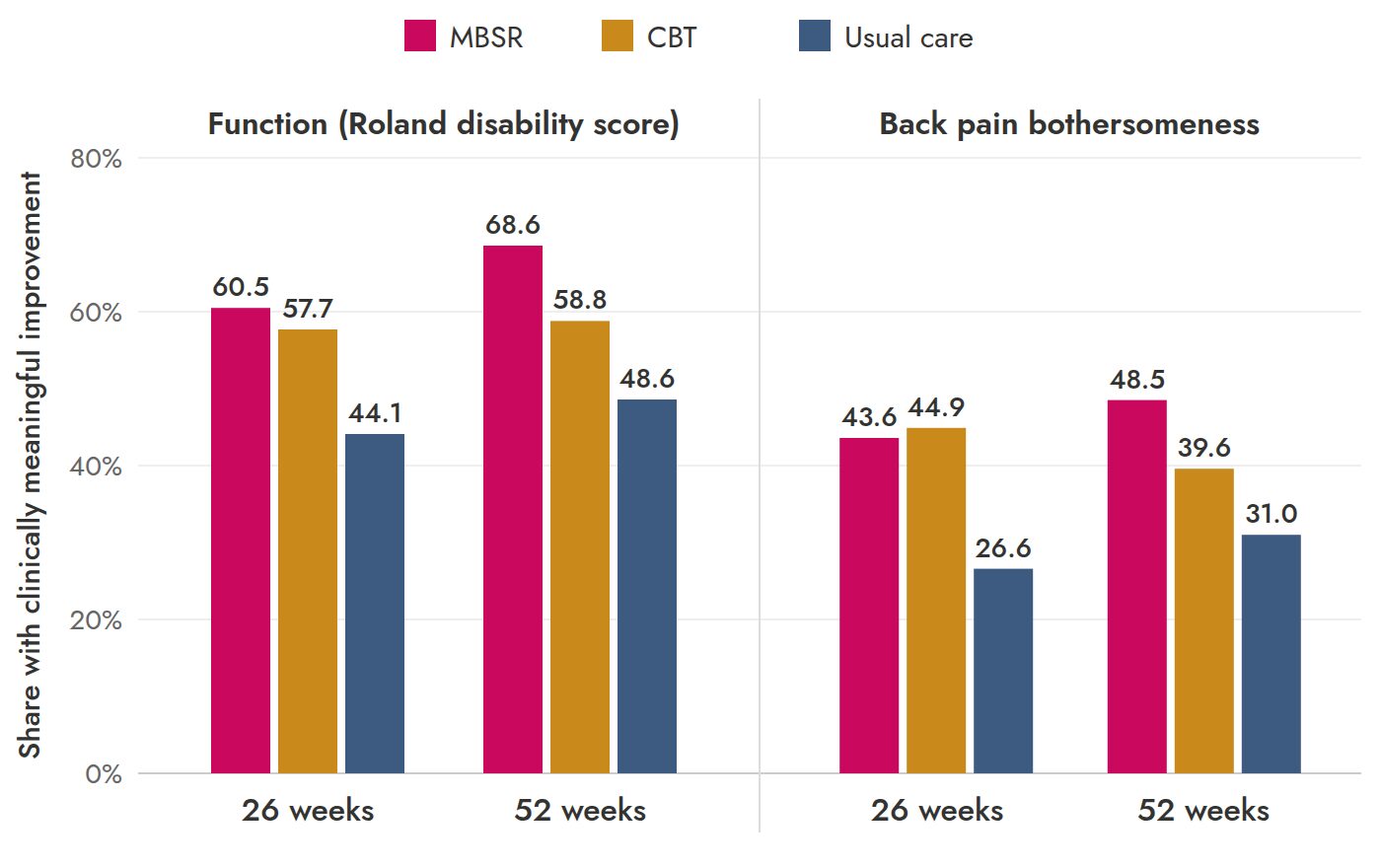
At 26 weeks, 60.5% of the MBSR group had a clinically meaningful improvement in function, compared with 57.7% of the CBT group and 44.1% of the usual care group. For pain bothersomeness, the figures were 43.6%, 44.9% and 26.6%. Put another way, for every 100 people offered MBSR, about 16 more had a meaningful gain in function, and 17 more a meaningful drop in how much their pain bothered them, than among 100 left to usual care.
In statistical terms, people in MBSR were 1.37 times as likely as those in usual care to improve meaningfully in function (
relative risk
A relative risk (or risk ratio) is the chance of an outcome in one group divided by the chance in another. A relative risk of 1 means no difference; 1.5 means the outcome was 50% more common in the first group. If 60% of one group improve and 40% of another, the relative risk is 1.5. Unlike an odds ratio, it can be read directly as how many times more likely something is.
More on Wikipedia
Read more in the glossary
1.37, 95%
confidence interval
A confidence interval is the range of values that a study’s data are consistent with, given the uncertainty that comes from measuring a limited sample. A 95% confidence interval for an effect of 0.30 running from 0.00 to 0.59, for example, means the true effect could plausibly be anywhere from nothing to moderate. Narrower intervals mean more precise estimates; an interval that includes zero means the study can’t rule out no effect.
More on Wikipedia
Read more in the glossary
1.06–1.77) and 1.64 times as likely for pain bothersomeness (1.15–2.34). CBT did about as well (1.31 and 1.69 compared with usual care). MBSR and CBT were statistically indistinguishable (relative risks of 0.95 and 1.03), so the researchers’ expectation that MBSR would beat CBT wasn’t borne out.
At 52 weeks, MBSR was still ahead of usual care, by a similar margin: 68.6% versus 48.6% for function, and 48.5% versus 31.0% for pain bothersomeness. CBT’s advantage over usual care on these two measures had narrowed (58.8% and 39.6%) and was no longer statistically significant, although MBSR and CBT still didn’t differ significantly from each other. When the outcomes were analyzed as average scores rather than shares of people improving, CBT did still beat usual care at 52 weeks.
Neither program had a clear effect at 4 weeks, halfway through the course. Differences began to appear by the end of the course at 8 weeks, and for MBSR they were at least as large at 26 and 52 weeks. The authors contrast this with their own earlier trials of acupuncture, massage and yoga in the same population, where benefits faded after treatment stopped, and suggest that MBSR and CBT may teach lasting skills for managing pain.
The average changes were modest. At 26 weeks, the MBSR group’s function score had improved by 4.3 points on the 23-point scale, compared with 3.0 points in usual care, and their pain bothersomeness by 1.5 points out of 10, compared with 0.8. The authors call the effects “moderate in size,” typical of the treatments recommended for chronic low back pain.
Miscellaneous Interesting Takeaways
Only About Half Came to Most Sessions
Almost 90% of those assigned to MBSR or CBT went to at least one session, but only 51% of the MBSR group and 57% of the CBT group attended at least 6 of the 8, and only 26% of the MBSR group went to the retreat. Because the analysis counted everyone assigned to a program, the results show what happened when people were offered a course, not what a full course does. The authors see the low attendance as making the results more impressive:
These benefits are remarkable given that only 51% of those randomized to MBSR and 57% of those randomized to CBT attended ≥6 of the 8 sessions.
That is one reading. Another is that it limits what the trial can say about how much of the program people need, which the authors list among the questions for future research.
Usual Care Is a Low Bar
The comparison group got nothing from the study except $50, and they knew it. So the trial can’t tell whether MBSR’s benefit came from mindfulness and yoga specifically or from what any weekly group course provides: an instructor’s attention, the company of others with back pain, and the expectation of getting better. Every outcome was also reported by participants who knew which group they were in, which could make people in a program report more improvement than people left out. The interviewers were blind to group, but they recorded what participants told them. The authors acknowledge the gap:
Although our trial lacked a condition controlling for nonspecific effects of instructor attention and group participation, CBT and MBSR have been shown to be more effective than control and active interventions for pain conditions.
The earlier trial of MBSR in older adults did compare it with a health education course matched for time and attention, and found less consistent benefits than this trial: better function right after the course but not 6 months later, and less average pain at 6 months but not right after the course. The authors note that the two trials differed in participants’ ages as well as in their comparison groups. A broader review of 47 trials with matched comparison programs found that mindfulness programs eased pain slightly more than the comparison programs.
CBT, an established treatment, is a much tougher comparison than usual care, and MBSR matched it. But a trial that finds no significant difference hasn’t proven the two are equal. The trial was designed to detect a fairly large difference between MBSR and CBT (20% in the share improving in function), so it could have missed smaller ones. A later meta-analysis of 142 trials found the same pattern across many conditions, including pain: mindfulness treatments beat no treatment but on average matched established therapies such as CBT.
CBT Did More for Mood
The sample wasn’t very distressed to begin with, but CBT improved depression, anxiety and mental well-being more than usual care at 8 and 26 weeks. MBSR beat usual care on these only at 8 weeks (on depression and the mental health score), and CBT beat MBSR on depression at 8 weeks and anxiety at 26 weeks, though the authors describe the depression difference as small. None of these differences remained at 52 weeks. The authors suggest comparing the two programs in more distressed patients.
On other measures, both programs reduced average pain intensity more than usual care at 8, 26 and 52 weeks, and more people in both said their pain was “much better” or “completely gone” at 26 and 52 weeks (26% in MBSR and 30% in CBT, versus 14% in usual care, at 26 weeks). The groups didn’t differ in how many people used medication for their back pain, or in the physical health score of a general health survey.
Yoga Sometimes Hurt, Temporarily
Of the 103 people who attended at least one MBSR session, 30 (29%) reported an adverse experience, mostly a temporary increase in pain during yoga. In CBT, 10 of 100 (10%) did, mostly a temporary increase in pain during progressive muscle relaxation. There were no serious adverse events.
A Note on the Authors’ Summary
The discussion section says that both MBSR and CBT led to greater improvement in pain and function than usual care “at 26 and 52 weeks.” That holds for MBSR. For CBT at 52 weeks, it holds for the average scores but not for the trial’s primary measure, the share of people who improved meaningfully, where CBT’s advantage over usual care was no longer statistically significant. Since CBT and MBSR didn’t differ significantly from each other at 52 weeks either, this doesn’t show that MBSR outlasted CBT.
Who Took Part
The participants came from one health care system and were mostly well educated and White (over 80%), and people were excluded if they couldn’t attend classes at set times and places. The authors note that the results may not apply to other settings and populations, or to CBT given one-to-one rather than in groups, which may be more effective. The trial was funded by the US National Institutes of Health, which had no role in its design, analysis or reporting, and the authors reported no conflicts of interest.
Final Reflection
This was a well-run trial: large, registered, with a prespecified analysis, blinded interviewers and a year of follow-up. Its central finding is practical. For adults with long-standing back pain, being offered an 8-week MBSR course, which isn’t designed specifically for pain, led to meaningful improvements in function and pain bothersomeness for more people than usual care, and the advantage was still there a year later. It did about as well as group CBT, the established psychological treatment, which matters because MBSR courses were becoming widely available while access to CBT is limited.
What the trial can’t show is how much of the benefit came from mindfulness itself rather than from joining a supportive weekly group with an expectation of improvement, since the comparison was usual care and the outcomes were self-reported. The improvements were also moderate, not dramatic: on average about 1.5 points less pain bothersomeness out of 10 at 26 weeks, against 0.8 with usual care. Together with trials such as the one of a mindfulness program for people with chronic pain who misuse opioids, it suggests that mindfulness training is a reasonable option for chronic pain, though this trial puts it alongside CBT rather than ahead of it.
Citation
Cherkin, D. C., Sherman, K. J., Balderson, B. H., Cook, A. J., Anderson, M. L., Hawkes, R. J., Hansen, K. E., & Turner, J. A. (2016). Effect of mindfulness-based stress reduction vs cognitive behavioral therapy or usual care on back pain and functional limitations in adults with chronic low back pain: A randomized clinical trial. JAMA, 315(12), 1240–1249. 10.1001/jama.2016.2323
Get the next summary by email
One or two new paper summaries every couple of weeks, sent to your inbox when they go up.
No spam, and you can unsubscribe at any time. Prefer a feed reader? Use the RSS feed.