
Background Information
Pain has two sides. One is how strong a sensation is: how hot, how sharp. The other is how much it bothers us. Pain researchers measure them separately, as intensity and unpleasantness, and the two can come apart. Research on
pain catastrophizing
Pain catastrophizing is a tendency to magnify the threat of pain, dwell on it and feel helpless in the face of it, for example by thinking that it will never stop or that something terrible is wrong. People who catastrophize tend to report more severe pain and more distress and disability from it.
More on Wikipedia
Read more in the glossary
, the habit of magnifying the threat of pain and dwelling on it, suggests that what we add to a sensation in our heads can make it hurt more.
Mindfulness programs such as
MBSR
Mindfulness-Based Stress Reduction (MBSR) is a program designed to help individuals cope with stress, pain, and illness. Developed by Jon Kabat-Zinn in the 1970s, it combines meditation and yoga to promote awareness and stress management. The eight-week program teaches participants to focus on the present moment non-judgmentally, enhancing their ability to manage difficulties.
More on Wikipedia
Read more in the glossary
have helped people with chronic pain, but they mix many ingredients: breath awareness, body scans, walking meditation, stretching, group discussion and a teacher. That makes it hard to say what does the work. The authors focus on two styles of attention found in these programs. In
focused attention
Focused attention is a style of meditation in which you keep your attention on one chosen object, such as the breath or a point in front of you, notice when the mind has wandered, and bring it back. It trains steady concentration, and Buddhist shamatha practice is a well-known example. Researchers often contrast it with open monitoring meditation.
Read more in the glossary
meditation, you hold your attention on one chosen object and bring it back when it strays. In
open monitoring
Open monitoring is a style of meditation in which attention isn’t fixed on any one object. You stay aware of whatever arises from moment to moment, such as sounds, sensations and thoughts, and let each come and go without reacting to it, holding on to it or pushing it away. Researchers often contrast it with focused attention meditation.
Read more in the glossary
meditation, you rest in a non-reactive awareness of whatever is happening, without focusing on anything in particular.
The two styles might relieve pain in different ways. Pointing attention away from pain is a form of distraction, which earlier studies found can lower both the intensity and the unpleasantness of pain. Open monitoring doesn’t push the pain away at all. Its promise is to cut down the mental commentary that piles on top of the sensation. The authors made a specific prediction:
…we would expect painful stimuli presented during a strong OM state to be perceived with normal or even increased intensity, due to the emphasis on open receptivity to sensory input; but with reduced unpleasantness, due to the emphasis on reduction of cognitive and affective elaboration of sensory input.
Beginners can’t easily hold either state firmly, so the researchers turned to people who had practiced for decades.
What They Did
The experts were 9 long-term practitioners in the Kagyu and Nyingma traditions of Tibetan Buddhism, each with at least 10,000 hours of formal meditation and up to 45,000. Some had practiced since early childhood, and some came to the lab from up to eleven years of retreat. The comparison group was 10 people from the local community with no meditation experience, matched for age (about 48 and 47 on average) and sex (5 men in each group). The novices got written instructions in both practices and were asked to practice at home for 30 minutes a day for a week before the experiment.
The focused attention practice, known in Tibetan as shiné (similar to
Shamatha
Shamatha (Pali samatha, “calm abiding”) is a Buddhist family of concentration practices that train attention to settle and stay on a chosen object, such as the sensations of the breath. Practitioners notice when the mind has wandered and bring it back, aiming for attention that is both stable and vivid. It is often paired with vipassana, or insight, practice.
More on Wikipedia
Read more in the glossary
), was aimed at a fixation cross on a screen, so attention was directed away from the pain. The open monitoring practice was one specific to the experts’ tradition, which the researchers called “Open Presence.” Its instructions ask the meditator to let sensations “be as they are, without engaging into them or rejecting them.”
Each person first found the temperature they rated 8 on a 0–10 pain scale, which came out between 46°C and 49°C. Lying in an
fMRI
An fMRI (functional Magnetic Resonance Imaging) measures changes in blood flow related to neural activity in the brain, offering insights into brain function and activity patterns.
More on Wikipedia
Read more in the glossary
scanner, they then did 32 trials, each cued as focused attention or Open Presence. They had 45 seconds to settle into the practice before a probe on the inside of the left wrist warmed for 12 seconds and then delivered 10 seconds of either their painful temperature or a warm, non-painful one six degrees cooler. After each painful stimulus, they rated its intensity (“how hot was it”) and its unpleasantness (“how much did it bother you”), each from 0 to 10.
To keep the novices motivated, the researchers promised a $50 bonus to the four whose pain-related brain activity dropped most during meditation. Basing the bonus on brain activity rather than ratings was meant to avoid tempting anyone to shade their answers. This paper reports only the ratings: the brain scans were held back until more people had been tested.
One Big Result: During Open Presence, Experts Found the Pain Less Unpleasant
During Open Presence, the experts rated the painful heat as less unpleasant than the novices did, and less unpleasant than they themselves rated it during focused attention. Both differences were statistically significant: the gap with novices (p = 0.013) and, even more strongly, the drop between the experts’ two practices (p = 0.0001), a large
effect size
Effect size is a statistical concept that quantifies the magnitude or strength of a relationship, difference, or intervention outcome. Unlike p-values which only indicate statistical significance, effect sizes measure how meaningful a result is in practical terms. Common measures include Cohen’s d (standardized mean difference), correlation coefficients (r), and odds ratios. In meditation research, effect sizes help quantify the practical impact of different meditation practices on psychological or physiological outcomes.
More on Wikipedia
Read more in the glossary
.
Intensity told a quieter story. The experts’ intensity ratings were also lower in Open Presence than in focused attention (p = 0.019), but the change was smaller than for unpleasantness. In the authors’ words, they “found a considerably smaller effect on intensity than unpleasantness.” The overall pattern, with expertise and practice type affecting unpleasantness more than intensity, was statistically significant (a three-way interaction, p = 0.005).
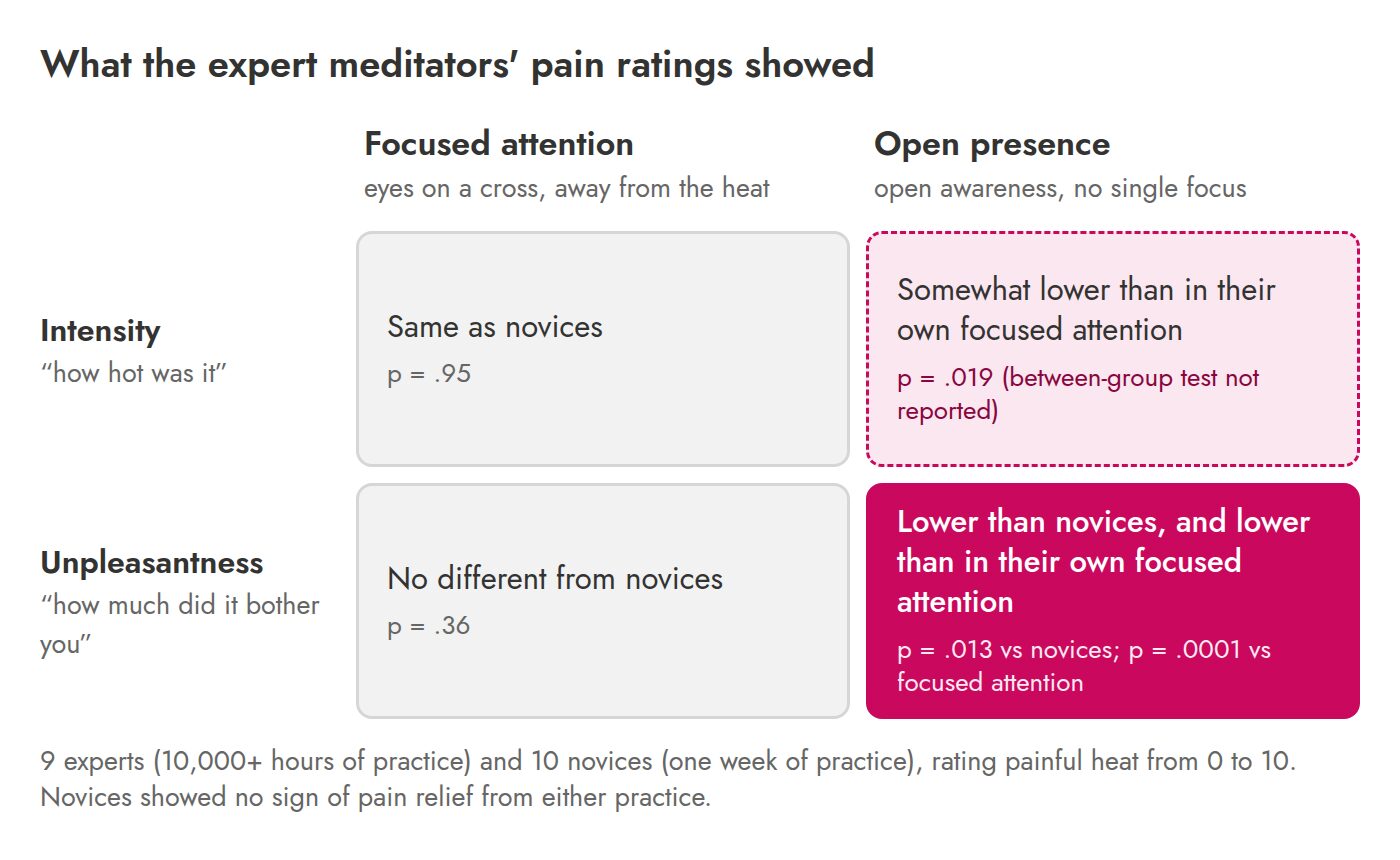
Focused attention made no measurable difference. The authors had expected experts aiming their attention at a cross to feel less pain on both scales, a kind of trained distraction. Instead, the two groups’ intensity ratings during focused attention were “virtually identical” (p = 0.95), and their unpleasantness ratings didn’t differ significantly (p = 0.36). Novices showed no pain relief from either practice.
The summary in the abstract, that experts had less unpleasantness “but not intensity,” is a little cleaner than the full results. The paper doesn’t report a direct comparison of the two groups’ intensity ratings during Open Presence, and the most targeted test, whether the experts’ advantage over novices during Open Presence was larger for unpleasantness than for intensity, fell short of significance (p = 0.083). The difference between the two kinds of rating shows up most clearly in how the experts’ ratings shifted between their two practices.
Miscellaneous Interesting Takeaways
Why Didn’t Focused Attention Work?
The authors offer several possible reasons. The experts may simply have been more skilled at Open Presence than at focused attention. A plain cross may also be a weak distraction: in earlier studies where distraction reduced pain, the distracting task was demanding or salient, whereas here everything depended on the meditator’s own control of attention. Participants knew they would rate the pain afterward, which may have kept part of their attention on it. And conversations with the experts turned up a surprise:
…informal discussion with some of the long-term practitioners revealed that some teachers in their tradition taught that the best way to regulate pain during Focused Attention practice would be to deliberately move the focus onto the affective response to the stimulus.
If some experts were used to turning toward their reaction to pain during focused attention, they may not have followed the instruction to look away from it.
A Close Cousin From Zen
The authors compare their results with a similar study by Grant and Rainville (2009) of Zen meditators. There too, novices got no pain relief from meditation and experts rated pain as less unpleasant during a mindfulness-type practice. The Zen experts’ intensity ratings dropped about as much as their unpleasantness, whereas here the drop in intensity was considerably smaller, which the authors suggest may reflect subtle differences between the practices. Together, they argue, the two studies suggest that the regulatory processes in open, non-judgmental awareness may matter more for meditation’s effects on pain than control of attention as such.
The Same Lab Followed Up With Brain Scans
The scanner data from this experiment were set aside, the authors explain, until the sample grew. A few years later the same lab published brain imaging from 14 experts and 14 novices practicing Open Presence during painful heat, using the same trial structure (Lutz et al., 2013), and described this paper as its “preliminary behavioral report.” In that larger group, experts again rated the pain as less unpleasant but just as intense, and their brains showed less activity in the salience network and amygdala before the heat and stronger salience-network responses during it. The 2013 paper doesn’t say how many of its participants also appear here.
Were the Experts Just Trying Harder?
Lifelong practitioners have a stake in showing that their practice works, and the authors acknowledge that a $50 bonus is “unlikely to match the motivation of life-long practitioners.” That kind of
demand characteristic
Demand characteristics are cues in an experiment that hint at what the researchers expect, which can lead participants to behave the way they think they are supposed to rather than how they normally would. Researchers reduce them by disguising the study’s purpose, measuring behavior unobtrusively, or using comparison conditions that seem just as plausible.
More on Wikipedia
Read more in the glossary
is a real concern when the outcome is a rating people give themselves. The authors’ best answer is that the experts’ advantage appeared in only one of the two practices, even though meditation traditions say both can ease pain. If the experts were simply eager to please, they would presumably have rated pain lower in both. Still, the authors stress that self-reports like these need to be backed up by other kinds of data before strong claims can be made.
Some Gaps in the Design
There was no plain, non-meditating condition, so the study can’t say how either group would have rated the heat at rest. Scholars of these practices had told the authors that experts this practiced tend to slip into meditation whenever nothing else is asked of them, and scanner time was limited. Because everyone’s temperature was calibrated outside meditation to feel like an 8 out of 10, they argue the two groups would probably have rated the heat similarly without meditating. The order of practices also wasn’t counterbalanced across people; the first painful stimulus always came during focused attention and the last during Open Presence. Re-running the analysis without those two trials changed none of the results. One expert had been diagnosed with fibromyalgia nearly 20 years earlier, and leaving that person out also changed nothing.
Final Reflection
This small study made a useful distinction. Meditation isn’t one thing, and in these experts only the open, non-reactive style changed how pain felt, and it changed how much the pain bothered them more than how hot it seemed. That fits the old Buddhist image of the second arrow: the sensation arrives either way, but the suffering added on top of it can be reduced.
The evidence is still thin. Nine experts and ten novices were compared once, using ratings they gave themselves, and people who spend decades meditating may differ from others in many ways besides practice. The authors are clear about what would settle it:
…conclusive establishment of the effectiveness of these practices will require future studies with random assignment of novices to meditation and control groups, and longitudinal monitoring as expertise develops.
Read alongside the larger brain-imaging study from the same lab, it makes a consistent case that long-term open monitoring practice goes with pain that bothers people less. Whether training produces that effect, and how much practice it takes, are questions for randomized trials.
Citation
Perlman, D. M., Salomons, T. V., Davidson, R. J., & Lutz, A. (2010). Differential effects on pain intensity and unpleasantness of two meditation practices. Emotion, 10(1), 65–71. 10.1037/a0018440
Get the next summary by email
One or two new paper summaries every couple of weeks, sent to your inbox when they go up.
No spam, and you can unsubscribe at any time. Prefer a feed reader? Use the RSS feed.