
Background Information
Most smokers want to quit, but the authors cite figures that fewer than 5% manage it in a given year. One reason is that reminders of smoking are everywhere, and seeing someone light up, or even a picture of a cigarette, can set off a strong urge. In brain-imaging studies of this
cue reactivity
Cue reactivity is the set of reactions that reminders of a drug, such as the sight of a cigarette, a bottle or a syringe, set off in someone who uses it: craving, bodily changes such as in heart rate and sweating, and activity in the brain’s reward circuits. Researchers measure it by showing such cues in the lab; stronger reactions have been linked to a higher risk of relapse.
More on Wikipedia
Read more in the glossary
, one area that reliably responds to smoking pictures is the
posterior cingulate cortex (PCC)
The posterior cingulate cortex (PCC) is a region toward the back of the brain’s midline. It is a central hub of the default mode network and tends to be active during self-related thought and mind-wandering. Many meditation studies track PCC activity or connectivity as a window onto the DMN.
More on Wikipedia
Read more in the glossary
, a hub of the
default mode network
The default mode network (DMN) is a system of connected brain areas that show increased activity when a person is not focused on what is happening around them, such as during daydreaming and mind-wandering. It can also be active when the individual is thinking about others or themselves, remembering the past, and planning for the future.
More on Wikipedia
Read more in the glossary
. The PCC is linked to self-related thinking and mind-wandering, and some researchers, including this paper’s senior author, Judson Brewer, have proposed that its activity reflects “getting caught up” in an experience, whether a train of thought or a craving.
Meditation seems to push the other way. In one-time comparisons, Brewer’s group had found that experienced meditators show less PCC activity than novices while meditating, and less default mode activity during meditation than during an active thinking task. Brewer had also tested mindfulness training for smoking: in a small randomized trial, more smokers quit after a four-week mindfulness course than after a standard program, and a follow-up analysis found that the training briefly weakened the link between how much people craved and how much they smoked. The authors put their idea this way:
In other words, we hypothesize that individuals who learn to be mindful of cravings may be more able to avoid getting caught up in them, with a concomitant reduction in PCC activation
This trial, led by Amy Janes at McLean Hospital with Brewer as senior author, set out to test that idea with mindfulness training delivered by a smartphone app. The main question was whether the app would reduce the PCC’s response to smoking cues, and whether people whose response fell would smoke less.
What They Did
The team assessed 1,011 people and randomly assigned 80 adult smokers, recruited through flyers and Facebook ads between December 2016 and July 2018. To take part, people had to smoke more than 10 cigarettes a day, rate themselves at least 8 out of 10 on readiness to change, own a smartphone and be 21 to 65 years old. Anyone with a current meditation or yoga practice, or who had taken a mindfulness course, was excluded. Of the 67 who completed the study, 45 were women, and almost all were white. They smoked about 17 cigarettes a day on average.
Each person had an
fMRI
An fMRI (functional Magnetic Resonance Imaging) measures changes in blood flow related to neural activity in the brain, offering insights into brain function and activity patterns.
More on Wikipedia
Read more in the glossary
scan, then opened a sealed envelope with their assignment, and a researcher installed one of two apps on their phone. Everyone was told to use their app to help them quit over the next four weeks.
- Mindfulness training: 22 modules of 5 to 15 minutes, with daily training videos and exercises to use in the moment. The app teaches users to track their smoking, notice what triggers it, become more aware of cravings and use mindfulness practices to ride them out, while setting a gradual taper over three weeks. It is based on the mindfulness program from the earlier trial. Brewer founded MindSciences, the company that developed it (more on this below).
- QuitGuide: the National Cancer Institute’s free app, based on Smokefree.gov, offering strategies for quitting and information about health. This was an
active control
An active control group is a comparison group that takes part in a different program designed to be just as engaging as the one being tested. In meditation research, it might involve exercise, music, or education classes with the same time commitment, teachers, and expectations of benefit. Comparing against an active control helps separate the effects of meditation itself from the general effects of joining a course.
More on Wikipedia
Read more in the glossary : a credible quit-smoking app without mindfulness.
After a month, everyone was scanned again. In each scan, people smoked a cigarette just beforehand (to keep craving from varying between them), then looked at 60 smoking pictures (such as people smoking or holding cigarettes) and 60 matched neutral pictures, each for 4 seconds, pressing a button whenever an animal appeared to show they were paying attention. The second scan used new pictures. The brain measure was how much more the PCC responded to smoking than to neutral pictures. The PCC
region of interest
In brain imaging, a region of interest (ROI) is an area chosen in advance for testing, such as the amygdala or hippocampus, usually because earlier research points to it. Limiting the main test to one region means fewer statistical comparisons, so real effects there are easier to detect. The trade-off is that the test says nothing about the rest of the brain, so ROI studies often add a separate, exploratory whole-brain search.
More on Wikipedia
Read more in the glossary
was fixed in advance, taken from a separate, earlier study by Janes’s group, which avoids picking a region because it happens to show the hoped-for result. People reported how many cigarettes they smoked a day at each visit.
One Big Result: Users Whose Brain Response Fell Cut Down More, but Only With the Mindfulness App
First, what didn’t happen. The study’s stated primary outcome was to show that the mindfulness app reduced the PCC’s response to smoking cues, and it didn’t. The PCC responded to smoking pictures in both groups at the start, and a month later its response had dipped only slightly in both, by much the same amount (3.6 units in the mindfulness group and 2.8 with QuitGuide, against spreads of about 33 from person to person; p = 0.92). Smoking didn’t differ significantly between the groups either. Both cut down a lot: the mindfulness group from 16.8 to 5.4 cigarettes a day, the QuitGuide group from 16.6 to 7.9. The difference in how much they cut down, 11.4 against 8.7 cigarettes, was not statistically significant (p = 0.10). The study had been sized to detect a much larger brain difference between groups than it found.
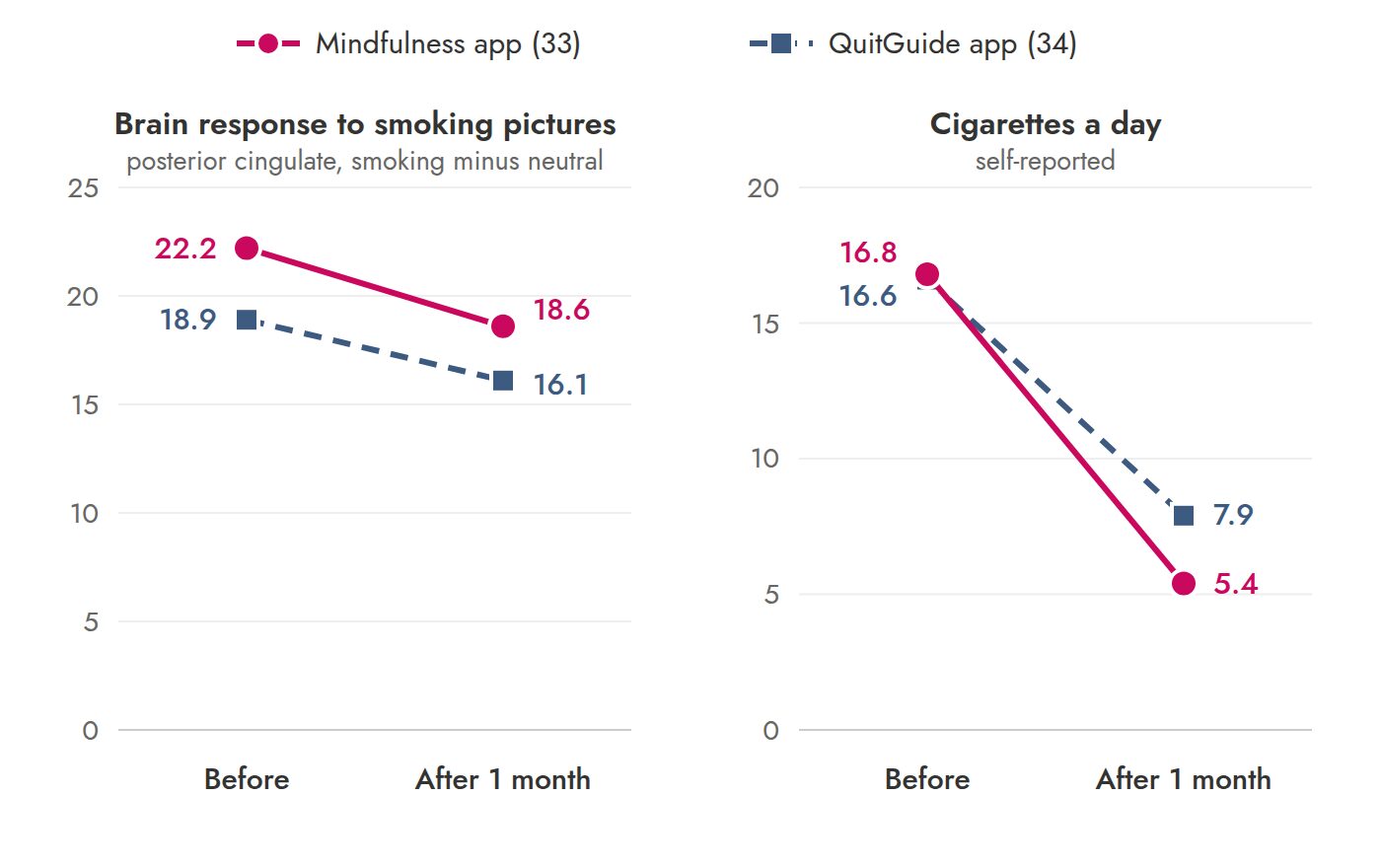
What the paper’s title highlights is a finding about individuals. Within the mindfulness group, people whose PCC response to smoking pictures fell more tended to cut down more (a Spearman
correlation
A correlation measures how closely two things rise and fall together across people or over time. Pearson’s r runs from −1 to +1: values near +1 mean that people high on one measure tend to be high on the other, values near −1 mean the reverse, and values near 0 mean no straight-line relationship. A correlation alone can’t show that one thing causes the other.
More on Wikipedia
Read more in the glossary
of 0.39, p = 0.02). With QuitGuide, there was no such link (0.08, p = 0.65). The authors read this as evidence that the mindfulness app works, in those it helps, by dampening the brain’s response to cues. They also acknowledge that on average, the brain change wasn’t enough:
Importantly, reductions in PCC reactivity, at a group level, were not specific enough to predict outcomes; only when individual variability was taken into account did the modeling have sufficient granularity to yield specific effects on smoking.
Three cautions apply. First, “predict” in the title means “correlate with”: the brain change and the smoking change were measured over the same month, so the data can’t say which came first, or whether something else, such as how hard someone was trying, drove both. Second, the paper reports a significant correlation in one group and not in the other, but doesn’t test whether the two correlations differ from each other, which is what showing an effect “specific to” mindfulness would require. Third, a correlation of 0.39 among 33 people is moderate, and the scatter plot in the paper shows nearly everyone in the mindfulness group cutting down, whatever their PCC did.
Miscellaneous Interesting Takeaways
Using the Mindfulness App More Went With Smoking Less
Both groups completed the same number of modules on average (15.6 of 22), so neither app was simply used more. But in the mindfulness group, people who completed more modules cut down more (a correlation of 0.49, p = 0.004), which the authors treat as a sign of a dose effect; with QuitGuide, the link wasn’t significant (0.20). In a model for the mindfulness group combining the PCC change, modules completed and how much people smoked at the start, all three were significant and together accounted for 58% of the variation in how much people cut down. The strongest of them was the starting amount: heavier smokers had more cigarettes to cut. The same model explained 8% of the variation with QuitGuide.
A Second Brain Area, but Not a Third
To check whether the link was specific to the PCC, the team looked at two other areas. The
medial prefrontal cortex
The medial prefrontal cortex (mPFC) is the part of the frontal lobes along the brain’s midline, just behind the forehead. It is a core part of the default mode network and is consistently active when people think about themselves, judge their own traits, or recall and plan events in their own lives.
More on Wikipedia
Read more in the glossary
, another default mode network hub that also quiets in experienced meditators, showed a borderline link in the mindfulness group (0.35, p = 0.05). The anterior
insula
The insula is a region of cortex folded deep inside each side of the brain. It helps represent the body’s internal state (interoception) and is involved in emotion, empathy and compassion. Its front part, the anterior insula, comes up often in meditation research.
More on Wikipedia
Read more in the glossary
, linked to nicotine dependence but not to meditation, showed none. The authors take this as evidence that mindfulness acts on the default mode network in particular.
People Who Reacted Least Gained Least
About 13% of participants showed no PCC response to smoking pictures at the start. Within the mindfulness group, those who did respond cut down significantly more than those who didn’t, and people whose response fell during the month cut down more than people whose response rose (by 14.1 against 8.6 cigarettes a day). Neither difference appeared with QuitGuide. The authors suggest that a brain scan before treatment might one day pick out the smokers most likely to benefit from mindfulness, those who get “caught up” by cues. That is a hypothesis for future studies; these subgroups were defined after the fact and were small.
The Link Appeared Only in Women
In a further analysis the authors added after the fact, the PCC–smoking correlation in the mindfulness group held for women (20 people, 0.49) but not men (13 people, −0.08), and the difference between the sexes was significant on a one-sided test (p = 0.04). The authors connect this to research suggesting that women more often smoke to manage low mood and negative feelings, and speculate that mindfulness may be particularly suited to them. They also suggest that the sex difference may explain why the apps didn’t differ overall, because “there were only nine women in the NCI group.” That doesn’t match the paper’s own Table 1, which lists 25 women and 9 men in the QuitGuide group, so this explanation is hard to follow. With 13 men in the mindfulness group, the sex finding is best treated as a lead to test, as the authors say.
Participants Much Preferred the Mindfulness App
Before starting, the two groups rated their app as equally useful and their chances of quitting as equally good (about 80%), which matters because expectations alone can change behavior. After a month, those using the mindfulness app were far more likely to say they’d recommend it to a friend (9.6 against 5.9). No adverse events from either app were reported.
The Conflict of Interest
The paper’s disclosure states that Brewer is the founder of MindSciences, “the company that developed the mindfulness app used in this study.” He owns stock in it, works for it as an unpaid scientist and has served on its board; the paper says this interest was disclosed to and managed by Brown University. The other authors reported no conflicts, and the study was funded by the US National Center for Complementary and Integrative Health. The design reduced some risks of bias: the randomization was prepared by an independent statistician, the people who scanned participants didn’t analyze the data, and the analysts were kept partly unaware of group assignments until the analyses were complete. The paper doesn’t name the app. The same lab has also tested a mindful eating app for food cravings.
What the Study Can’t Show
The authors name the short follow-up and the focus on a single brain region as limitations:
there are several limitations, including the short duration of follow-up for smoking outcomes and the specific focus on a single region of interest.
Several others are worth adding. Smoking was measured by self-report. The paper says breath carbon monoxide was tested at each visit, but it reports no carbon monoxide results and no quit rates, even though people were asked to use the apps to quit. Only the 67 people who finished both scans were analyzed (12 of the 80 randomized didn’t come back for the second scan, and 1 was excluded), so this was not an
intention-to-treat
An intention-to-treat analysis counts every randomized participant in the group they were assigned to, whether or not they completed or even started the treatment. It keeps the benefit of randomization, since dropping people who didn’t follow their plan can leave groups that differ in other ways, and it estimates what happens when a treatment is offered in practice rather than when it is taken exactly as intended.
More on Wikipedia
Read more in the glossary
analysis. And beyond the main test, the paper reports many follow-up analyses (other regions, subgroups by sex and by brain response) without correcting for
multiple comparisons
The multiple comparisons problem arises when researchers run many statistical tests at once. Each test has a small chance of a false positive, so across thousands of tests, such as one for every point in a brain scan, some “significant” results will turn up by chance alone. Corrections raise the bar for significance to keep the overall false-positive rate down, at the cost of making small real effects harder to detect.
More on Wikipedia
Read more in the glossary
, several with p-values close to 0.05.
Final Reflection
The paper’s title says that quitting starts in the brain, and that the app produced decreases in neural responses that predict reductions in smoking. The results are more modest. The mindfulness app didn’t reduce the PCC’s response to smoking cues more than a standard app did, and its users didn’t cut down significantly more. What the study found is a moderate link, within the mindfulness group only, between a falling PCC response and falling cigarette use over the same month.
That is still an interesting result. It fits with an earlier brain-imaging experiment in which smokers who mindfully attended to smoking pictures for a few seconds showed quieter activity in a different craving-linked area, though that study didn’t report a person-by-person link with craving and didn’t track smoking. Here, over a month of real-world practice, the people whose cue response quieted were the ones who smoked less. Whether the brain change helped cause the drop in smoking, whether it would last, and whether it would show up in quit rates confirmed by a breath test, are questions the study leaves for larger trials with longer follow-up and a test that compares the groups directly.
Citation
Janes, A. C., Datko, M., Roy, A., Barton, B., Druker, S., Neal, C., Ohashi, K., Benoit, H., van Lutterveld, R., & Brewer, J. A. (2019). Quitting starts in the brain: A randomized controlled trial of app-based mindfulness shows decreases in neural responses to smoking cues that predict reductions in smoking. Neuropsychopharmacology, 44(9), 1631–1638. 10.1038/s41386-019-0403-y
Get the next summary by email
One or two new paper summaries every couple of weeks, sent to your inbox when they go up.
No spam, and you can unsubscribe at any time. Prefer a feed reader? Use the RSS feed.