
Background Information
Most smokers want to quit, but few manage it. The authors cite US figures showing that more than 70% of smokers want to stop, yet fewer than 5% succeed each year. Behavioral treatments have long taught people to avoid their triggers, distract themselves from
cravings
Craving is an intense, often hard-to-resist desire for a substance or activity, such as a cigarette, a drink or a drug. It is a core feature of addiction: cues linked to past use, such as places, moods or the sight of a lighter, can trigger it, and strong cravings make relapse more likely. Mindfulness-based treatments teach people to notice cravings as passing sensations and ride them out rather than act on them.
More on Wikipedia
Read more in the glossary
, substitute something else for a cigarette, and reduce stress. By the authors’ count, abstinence rates with these approaches had hovered around 20–30% for three decades.
The authors suggest one reason: smoking is a learned habit, reinforced every time a cigarette eases a bad mood or caps a good one, and triggers are everywhere. Distraction takes mental effort that is often in short supply right after a strong negative feeling, and a substitute such as a carrot stick isn’t always to hand. Newer approaches, such as
acceptance and commitment therapy
Acceptance and commitment therapy (ACT) is a form of psychotherapy that combines mindfulness and acceptance with values-based action. Rather than trying to change or get rid of difficult thoughts and feelings, people learn to notice and make room for them, clarify what matters to them, and commit to acting on those values.
More on Wikipedia
Read more in the glossary
, instead teach people to tolerate cravings and negative feelings without acting on them.
Mindfulness
Mindfulness is the psychological process of purposely bringing one’s attention to experiences occurring in the present moment without judgment. It involves maintaining awareness of thoughts, feelings, bodily sensations, and surrounding environment with an attitude of curiosity and acceptance. In meditation contexts, mindfulness practices typically involve focusing attention on the breath or body sensations as anchors to the present moment while acknowledging and releasing distracting thoughts.
More on Wikipedia
Read more in the glossary
training fits that second approach. Rather than steering clear of cravings, participants learn to notice them closely and accept them as passing sensations, so that the urge no longer automatically leads to lighting up. Judson Brewer and colleagues at Yale add a twist they consider fairly specific to mindfulness, seeing cravings and moods as events in the mind and body rather than something happening to you:
In doing so, individuals may learn to (literally) not take affective and withdrawal states personally, which also may help them quit smoking
Earlier studies of mindfulness for smoking had been small and uncontrolled. In one, 10 of 18 smokers who took
MBSR
Mindfulness-Based Stress Reduction (MBSR) is a program designed to help individuals cope with stress, pain, and illness. Developed by Jon Kabat-Zinn in the 1970s, it combines meditation and yoga to promote awareness and stress management. The eight-week program teaches participants to focus on the present moment non-judgmentally, enhancing their ability to manage difficulties.
More on Wikipedia
Read more in the glossary
were abstinent six weeks after their quit date, but with no comparison group. To the authors’ knowledge, this was the first trial to test mindfulness training on its own against an established, evidence-based smoking treatment.
What They Did
The team recruited adults through flyers and media advertisements offering behavioral treatment to help them quit. To take part, people had to be 18 to 60, smoke at least 10 cigarettes a day and want to quit. People taking psychiatric medications, those dependent on another substance in the past year and those with a serious or unstable medical condition were excluded. Of 103 eligible people, 88 were randomized in this
randomized controlled trial
A Randomized Controlled Trial is a scientific study design that randomly assigns participants to either an experimental group receiving an intervention or a control group, allowing researchers to measure the true effect of the intervention while minimizing bias.
More on Wikipedia
Read more in the glossary
. They averaged 46 years old and 20 cigarettes a day, had started smoking regularly at 16, and had tried to quit about five times before; 63% were men and 45% were from ethnic minority groups.
Each person was assigned to one of two group programs, balanced by age, sex, race and how much they smoked:
- Mindfulness Training (MT): adapted for quitting smoking from earlier mindfulness manuals for relapse prevention, including one from Brewer’s group. Sessions covered how smoking becomes a habit triggered by cues, what cravings feel like in the body, and a technique for meeting them called RAIN (Recognize, Accept, Investigate and Note what a craving feels like as it arises). Participants also learned
loving-kindness
Loving-kindness meditation (mettā in Pali) is a Buddhist practice of deliberately cultivating warm, unconditional goodwill. Practitioners silently repeat wishes such as “may you be happy” or picture a person, usually starting with themselves or someone close and then extending the wishes to acquaintances, strangers, difficult people and all beings. It is one of the four brahmaviharas.
More on Wikipedia
Read more in the glossary for difficult emotions, breath meditation, mindful walking and the body scan The body scan is a meditation practice in which attention is moved slowly through the body, part by part, noticing whatever sensations are present without trying to change them. It is a core exercise in mindfulness programs such as MBSR.
More on Wikipedia
Read more in the glossary , and practiced informally while going about the day, including while smoking. One therapist with more than 13 years of mindfulness training led the groups. - Freedom From Smoking (FFS): the American Lung Association’s established program, which the authors describe as manualized, validated and widely used. It covers self-monitoring, identifying triggers, a personal quit plan, coping strategies, stress reduction, relaxation, social support and relapse prevention. Two certified therapists led it.
FFS served as an
active control
An active control group is a comparison group that takes part in a different program designed to be just as engaging as the one being tested. In meditation research, it might involve exercise, music, or education classes with the same time commitment, teachers, and expectations of benefit. Comparing against an active control helps separate the effects of meditation itself from the general effects of joining a course.
More on Wikipedia
Read more in the glossary
that the authors matched closely to the mindfulness course. Both had eight 90-minute group sessions twice a week for four weeks, on the same days, with a quit day at the end of week two. Both gave out a practice CD with five tracks totaling about 30 minutes. FFS normally runs over eight weeks, so it was compressed to fit. Participants were neither encouraged nor discouraged from using
nicotine replacement
Nicotine replacement therapy (NRT) gives smokers nicotine without tobacco smoke, through patches, gum, lozenges, inhalers or sprays, to ease withdrawal and cravings while they quit. It is one of the standard medications for stopping smoking, often combined with counseling.
More on Wikipedia
Read more in the glossary
.
A research assistant who didn’t deliver either treatment asked participants how much they had smoked each day. Anyone who said they hadn’t smoked was checked with a breath test: exhaled carbon monoxide, which rises after smoking, had to be at most 10 parts per million. The two main outcomes were cigarettes per day and “7-day point prevalence abstinence”, meaning no smoking at all in the past week, at the end of treatment (week 4) and 17 weeks after treatment began. Follow-up visits were at 6, 12 and 17 weeks, and participants were paid for each assessment.
Not everyone who was randomized began treatment. Sixteen people, eight in each group, never completed the baseline paperwork and never started, leaving 33 in mindfulness training and 38 in FFS. Those who started attended 6.7 and 6.2 of the 8 sessions on average. At 17 weeks, 88% of the mindfulness group and 87% of the FFS group who had started treatment came back for assessment. To allow for several tests, the authors counted a result as significant only if p was .025 or less, rather than the usual .05, a guard against
multiple comparisons
The multiple comparisons problem arises when researchers run many statistical tests at once. Each test has a small chance of a false positive, so across thousands of tests, such as one for every point in a brain scan, some “significant” results will turn up by chance alone. Corrections raise the bar for significance to keep the overall false-positive rate down, at the cost of making small real effects harder to detect.
More on Wikipedia
Read more in the glossary
.
One Big Result: At 17 Weeks, 31% of the Mindfulness Group Weren’t Smoking, Against 6% With the Standard Program
Both groups cut down sharply during treatment and smoked less through follow-up than at the start. But the mindfulness group cut down faster during treatment and kept its gains through the 17 weeks. This held in an
intention-to-treat
An intention-to-treat analysis counts every randomized participant in the group they were assigned to, whether or not they completed or even started the treatment. It keeps the benefit of randomization, since dropping people who didn’t follow their plan can leave groups that differ in other ways, and it estimates what happens when a treatment is offered in practice rather than when it is taken exactly as intended.
More on Wikipedia
Read more in the glossary
analysis of everyone randomized except one person whose data couldn’t be used (F = 7.01, p = .008), and again among the 71 who started treatment, measured from the week before treatment began (F = 11.11, p = .001). The paper reports cigarettes per day as test statistics and a chart of model estimates, not as group averages in its text.
For quitting outright, the mindfulness group was ahead at both time points, though only the second difference counted as significant:
- End of treatment (week 4): 36% of the mindfulness group had not smoked in the past week, against 15% of the FFS group (p = .063, a trend).
- 17 weeks: 31% against 6% (p = .012).
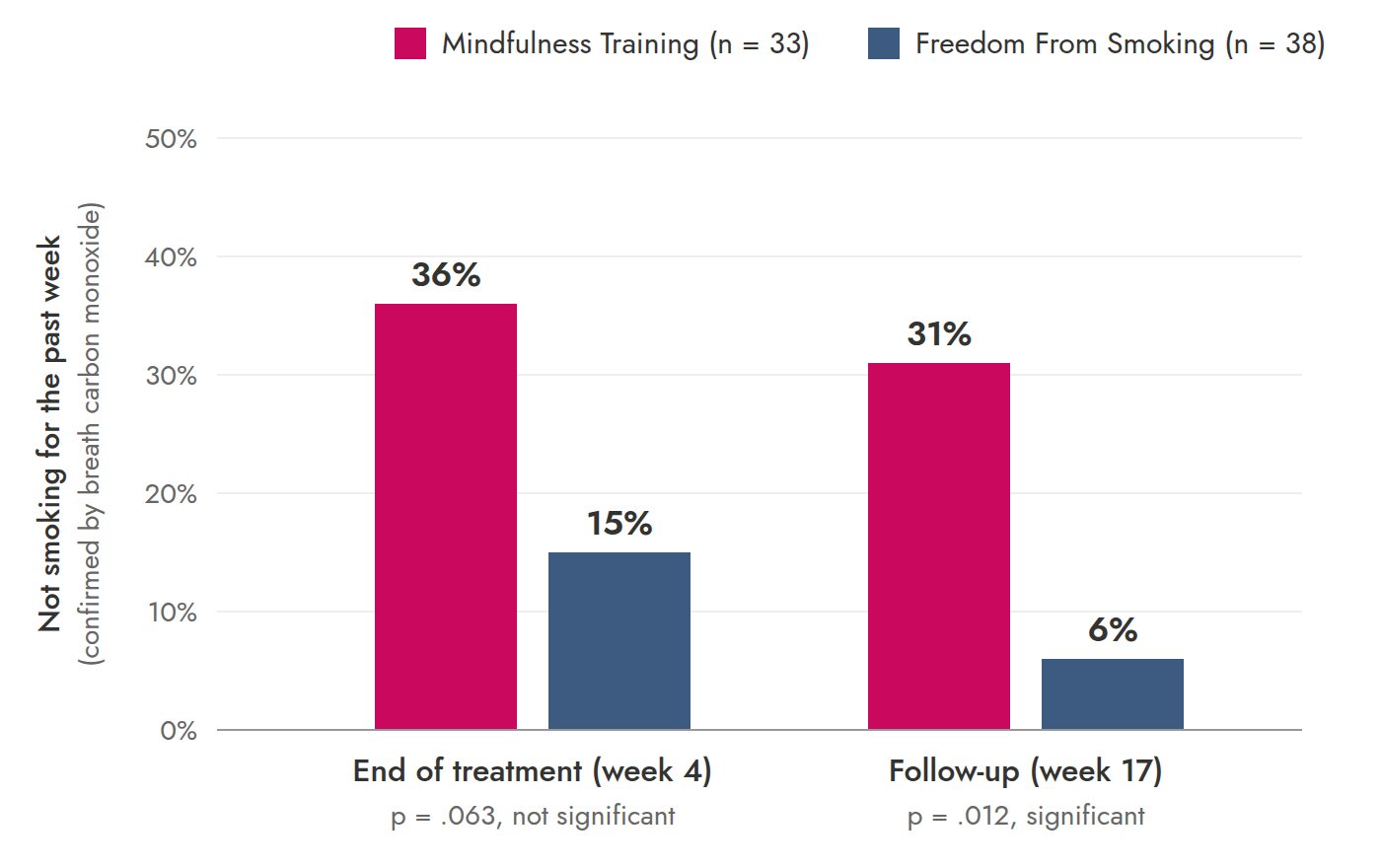
With about 30 people in each group, 31% against 6% amounts to roughly ten people against two, so a handful of people either way would change the percentages a lot. These rates were calculated among the 71 who started treatment, not all 88 who were randomized, and the paper doesn’t spell out how people who missed the 17-week visit were counted.
The authors compare their result with the wider field, and acknowledge that part of the gap may be down to the comparison program:
our 17-week point prevalence odds ratio of 6.75, is significantly larger than the average odds ratio of 1.76 found in a recent meta-analysis of previous studies of group counseling …, though this may be in part a result of the relatively poor performance of FFS.
An
odds ratio
An odds ratio compares the odds of an outcome in one group with the odds in another, where the odds are the chance something happens divided by the chance it doesn’t. An odds ratio of 1 means no difference, above 1 means higher odds in the first group, and below 1 lower odds. When an outcome is common, an odds ratio looks bigger than the difference in percentages: 30% versus 20% is an odds ratio of about 1.7.
More on Wikipedia
Read more in the glossary
of 6.75 means the odds of being abstinent were nearly seven times higher in the mindfulness group. FFS did do poorly here. Its 6% at 17 weeks was below the 11% the authors cite for people who quit on their own. They suggest why: FFS was run in half its usual length, and medication, which is usually combined with counseling, was neither encouraged nor discouraged.
Miscellaneous Interesting Takeaways
Medication Doesn’t Explain the Difference
Few people used quitting aids. During treatment, three people in the mindfulness group (9%) and four in FFS (11%) used some nicotine replacement. During follow-up, it was three (9%) against eight (21%). No one in the mindfulness group reported other quit-smoking medications, while one FFS participant took varenicline and another bupropion, two prescription drugs for quitting. The paper tested how many days people used nicotine replacement, and the groups didn’t differ significantly. If anything, the group with worse results used somewhat more quitting aids, so medication doesn’t seem to account for the mindfulness group’s advantage. No serious adverse events were reported in either group.
Sitting Meditation Tracked Success
Mindfulness participants reported doing formal practice, such as guided meditations from the CD, for about 18 minutes a day on 4.6 days a week during treatment, and informal practice about 4.8 times a day. Those who practiced more smoked fewer cigarettes at the end of treatment, both for formal practice (r = −.44) and informal practice (r = −.48). In FFS, no amount of home practice was linked to outcomes.
The strongest link came from a post hoc look at individual practices. The more sitting meditation people did, the more likely they were to be abstinent, at every time point, with correlations of about .5 to .6 in size at the end of treatment and at 17 weeks. The authors offer a reading of this:
The correlations between sitting meditation and treatment outcomes are noteworthy as they may suggest that practicing to “sit” through difficult mind-states (including negative affect and craving) may train individuals to do the same when faced with an opportunity to smoke.
They also raise the alternative: people who take to sitting meditation may simply be the ones for whom mindfulness works, which could make it a useful early sign of who will benefit. These are correlations in fewer than 30 people, picked out from a table of 64 practice–outcome pairs, so they are leads rather than findings. The FFS group also did much less home practice (formal practice 1.5 days a week), so the two groups’ correlations aren’t strictly comparable. A later analysis of this trial by Elwafi and colleagues looked at one possible mechanism, whether mindfulness weakened the link between craving and smoking.
What the Design Can’t Tell Us
The authors list most of the limits themselves. It was a pilot at a single site. One therapist led every mindfulness group and two led FFS, and nobody formally checked that each program was delivered as written, so the results may partly reflect these particular teachers rather than the methods. The mindfulness teacher was highly experienced, and the program was adapted from the research team’s own earlier work. Follow-up ended at 17 weeks after treatment began, about four months, while six months is the standard in smoking research. People on psychiatric medications were excluded, even though smoking is especially common among people with psychiatric disorders. And with roughly 70 people in treatment, the trial was small enough that the size of the advantage is uncertain.
Participants weren’t told which kind of treatment they might get until after randomization, which the authors see as limiting the role of expectations. Still, they knew which program they were in, and their own reports of how much they smoked were checked by a breath test only when they said they hadn’t smoked.
Final Reflection
This pilot trial was an early, encouraging test of mindfulness as a stand-alone treatment for smoking. Against a recognized program matched in length, format and home practice, four weeks of group mindfulness training led to faster reductions in smoking and more people off cigarettes four months on, 31% against 6%. The main abstinence result rests on small numbers, and the comparison program did unusually badly in its shortened form, so the true advantage is likely smaller than this trial suggests.
Later evidence pointed the same way. A meta-analysis of mindfulness for psychiatric disorders found that smoking was the one condition where mindfulness programs outperformed evidence-based treatments, such as the American Lung Association’s (d = 0.42). Taken alone, this study is best read as what its authors called it: a promising first trial that needed larger, longer and multi-site replications before mindfulness could be counted among proven ways to quit.
Citation
Brewer, J. A., Mallik, S., Babuscio, T. A., Nich, C., Johnson, H. E., Deleone, C. M., Minnix-Cotton, C. A., Byrne, S. A., Kober, H., Weinstein, A. J., Carroll, K. M., & Rounsaville, B. J. (2011). Mindfulness training for smoking cessation: Results from a randomized controlled trial. Drug and Alcohol Dependence, 119(1–2), 72–80. 10.1016/j.drugalcdep.2011.05.027
Get the next summary by email
One or two new paper summaries every couple of weeks, sent to your inbox when they go up.
No spam, and you can unsubscribe at any time. Prefer a feed reader? Use the RSS feed.