
Background Information
Craving sits at the center of most accounts of addiction. In the learning model the authors lay out, smoking relieves unpleasant states such as withdrawal, stress or sadness, a form of
negative reinforcement
Negative reinforcement is learning in which a behavior becomes more likely because it removes or relieves something unpleasant. Smoking to ease withdrawal, stress or a bad mood is a common example: the relief teaches the brain to reach for a cigarette the next time that feeling appears. It is the counterpart of positive reinforcement, where a behavior is strengthened by a pleasant result.
More on Wikipedia
Read more in the glossary
. Over time, both outside cues (a coffee, a work break) and inner feelings come to trigger craving, craving leads to a cigarette, and each cigarette strengthens the loop. Studies of smokers consistently find that people who crave more smoke more, and rising craving predicts lapses after a quit attempt.
Many standard quit-smoking programs work around craving: avoid your triggers, distract yourself, swap in another activity, or relax.
mindfulness
Mindfulness is the psychological process of purposely bringing one’s attention to experiences occurring in the present moment without judgment. It involves maintaining awareness of thoughts, feelings, bodily sensations, and surrounding environment with an attitude of curiosity and acceptance. In meditation contexts, mindfulness practices typically involve focusing attention on the breath or body sensations as anchors to the present moment while acknowledging and releasing distracting thoughts.
More on Wikipedia
Read more in the glossary
training takes a different approach. It teaches people to notice a craving, with curiosity and without judgment, and to let it pass without acting on it. The authors put the hypothesis like this:
By learning non-judgmental observation of craving itself through MT, one might decouple the associative link between craving and subsequent behavior. In other words, individuals may learn to notice affective states and urges to smoke, and just allow them to arise and pass without habitually or impulsively acting on them.
(MT is mindfulness training.) The data came from a randomized trial by Judson Brewer (the senior author here) and colleagues that compared mindfulness training with Freedom From Smoking, the American Lung Association’s
cognitive behavioral
Cognitive behavioral therapy (CBT) is a structured, usually short-term talk therapy that helps people notice and change unhelpful patterns of thinking and behavior. It is one of the most thoroughly tested psychological treatments and a first-line option for depression, anxiety disorders and many other conditions.
More on Wikipedia
Read more in the glossary
program. As this paper summarizes it, the mindfulness group cut its smoking faster and more of its members were abstinent 4 months later (31% versus 6%). In the mindfulness group, more home practice also went with more success at quitting. This follow-up paper asks why: did the training change the relationship between craving and smoking itself?
What They Did
The analysis used only the people randomized to mindfulness training. Of the 41 assigned to it, 33 started. They averaged 46 years old, 66% were men, and they smoked about 19 cigarettes a day and had made 6 earlier quit attempts on average. The training was eight group sessions over 4 weeks, twice a week, with a suggested quit day at the end of week 2. Participants attended 6.7 sessions on average.
Home practice came in two kinds:
- Formal practice: the
body scan
The body scan is a meditation practice in which attention is moved slowly through the body, part by part, noticing whatever sensations are present without trying to change them. It is a core exercise in mindfulness programs such as MBSR.
More on Wikipedia
Read more in the glossary , loving-kindness meditation Loving-kindness meditation (mettā in Pali) is a Buddhist practice of deliberately cultivating warm, unconditional goodwill. Practitioners silently repeat wishes such as “may you be happy” or picture a person, usually starting with themselves or someone close and then extending the wishes to acquaintances, strangers, difficult people and all beings. It is one of the four brahmaviharas.
More on Wikipedia
Read more in the glossary and awareness of the breath. Participants did it on 5.4 days a week on average, about 342 minutes in total over the four weeks. - Informal practice: setting a daily intention, doing everyday activities mindfully, and techniques for working with cravings as they arise, such as RAIN (Recognize, Accept, Investigate and Note what is happening in the mind and body). Participants did this on 5.6 days a week, about 107 times in total.
Participants logged their practice and the cigarettes they smoked each day in diaries, which a research assistant not involved in the training checked twice a week, along with a breath test for carbon monoxide. Craving was measured with the Questionnaire of Smoking Urges–Brief: 10 statements such as “I have an urge for a cigarette now,” each rated on a 7-point scale. Craving and smoking were measured at the start, at the end of the 4-week training, and at follow-ups at 6 weeks, 3 months and 4 months after training began.
The team asked three questions. First, how strong was the
correlation
A correlation measures how closely two things rise and fall together across people or over time. Pearson’s r runs from −1 to +1: values near +1 mean that people high on one measure tend to be high on the other, values near −1 mean the reverse, and values near 0 mean no straight-line relationship. A correlation alone can’t show that one thing causes the other.
More on Wikipedia
Read more in the glossary
between craving and smoking at each point? Second, did the amount of home practice predict smoking at the end of training, after accounting for each person’s craving and smoking at the start? Third, using
moderation analysis
Moderation analysis is a statistical method that tests whether the link between two variables changes depending on a third, called the moderator. For example, it can ask whether the link between craving and smoking is weaker in people who practice mindfulness more often. It is usually tested by adding an interaction term (the product of the two predictors) to a regression. It shows that a relationship differs between people, not why.
More on Wikipedia
Read more in the glossary
, did people who practiced more show a weaker link between craving and smoking? Missing values were filled in with each person’s last recorded value. The authors say two other ways of handling missing data gave nearly identical results.
One Big Result: By the End of Training, Craving No Longer Predicted How Much People Smoked
Before training, craving and smoking went closely together: people who reported stronger urges smoked more cigarettes a day (r = 0.58), and craving accounted for about a third of the differences in how much people smoked. Each point higher on the craving scale went with about 3.5 more cigarettes a day.
By the end of the four weeks, the group was smoking much less (about 4 cigarettes a day, down from 19), and craving had fallen too, from 3.96 to 2.31 on the 7-point scale. But the link between them had all but disappeared (r = 0.13, not statistically significant). A test comparing the two correlations found the drop was unlikely to be chance (p = 0.04).
The clearest sign of this decoupling was that at the end of training, people who had quit reported about as much craving (2.18) as those still smoking (2.45). The quitters had stopped smoking while still craving about as much as everyone else. A drop in craving from the start to the end of training didn’t predict how much people smoked, either.
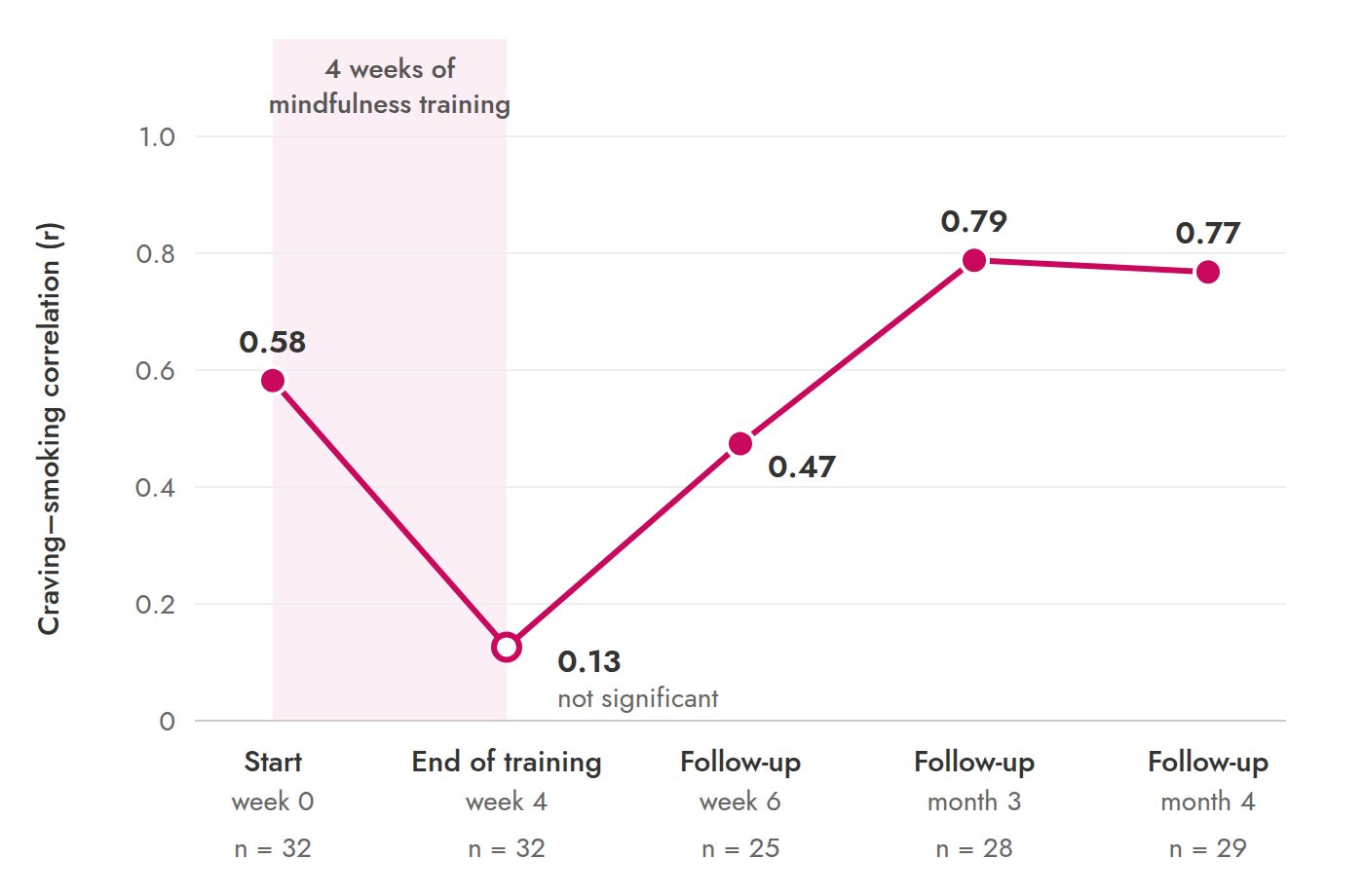
The decoupling didn’t last, though. Two weeks after training ended, the correlation was back (r = 0.47), and by 3 and 4 months it was stronger than at the start (r = 0.79 and 0.77). The authors explain this as craving catching up with behavior. People who stayed abstinent now reported less craving than those who kept smoking (at 4 months, a significant difference), so craving and smoking lined up again across the group. They offer an analogy:
A simplistic analogy is that craving is like a fire that is fed by smoking. When someone stops smoking, the fire of craving is still present and only burns down on its own once its fuel has been consumed (and no more fuel has been added).
On this reading, the end of training was a window in which quitters had stopped smoking but their craving hadn’t yet faded, and mindfulness may have helped them not act on it.
Miscellaneous Interesting Takeaways
More Practice, Fewer Cigarettes
All four measures of home practice predicted smoking at the end of training, even after accounting for each person’s craving and smoking at the start. Each extra day a week of formal practice went with about 1.2 fewer cigarettes a day, and each extra day a week of informal practice with about 1.5 fewer. The model with days of informal practice explained 54% of the differences in end-of-training smoking. These are associations within one group, though. Nobody was randomly assigned to practice more, so more motivated participants, or those having an easier month, may simply have both practiced more and smoked less.
The Moderation Result Is Weaker Than It Sounds
The paper’s headline claim is that informal practice “predicts a decoupling” of craving and smoking. Only one of the four practice measures, days a week of informal practice, significantly moderated the craving–smoking link (p = 0.03). The other three did not, and the paper reports no correction for running four tests. The large
effect size
Effect size is a statistical concept that quantifies the magnitude or strength of a relationship, difference, or intervention outcome. Unlike p-values which only indicate statistical significance, effect sizes measure how meaningful a result is in practical terms. Common measures include Cohen’s d (standardized mean difference), correlation coefficients (r), and odds ratios. In meditation research, effect sizes help quantify the practical impact of different meditation practices on psychological or physiological outcomes.
More on Wikipedia
Read more in the glossary
quoted alongside this result (f² = 1.17) belongs to the whole regression model, which is driven mostly by practice predicting less smoking, not to the moderation itself.
Why the Link Might Have Shrunk
The group-level drop in correlation is the paper’s most solid finding. The authors’ explanation is that craving lags behind quitting. Craving was also sampled once per visit, in a research setting. The authors note this may not capture urges that rise and fall through the day, and suggest
experience sampling
Ecological momentary assessment (EMA), also called experience sampling, asks people to report what they are feeling or doing several times a day, in the moment and in their everyday surroundings, usually through short surveys sent to their phones at set or random times. Because answers are given on the spot rather than recalled later, they are less colored by memory than questionnaires about the past week or month, and they can show how experiences rise and fall through the day.
More on Wikipedia
Read more in the glossary
in future studies.
Most importantly, the analysis didn’t look at the Freedom From Smoking group. The authors acknowledge:
…we did not examine whether decoupling of the craving/smoking association that was moderated by home practice was specific to MT or whether the same associations would have been found in a non-MT group.
So the study can’t say whether the same temporary decoupling happens whenever people cut down sharply, with any program.
Surfing the Urge
The idea that people can feel an urge without obeying it echoes an earlier study the authors cite. In a study titled “Surfing the urge,” Bowen and Marlatt gave college smokers brief mindfulness instructions: accept thoughts without judging them, and pay attention to urges and the sensations that come with them without trying to change or get rid of them. A week later, those students smoked significantly fewer cigarettes than students who didn’t get the instructions, even though the two groups’ urges didn’t differ significantly. The authors argue that the most useful clinical message may be the same. Rather than trying to suppress cravings, smokers can learn that a craving doesn’t have to lead to a cigarette, and can expect cravings to linger for a while after they quit.
Final Reflection
This small study gives a concrete form to the idea at the heart of mindfulness approaches to addiction: the aim is not to stop wanting a cigarette, but to stop the wanting from automatically becoming smoking. At the end of four weeks of training, the usual tight link between how much smokers craved and how much they smoked had largely disappeared, and people who had quit were still craving about as much as those who hadn’t.
The evidence that mindfulness itself caused that decoupling is thin. The analysis covered 32 people in one arm of a trial, with no comparison to the people who got a standard program. The decoupling was gone within weeks. The link to home practice rests on one of four tests, with a coefficient whose direction is hard to square with the authors’ description. The study is best read as an early, hypothesis-generating look at how mindfulness might help people quit, and the decoupling idea needs testing in larger trials that compare groups directly and track craving in daily life.
Citation
Elwafi, H. M., Witkiewitz, K., Mallik, S., Thornhill, T. A., IV, & Brewer, J. A. (2013). Mindfulness training for smoking cessation: Moderation of the relationship between craving and cigarette use. Drug and Alcohol Dependence, 130(1–3), 222–229. 10.1016/j.drugalcdep.2012.11.015
Get the next summary by email
One or two new paper summaries every couple of weeks, sent to your inbox when they go up.
No spam, and you can unsubscribe at any time. Prefer a feed reader? Use the RSS feed.