
Background Information
Most attempts to quit smoking fail, and
craving
Craving is an intense, often hard-to-resist desire for a substance or activity, such as a cigarette, a drink or a drug. It is a core feature of addiction: cues linked to past use, such as places, moods or the sight of a lighter, can trigger it, and strong cravings make relapse more likely. Mindfulness-based treatments teach people to notice cravings as passing sensations and ride them out rather than act on them.
More on Wikipedia
Read more in the glossary
is one of the reasons. The authors cite studies showing that smokers with stronger cravings are more likely to relapse, and that craving often comes just before a relapse. By the time this paper was written, a small randomized trial had found that a four-week mindfulness course helped more smokers quit than a standard program, and one idea was that it worked by changing how people respond to their cravings.
Craving can be studied in the lab with
cue reactivity
Cue reactivity is the set of reactions that reminders of a drug, such as the sight of a cigarette, a bottle or a syringe, set off in someone who uses it: craving, bodily changes such as in heart rate and sweating, and activity in the brain’s reward circuits. Researchers measure it by showing such cues in the lab; stronger reactions have been linked to a higher risk of relapse.
More on Wikipedia
Read more in the glossary
experiments: show smokers pictures of cigarettes, ask how much they want one, and look at what their brains do. Brain-imaging studies of this kind find heightened activity in a familiar set of areas, including the
anterior cingulate cortex
The anterior cingulate cortex (ACC) is a strip of cortex on the inner surface of each frontal lobe, curving around the front of the corpus callosum. It is involved in monitoring conflicts and errors, regulating attention and emotion, and processing pain, and it often turns up in brain-imaging studies of meditation.
More on Wikipedia
Read more in the glossary
(among them its lowest part, the
subgenual anterior cingulate
The subgenual anterior cingulate cortex (sgACC) is the lowest part of the anterior cingulate cortex, lying beneath the bend (genu) at the front of the corpus callosum, next to the ventromedial prefrontal cortex. It is involved in emotion and mood: it is overactive in depression, where it has been a target of deep brain stimulation. Brain-imaging studies have also found it more active when smokers see cigarette cues and crave.
More on Wikipedia
Read more in the glossary
, or sgACC), the
ventromedial prefrontal cortex
The ventromedial prefrontal cortex (vmPFC) is the lower part of the frontal lobes along the brain’s midline, just above the eyes. Together with the neighboring medial orbitofrontal cortex and the subgenual (lower) part of the anterior cingulate, it helps weigh how much something matters to oneself, represents reward and value, and links emotions with the body’s internal states.
More on Wikipedia
Read more in the glossary
and the
striatum
The striatum is a group of structures deep in the brain that is central to reward, motivation and habit. Its lower part, the ventral striatum (which includes the nucleus accumbens), responds to pleasures and to cues that predict them, and is strongly activated by addictive drugs. Its upper part, the dorsal striatum, is involved in movement and in habits that run automatically.
More on Wikipedia
Read more in the glossary
. One study the authors cite found that the quit-smoking drug bupropion dampened the sgACC’s response to cigarette cues.
Two earlier studies had asked smokers to pay mindful attention while craving was stirred up. Neither found that it significantly reduced the craving people reported, and no one had looked at what mindful attention does in the brain during craving. The authors set up two competing accounts of how it might help:
- Regulation: mindful attention works from the top down, like deliberate strategies for controlling emotion. It should recruit control areas on the outer surface of the prefrontal cortex, such as the
dorsolateral prefrontal cortex
The dorsolateral prefrontal cortex (dlPFC) is a region on the upper outer sides of the frontal lobes. It is a core part of the brain’s executive control network, supporting working memory, directing attention and regulating emotion. Stronger dlPFC activity and connectivity have been associated with lower pain, negative emotion and stress.
More on Wikipedia
Read more in the glossary , which would then turn down activity in craving areas. - Reduced reactivity: mindful attention works from the bottom up. By simply noticing a craving without judging it or reacting to it, a person dampens the craving areas directly, with no extra effort from the prefrontal cortex.
What They Did
The 54 participants were adult smokers recruited for a larger quit-smoking study at the University of Pittsburgh, and this experiment took place before any treatment. All were right-handed, smoked at least 10 cigarettes a day (about 18 on average, for about 26 years) and strongly wanted to quit within the next month. Their average age was 45, 31% were women, and 47% were African-American. None had meditated before. People taking medications that affect the nervous system, or with untreated psychiatric illness, brain injury or other drug use, were excluded. Everyone abstained from smoking for at least 12 hours before the scan, confirmed with a breath test for carbon monoxide, and passed a urine drug screen.
Before going into the scanner, each person had a brief training session with a researcher, practicing two ways of viewing pictures on sample images while describing their thoughts aloud and getting feedback. For LOOK, they were to relax and view the picture as naturally as possible. For MINDFULLY ATTEND:
For the MINDFULLY ATTEND condition, participants were instructed to actively focus on their responses to the picture, including thoughts, feelings, memories and bodily sensations, while maintaining a nonjudgmental attitude toward those responses.
The researchers deliberately did not present this as a way to reduce craving. Participants were told to notice whatever they felt, craving included, as open-mindedly as possible, and to “notice and accept” it.
In the
fMRI
An fMRI (functional Magnetic Resonance Imaging) measures changes in blood flow related to neural activity in the brain, offering insights into brain function and activity patterns.
More on Wikipedia
Read more in the glossary
scanner, each trial began with the instruction (LOOK or MINDFULLY ATTEND), followed by a picture shown for 8 seconds: either a smoking image, such as a lit cigarette, or a neutral one, such as bookcases. Smokers then rated their craving and their negative emotion, each from 1 (weak) to 5 (strong). Over four 7-minute runs, each kind of trial came up 12 times, in a shuffled order. The comparisons of interest were looking at neutral pictures, looking at smoking pictures and mindfully attending to smoking pictures. (The session also included a reappraisal instruction and distressing pictures, which the authors report in a separate paper.)
Seven people were dropped from the brain analyses for too much head movement, trouble with the response glove or not doing the task correctly, leaving 47. The authors searched the whole brain, using a standard correction for
multiple comparisons
The multiple comparisons problem arises when researchers run many statistical tests at once. Each test has a small chance of a false positive, so across thousands of tests, such as one for every point in a brain scan, some “significant” results will turn up by chance alone. Corrections raise the bar for significance to keep the overall false-positive rate down, at the cost of making small real effects harder to detect.
More on Wikipedia
Read more in the glossary
that counted only clusters of at least 54 neighboring voxels that each passed p < 0.001.
One Big Result: Mindful Attention Quieted a Craving-Linked Area Instead of Recruiting Control Areas
First, a check that the pictures worked: looking at smoking pictures, compared with neutral ones, activated the
precuneus
The precuneus is a region on the inner surface of the parietal lobe, toward the back of the brain’s midline, next to the posterior cingulate cortex. Together they form a core hub of the default mode network, and the precuneus is often active during self-related thinking, memory recall and imagining one’s own point of view.
More on Wikipedia
Read more in the glossary
and a frontal area extending into the lower anterior cingulate, regions earlier cue studies had linked to craving.
The main test compared mindfully attending to smoking pictures with just looking at them. A large region on both sides of the brain, spanning the sgACC and the neighboring ventromedial prefrontal cortex (279 voxels), was less active during mindful attention. Nothing anywhere in the brain was more active. So there was no sign of the lateral prefrontal control areas that the regulation account predicted.
The team then checked whether the area that quieted was the same one that smoking pictures had switched on. Within the region that mindful attention dampened, a smaller cluster in the left sgACC (53 voxels) was also more active when people looked at smoking rather than neutral pictures. When people mindfully attended to smoking pictures, its activity was no different from looking at neutral ones. In other words, mindful attention seemed to bring this craving-linked area back to its level for a picture of bookcases. The authors’ reading:
This suggests that nonjudgmental attention to one’s craving-related experience lessens not only the subjective experience of craving, but also its neural correlates.
The authors take this as support for the reduced reactivity account. One caution: the second check started from the area that mindful attention had dampened, and both comparisons included the same just-looking-at-smoking trials, so it was not a fully independent test.
Miscellaneous Interesting Takeaways
Craving Fell, but Only a Little
Smoking pictures did stir up craving. Average ratings were 2.82 out of 5 when people just looked at them, against 2.20 for neutral pictures. When people mindfully attended to the smoking pictures, craving averaged 2.70. In the full group of 54, that difference was statistically significant (p < 0.05), but in the 47 people whose brain scans were analyzed, it was only marginal (p = 0.09). So the brain result comes from a group in which the drop in craving could have been chance.
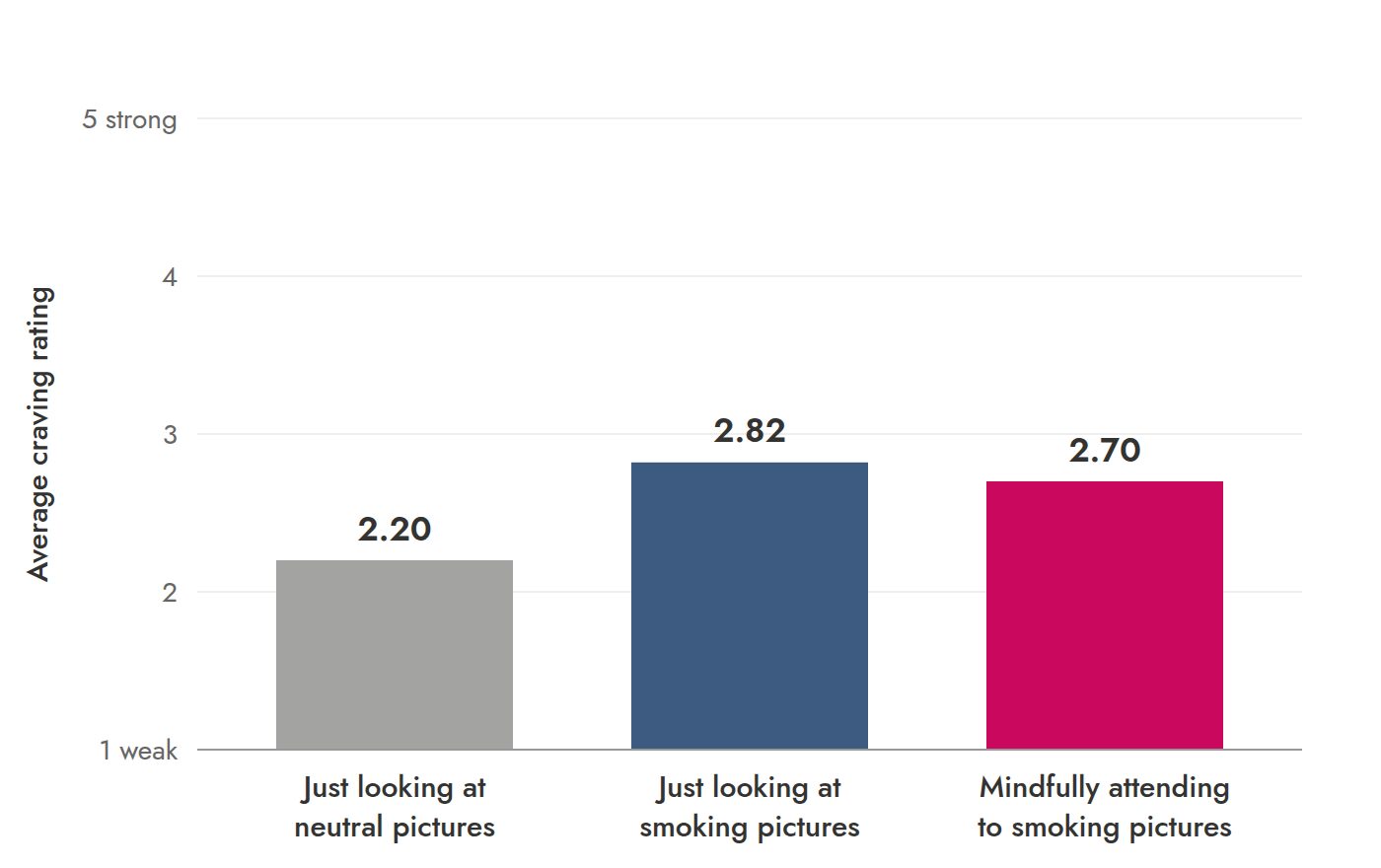
The paper is not entirely clear about which group these averages come from: the text gives them alongside the full-sample analysis, while the figure that plots them is labeled as the scanned group. Either way, the reduction is about a tenth of a point on a 5-point scale, much smaller than the jump from neutral to smoking pictures. Ratings of negative emotion followed the same pattern: 1.99 for neutral pictures, 2.31 for just looking at smoking pictures and 2.19 for mindfully attending to them (p < 0.05).
The Craving Network Fell Out of Step
To see how the quieted area worked with the rest of the brain, the authors ran a
psychophysiological interaction
A psychophysiological interaction (PPI) analysis measures, with fMRI, whether two brain regions work together more or less closely in one condition than another, for example during painful heat compared with harmless warmth. It asks whether a chosen region’s activity tracks another region’s activity differently depending on the task, a kind of task-dependent functional connectivity. Like other connectivity measures, it shows coordinated activity, not a physical connection or which region drives the other.
More on Wikipedia
Read more in the glossary
analysis, a measure of whether two areas’ activity rises and falls together more in one condition than another. Starting from the sgACC, they found that during mindful attention it moved less in step with the insula on both sides, the caudate (part of the striatum), premotor cortex, part of the middle frontal gyrus and areas of the parietal lobe, including the precuneus and
inferior parietal lobule
The inferior parietal lobule (IPL) is a region on the outer surface of the parietal lobe, toward the back and side of the head. It combines information from the senses and the body and is involved in attention, language, the sense of being the one who causes one’s own actions (agency), and telling oneself apart from others.
More on Wikipedia
Read more in the glossary
. The authors note that several of these have been linked to craving: the striatum to reward, the caudate and premotor cortex to planning the actions that smoking cues prompt, and the
insula
The insula is a region of cortex folded deep inside each side of the brain. It helps represent the body’s internal state (interoception) and is involved in emotion, empathy and compassion. Its front part, the anterior insula, comes up often in meditation research.
More on Wikipedia
Read more in the glossary
to the bodily feel of craving (damage to the insula has been found to disrupt addiction to cigarettes). No area of the lateral prefrontal cortex became more closely coupled with the sgACC.
The authors suggest that mindfulness “may decouple craving neurocircuitry.” That is a fair description of the statistics, but coordinated activity doesn’t show that one area drives another, or that the change mattered for how much people craved.
Why No Top-Down Control?
Earlier studies had found that mindfulness engaged the prefrontal cortex’s control areas. The authors argue that those studies used tasks that themselves called for active regulation, such as putting feelings into words or reframing them. Here, participants were trained only to notice and accept:
Consistently, we trained participants to ‘notice and accept’ any feelings, sensations, etc., but not to reappraise, let go of, or distance themselves from any such perceptions.
A later study with a similar design found a related but different pattern. When people new to meditation viewed their reactions to imagined stressful events as passing mental states, the ventromedial prefrontal and subgenual cingulate areas were again less active than when they immersed themselves in the scene, but lateral control areas were more active. How much control a “mindful” instruction calls for may depend on exactly how it is worded, a point the authors themselves make about defining mindfulness in experiments. Not finding extra prefrontal activity is also not the same as showing it was absent, since a whole-brain search with a strict threshold can miss modest changes.
What the Design Can’t Show
- One brief session. Participants practiced the instruction in a short session before the scan (the paper doesn’t say how long) and used it for 8 seconds at a time. The authors acknowledge that how the effects “may change or evolve over time is unclear,” and the paper reports nothing about whether anyone went on to smoke less or quit.
- Mindful attention against just looking. Mindfully attending is a more active instruction than relaxing and looking, so part of the difference could come from doing anything deliberate with the picture. The reappraisal condition that could speak to this is reported elsewhere. There was also no mindful-attention condition for neutral pictures, a gap the authors acknowledge.
- Expectations. Participants knew which instruction they were following, so they may have guessed what the researchers hoped to see, a form of
demand characteristics
Demand characteristics are cues in an experiment that hint at what the researchers expect, which can lead participants to behave the way they think they are supposed to rather than how they normally would. Researchers reduce them by disguising the study’s purpose, measuring behavior unobtrusively, or using comparison conditions that seem just as plausible.
More on Wikipedia
Read more in the glossary . The authors argue this is unlikely because mindful attention was never presented as a way to reduce craving, and people might even expect attending to a craving to strengthen it. - Brain and craving weren’t linked person by person. The paper doesn’t report whether the people whose sgACC quieted most were the ones whose craving fell most. Its summary says mindful attention reduces craving “by decreasing activity and functional connectivity” in craving areas, which is more than the data show.
- Psychiatric history wasn’t assessed beyond a depression questionnaire, which the authors list as a limitation.
Final Reflection
This was among the first studies to look inside the brain while people paid mindful attention to a craving, and its central finding is neat: smokers with no meditation experience, after brief instruction, could look at a lit cigarette while noticing their reactions without judgment, and a craving-linked area at the base of the frontal lobes responded about as it did to a picture of bookcases. The control areas that deliberate self-control strategies usually rely on stayed quiet, which fits the idea that mindfulness works less by fighting a craving than by not feeding the reaction to it.
That idea echoes a later analysis of the mindfulness group in the smoking trial, where the usual link between how much people craved and how much they smoked briefly vanished after training. The two studies describe “decoupling” at different levels, one in brain activity during an 8-second picture and the other in day-to-day behavior over weeks, and neither shows that one causes the other.
The study’s limits are those of a single, short lab session: a small drop in craving that was only marginal among the people scanned, comparisons with passive looking rather than another strategy, and no follow-up of smoking. It offers a plausible brain-level picture of how mindful attention might change the response to smoking cues, one that trials following people through actual quit attempts would need to test.
Citation
Westbrook, C., Creswell, J. D., Tabibnia, G., Julson, E., Kober, H., & Tindle, H. A. (2013). Mindful attention reduces neural and self-reported cue-induced craving in smokers. Social Cognitive and Affective Neuroscience, 8(1), 73–84. 10.1093/scan/nsr076
Get the next summary by email
One or two new paper summaries every couple of weeks, sent to your inbox when they go up.
No spam, and you can unsubscribe at any time. Prefer a feed reader? Use the RSS feed.