
Background Information
Most smokers want to quit, and most who try fail. The authors cite figures that put the scale of the problem plainly: about 70% of US smokers say they want to quit, but of those who try without formal help, only 3–5% are still abstinent 6 to 12 months later. College students are no exception. Roughly 70–80% of student smokers say they’d like to quit, yet about 87% of those who smoke daily are still smoking after four years of college.
One reason quitting is so hard is the loop described by
negative reinforcement
Negative reinforcement is learning in which a behavior becomes more likely because it removes or relieves something unpleasant. Smoking to ease withdrawal, stress or a bad mood is a common example: the relief teaches the brain to reach for a cigarette the next time that feeling appears. It is the counterpart of positive reinforcement, where a behavior is strengthened by a pleasant result.
More on Wikipedia
Read more in the glossary
: a cigarette relieves withdrawal, stress or a bad mood, so those feelings come to trigger
craving
Craving is an intense, often hard-to-resist desire for a substance or activity, such as a cigarette, a drink or a drug. It is a core feature of addiction: cues linked to past use, such as places, moods or the sight of a lighter, can trigger it, and strong cravings make relapse more likely. Mindfulness-based treatments teach people to notice cravings as passing sensations and ride them out rather than act on them.
More on Wikipedia
Read more in the glossary
, and acting on the craving brings relief that strengthens the habit. Many quit-smoking strategies try to break the loop by avoiding triggers or fighting the urge.
mindfulness
Mindfulness is the psychological process of purposely bringing one’s attention to experiences occurring in the present moment without judgment. It involves maintaining awareness of thoughts, feelings, bodily sensations, and surrounding environment with an attitude of curiosity and acceptance. In meditation contexts, mindfulness practices typically involve focusing attention on the breath or body sensations as anchors to the present moment while acknowledging and releasing distracting thoughts.
More on Wikipedia
Read more in the glossary
suggests something else: notice the urge, with curiosity and without judging it, and let it pass without acting on it.
That idea already had a name in addiction treatment. Alan Marlatt, the senior author here and the psychologist behind
relapse prevention
Relapse prevention is a cognitive-behavioral approach to addiction treatment, developed by G. Alan Marlatt and colleagues, that helps people stay off alcohol or drugs after they have stopped. Patients learn to identify high-risk situations, such as stress or certain places and people, to plan and practice ways of coping with them, and to treat a slip as something to learn from rather than a complete failure.
More on Wikipedia
Read more in the glossary
, had described “urge surfing” in a 1985 book on relapse prevention: treat a craving as a wave that rises, peaks and falls, and ride it out rather than fight it or give in. When this study was done, only a handful of studies had tested mindfulness on its own for substance use, and those either weren’t randomized or had no control group. The authors set out to test a very small dose, a single set of recorded instructions, to see whether it changed what smokers did over the following week. They were clear that this was not meant as a quit-smoking program, but a first step toward building such practices into one.
What They Did
The 123 participants were students in undergraduate psychology courses at a major US university (the University of Washington, where the authors worked), who took part for course credit. To join, they had to be at least 18, current smokers and somewhat interested in cutting down or quitting, but not in a quit program. Their average age was 20, 73% were men, and about half were white and a third Asian-American. They were light smokers: about 5 cigarettes a day on average, with low scores on the
Fagerström Test for Nicotine Dependence
The Fagerström Test for Nicotine Dependence (FTND) is a short, widely used questionnaire that rates how dependent a person is on nicotine. Its six questions ask, for example, how soon after waking the person has their first cigarette, whether they find it hard not to smoke where smoking is forbidden, and how many cigarettes they smoke a day. Scores run from 0 to 10, with higher scores meaning stronger dependence.
More on Wikipedia
Read more in the glossary
.
Students signed up for group sessions in the lab. Rather than assigning each person individually, the researchers assigned whole sessions to one condition or the other, alternating time slots from week to week so that each condition got the same mix of days and times. This put 61 people in the mindfulness group and 62 in the control group.
Everyone was asked not to smoke for 12 hours beforehand, to make them crave. Most (80%) said they had managed it, with an average of about 17 hours since their last cigarette. In the lab, they sat facing the walls so they couldn’t see one another, didn’t talk, and followed an audio recording through a four-stage
cue exposure
Cue reactivity is the set of reactions that reminders of a drug, such as the sight of a cigarette, a bottle or a syringe, set off in someone who uses it: craving, bodily changes such as in heart rate and sweating, and activity in the brain’s reward circuits. Researchers measure it by showing such cues in the lab; stronger reactions have been linked to a higher risk of relapse.
More on Wikipedia
Read more in the glossary
designed to stir up the urge to smoke, each stage lasting 4 to 6 minutes and more tempting than the last:
- Open a pack of cigarettes.
- Place a cigarette on the table in front of you.
- Put the cigarette in your mouth.
- Bring a lighter up to the cigarette, without lighting it.
After each stage, they filled in a short questionnaire about their urges to smoke (the Questionnaire of Smoking Urges–Brief) and their negative mood.
The same recording also gave coping instructions, and this was the only thing that differed between the groups. The control group was repeatedly told to cope the way they naturally would, calling on techniques they had used before when they wanted a cigarette but had decided not to smoke, or weren’t allowed to. The mindfulness group was told to accept their feelings, sensations and thoughts in a mindful, nonjudgmental way, and to pay close attention to them without trying to change or get rid of them. Then came urge surfing:
It was suggested that participants picture urges as waves, and imagine riding these waves as they naturally ebbed and flowed, rather than fighting the urge or giving in to it
The two sets of instructions were matched in length (about 11 minutes in all), in word count, and in how often they used the words “smoking,” “cigarettes,” “craving” and “urge.” That makes the control condition a fair comparison for the mindfulness instructions themselves, rather than for simply getting more attention. Students went home with sheets to record how many cigarettes they smoked each day for the next week. Researchers phoned them 24 hours and 7 days later to ask about their urges, mood and smoking. By the 7-day call, 111 (90%) were still taking part.
One Big Result: The Urge-Surfing Group Smoked Less the Following Week, Though Its Urges Were No Weaker
The authors’ main prediction was about behavior, and it held up. Over the 7 days after the session, after accounting for how much each person smoked beforehand, the mindfulness group smoked significantly fewer cigarettes a day than the control group (p = 0.002). The authors put the
effect size
Effect size is a statistical concept that quantifies the magnitude or strength of a relationship, difference, or intervention outcome. Unlike p-values which only indicate statistical significance, effect sizes measure how meaningful a result is in practical terms. Common measures include Cohen’s d (standardized mean difference), correlation coefficients (r), and odds ratios. In meditation research, effect sizes help quantify the practical impact of different meditation practices on psychological or physiological outcomes.
More on Wikipedia
Read more in the glossary
at d = 0.64, a medium to large effect. The mindfulness group went from 5.93 cigarettes a day beforehand to an average of 4.38 over the week, 1.55 fewer, a 26% drop. The control group started at 4.73 and averaged 5.26 over the week. The difference was still there on the last day (p = 0.015). Comparing each group’s starting figure with day 7, the mindfulness group’s smoking had fallen significantly (p < 0.001) and the control group’s had not (p = 0.44).
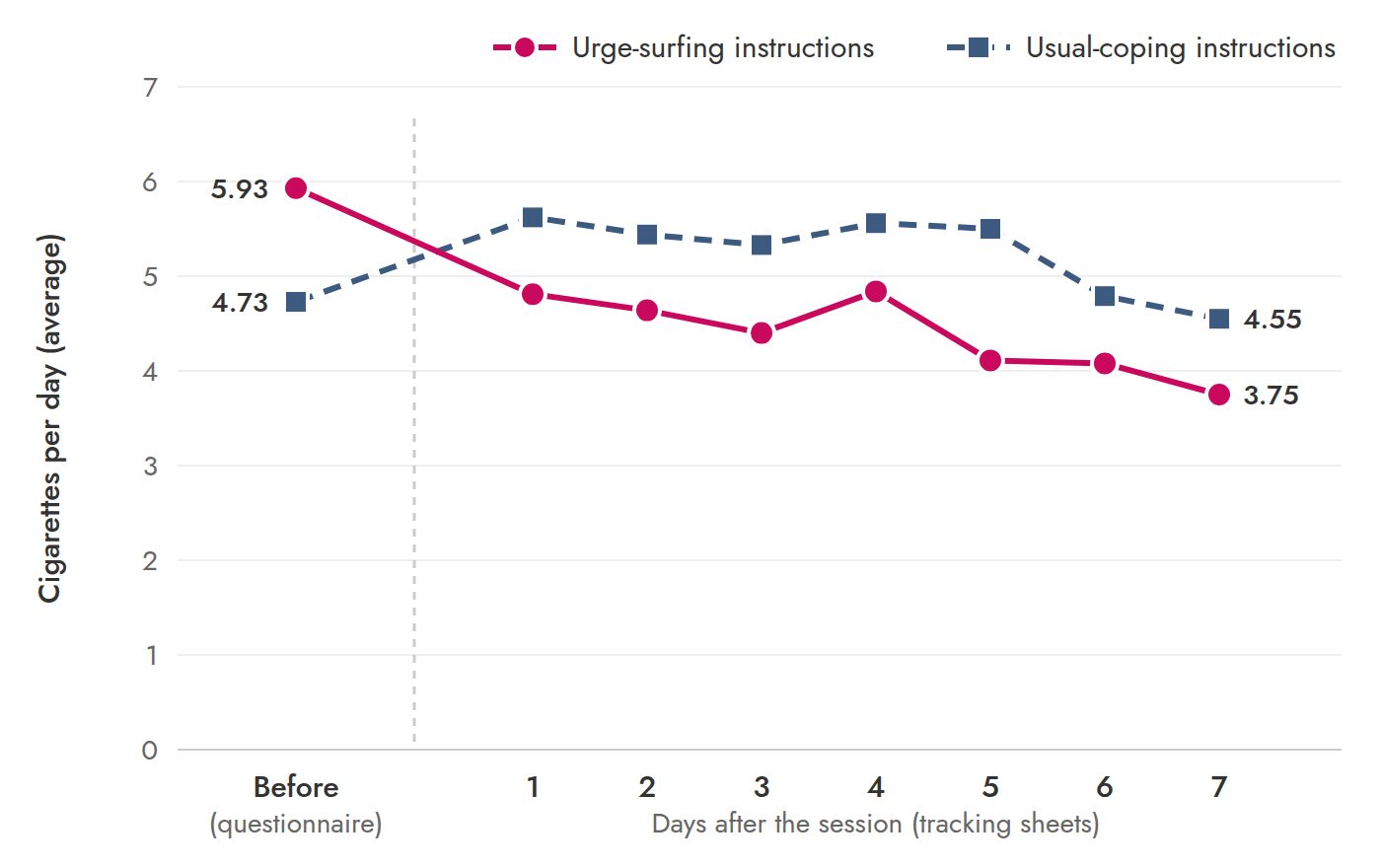
The urges themselves told a different story. According to the paper, the cue exposure did raise urges (p = 0.002; the test is confusingly labeled as an effect of treatment). But the two groups’ urges didn’t differ significantly during the session (p = 0.14), or when researchers called 24 hours later (p = 0.82) or a week later (p = 0.39). Negative mood didn’t differ at any point either. The paper reports these tests but not the average urge or mood scores, so we can’t see how large any differences were.
The authors’ reading is that mindfulness may change what people do with an urge rather than how strong it is:
This differential change in smoking behavior in the absence of differences in negative affect or urges may indicate changes in an individual’s response to these experiences following even brief training in mindfulness-based techniques.
That fits the instructions, which never promised to make urges go away. But the study didn’t measure how people responded to their urges, so it can’t confirm this mechanism, and the authors say the mechanisms “remain unclear.”
Miscellaneous Interesting Takeaways
Mood and Urges Came Apart
In an analysis the authors describe as post hoc (decided after seeing the data), they looked at how closely negative mood and urges went together at the 7-day call. In the control group, the two were closely linked (a
correlation
A correlation measures how closely two things rise and fall together across people or over time. Pearson’s r runs from −1 to +1: values near +1 mean that people high on one measure tend to be high on the other, values near −1 mean the reverse, and values near 0 mean no straight-line relationship. A correlation alone can’t show that one thing causes the other.
More on Wikipedia
Read more in the glossary
of r = 0.66): people in a worse mood also had stronger urges to smoke. In the mindfulness group, the link was much weaker (r = 0.29), and a test of
moderation
Moderation is when the strength of a link between two things depends on a third factor, called the moderator. For example, low mood might strongly predict craving in one treatment group but hardly at all in another; treatment group then moderates the link between mood and craving. Researchers test it with an interaction term in a regression. Combined with mediation analysis, it is called moderated mediation.
More on Wikipedia
Read more in the glossary
found this difference was significant (p = 0.022). The authors suggest that after the instructions, a bad mood didn’t trigger urges as strongly, or urges didn’t sour the mood as much.
This echoes a later finding from a quit-smoking trial, in which the link between how much smokers craved and how much they smoked almost vanished by the end of four weeks of mindfulness training. The two aren’t the same link, though: here it was mood and urges, there craving and cigarettes. And this one was a single unplanned test, a week after one session, with no average scores to show which way each group moved.
The Control Group’s Smoking Didn’t Fall
The text of the paper says the control group smoked 0.53 fewer cigarettes a day than at the start, an 11% decrease. But the daily averages in the paper’s own table add up to the opposite: 5.26 a day over the week, against 4.73 at the start, which is 0.53 more, an 11% increase. The mindfulness group’s 1.55-cigarette drop matches the same table exactly, so “fewer” looks like a slip. Either way, the control group didn’t cut back, and the abstract’s description of it as a “no-instruction control group” is also loose: the control students did get instructions, to cope with their urges in their usual way.
Who Benefited
The effect on smoking didn’t depend on how dependent people were on nicotine, or on gender, age or ethnic minority status. With a sample this small, though, these checks may have had little power to find differences, and the authors note that the dependence questionnaire was unreliable in this group (
Cronbach’s alpha
Cronbach’s alpha is a measure of how consistently a set of questionnaire items measures the same thing, based on how strongly people’s answers to them go together. It runs from 0 to 1; values of about 0.7 or higher are usually considered acceptable for research.
More on Wikipedia
Read more in the glossary
of 0.30, where about 0.7 is usually considered acceptable). Light, irregular smoking may make its questions a poor fit for students.
What the Design Can’t Show
The authors list several limits themselves, and are candid about the size of the effect:
Additionally, although the observed reduction in self-reported smoking over the 7-day follow-up period was statistically significant, the change was small in magnitude (i.e., a reduction of 1.55 cigarettes from the baseline assessment). This potentially limits the clinical significance of this finding.
Others they note: all measures were self-reported, with no breath test for carbon monoxide to check smoking. The students were young, mostly male, light smokers who weren’t seeking treatment and weren’t trying to quit. And there was no measure of whether the instructions actually made anyone more mindful.
A few more points are worth keeping in mind:
- A week is short. The paper doesn’t say whether participants were asked to keep practicing, or whether anyone did. Whether a single recording could have any lasting effect is unknown.
- The groups started differently, and were measured differently. The mindfulness group smoked more to begin with (5.93 against 4.73 cigarettes a day, not a significant difference). The analysis adjusted for this, but a group that starts higher has more room to fall, and some of the drop could be
regression to the mean
Regression to the mean is the tendency for unusually high or low measurements to be followed by ones closer to average, because part of any single measurement is chance. People who score as very stressed on a questionnaire one week will, on average, score a little less stressed the next, with or without treatment. In a trial, a group that happens to start out worse can therefore seem to improve more, which is one reason researchers compare against a control group and adjust for starting scores.
More on Wikipedia
Read more in the glossary . The starting figure also came from the opening questionnaire, while the follow-up figures came from daily tracking sheets, so the two may not be strictly comparable. - Sessions, not people, were assigned. Conditions alternated by time slot rather than being assigned to each person by chance. Students who shared a session also shared a condition.
- Expectations. Participants were told the study compared ways of coping with craving, and the mindfulness group was given a new technique while the control group was told to do what it always did. Students reporting their smoking by phone may have guessed which answer was hoped for, a form of
demand characteristics
Demand characteristics are cues in an experiment that hint at what the researchers expect, which can lead participants to behave the way they think they are supposed to rather than how they normally would. Researchers reduce them by disguising the study’s purpose, measuring behavior unobtrusively, or using comparison conditions that seem just as plausible.
More on Wikipedia
Read more in the glossary .
Final Reflection
This small study was an early controlled test of urge surfing on its own, outside a larger treatment program. A few minutes of recorded instructions didn’t make urges any weaker, but students who heard them smoked somewhat less over the following week. The idea that mindfulness changes the response to a craving rather than the craving itself reappears in later work, from a brain-scanning study in which mindful attention to smoking pictures eased craving only slightly, to the decoupling of craving from smoking seen in a quit-smoking trial.
The evidence here is preliminary. The effect was about one and a half cigarettes a day, self-reported, in light-smoking students, for one week, after a single session. Fuller programs have since been tested: a four-week mindfulness course helped more smokers quit than a standard program, and Bowen and colleagues went on to develop mindfulness-based relapse prevention, an eight-week program for people recovering from addiction. This study is best read as an early proof of concept: a brief, cheap instruction seemed to nudge behavior, and it raised the question of how noticing an urge, rather than fighting it, might loosen its grip.
Citation
Bowen, S., & Marlatt, A. (2009). Surfing the urge: Brief mindfulness-based intervention for college student smokers. Psychology of Addictive Behaviors, 23(4), 666–671. 10.1037/a0017127
Get the next summary by email
One or two new paper summaries every couple of weeks, sent to your inbox when they go up.
No spam, and you can unsubscribe at any time. Prefer a feed reader? Use the RSS feed.