
Background Information
Many studies have found that meditation can take the edge off emotional reactions, mostly using pictures. After eight weeks of mindful-attention training, for example, the amygdala reacted less to emotional photos. Words are a different kind of emotional material: their feeling comes through their meaning, which the authors call a higher-level representation. Larissa Lusnig, Markus Hofmann and colleagues at the University of Wuppertal in Germany found no earlier study of whether meditation changes how people process emotional words.
They chose
Zen
Zen is a school of Mahayana Buddhism that developed in China (as Chan) and spread to Japan, Korea and Vietnam. Its central practice is seated meditation (zazen), such as shikantaza, “just sitting” in open awareness without a particular object, or working with koans, paradoxical questions meant to cut through ordinary conceptual thinking.
More on Wikipedia
Read more in the glossary
meditation, which the authors group with
mindfulness
Mindfulness is the psychological process of purposely bringing one’s attention to experiences occurring in the present moment without judgment. It involves maintaining awareness of thoughts, feelings, bodily sensations, and surrounding environment with an attitude of curiosity and acceptance. In meditation contexts, mindfulness practices typically involve focusing attention on the breath or body sensations as anchors to the present moment while acknowledging and releasing distracting thoughts.
More on Wikipedia
Read more in the glossary
as
open monitoring
Open monitoring is a style of meditation in which attention isn’t fixed on any one object. You stay aware of whatever arises from moment to moment, such as sounds, sensations and thoughts, and let each come and go without reacting to it, holding on to it or pushing it away. Researchers often contrast it with focused attention meditation.
Read more in the glossary
practice. In the Japanese Soto Zen tradition, practitioners sit facing a wall with their eyes half open, alternating seated meditation (zazen) with short periods of walking meditation (kinhin). The authors describe a central part of the practice:
Thoughts, which naturally cross the mind during Zen meditation, are not judged as “good” or “bad” by the meditator.
If a meditation session made people less inclined to sort experience into good and bad, it might show up in how they judge the emotional tone of words. The researchers tested that in two ways. One was explicit: simply asking people how positive or negative each word was, its
valence
In psychology, valence is how pleasant or unpleasant something is, from negative through neutral to positive. Together with arousal, it is one of the two main dimensions researchers use to describe emotions and emotional material such as words, pictures and sounds. Word lists used in research give each word an average valence rating collected from many people, and in experiments people are often asked to rate it themselves on a scale running from very negative to very positive.
More on Wikipedia
Read more in the glossary
. The other was implicit. In a
lexical decision task
A lexical decision task is a standard psychology test in which a person sees a string of letters and decides, usually by pressing a button, whether it is a real word or a made-up one that could be pronounced but means nothing. Researchers use it to study how words and their meanings are recognized: comparing the responses to real words and to nonwords isolates what the meaning adds.
More on Wikipedia
Read more in the glossary
, people only decide, as fast as they can, whether a string of letters is a real word. Nobody asks about emotion, but a word’s emotional content still nudges how quickly it is recognized. In an earlier study using the same word set, Hofmann’s group had found that calm negative words (low in
arousal
In emotion research, arousal is how stirring or calming something is, from quiet and low-energy to excited or alarmed, whatever its valence. Words like “panic” and “sadness” are both negative, for example, but panic is high in arousal and sadness low. Along with valence, it is one of the two main dimensions used to describe emotions and emotional words, pictures and sounds.
More on Wikipedia
Read more in the glossary
) were recognized more slowly than neutral words, while positive and highly arousing negative words were recognized faster.
What They Did
Twenty Zen practitioners were recruited at meditation centers in North Rhine-Westphalia, Germany. They were 19 to 53 years old (average 33), 9 were women, and they had meditated for 7.9 years on average (from half a year to 28 years), for about 4.3 hours a week. Twenty people of similar age and gender, recruited at the university or online, formed the comparison group (9 women, 18 to 56 years old, average 34.5). None had any meditation or yoga experience. All were native German speakers.
The words were 200 German nouns in four groups, carefully matched for features that affect how fast words are read, such as length and how common they are: highly arousing negative, calm negative, neutral, and positive words. (The word list didn’t have enough highly arousing positive nouns to form a fifth group.) Each participant did the task twice, once before and once after a session, with a different half of the words (100 words and 100 nonwords) each time, the halves swapped for half of the people. On each trial a letter string appeared for one second, and participants had to press a button within that second to say whether it was a word. About five minutes after each task, they rated every word they had just seen on a scale from −3 (very negative) through 0 (neutral) to +3 (very positive).
Between the two rounds, the groups did different things. The meditators took part in a 1.5-hour Zen session: two 25-minute periods of zazen, each followed by 5 minutes of kinhin, plus about 30 minutes of recited
mantras
A mantra is a sound, word or phrase that is repeated, aloud or silently, as a spiritual or meditative practice. Mantras are central to Hindu and Buddhist traditions and appear in many others. In mantra meditation, the repetition itself serves as the object of attention, and practitioners often describe it as calming.
More on Wikipedia
Read more in the glossary
, such as the Heart Sutra. The comparison group watched a 90-minute nature documentary, Unsere Erde (“Our Earth”), chosen as interesting but calm and not arousing.
Everyone also took a personality questionnaire, a concentration test and a vocabulary-based intelligence test. The groups didn’t differ in concentration or intelligence, but the meditators scored higher on
openness to experience
Openness to experience is one of the five broad personality traits in the widely used Big Five model. People high in openness tend to be imaginative, curious, attentive to their inner feelings, drawn to variety and new ideas, and sensitive to art and beauty. It is measured with personality questionnaires such as the NEO Five-Factor Inventory.
More on Wikipedia
Read more in the glossary
(6.35 vs. 4.45) and lower on “need for achievement and performance” (4.00 vs. 5.20), so the researchers included both scores in every analysis. The data were analyzed with
mixed-effects models
A mixed-effects model is a statistical method for data in which the same people are measured many times, such as a daily rating over a month. It separates effects that apply to everyone, such as which group a person was in, from each person’s own baseline and ups and downs, so that people who contributed more days don’t count as extra independent evidence and people who skipped days can still be included.
More on Wikipedia
Read more in the glossary
that account for differences between people and between words.
One Big Result: After Meditating, Emotional Words Were Rated Closer to Neutral
After the Zen session, the meditators rated the emotional words as less emotional than before. Negative words, both highly arousing and calm ones, were rated as less negative, and positive words as less positive. The comparison group’s ratings were essentially the same after the film as before.
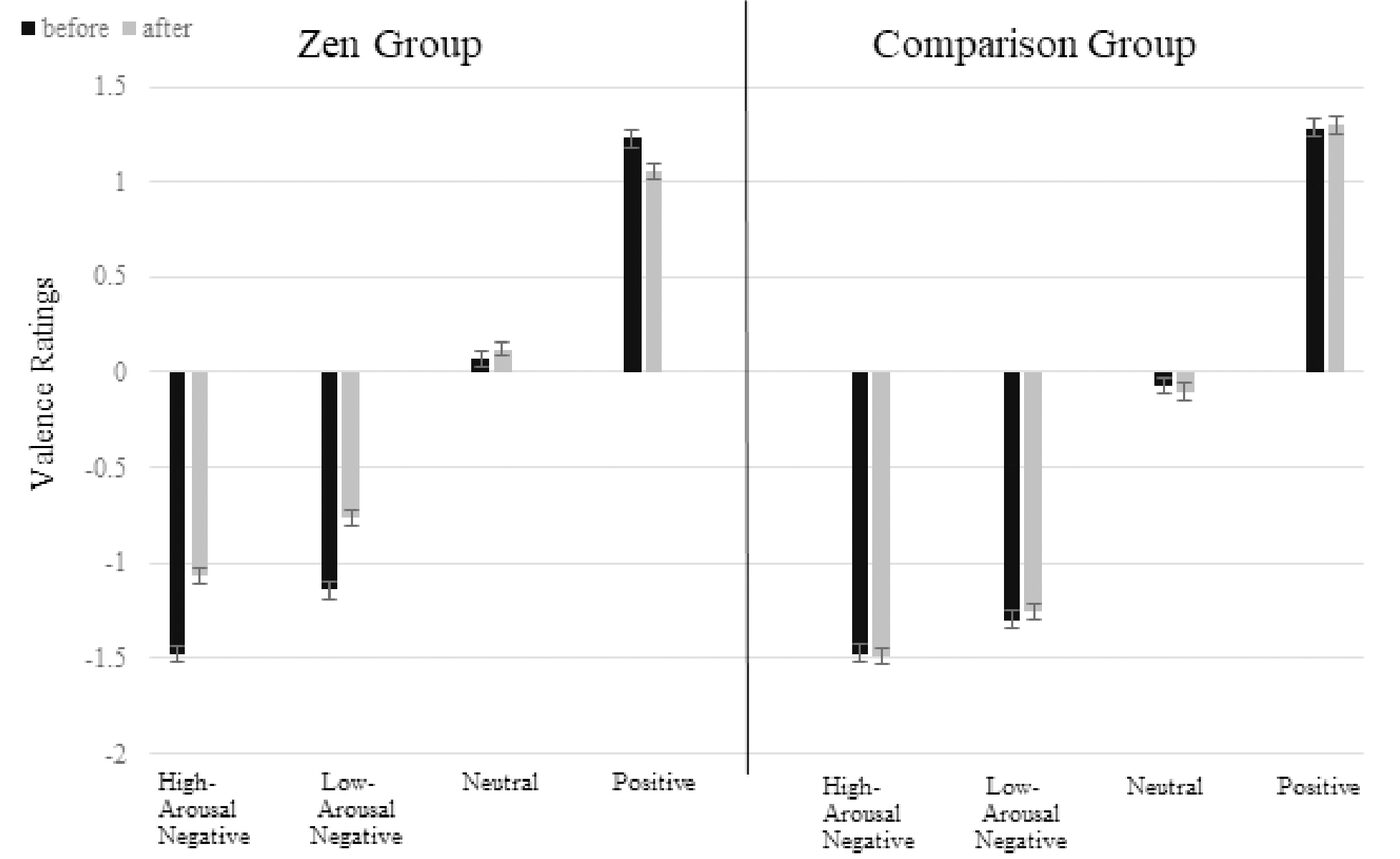
In statistical terms, the change from before to after differed between the groups for all three kinds of emotional word (p ≤ .003 for each). Within the Zen group, the shift toward neutral was significant for each kind of word (p < .001), while none of the comparison group’s changes came close to significance. The paper reports these results as regression estimates rather than average ratings, so the size of the shift is best seen in the figure. Leaving out the personality scores, or adding two others on which the groups differed slightly, didn’t change which results were significant.
The authors’ explanation is
emotion regulation
Emotion regulation is the set of ways people influence which emotions they have, when they have them, and how they experience and express them. Psychologist James Gross’s process model groups the strategies into five families: choosing situations, changing situations, shifting attention (attentional deployment), changing how one thinks about a situation (reappraisal), and changing one’s response, such as suppressing an expression.
More on Wikipedia
Read more in the glossary
: Zen practice trains people not to judge thoughts as positive or negative, and after a session the meditators judged words less strongly. But the implicit measure told a different story:
Even though the explicit evaluation of words was affected by meditation, we found no effects of meditation in the lexical decision task, where affective evaluation was not explicitly required.
Miscellaneous Interesting Takeaways
The Meditators Got Faster at Recognizing Every Kind of Word
Although the words’ emotional tone affected recognition no differently after meditation, the meditators recognized all the words faster after their session (p < .001), whatever their emotional tone. The comparison group’s speed didn’t change significantly after the film (p = .275). The authors suggest that the session freed up attention, perhaps because the meditators were less distracted by the words’ emotional content, were more focused, or let their minds wander less.
There is a wrinkle, which the authors raise themselves:
The descriptive data might appear to suggest that meditators demonstrated, before the interventions, generally slower RTs than comparison subjects did.
In their chart of response times, the meditators look slower than the comparison group before the session and about as fast afterward. The authors tested this, and the groups’ response times didn’t differ significantly either before or after the sessions. So the meditators sped up relative to their own starting point, but they didn’t end up faster than people who hadn’t meditated.
Calm Negative Words Slowed Everyone Down
Both groups recognized calm negative words more slowly than neutral ones, before and after the sessions, repeating the result of Hofmann’s earlier study. The other two earlier findings, faster recognition of positive and highly arousing negative words, didn’t appear in either group. The authors argue that the gap isn’t just a matter of the small sample, since the test statistics didn’t even lean that way, and suggest that the earlier study’s setup (participants were having
EEG
An electroencephalogram (EEG) is a recording of brain activity. During this painless test, small sensors are attached to the scalp to pick up the electrical signals produced by the brain.
More on Wikipedia
Read more in the glossary
electrodes attached, which may be mildly stressful) might have strengthened those effects.
Why Would Meditation Change One Measure but Not the Other?
The authors’ answer is time. In the rating task, people could take as long as they liked to weigh each word’s feeling. In the lexical decision task, they had one second to respond, which may have limited the task to the earliest, automatic stage of processing a word’s emotional meaning, before the slower, more evaluative stage that meditation may influence. They propose testing Zen meditators on emotional words with less time pressure, in a task that draws on those later, evaluative stages. On this account, a single session changed how people judge emotional words when they stop to think, not the split-second emotional pull of the words themselves.
Zen Meditators and Words, Another Look
This isn’t the only study of Zen practitioners judging letter strings. In an earlier
fMRI
An fMRI (functional Magnetic Resonance Imaging) measures changes in blood flow related to neural activity in the brain, offering insights into brain function and activity patterns.
More on Wikipedia
Read more in the glossary
study, Zen meditators doing a lexical decision task while focusing on their breath showed a shorter-lived response to word meanings in parts of the
default mode network
The default mode network (DMN) is a system of connected brain areas that show increased activity when a person is not focused on what is happening around them, such as during daydreaming and mind-wandering. It can also be active when the individual is thinking about others or themselves, remembering the past, and planning for the future.
More on Wikipedia
Read more in the glossary
than non-meditators did, a finding the authors cite when suggesting that less
mind-wandering
Mind wandering is the spontaneous shift of attention away from a current task or external environment to internally generated thoughts, memories, or fantasies. This common cognitive process is associated with default mode network activation and has been extensively studied in relation to meditation practices, which often aim to reduce mind wandering.
More on Wikipedia
Read more in the glossary
may have sped up their meditators. A different kind of evidence comes from students taking a meditation course, who came to recall more positive words than students in other courses.
Some Questions the Design Leaves Open
The two groups differed in two ways at once: who they were (experienced meditators vs. people who had never meditated) and what they did between the two rounds (a Zen session that included chanting vs. a film). That means the study can’t say whether the shift came from the meditation itself or from something else about the meditators’ 90 minutes, or whether beginners would show it after a first session. The groups weren’t randomly assigned, and they differed in personality; the researchers handled that statistically, but other unmeasured differences could remain. The ratings are self-reports, and the meditators knew they had just meditated, so their expectations can’t be ruled out as part of the effect. With 20 people per group, a single session and no later follow-up, it’s also unknown how long the shift lasted.
Final Reflection
This small study asked a precise question: does a meditation session change how people respond to emotional words, and if so, at which stage? Its answer splits in two. When experienced Zen meditators stopped to rate how positive or negative words were, they rated them more neutrally after 90 minutes of practice, while non-meditators who watched a film didn’t change. When the same words flashed up for a one-second word-or-not decision, their emotional tone affected the meditators just as much as before, though the meditators responded faster overall.
The authors read this as the session changing a later, evaluative stage of processing rather than the earliest, automatic one, which echoes the Zen instruction to notice thoughts without labeling them good or bad. But this is one session in 20 experienced meditators compared with 20 non-meditators doing something else entirely, so the clearest conclusion is a modest one: right after their practice, these meditators judged emotional words less strongly, and whether that comes from the practice itself or would be seen in newcomers remains to be tested.
Citation
Lusnig, L., Radach, R., Mueller, C. J., & Hofmann, M. J. (2020). Zen meditation neutralizes emotional evaluation, but not implicit affective processing of words. PLoS ONE, 15(2), e0229310. 10.1371/journal.pone.0229310
Get the next summary by email
One or two new paper summaries every couple of weeks, sent to your inbox when they go up.
No spam, and you can unsubscribe at any time. Prefer a feed reader? Use the RSS feed.