
Background Information
People who are depressed or anxious tend to process emotional information in a lopsided way. Their attention and memory lean toward negative things and away from positive ones, while healthy, happy people tend to have a mild bias toward the positive. Losing that positive tilt, or gaining a negative one, predicts later episodes of depression and anxiety. Treatments that shift these biases, from
cognitive behavioral therapy
Cognitive behavioral therapy (CBT) is a structured, usually short-term talk therapy that helps people notice and change unhelpful patterns of thinking and behavior. It is one of the most thoroughly tested psychological treatments and a first-line option for depression, anxiety disorders and many other conditions.
More on Wikipedia
Read more in the glossary
to antidepressants to
cognitive bias modification
Cognitive bias modification (CBM) is a set of training exercises, often simple computer tasks, that aim to change automatic habits of attention or interpretation, such as a tendency to notice threats first or to read ambiguous situations negatively. People practice, for example, shifting their attention toward neutral or positive pictures and away from negative ones. It has been studied as a treatment for anxiety and depression.
More on Wikipedia
Read more in the glossary
(computer exercises that train attention toward positive or away from negative material), tend to ease symptoms as they do so.
Douglas Roberts-Wolfe, Willoughby Britton and colleagues at Brown University wondered whether meditation might work partly the same way. A central feature of meditation is training attention, and the authors suggest it may strengthen the brain’s top-down control over emotional reactions. If so, meditators might come to process emotional information differently, and that might help explain why meditation often improves well-being.
The few earlier studies on the question had clear gaps. One tested people only after a mindfulness course, so it couldn’t show change; another used a single 12-minute breathing exercise just before the test, which says little about longer training. And their comparison groups did nothing comparable, so any effect could have come from effort, expectation or simply being in a group. This study measured people before and after 12 weeks of training and compared them with students in courses chosen to be similar.
What They Did
The researchers recruited 58 undergraduates (28 women, average age 20) from three kinds of courses between 2008 and 2010. Thirty-five took a course that included “meditation laboratories.” The other 23, an
active control group
An active control group is a comparison group that takes part in a different program designed to be just as engaging as the one being tested. In meditation research, it might involve exercise, music, or education classes with the same time commitment, teachers, and expectations of benefit. Comparing against an active control helps separate the effects of meditation itself from the general effects of joining a course.
More on Wikipedia
Read more in the glossary
, took either music courses with practice labs (a similar mix of lectures and hands-on practice) or religious studies or East Asian studies courses with similar content but no meditation, some taught by the same professor and some voted by students as “inspirational and transformative.” The paper doesn’t say how many students came from each kind of comparison course. Students chose their own courses; nobody was randomly assigned.
The meditation labs met for an hour three times a week. Each included about 30 minutes of practice from Buddhist or Taoist traditions, followed by 5 to 10 minutes of written reflection and questions. They were taught by the course professor, Harold Roth, a scholar of Buddhist and Taoist contemplative practice and a co-author, with more than 30 years of
Zen
Zen is a school of Mahayana Buddhism that developed in China (as Chan) and spread to Japan, Korea and Vietnam. Its central practice is seated meditation (zazen), such as shikantaza, “just sitting” in open awareness without a particular object, or working with koans, paradoxical questions meant to cut through ordinary conceptual thinking.
More on Wikipedia
Read more in the glossary
practice. Students practiced both
Shamatha
Shamatha (Pali samatha, “calm abiding”) is a Buddhist family of concentration practices that train attention to settle and stay on a chosen object, such as the sensations of the breath. Practitioners notice when the mind has wandered and bring it back, aiming for attention that is both stable and vivid. It is often paired with vipassana, or insight, practice.
More on Wikipedia
Read more in the glossary
and
Vipassana
Vipassana is a form of Buddhist meditation focused on the cultivation of insight through moment-to-moment awareness of bodily sensations, thoughts, and emotions. It emphasizes non-reactivity and equanimity, helping practitioners observe mental and physical phenomena without attachment.
More on Wikipedia
Read more in the glossary
: holding attention on one object, like the breath, or on a class of objects, like body sensations, but not open, objectless awareness. Although the paper calls this
mindfulness
Mindfulness is the psychological process of purposely bringing one’s attention to experiences occurring in the present moment without judgment. It involves maintaining awareness of thoughts, feelings, bodily sensations, and surrounding environment with an attitude of curiosity and acceptance. In meditation contexts, mindfulness practices typically involve focusing attention on the breath or body sensations as anchors to the present moment while acknowledging and releasing distracting thoughts.
More on Wikipedia
Read more in the glossary
training, its emphasis differed from courses such as
MBSR
Mindfulness-Based Stress Reduction (MBSR) is a program designed to help individuals cope with stress, pain, and illness. Developed by Jon Kabat-Zinn in the 1970s, it combines meditation and yoga to promote awareness and stress management. The eight-week program teaches participants to focus on the present moment non-judgmentally, enhancing their ability to manage difficulties.
More on Wikipedia
Read more in the glossary
:
Meditation instruction emphasized attention allocation rather than the acceptance that is central to Western styles of mindfulness, although it incorporated ideals of letting go of evaluation.
At the start and end of the 12-week course, everyone did an emotional memory task. They saw one list of words on a screen and heard a second list read aloud. Each list had six positive words, six negative and six neutral, plus neutral “buffer” words at the start and end, and the lists were balanced for word length, how common the words are and how strongly they stir people up. Participants rated each word for pleasantness and
arousal
In emotion research, arousal is how stirring or calming something is, from quiet and low-energy to excited or alarmed, whatever its valence. Words like “panic” and “sadness” are both negative, for example, but panic is high in arousal and sadness low. Along with valence, it is one of the two main dimensions used to describe emotions and emotional words, pictures and sounds.
More on Wikipedia
Read more in the glossary
, which made them think about it. They had been told only that they “may be asked to recall these words sometime in the future,” but right after each list they were asked to recall as many words as they could, in any order (
free recall
Free recall is a memory test in which people study a list of items, such as words, and then report as many as they can remember, in any order, with no hints. It measures what people can bring back to mind on their own. Because it captures only the end result, it can’t by itself show whether a difference comes from what people noticed, how they stored the items or how they retrieved them.
More on Wikipedia
Read more in the glossary
). Counts were added across both lists, so a person could recall up to 12 words of each kind. Different word lists were used before and after.
Participants also completed two questionnaires: the Scales of Psychological Well-Being, which covers self-acceptance, purpose in life, personal growth, good relationships, autonomy and mastery of daily life, and the Mood and Anxiety Symptom Questionnaire, which measures symptoms of depression and anxiety.
One Big Result: Meditators’ Recall of Positive Words Rose to Match the Comparison Group’s
Meditators recalled more positive words after the course than before: on average 4.0 of 12 at the start and 4.9 at the end, a significant rise. The comparison group went slightly the other way, from 5.4 to 4.9, a change that wasn’t statistically significant. The difference between the two groups’ changes was significant (p = .013), with an
effect size
Effect size is a statistical concept that quantifies the magnitude or strength of a relationship, difference, or intervention outcome. Unlike p-values which only indicate statistical significance, effect sizes measure how meaningful a result is in practical terms. Common measures include Cohen’s d (standardized mean difference), correlation coefficients (r), and odds ratios. In meditation research, effect sizes help quantify the practical impact of different meditation practices on psychological or physiological outcomes.
More on Wikipedia
Read more in the glossary
between medium and large by the benchmarks the paper uses (partial η² = 0.11). There was no change of note in negative words, neutral words or the total recalled, so meditators weren’t simply remembering more of everything.
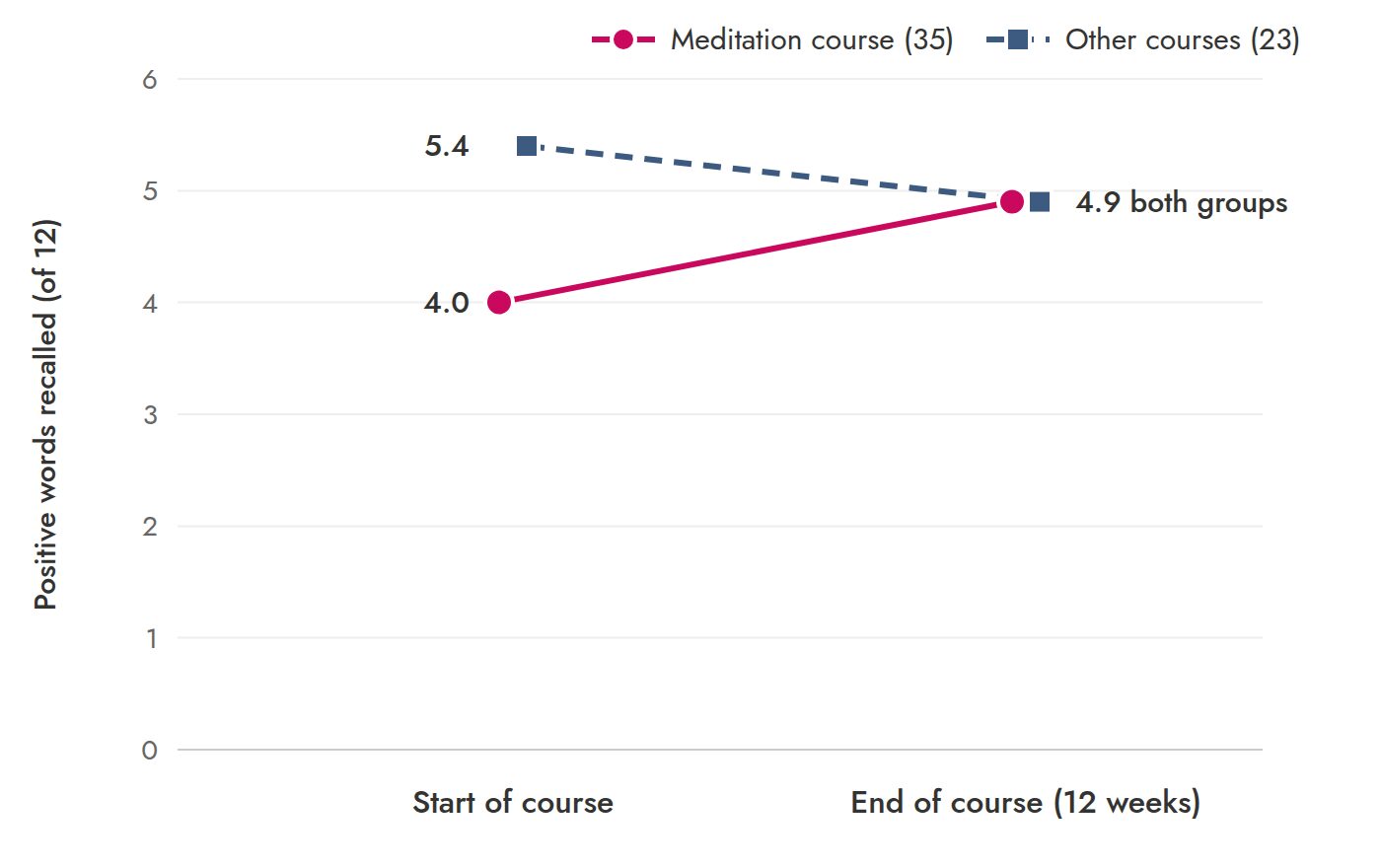
The authors read this as a shift in emotional processing:
This increase in positive words occurred in the context of no change in either total word or negative word recall, which suggests an increased efficiency in positive information processing.
The chart shows the important catch. The two groups didn’t start level: the comparison students recalled significantly more positive words at the outset (p = .003), and by the end the groups were the same. The authors point out that when a group starts unusually low, its scores can drift up on retesting with no help from the intervention, a statistical effect called
regression to the mean
Regression to the mean is the tendency for unusually high or low measurements to be followed by ones closer to average, because part of any single measurement is chance. People who score as very stressed on a questionnaire one week will, on average, score a little less stressed the next, with or without treatment. In a trial, a group that happens to start out worse can therefore seem to improve more, which is one reason researchers compare against a control group and adjust for starting scores.
More on Wikipedia
Read more in the glossary
:
These baseline differences raise the possibility that the meditators’ disproportionate increase in positive word recall may be a form of regression to the mean.
They offer two reasons the groups might have differed at the start. The music students were fairly advanced, with hundreds of hours of practice, and music training is linked to stronger
executive function
Executive functions are the mental skills used to control and direct thinking and behavior toward a goal. The three core ones are usually given as inhibitory control (holding back an automatic response or ignoring a distraction), working memory (keeping information in mind and using it) and cognitive flexibility (switching between rules, tasks or points of view). They develop rapidly in early childhood, rely heavily on the prefrontal cortex, and predict how well children do at school.
More on Wikipedia
Read more in the glossary
. And some students may have chosen the meditation course because they were struggling emotionally and hoped it would help. Either way, because students picked their own courses (
self-selection
Self-selection bias arises when people decide for themselves whether to take part in a study, so those who do may differ from those who don’t in ways that affect the results. A survey advertised as being about the unwanted effects of meditation, for example, may draw more people who have had such effects, making them look more common than they are among meditators in general.
More on Wikipedia
Read more in the glossary
), the groups may have differed in ways the study couldn’t measure.
Miscellaneous Interesting Takeaways
Well-Being Rose in the Meditation Group
On the well-being questionnaire, which can range from 84 to 504, meditators’ average score rose from 368.2 to 383.1, a significant gain, while the comparison group’s barely moved (373.2 to 371.2). The difference in change between the groups was significant (p = .013) and of the same size as for positive words (partial η² = 0.11). Depression and anxiety symptoms moved in the expected directions, falling slightly in meditators (121.3 to 118.1) and rising in the comparison group (118.7 to 123.9), but the difference between the groups fell short of significance (p = .088), and neither group’s change was significant by itself. The students’ symptoms were in the “mild” range to begin with, which the authors suggest left little room for improvement.
Positive Memory and Well-Being Moved Together
Across all 58 students, those whose recall of positive words rose more also tended to report larger gains in well-being (
correlation
A correlation measures how closely two things rise and fall together across people or over time. Pearson’s r runs from −1 to +1: values near +1 mean that people high on one measure tend to be high on the other, values near −1 mean the reverse, and values near 0 mean no straight-line relationship. A correlation alone can’t show that one thing causes the other.
More on Wikipedia
Read more in the glossary
r = 0.31) and larger drops in depression and anxiety symptoms (r = −0.29). Changes in negative or neutral word recall weren’t linked to either. These are modest correlations, and with only a before and an after measurement the authors say they can’t test whether better positive processing caused the gains in well-being (a
mediation analysis
Mediation analysis is a statistical method that tests whether a third variable helps explain the link between a cause and an effect, for example whether a brain change helps explain why a training program altered a health marker. It estimates how much of the overall effect runs through that variable. A significant result is consistent with a causal pathway but does not prove one on its own.
More on Wikipedia
Read more in the glossary
would need more time points).
More Positive, Not Less Negative
Earlier studies had found mindfulness reduced memory or attention biases toward negative or threatening material. Here, neither group changed in recall of negative words. The authors suggest that’s because these were healthy students without much negative bias to lose, and that a fading positive bias may come before a growing negative one as well-being declines, so positive processing might be the more sensitive early signal. The same pattern, more positive change than negative, showed up in the questionnaires too.
Possible Brain Pathways, Not Measured Here
The paper discusses several brain regions that could link meditation with a more positive memory bias, including the
amygdala
The amygdala is a pair of almond-shaped structures deep in the brain’s temporal lobes. It plays a central role in processing emotion, especially threat and fear. Meditation studies often look at how strongly the amygdala responds to emotional images, and sometimes at its size.
More on Wikipedia
Read more in the glossary
, prefrontal areas that help regulate it and the
insula
The insula is a region of cortex folded deep inside each side of the brain. It helps represent the body’s internal state (interoception) and is involved in emotion, empathy and compassion. Its front part, the anterior insula, comes up often in meditation research.
More on Wikipedia
Read more in the glossary
, which supports
interoception
Interoception is the sense of the body’s internal state: feeling your heartbeat, breathing, hunger, warmth, tension and other sensations from inside the body. Interoceptive awareness is how much attention a person pays to these signals. Practices such as the body scan, which moves attention through the body part by part, aim to strengthen it.
More on Wikipedia
Read more in the glossary
, the sense of the body’s internal state. In another paper on this same sample, the meditators showed greater body awareness than the comparison students. But this study didn’t scan anyone’s brain, so these links are the authors’ suggestions rather than findings.
What a Free Recall Test Can and Can’t Show
The authors argue that a memory test like this is less open than a questionnaire to
demand characteristics
Demand characteristics are cues in an experiment that hint at what the researchers expect, which can lead participants to behave the way they think they are supposed to rather than how they normally would. Researchers reduce them by disguising the study’s purpose, measuring behavior unobtrusively, or using comparison conditions that seem just as plausible.
More on Wikipedia
Read more in the glossary
, cues that nudge people to answer the way they think researchers expect. They also note its limit: because people only wrote down what they remembered, the test can’t tell whether meditation changed what they noticed, how they stored the words or how they retrieved them.
Final Reflection
This small study asked a sensible question: if meditation trains attention, does it change which emotional information sticks? After a semester of meditation labs, students remembered more positive words and reported more well-being, compared with students in other hands-on or similar-content courses, and the two changes went together. That fits with other work in this theme, such as a randomized trial in which a loving-kindness workshop gradually raised people’s daily positive emotions without changing negative ones.
But the headline finding is a convergence: the meditators started lower than the comparison students on positive recall and ended level with them. With self-selected groups and that starting gap, regression to the mean and differences in who chose meditation are real alternative explanations, as the authors themselves say. The practice taught also emphasized directing attention rather than the acceptance at the heart of standard mindfulness programs, and students’ practice outside class wasn’t recorded. The study is best read as an early, intriguing pointer that positive emotional processing might be one route by which meditation improves well-being, one that needs a randomized trial, as the authors call for, to test properly.
Citation
Roberts-Wolfe, D., Sacchet, M. D., Hastings, E., Roth, H., & Britton, W. (2012). Mindfulness training alters emotional memory recall compared to active controls: Support for an emotional information processing model of mindfulness. Frontiers in Human Neuroscience, 6, 15. 10.3389/fnhum.2012.00015
Get the next summary by email
One or two new paper summaries every couple of weeks, sent to your inbox when they go up.
No spam, and you can unsubscribe at any time. Prefer a feed reader? Use the RSS feed.