
Background Information
Most studies of meditation and the brain’s structure are small. They compare a few dozen long-term meditators with non-meditators, or scan a few dozen beginners before and after a course. A recurring target is the
amygdala
The amygdala is a pair of almond-shaped structures deep in the brain’s temporal lobes. It plays a central role in processing emotion, especially threat and fear. Meditation studies often look at how strongly the amygdala responds to emotional images, and sometimes at its size.
More on Wikipedia
Read more in the glossary
, a pair of almond-shaped structures deep in the brain that flag threats and help set off the stress response. In one widely cited study, people whose stress fell most during a
mindfulness
Mindfulness is the psychological process of purposely bringing one’s attention to experiences occurring in the present moment without judgment. It involves maintaining awareness of thoughts, feelings, bodily sensations, and surrounding environment with an attitude of curiosity and acceptance. In meditation contexts, mindfulness practices typically involve focusing attention on the breath or body sensations as anchors to the present moment while acknowledging and releasing distracting thoughts.
More on Wikipedia
Read more in the glossary
course showed the largest drops in
gray matter
Gray matter is brain tissue made up mostly of nerve cell bodies and their connections. It forms the brain’s outer layer (the cortex) and several deeper structures. Structural MRI can estimate gray matter volume (how big a region is), density (how concentrated the tissue is), and cortical thickness (how deep the outer layer is).
More on Wikipedia
Read more in the glossary
density in part of the right amygdala (Hölzel et al., 2010). Another target is the
hippocampus
The hippocampus is a curved structure deep in each temporal lobe of the brain. It is essential for learning and forming new memories, and it also helps regulate emotion and the stress response. It can change with experience, and it tends to be smaller in people with long-term depression or post-traumatic stress disorder.
More on Wikipedia
Read more in the glossary
, which is central to memory; some studies have found it larger in meditators (Luders et al., 2009).
As the authors of this study pointed out, all of this earlier work had been done either in patient groups or in small samples of healthy young volunteers, and no study had looked at a whole population. They had access to one. The Rotterdam Study is a long-running Dutch
cohort study
A cohort study follows a defined group of people, the cohort, over time, measuring their characteristics and habits and recording what happens to them. Because the researchers don’t assign anything, it can show which things go together and which come first, but not on its own that one causes the other. Large population cohorts often invite everyone above a certain age in a district and re-examine them every few years.
More on Wikipedia
Read more in the glossary
of 14,926 people aged 45 and over, re-examined every two to three years, and since 2005 its participants have been invited for brain scans. That made it possible to ask, in ordinary people rather than volunteers recruited for a meditation study, whether those who practice meditation or yoga differ in stress, mood and the size of the amygdala and hippocampus.
What They Did
The researchers included everyone examined at the research center between 2008 and 2013 who had answered questions about meditation and yoga and had a brain MRI. After excluding people with stroke, dementia or Parkinson’s disease and those with unusable scans, 3,742 remained. Their average age was 64, and 55% were women.
In a home interview, trained interviewers asked whether people practiced any of three kinds of activity: “looking for stillness inside oneself,” meditation or mindfulness (grouped as meditation); yoga, tai chi, qigong or a similar movement therapy (grouped as yoga); or relaxation or breathing exercises. They also asked how many hours a week and how many years people had practiced, and whether the practice helped them cope with stress. Practitioners were defined as people who practiced for at least an hour a week and for at least a year. Those who practiced less were counted with the non-practitioners.
Each person had an MRI scan, and software measured the volume of the left and right amygdala and hippocampus. Stress was a single question (“how much stress do you experience,” rated from 1, not at all, to 5, very much). Depressive symptoms were measured with the
CES-D
The Center for Epidemiologic Studies Depression Scale (CES-D) is a 20-item questionnaire asking how often, over the past week, people have had symptoms of depression such as poor sleep, low mood or feeling that everything was an effort. Total scores range from 0 to 60, with higher scores meaning more symptoms. It was designed for screening and research in the general population, not for diagnosing depression.
More on Wikipedia
Read more in the glossary
and anxiety with the anxiety items of the Hospital Anxiety and Depression Scale (HADS-A).
The comparisons of brain volume were adjusted for age, sex, education and the space inside the skull (intracranial volume), and the main regression analyses also for cardiovascular risk factors (such as blood pressure, cholesterol, diabetes, smoking and alcohol), depression, anxiety and stress. For a look over time, the researchers turned to the 2,397 participants who had also had a brain scan five years earlier, and counted as practitioners the 218 (9%) who had practiced for five years or more. They analyzed both scans together with a
mixed-effects model
A mixed-effects model is a statistical method for data in which the same people are measured many times, such as a daily rating over a month. It separates effects that apply to everyone, such as which group a person was in, from each person’s own baseline and ups and downs, so that people who contributed more days don’t count as extra independent evidence and people who skipped days can still be included.
More on Wikipedia
Read more in the glossary
.
One Big Result: Practitioners’ Right Amygdala Was About 2% Smaller
Of the 3,742 people, 588 (15.7%) reported some form of practice, and 289 met the cutoff of an hour a week for at least a year. Meditation was the most common (159 people), then yoga or similar (98) and breathing exercises (75); 43 did more than one. Practitioners had kept at it for a median of 10 years. They were younger (61.9 versus 64.3 years on average), more often women (73% versus 53%) and better educated than non-practitioners.
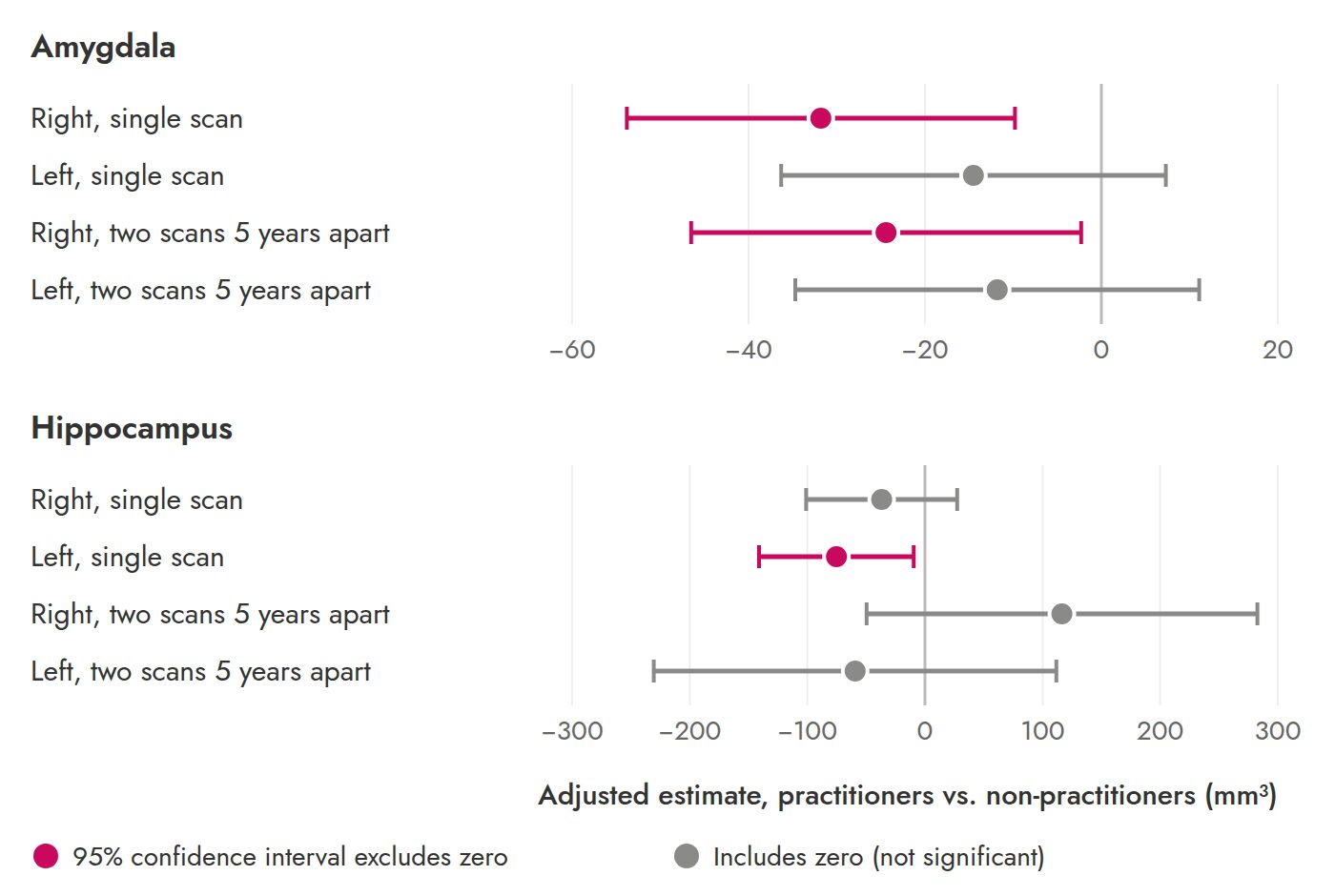
Their brains were no larger or smaller overall (943.1 versus 940.4 milliliters). But after adjusting for age, sex, education and intracranial volume, their right amygdala averaged 1,386.8 cubic millimeters, against 1,415.8 in non-practitioners (p < .01), a difference of about 2%. The left amygdala didn’t differ significantly (1,321.4 versus 1,334.8). With all the adjustments, including stress, depression and anxiety, practice was linked to a right amygdala 31.8 cubic millimeters smaller (95%
confidence interval
A confidence interval is the range of values that a study’s data are consistent with, given the uncertainty that comes from measuring a limited sample. A 95% confidence interval for an effect of 0.30 running from 0.00 to 0.59, for example, means the true effect could plausibly be anywhere from nothing to moderate. Narrower intervals mean more precise estimates; an interval that includes zero means the study can’t rule out no effect.
More on Wikipedia
Read more in the glossary
9.8 to 53.8 smaller, p = .005).
In the 2,397 people with two scans, the right amygdala showed a similar link. In the mixed-effects model with all the adjustments, practicing for five years or more was again linked to a smaller right amygdala, by an estimated 24.4 cubic millimeters (95% confidence interval 2.3 to 46.5, p = .031), a result the authors describe as “a significant interaction over time.” The paper doesn’t report each group’s volume at each scan, so it doesn’t show whether practitioners’ right amygdala shrank more over the five years or was smaller at both scans. And since these practitioners had practiced for at least five years, this is not a look at people before and after they took up practice.
Miscellaneous Interesting Takeaways
Practitioners Reported More Stress, Not Less
After adjusting for age, sex and education, practitioners rated their stress slightly higher than non-practitioners (2.2 versus 2.0 on the 1-to-5 scale) and had slightly more depressive symptoms (6.2 versus 5.2 on the CES-D). Anxiety didn’t differ. Looking at the practices separately, depressive symptoms were higher among meditators but not among yoga or breathing practitioners, while stress was higher in the yoga and breathing groups but not among meditators. At the same time, 90.7% of practitioners said their practice helped them cope with stress (5.5% said it didn’t, and 3.8% didn’t know).
The authors offer two readings. One is
confounding by indication
Confounding happens when a third factor influences both of the things a study compares, creating or hiding a link between them. If people who exercise also tend to eat better, for example, a link between exercise and health may partly reflect diet. Researchers measure likely confounders and adjust for them statistically, but they can’t adjust for factors they didn’t measure; random assignment is the surest way to rule confounding out. In confounding by indication, the reason someone takes up a treatment, such as feeling stressed, is itself linked to the outcome being studied.
More on Wikipedia
Read more in the glossary
: people under stress may seek out these practices.
Meditation and yoga practices are known for their stress-reducing intent, making it plausible that people experiencing stress make use of these strategies, and that practice could even be seen as a marker of stress.
The other is that practice changes how people notice and handle stress:
The higher reported stress and depression levels could also mean that meditation and yoga practitioners have become more aware of their stress, but are at the same time more able to deal with it hence the smaller amygdala volume.
Neither can be tested with a single questionnaire. The authors also suggest it “seems plausible” that the smaller amygdala is due to “less experienced stress through meditation practice,” but in this sample practitioners reported more stress, not less, and stress ratings weren’t significantly correlated with right amygdala volume (r = −0.02, p = .227). The amygdala difference remained when stress, depression and anxiety were adjusted for, which the authors take as a sign that confounding by indication doesn’t explain it.
More Practice Didn’t Mean a Smaller Amygdala
If practice shrank the amygdala, more practice might be expected to shrink it more. That’s not what the study found. The amount of practice wasn’t correlated with amygdala volume, depression or stress, and in the analysis over time, hours times years of practice had no significant effect on the right amygdala (p = .15). When the cutoff for counting as a practitioner was raised from one hour a week to two, the difference between the groups was no longer significant. The authors suggest this happened because people practicing one to two hours a week, who also had smaller amygdalas, were then counted with the non-practitioners, and conclude that practicing more hours a week doesn’t necessarily increase the effect.
The Left Hippocampus Was Smaller, Not Larger
Earlier studies had found larger hippocampi in meditators, but here practitioners’ left hippocampus was smaller in the one-time comparison (3,891.2 versus 3,958.1 cubic millimeters; in the fully adjusted analysis, 75.3 smaller, p = .025). The right hippocampus didn’t differ significantly, and neither hippocampus showed a significant link with practice in the analysis of two scans.
Little Difference Between Types of Practice
Comparing meditation, yoga and breathing exercises separately, the right amygdala was smallest among meditators and the amygdalas were largest in the yoga group, but none of these differences between the practices was statistically significant. Relative to total brain size, the right amygdala was slightly smaller than non-practitioners’ in the meditation and breathing groups. The authors attribute the right-sided result to the right amygdala’s link, in earlier research, with negative emotions and immediate action.
What the Design Can’t Show
The authors list several limits. The participants were generally healthy people willing to take part in research, mostly older, and practice was recalled rather than recorded. Stress was measured with one question, and only once, so there are no data on how it changed. The study grouped meditation, yoga, tai chi, qigong and breathing exercises together, each of which comes in many styles. Physical activity wasn’t adjusted for, because the authors considered it a likely step on the path from practice to the brain rather than a separate cause. Most fundamentally, people chose whether to practice, and the direction of the link can’t be settled:
It could be that people with a smaller right amygdala are naturally drawn to meditation and yoga practices.
The study also tested several brain volumes, and the paper doesn’t report a correction for
multiple comparisons
The multiple comparisons problem arises when researchers run many statistical tests at once. Each test has a small chance of a false positive, so across thousands of tests, such as one for every point in a brain scan, some “significant” results will turn up by chance alone. Corrections raise the bar for significance to keep the overall false-positive rate down, at the cost of making small real effects harder to detect.
More on Wikipedia
Read more in the glossary
.
Final Reflection
This study’s strength is its size and setting. Rather than recruiting meditators, it looked at practice as it occurs in a whole community of middle-aged and older adults, with brain scans and health data that most meditation studies don’t have. In that setting, the 289 people who practiced meditation, yoga or breathing exercises for at least an hour a week had a right amygdala about 2% smaller than the rest of the sample, after adjusting for many differences between them.
What it can’t show is why. Practitioners reported a little more stress and depressive symptoms, more practice didn’t go with a smaller amygdala, and the left hippocampus came out smaller, opposite to earlier small studies. When the question was put to a randomized test elsewhere on this site, eight weeks of
MBSR
Mindfulness-Based Stress Reduction (MBSR) is a program designed to help individuals cope with stress, pain, and illness. Developed by Jon Kabat-Zinn in the 1970s, it combines meditation and yoga to promote awareness and stress management. The eight-week program teaches participants to focus on the present moment non-judgmentally, enhancing their ability to manage difficulties.
More on Wikipedia
Read more in the glossary
changed gray matter, including in the amygdala, no more than a matched wellness course, and a meta-analysis of 21 structural studies found that the smallest studies reported the largest effects.
Taken together, this is a large observational finding of a small difference in the right amygdala of people who practice. It fits the idea that these practices are linked to the brain’s threat system, but people who already differ may be the ones who take them up, and only experiments that assign practice can tell the two apart.
Citation
Gotink, R. A., Vernooij, M. W., Ikram, M. A., Niessen, W. J., Krestin, G. P., Hofman, A., Tiemeier, H., & Hunink, M. G. M. (2018). Meditation and yoga practice are associated with smaller right amygdala volume: the Rotterdam study. Brain Imaging and Behavior, 12(6), 1631–1639. 10.1007/s11682-018-9826-z
Get the next summary by email
One or two new paper summaries every couple of weeks, sent to your inbox when they go up.
No spam, and you can unsubscribe at any time. Prefer a feed reader? Use the RSS feed.