
Background Information
Brain imaging studies in the early 2000s had found that seeing or imagining another person’s pain or disgust activates some of the same brain regions that are active when you feel it yourself, especially the
insula
The insula is a region of cortex folded deep inside each side of the brain. It helps represent the body’s internal state (interoception) and is involved in emotion, empathy and compassion. Its front part, the anterior insula, comes up often in meditation research.
More on Wikipedia
Read more in the glossary
and the
anterior cingulate cortex
The anterior cingulate cortex (ACC) is a strip of cortex on the inner surface of each frontal lobe, curving around the front of the corpus callosum. It is involved in monitoring conflicts and errors, regulating attention and emotion, and processing pain, and it often turns up in brain-imaging studies of meditation.
More on Wikipedia
Read more in the glossary
(ACC). This is one way neuroscientists study empathy, which the authors define broadly as “the capacity to understand and share another person’s experience.”
Those studies looked at how people respond to others’ emotions as they are. Antoine Lutz, Richard Davidson and colleagues at the University of Wisconsin–Madison asked a different question: what happens to this empathy circuitry when someone deliberately puts their mind into a state of compassion? Many contemplative traditions train loving-kindness (the wish for others to be happy) and compassion (the wish for others to be free of suffering) with specific meditations. According to those traditions, practicing them makes caring feelings and actions arise more readily when someone actually meets another person’s joy or suffering.
The team had already recorded unusually strong
Gamma
Gamma brain waves are a type of brainwave pattern that oscillate at approximately 25 to 100 Hz. Gamma waves are associated with states of heightened perception, problem-solving, and consciousness. Gamma waves play a crucial role in cognitive functioning, including memory, and information processing, and are thought to integrate thoughts and information from different parts of the brain.
More on Wikipedia
Read more in the glossary
brain waves in long-term Buddhist practitioners during the same meditation (Lutz et al. 2004). This study used
fMRI
An fMRI (functional Magnetic Resonance Imaging) measures changes in blood flow related to neural activity in the brain, offering insights into brain function and activity patterns.
More on Wikipedia
Read more in the glossary
to see which brain regions those practitioners engage, and in particular how their brains react to the sound of other people’s emotions while they meditate.
What They Did
The researchers recruited 16 long-term Buddhist meditators, 9 of Asian and 7 of European origin, through Matthieu Ricard, a Western Buddhist monk with scientific training. Each had completed an estimated 10,000 to 50,000 hours of meditation in the Nyingmapa and Kagyupa Tibetan traditions, including compassion meditation. The hours were estimated from each person’s daily practice and retreat time, counting ten hours per day of retreat. For comparison, the team recruited 16 local volunteers through newspaper advertisements: people interested in learning to meditate who had no prior training. The groups were matched for age and gender (all but four participants were men).
A week before scanning, the novices were given written instructions by Ricard and practiced for an hour a day: 20 minutes each of this compassion meditation and two other meditations. The practice studied, called “non-referential” compassion, does not focus on any particular person. Beginners start by thinking of someone they care about and letting a feeling of loving-kindness or compassion toward them fill the mind, then extend it to all beings. The comparison was a neutral resting state, described to novices as a relaxed, ordinary state that is neither pleasant nor unpleasant.
In the scanner, participants alternated about 3 minutes of meditation with about 1.6 minutes of rest, with eyes open on a fixation point, in sessions on two separate days. Every 6 to 10 seconds a 2-second sound from a standard research collection played: a negative sound (a woman in distress), a positive one (a baby laughing) or a neutral one (background noise in a restaurant), 25 of each in all. Participants were told to keep meditating, or resting, through the sounds. The researchers did not ask them to do anything in response:
In this study we did not include a behavioral task because practitioners reported that a task would disrupt their ongoing meditation.
After each run, participants rated the intensity of each meditation block, which let the researchers compare each person’s best and worst blocks. An eye tracker also recorded pupil size, a sign of arousal.
One expert and one novice were dropped for too much head movement, leaving 15 per group. Seven experts and seven novices contributed only one of the two sessions, mostly because of head movement, and the groups were balanced on this. The main analysis asked where in the brain the response to sounds depended on group (expert or novice), state (meditation or rest) and the type of sound, with statistical corrections for testing many brain locations at once (
multiple comparisons
The multiple comparisons problem arises when researchers run many statistical tests at once. Each test has a small chance of a false positive, so across thousands of tests, such as one for every point in a brain scan, some “significant” results will turn up by chance alone. Corrections raise the bar for significance to keep the overall false-positive rate down, at the cost of making small real effects harder to detect.
More on Wikipedia
Read more in the glossary
).
One Big Result: Experts’ Insula Responded More to Emotional Sounds, Especially Distress, During Compassion
As the authors predicted, several regions tied to feeling emotions showed this three-way pattern: both sides of the insula, and a region on the right where the insula meets the secondary
somatosensory cortex
The somatosensory cortex is the part of the brain’s surface that receives touch, temperature, pain and body-position signals. The primary somatosensory cortex (S1), a strip behind the central groove at the top of the brain, holds a map of the body, with each body part in its own spot; the secondary somatosensory cortex (S2), lower down on each side, helps tell what a sensation is and how strong it feels.
More on Wikipedia
Read more in the glossary
, which processes bodily sensation, plus a region in the left precuneus. Going from rest to compassion meditation, the experts’ response to emotional sounds (positive and negative) rose more, relative to neutral sounds, than the novices’ did. The neutral sounds themselves drew about the same response in meditation and rest in most of these regions.
The researchers then compared the negative and positive sounds directly. Only one region showed the pattern: the right insula. There, going from rest to meditation, experts’ responses to the distressed woman grew more than their responses to the laughing baby, compared with the novices (t = 2.1, p < 0.05). The authors had predicted that, since the practice is meant to foster helping others, compassion would heighten responses to suffering most.
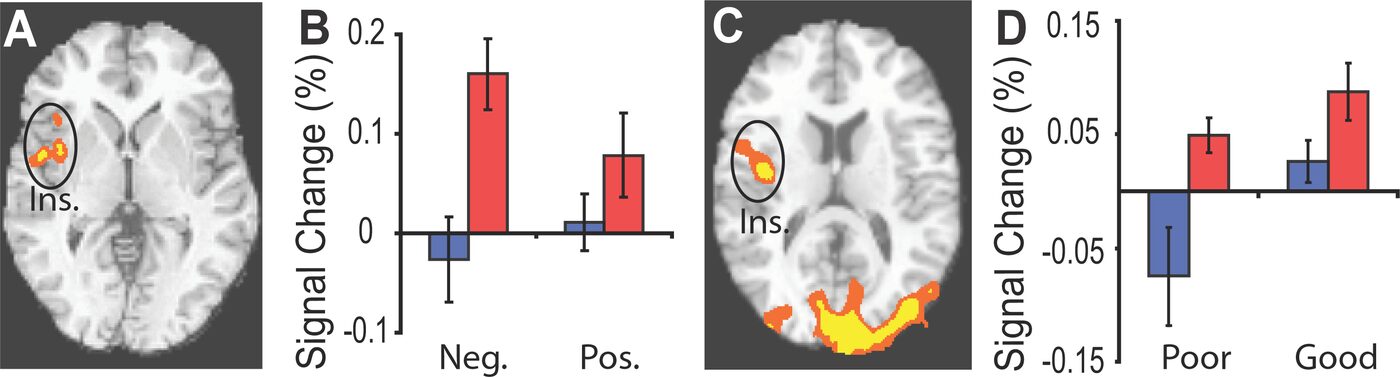
The insula also tracked how well the meditation went. In the 22 people who gave usable ratings (12 experts and 10 novices), the right insula responded more strongly to emotional sounds in the blocks they rated as their best than in their worst, across both groups (F(1,20) = 6.8, p < 0.05). A whole-brain version of this comparison, which the authors describe as “exploratory,” also picked out the right insula and the ACC. Note that this compared best and worst blocks rather than correlating brain activity with ratings across the scale.
Miscellaneous Interesting Takeaways
Experts Engaged Regions Tied to Understanding Others’ Minds
Across both groups, meditation increased responses to the sounds in a wider set of regions, including the anterior insula and ACC, plus regions linked to thinking about other people’s mental states (
Theory of Mind
Theory of mind is the ability to work out what another person thinks, believes or intends. It is also called mentalizing or cognitive perspective-taking. It is usually distinguished from empathy, which involves sharing another person’s feelings rather than reasoning about their thoughts.
More on Wikipedia
Read more in the glossary
): the right
temporoparietal junction
The temporoparietal junction (TPJ) is the area where the brain’s temporal and parietal lobes meet, toward the back and side of the head. It helps combine signals from the body and senses into a sense of where the self is, and it is central to theory of mind: working out what other people think and intend.
More on Wikipedia
Read more in the glossary
(TPJ), the posterior superior temporal sulcus (pSTS), the
medial prefrontal cortex
The medial prefrontal cortex (mPFC) is the part of the frontal lobes along the brain’s midline, just behind the forehead. It is a core part of the default mode network and is consistently active when people think about themselves, judge their own traits, or recall and plan events in their own lives.
More on Wikipedia
Read more in the glossary
, and the
posterior cingulate
The posterior cingulate cortex (PCC) is a region toward the back of the brain’s midline. It is a central hub of the default mode network and tends to be active during self-related thought and mind-wandering. Many meditation studies track PCC activity or connectivity as a window onto the DMN.
More on Wikipedia
Read more in the glossary
and
precuneus
The precuneus is a region on the inner surface of the parietal lobe, toward the back of the brain’s midline, next to the posterior cingulate cortex. Together they form a core hub of the default mode network, and the precuneus is often active during self-related thinking, memory recall and imagining one’s own point of view.
More on Wikipedia
Read more in the glossary
.
When the groups were compared, the experts showed a much larger increase in the right TPJ, right pSTS, precuneus and posterior cingulate, the right inferior frontal gyrus, both
amygdalae
The amygdala is a pair of almond-shaped structures deep in the brain’s temporal lobes. It plays a central role in processing emotion, especially threat and fear. Meditation studies often look at how strongly the amygdala responds to emotional images, and sometimes at its size.
More on Wikipedia
Read more in the glossary
and two motor regions. Within-group tests found the change significant in every one of these regions for the experts and in none for the novices. In the TPJ, the experts’ increase was strongly biased toward the right side, while the novices showed virtually no change there. Both groups’ auditory cortex responded to the sounds equally in both states, so the difference wasn’t in simply hearing them. The authors read the TPJ result this way:
Our finding of greater activation in the right pSTS/ TPJ among experts suggests that the meditative practice of compassion may enhance emotion sharing, as well as perspective taking.
They also note that the TPJ, inferior frontal gyrus and amygdala are involved in noticing salient or emotional events, and suggest the experts may have been more primed to detect “the suffering of others” during the meditation.
Experts Flipped Their Response to Sounds Between Rest and Meditation
In the right TPJ, precuneus and related regions, the experts’ response to the sounds was below baseline on average at rest but above it during meditation. Many of these regions overlap with the
default mode network
The default mode network (DMN) is a system of connected brain areas that show increased activity when a person is not focused on what is happening around them, such as during daydreaming and mind-wandering. It can also be active when the individual is thinking about others or themselves, remembering the past, and planning for the future.
More on Wikipedia
Read more in the glossary
, which tends to be active during rest. The authors suggest this means the regions were more active during rest than meditation before the sounds arrived, and call for studies of what the two states feel like from the inside.
Pupils Widened More in Experts
Pupil size rose more after the sounds during meditation than rest, and more so for experts (F(1,15) = 5.2, p < 0.05). This analysis included only the 16 people (9 novices and 7 experts) with enough clean pupil data. Bigger pupil increases went with bigger increases in the anterior insula (r = 0.54). To check that the insula effect wasn’t just general arousal, the researchers removed the pupil signal from the brain data, and the insula effects remained.
No Overall Difference Between Experts and Novices
There was no main effect of group: the experts’ brains did not simply respond more to sounds overall. The differences appeared only in how responses changed between rest and meditation. Within the experts, the researchers also tested whether lifetime hours of practice or age predicted the size of the brain responses, and found no significant effect of either.
What the Discussion Says Versus the Tables
The discussion opens by saying that “All participants exhibited stronger neural responses to all emotional sounds in the AI and ACC during compassion meditation than when at rest.” In Table 3, though, the within-group test for the anterior insula is significant for the experts but not for the novices. The ACC increase was significant in both groups.
Final Reflection
This was an early look at what the brain does when compassion is deliberately cultivated rather than spontaneously felt. While highly experienced practitioners generated compassion, the sound of a distressed person drew a stronger response in their insula, a region tied to feeling emotions in the body, than it did in novices. Regions tied to understanding others’ minds, such as the right TPJ, also responded much more. The authors point out that
EEG
An electroencephalogram (EEG) is a recording of brain activity. During this painless test, small sensors are attached to the scalp to pick up the electrical signals produced by the brain.
More on Wikipedia
Read more in the glossary
data from “the same group of long-term meditators during the same meditation” had shown the unusually strong gamma waves reported in 2004.
The study’s limits are the ones that come with comparing experts to beginners at a single point in time. The authors say so plainly:
Because novices and experts differ in many respects other than simply the extent of meditative training (such as culture of origin and first language), longitudinal research that follows individuals over time in response to compassion training will be needed to further substantiate our findings.
The groups were small, the experts’ hours of practice did not track their brain responses, and there was no task to show whether a stronger insula response leads to kinder behavior. Later studies on this site took up exactly those gaps. In a randomized trial, two weeks of compassion training left beginners more generous to a stranger than a comparison training did, and changes in their brain responses to suffering tracked how much they gave. And in a nine-month training study, the compassion module was linked to cortical thickening running into the insula. This study helped set the agenda for that work by showing that a deliberately generated state of compassion changes how the brain responds to the sound of another person’s emotion, and more so in people who have practiced it for years.
Citation
Lutz, A., Brefczynski-Lewis, J., Johnstone, T., & Davidson, R. J. (2008). Regulation of the neural circuitry of emotion by compassion meditation: Effects of meditative expertise. PLoS ONE, 3(3), e1897. 10.1371/journal.pone.0001897
Get the next summary by email
One or two new paper summaries every couple of weeks, sent to your inbox when they go up.
No spam, and you can unsubscribe at any time. Prefer a feed reader? Use the RSS feed.