
Background Information
People with
social anxiety disorder
Social anxiety disorder (SAD), also called social phobia, is an anxiety disorder marked by an intense, lasting fear of being watched, judged or embarrassed in social or performance situations. People with it often avoid such situations or endure them with great distress, and tend to focus on critical thoughts about themselves and on signs of others’ disapproval. It is one of the most common anxiety disorders and is usually treated with cognitive-behavioral therapy or medication.
More on Wikipedia
Read more in the glossary
live with an intense fear of being judged. In social situations they tend to turn their attention inward, onto critical thoughts and images of themselves, and outward, onto other people’s faces for signs of disapproval. The authors, Philippe Goldin and James Gross at Stanford, explain that this pattern of attention helps keep the anxiety going, because it gets in the way of the ordinary learning that would otherwise let fear fade. Their earlier brain-imaging work had found that adults with social anxiety recruit attention- and control-related brain networks less than other people when trying to reappraise their reactions to social threats and to negative beliefs about themselves.
Mindfulness
Mindfulness is the psychological process of purposely bringing one’s attention to experiences occurring in the present moment without judgment. It involves maintaining awareness of thoughts, feelings, bodily sensations, and surrounding environment with an attitude of curiosity and acceptance. In meditation contexts, mindfulness practices typically involve focusing attention on the breath or body sensations as anchors to the present moment while acknowledging and releasing distracting thoughts.
More on Wikipedia
Read more in the glossary
training seemed a natural fit.
MBSR
Mindfulness-Based Stress Reduction (MBSR) is a program designed to help individuals cope with stress, pain, and illness. Developed by Jon Kabat-Zinn in the 1970s, it combines meditation and yoga to promote awareness and stress management. The eight-week program teaches participants to focus on the present moment non-judgmentally, enhancing their ability to manage difficulties.
More on Wikipedia
Read more in the glossary
(MBSR) teaches people to notice thoughts, emotions and sensations as passing events, and much of its formal practice is
focused attention
Focused attention is a style of meditation in which you keep your attention on one chosen object, such as the breath or a point in front of you, notice when the mind has wandered, and bring it back. It trains steady concentration, and Buddhist shamatha practice is a well-known example. Researchers often contrast it with open monitoring meditation.
Read more in the glossary
on the breath. The authors framed this in terms of
emotion regulation
Emotion regulation is the set of ways people influence which emotions they have, when they have them, and how they experience and express them. Psychologist James Gross’s process model groups the strategies into five families: choosing situations, changing situations, shifting attention (attentional deployment), changing how one thinks about a situation (reappraisal), and changing one’s response, such as suppressing an expression.
More on Wikipedia
Read more in the glossary
, the ways people influence which emotions they have and how strongly. One family of strategies is attentional deployment: shifting where your attention goes. If MBSR works by training that skill, people should get better at calming themselves by turning their attention to the breath, while a strategy the course never teaches should not change.
Only two studies of MBSR for social anxiety existed. A randomized trial had found that MBSR and group cognitive–behavioral therapy (CBGT) improved mood, functioning and quality of life about equally, but social anxiety scores were significantly lower after CBGT. The authors’ own earlier study had found less anxiety and a more positive view of the self after MBSR. Neither showed what happens in the brain when someone with social anxiety faces the kind of harsh self-beliefs at the heart of the disorder.
What They Did
Sixteen right-handed adults (nine women, average age 35) with a primary diagnosis of generalized social anxiety disorder took part. They were diagnosed with a structured clinical interview, and some had other current conditions, such as
generalized anxiety disorder
Generalized anxiety disorder (GAD) is an anxiety disorder marked by excessive, hard-to-control worry about many everyday matters, such as health, work or family, lasting at least six months. The worry comes with physical and mental symptoms such as restlessness, tiring easily, trouble concentrating, irritability, muscle tension and poor sleep.
More on Wikipedia
Read more in the glossary
(three) or a specific phobia (three). None were taking psychiatric medication or had meditated before.
Everyone took the standard 8-week MBSR course, developed by Kabat-Zinn: a 2.5-hour class once a week in a group of eight, a half-day meditation retreat, and CDs for practice at home. On average, people attended 7.07 of the 8 classes and logged 2.26 hours of home practice a week. The course was taught by the first author, who the paper says had spent six years living and studying in Buddhist monasteries in Nepal and India and had led MBSR courses for ten years, though he was not board certified in MBSR.
Before and after the course, each person was scanned with
fMRI
An fMRI (functional Magnetic Resonance Imaging) measures changes in blood flow related to neural activity in the brain, offering insights into brain function and activity patterns.
More on Wikipedia
Read more in the glossary
while doing an emotion regulation task. On each trial, a negative self-belief appeared on the screen, such as “I am ashamed of my shyness” or “People always judge me,” and they read it over and over for 12 seconds. Then, with the statement still on screen, a cue told them either to “Shift attention to the breath,” attending to the sensation of breathing at the nostrils, or to “Count backward from 168,” a distraction strategy that MBSR doesn’t teach. After 12 more seconds, they rated how negative they felt, from 1 (not at all) to 4 (very much). There were 18 statements in all, chosen by the researchers, half followed by each strategy. A simple task of counting asterisks on the screen served as a baseline.
People also filled in questionnaires on social anxiety (the Liebowitz Social Anxiety Scale), depression, rumination,
state anxiety
The State Anxiety Inventory is the half of the State-Trait Anxiety Inventory (STAI) that asks how anxious someone feels right now, rather than how anxious they tend to be in general. People rate 20 statements such as “I feel worried” from 1 (not at all) to 4 (very much so), giving a score from 20 to 80. Because it captures the moment, researchers can give it just before and just after a single session.
More on Wikipedia
Read more in the glossary
and self-esteem. Two of the 16, one man and one woman, declined the second scan because they found scanning distressing, so the results after the course come from 14 people.
There was no comparison group. Every result is a comparison of the same people before and after the course.
One Big Result: Turning to the Breath Upset People Less After the Course, but Counting Backward Didn’t Change
Before the course, both strategies worked. Compared with just reading the statements, attending to the breath and counting backward both lowered people’s negative emotion ratings, and the two strategies worked about equally well.
After the course, one of them worked better. When people turned to the breath, their negative emotion ratings were significantly lower than before the course (t(14) = 3.25, p < .01). Their ratings after counting backward did not change (t(14) = 0.41), and neither did their ratings for simply reacting to the statements (t(14) = 1.21). The paper reports each of these as a separate before-and-after test, without a direct test of whether the breath strategy changed more than the distraction strategy did. Its text doesn’t give the average ratings; they are shown only in a bar chart. And a figure caption notes that the ratings for reacting were collected after the scan, rather than during it like the other ratings.
The brain scans followed the same pattern. When people turned to the breath, compared with just reading the statement, areas that the authors link to visual attention were more active after the course than before: the
inferior parietal lobule
The inferior parietal lobule (IPL) is a region on the outer surface of the parietal lobe, toward the back and side of the head. It combines information from the senses and the body and is involved in attention, language, the sense of being the one who causes one’s own actions (agency), and telling oneself apart from others.
More on Wikipedia
Read more in the glossary
on both sides and the left superior parietal lobule, the
cuneus
The cuneus is a wedge-shaped area on the inner surface of each occipital lobe, at the back of the brain. It takes part in basic visual processing and has been linked to directing and holding visual attention.
More on Wikipedia
Read more in the glossary
and
precuneus
The precuneus is a region on the inner surface of the parietal lobe, toward the back of the brain’s midline, next to the posterior cingulate cortex. Together they form a core hub of the default mode network, and the precuneus is often active during self-related thinking, memory recall and imagining one’s own point of view.
More on Wikipedia
Read more in the glossary
, the right middle occipital gyrus, and small parts of the right
parahippocampal gyrus
The parahippocampal gyrus is a fold of cortex on the inner, lower surface of each temporal lobe, running alongside the hippocampus. It helps form memories, especially of places and scenes. Together with nearby areas such as the cingulate cortex and insula, it is counted as part of the paralimbic system, which links the brain’s emotion-related limbic structures, such as the amygdala, with the outer cortex.
More on Wikipedia
Read more in the glossary
and the
precentral gyrus
The precentral gyrus is a ridge of cortex running across the top and side of each frontal lobe, just in front of the central sulcus. It houses the primary motor cortex, which sends the signals that move the body; the other side of the brain controls each side of the body.
More on Wikipedia
Read more in the glossary
. These results came from a whole-brain analysis with a correction for
multiple comparisons
The multiple comparisons problem arises when researchers run many statistical tests at once. Each test has a small chance of a false positive, so across thousands of tests, such as one for every point in a brain scan, some “significant” results will turn up by chance alone. Corrections raise the bar for significance to keep the overall false-positive rate down, at the cost of making small real effects harder to detect.
More on Wikipedia
Read more in the glossary
. No area became less active, and for counting backward nothing changed at all. The authors suggest these changes may reflect alerting to a stimulus.
The people whose social anxiety scores fell the most also showed the biggest increases in three of these regions, all in the
occipital lobe
The occipital lobe, at the back of the brain, is the brain’s main center for vision. Its outer layer, the occipital or visual cortex, receives signals from the eyes and analyzes features such as edges, color and movement.
More on Wikipedia
Read more in the glossary
at the back of the brain: the medial cuneus (r = .68, p = .03), left cuneus (r = .65, p = .04) and right middle occipital gyrus (r = .65, p = .01), among the 14 people with scans from both times. The authors offer two explanations for the extra visual activity, and the study can’t tell them apart:
First, MBSR may have helped adults with SAD be more visually engaged in (i.e., less avoidant of) negative self-beliefs. Alternatively, greater neural recruitment of attention-related brain regions may be due to more refined visualization of the movement of the breath at the nostrils, which also involves better allocation of attention to the task.
Miscellaneous Interesting Takeaways
Symptoms Eased
From before the course to after it, scores fell for social anxiety, depression, rumination and state anxiety, and self-esteem rose. All five changes were statistically significant.
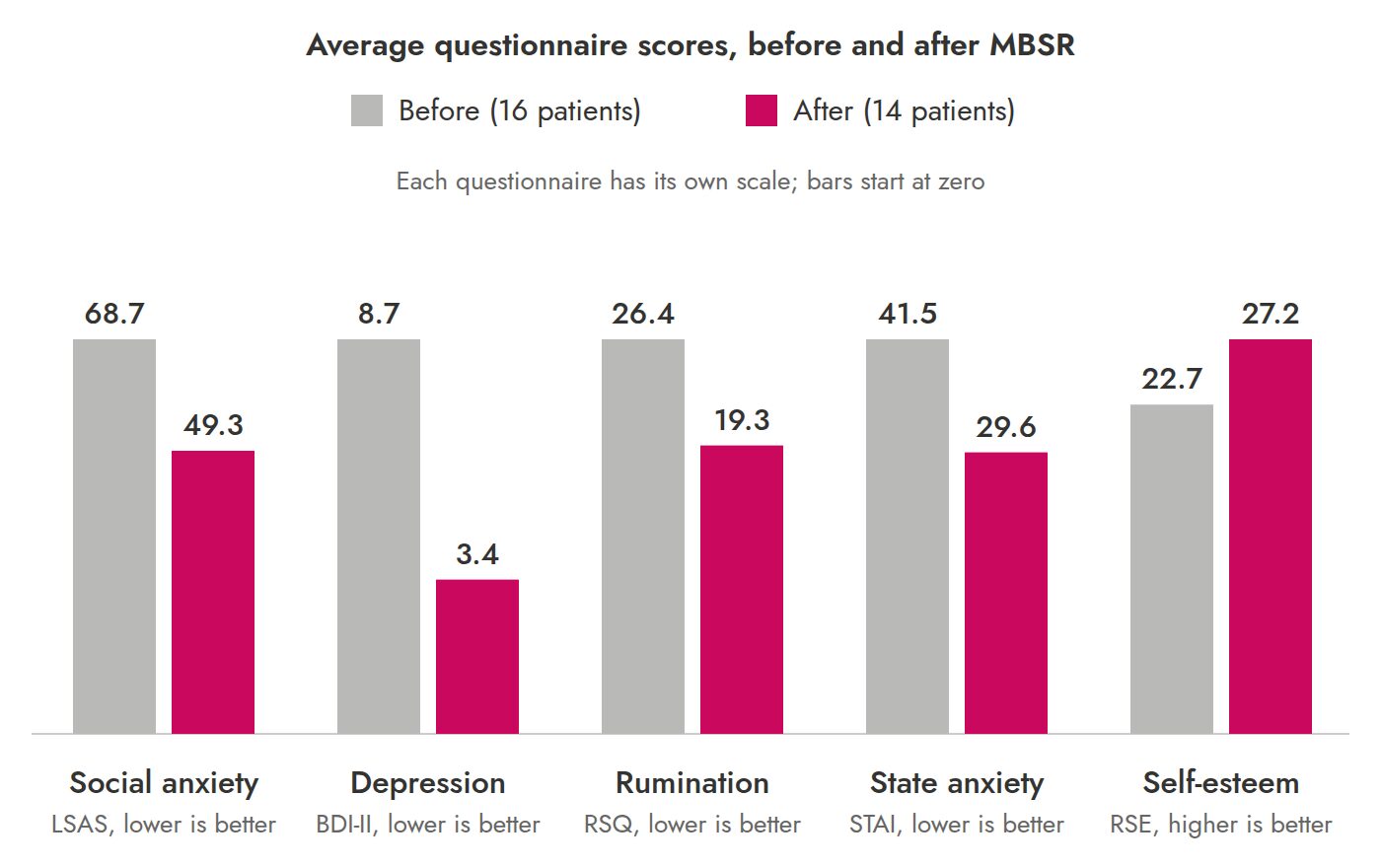
The paper gives each change an
effect size
Effect size is a statistical concept that quantifies the magnitude or strength of a relationship, difference, or intervention outcome. Unlike p-values which only indicate statistical significance, effect sizes measure how meaningful a result is in practical terms. Common measures include Cohen’s d (standardized mean difference), correlation coefficients (r), and odds ratios. In meditation research, effect sizes help quantify the practical impact of different meditation practices on psychological or physiological outcomes.
More on Wikipedia
Read more in the glossary
(partial eta squared, the share of variation explained): .59 for social anxiety, .84 for state anxiety, .53 for rumination, .51 for self-esteem and .27 for depression. The authors write that the changes in anxiety, depression and self-esteem were similar to the moderate effects found in a meta-analysis of 38 studies of behavioral and drug treatments for social anxiety. Without a comparison group, though, it’s impossible to know how much of the improvement came from MBSR, and how much from time, from expecting to improve, or from the attention of being in a study.
A Late Dip in the Amygdala, Before the Breath Cue
The abstract lists reduced activity in the
amygdala
The amygdala is a pair of almond-shaped structures deep in the brain’s temporal lobes. It plays a central role in processing emotion, especially threat and fear. Meditation studies often look at how strongly the amygdala responds to emotional images, and sometimes at its size.
More on Wikipedia
Read more in the glossary
, the brain’s threat-detection hub, as one of the changes during the breath-focused task. That result needs a closer look. The whole-brain comparison of breath-focus with reacting found no amygdala change at all. Instead, the authors took the right amygdala region that had responded to the statements before the course and followed its activity second by second through each trial.
Before the course, the amygdala’s response took about 6 seconds to start, then climbed to a peak at the end of the 12 seconds of reading the statement. After the course, its activity was significantly lower before the cue to turn to the breath appeared. So the drop happened while people were still just reading the statement, not while they were attending to their breath. The paper gives no test statistic for it; a figure marks it p < .05. The authors also describe a larger initial spike in amygdala activity after the course, followed by the drop. They suggest that people may have begun turning to the breath on their own, before being asked:
This highlights the possibility that one potential outcome of MBSR is to change specific aspects of attention regulation from explicit (i.e., more effortful) to an implicit (i.e., more automatic) process.
That is an intriguing idea, but the study didn’t test it, and the paper doesn’t report asking people what they were doing while they read the statements.
An earlier study on this site found that after an MBSR course, people whose stress fell the most also showed the largest drops in amygdala gray matter density. That study measured the amygdala’s structure rather than its activity, in stressed but healthy adults, and it too had no control group.
What Reading the Statements Did in the Brain
Before the course, reading the negative self-beliefs (compared with counting asterisks) activated a set of midline areas that the authors link to thinking about oneself, the
ventromedial
The ventromedial prefrontal cortex (vmPFC) is the lower part of the frontal lobes along the brain’s midline, just above the eyes. Together with the neighboring medial orbitofrontal cortex and the subgenual (lower) part of the anterior cingulate, it helps weigh how much something matters to oneself, represents reward and value, and links emotions with the body’s internal states.
More on Wikipedia
Read more in the glossary
and dorsomedial prefrontal cortex and the
posterior cingulate
The posterior cingulate cortex (PCC) is a region toward the back of the brain’s midline. It is a central hub of the default mode network and tends to be active during self-related thought and mind-wandering. Many meditation studies track PCC activity or connectivity as a window onto the DMN.
More on Wikipedia
Read more in the glossary
, along with the right amygdala, visual areas and memory areas. This baseline result is where the amygdala region tracked after the course came from. Among its evidence that MBSR changes how people relate to themselves, the paper cites a study of MBSR and two modes of self-focus, which found less narrative, conceptual self-focus and more experiential, sensory self-focus after the course.
The Authors Are Clear About the Limits
The paper’s limitations section begins with the most important one:
This study is limited by the lack of a control group or active comparison clinical intervention that would provide a basis for making a stronger inference about how MBSR might modify the behavioral and neural bases of different types of emotion regulation.
The authors add that future studies should be randomized trials with at least two groups, to address “potential confounds such as practice effects and habituation to the scanner environment.” Both matter here, since everyone did the same task in the same scanner twice. The authors also note that the statements were chosen by the experimenters rather than by the patients, and that the study tested only one MBSR practice, attending to the breath at the nostrils, so its results don’t extend to other practices such as the
body scan
The body scan is a meditation practice in which attention is moved slowly through the body, part by part, noticing whatever sensations are present without trying to change them. It is a core exercise in mindfulness programs such as MBSR.
More on Wikipedia
Read more in the glossary
.
Final Reflection
This small study asked a precise question: if MBSR works through attention, does it improve the specific attention skill it trains? For 14 people with social anxiety disorder, the answer looked like yes. After the course, turning to the breath took more of the sting out of harsh statements about themselves than it had before, and visual and attention areas engaged more, while a strategy the course never taught, counting backward, changed neither in feeling nor in the brain. That specificity, which the authors predicted, is the study’s most interesting feature, since a general improvement from time or familiarity might be expected to show up in both strategies.
But it is a single group of 14 people, scanned twice, with no comparison group and no direct test of the two strategies against each other. Symptoms improved, but the randomized trial the authors cite found group
CBT
Cognitive behavioral therapy (CBT) is a structured, usually short-term talk therapy that helps people notice and change unhelpful patterns of thinking and behavior. It is one of the most thoroughly tested psychological treatments and a first-line option for depression, anxiety disorders and many other conditions.
More on Wikipedia
Read more in the glossary
reduced social anxiety more than MBSR. And the amygdala result in the abstract came from a follow-up look at one region and appeared before the breath cue, not during breath-focused attention itself.
It fits with broader evidence that mindfulness therapies help with psychiatric symptoms about as much as established treatments, and with a randomized trial in generalized anxiety disorder in which MBSR’s benefit was linked to learning to step back from one’s thoughts. Read alone, it is best taken as an early, carefully reasoned pilot, one whose authors call for randomized trials comparing MBSR with another course to test what it suggests.
Citation
Goldin, P. R., & Gross, J. J. (2010). Effects of mindfulness-based stress reduction (MBSR) on emotion regulation in social anxiety disorder. Emotion, 10(1), 83–91. 10.1037/a0018441
Get the next summary by email
One or two new paper summaries every couple of weeks, sent to your inbox when they go up.
No spam, and you can unsubscribe at any time. Prefer a feed reader? Use the RSS feed.