
Background Information
The
amygdala
The amygdala is a pair of almond-shaped structures deep in the brain’s temporal lobes. It plays a central role in processing emotion, especially threat and fear. Meditation studies often look at how strongly the amygdala responds to emotional images, and sometimes at its size.
More on Wikipedia
Read more in the glossary
is a pair of almond-shaped structures deep in the brain that help flag what is emotionally important, from threats to pleasant surprises. How strongly it reacts to emotional images varies from person to person and has been linked to personality traits, to habitual ways of regulating emotion, and to conditions such as depression and anxiety.
By 2012, a few studies had found that the amygdala responds less to emotional material while people meditate, both in beginners after a short course and in some experienced meditators. But those studies scanned people in a meditative state. The bigger question is whether training changes how the brain reacts in everyday life, when nobody is meditating. The authors explain why they designed their study around that question:
Since we were interested in putative changes in affective trait, study participants were not instructed to enter a meditative state, so that changes in brain activity would reflect uncontrived emotional responses without being influenced by a purposeful manipulation of brain state.
They also wanted to compare two quite different kinds of meditation. Mindful-attention practice trains steady, clear awareness and might be expected to dampen emotional reactions. Compassion practice deliberately cultivates feeling for other people’s suffering, and an earlier study had found that when experienced meditators entered a compassionate meditative state, their amygdala responded more strongly to emotional sounds of human voices, such as a woman screaming. The two kinds of training might therefore push the amygdala in opposite directions.
What They Did
The participants were part of a larger study at Emory University in Atlanta, the Compassion and Attention Longitudinal Meditation (CALM) study. They were healthy, medication-free adults aged 25 to 55 with no meditation experience. In this
randomized controlled trial
A Randomized Controlled Trial is a scientific study design that randomly assigns participants to either an experimental group receiving an intervention or a control group, allowing researchers to measure the true effect of the intervention while minimizing bias.
More on Wikipedia
Read more in the glossary
, people were randomly assigned to one of three eight-week programs, each with 2 hours of class a week:
- Mindful Attention Training (MAT). A simplified version of the
Shamatha
Shamatha (Pali samatha, “calm abiding”) is a Buddhist family of concentration practices that train attention to settle and stay on a chosen object, such as the sensations of the breath. Practitioners notice when the mind has wandered and bring it back, aiming for attention that is both stable and vivid. It is often paired with vipassana, or insight, practice.
More on Wikipedia
Read more in the glossary training taught at three-month retreats such as the Shamatha Project (the source of a study of perception and vigilance on retreat), with its compassion and ethics content removed. It moved from mindfulness Mindfulness is the psychological process of purposely bringing one’s attention to experiences occurring in the present moment without judgment. It involves maintaining awareness of thoughts, feelings, bodily sensations, and surrounding environment with an attitude of curiosity and acceptance. In meditation contexts, mindfulness practices typically involve focusing attention on the breath or body sensations as anchors to the present moment while acknowledging and releasing distracting thoughts.
More on Wikipedia
Read more in the glossary of breathing, to watching thoughts and emotions come and go, to “awareness of awareness,” combining focused attention Focused attention is a style of meditation in which you keep your attention on one chosen object, such as the breath or a point in front of you, notice when the mind has wandered, and bring it back. It trains steady concentration, and Buddhist shamatha practice is a well-known example. Researchers often contrast it with open monitoring meditation.
Read more in the glossary and open monitoring Open monitoring is a style of meditation in which attention isn’t fixed on any one object. You stay aware of whatever arises from moment to moment, such as sounds, sensations and thoughts, and let each come and go without reacting to it, holding on to it or pushing it away. Researchers often contrast it with focused attention meditation.
Read more in the glossary . - Cognitively-Based Compassion Training (CBCT). A secular program based on Tibetan Buddhist
Lojong
Lojong, Tibetan for “mind training,” is a set of Tibetan Buddhist practices for cultivating compassion, traced to the Indian teachers Atisha and Shantideva. Rather than simply observing thoughts, it uses reasoning and reflection to question habitual attitudes toward oneself and others, such as sorting people into friends, enemies and strangers, and to extend warmth step by step to a widening circle of people, including those one dislikes.
More on Wikipedia
Read more in the glossary , designed by one of the authors, Lobsang Tenzin Negi. It started with attention training and then worked through compassion for oneself, equanimity toward friends, enemies and strangers, appreciation and empathy, ending in “active compassion” for others. An earlier version of this program, taught to Emory students, is the subject of a trial on stress and inflammation by several of the same researchers. - Health discussion (control). An
active control
An active control group is a comparison group that takes part in a different program designed to be just as engaging as the one being tested. In meditation research, it might involve exercise, music, or education classes with the same time commitment, teachers, and expectations of benefit. Comparing against an active control helps separate the effects of meditation itself from the general effects of joining a course.
More on Wikipedia
Read more in the glossary adapted from a university health education course, covering topics such as diet, exercise, sleep, relationships and stress, with talks, small-group discussions and role-play. It matched the class time; instead of meditating at home, participants reported each week which of the previous week’s health tips they had started using.
Both meditation groups were asked to practice for an average of 20 minutes a day at home and to log it.
Fifty-one volunteers (average age 34) agreed to be scanned, and they had their first scan before being randomized. A second scan followed within three weeks after the program ended. Five people dropped out, and 10 fell asleep or moved too much in the scanner in at least one session, leaving 12 people in each group for the analysis. The scientists running the scans didn’t know who was in which group until all the scans were done.
In the
fMRI
An fMRI (functional Magnetic Resonance Imaging) measures changes in blood flow related to neural activity in the brain, offering insights into brain function and activity patterns.
More on Wikipedia
Read more in the glossary
scanner, people saw photos of people from the International Affective Picture System, a database of emotional images used in research: a third positive, a third negative (typically people suffering) and a third neutral, each shown for 5 seconds. They were simply told to press a button whenever a picture appeared and to “let yourself react to them naturally.” The word “meditation” was avoided throughout, and at the end everyone said they had not been meditating during the pictures.
The analysis focused on two
regions of interest
In brain imaging, a region of interest (ROI) is an area chosen in advance for testing, such as the amygdala or hippocampus, usually because earlier research points to it. Limiting the main test to one region means fewer statistical comparisons, so real effects there are easier to detect. The trade-off is that the test says nothing about the rest of the brain, so ROI studies often add a separate, exploratory whole-brain search.
More on Wikipedia
Read more in the glossary
, the left and right amygdala, traced on each person’s own brain scan. The researchers also gave everyone the Beck Depression Inventory and the
Beck Anxiety Inventory
The Beck Anxiety Inventory (BAI) is a 21-item questionnaire on which people rate how much they have been bothered by common symptoms of anxiety over the past week, such as nervousness, fear of the worst happening, a pounding heart or feeling unsteady. Each item is scored from 0 to 3, for a total of 0 to 63. Many of its items describe the bodily side of anxiety.
More on Wikipedia
Read more in the glossary
, standard questionnaires, before and after the programs.
One Big Result: Mindful-Attention Training Lowered the Right Amygdala’s Response to Emotional Photos
Before training, the three groups’ amygdala responses did not differ significantly. The control group looked lower in the figure below, and the authors suggest this may reflect the larger share of men in that group.
After training, there was a significant difference between groups in how the right amygdala’s response to all the photos changed (p < 0.035). Follow-up comparisons showed the change in the mindful-attention group was significantly larger than in the control group, while the compassion group did not differ significantly from either.
Looking within each group:
- Mindful-attention group: the right amygdala’s response fell for all images taken together (p = 0.012) and for positive images (p = 0.011). Its response to negative images also fell, but not significantly, and its response to neutral images didn’t change.
- Compassion group: the response to positive images fell by about as much as in the mindful-attention group on average, but this wasn’t statistically significant (p = 0.085). Its response to negative images rose slightly, also not significantly.
- Control group: no significant changes or trends.
The left amygdala showed no effects or trends, and a whole-brain search found no significant before-and-after differences in any group.
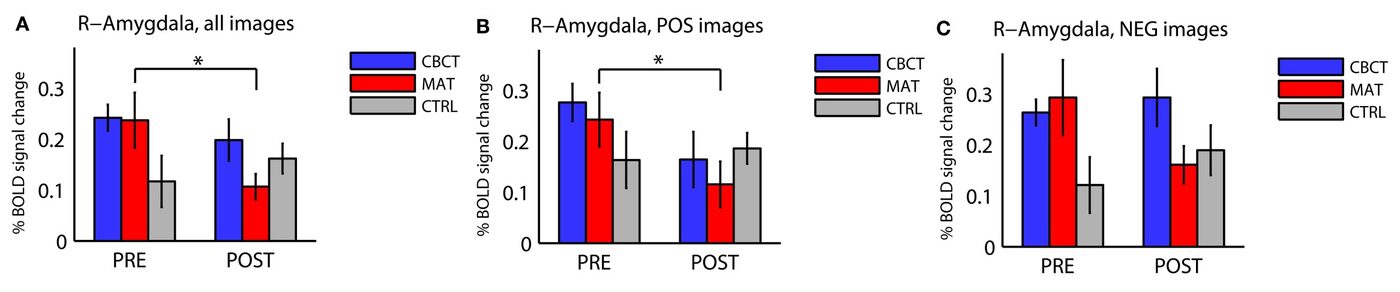
The authors read this as evidence that the training itself caused the change, since the design was controlled and the control group didn’t change. Two details call for some care. The positive-image result comes from a within-group test, so it shows that the mindful-attention group changed, not that it changed more than the controls; the one between-group difference reported is for all images together. And the control group’s response, which started lower, did not fall. The authors suggest two possible explanations: that mindful-attention training let people give the images more attention, or that it raised their everyday positive mood, though they note they didn’t measure mood directly.
Miscellaneous Interesting Takeaways
Compassion Training: A Rise to Images of Suffering That Went With Lower Depression Scores
The compassion group’s small, non-significant rise in amygdala response to negative images was larger in people who had practiced more, and those who practiced least showed a small drop, but this relationship also fell short of significance (r = 0.46, p = 0.13).
The researchers then compared each compassion trainee’s change in amygdala response to negative images with their change in depression score. Those with a bigger rise in amygdala response tended to have a bigger drop in depression score (a
correlation
A correlation measures how closely two things rise and fall together across people or over time. Pearson’s r runs from −1 to +1: values near +1 mean that people high on one measure tend to be high on the other, values near −1 mean the reverse, and values near 0 mean no straight-line relationship. A correlation alone can’t show that one thing causes the other.
More on Wikipedia
Read more in the glossary
of 0.58, p = 0.048, across 12 people). In the mindful-attention group there was no such link (r = 0.06), and neither group showed a link with anxiety scores.
This runs against the usual picture, in which depression goes with a stronger amygdala response to negative images. The authors note that earlier studies typically used faces showing sadness or anger, whereas their negative photos showed people in difficult situations, which may be more likely to evoke compassion. They offer a tentative interpretation:
One might speculate that these images of suffering inspired more compassion in the participants after compassion training, which may itself be related to an increase in amygdala activation, as seen in experts (Lutz et al., 2008a).
That is worth holding loosely. The link rests on 12 people, it was found while following up a non-significant trend, and its p-value only just crosses the usual threshold.
Depression and Anxiety Scores Didn’t Change Differently Between Groups
Questionnaire results are reported for 41 people who completed the scanning study and the questionnaires (a few more than the 36 whose scans were analyzed). Scores in these healthy volunteers were low to begin with: group averages of about 3 to 6 for depression and 3 to 5 for anxiety. Anxiety and depression scores fell over time across everyone, but the groups didn’t change differently (p = 0.10 for both). In an exploratory analysis, only the compassion group’s depression scores fell significantly on their own, by about 3 points. In the meditation groups, how much people practiced was not related to their questionnaire scores or to changes in them.
Practice Fell Short of 20 Minutes a Day
The mindful-attention group logged an average of 645 minutes of home practice over the eight weeks (range 210 to 1,491), and the compassion group 454 minutes (range 190 to 905), a difference that wasn’t significant. That works out to roughly 11 and 7.5 hours, well under the 20 minutes a day participants were asked for.
Why the Compassion Results Were Unclear
The authors give two reasons the compassion group’s rise in response to images of suffering might not have reached significance. One is the small sample:
This raises the possibility that our study simply did not have sufficient statistical power, with our relatively small sample size of twelve subjects per group.
The other is that CBCT begins with attention training much like MAT. If attention training lowers the amygdala’s response and compassion training raises it, the two could cancel out. They point to the low-practice compassion trainees, who looked more like the mindful-attention group, as a hint that the compassion-specific effect only appeared with more practice. Both explanations are possibilities the study couldn’t test.
A Small Inconsistency About Men and Women
Before training, women’s right amygdala responded more strongly to the photos than men’s. The results section reports this difference as significant (p = 0.038), while the discussion calls it “a trend which was almost statistically significant (p = 0.059).” Either way, the authors say the study was too small and unbalanced to examine gender, and they suggest it as a question for future work.
Final Reflection
This was among the first studies to look for changes in how the brain reacts to emotional material when people who had trained in meditation weren’t meditating, which is closer to what matters in daily life. Its main finding is that after eight weeks of mindful-attention training, the right amygdala responded less to emotional photos of people, and this change was larger than in a health-class control group. The compassion results were more tantalizing than solid: a trend toward a stronger response to images of suffering, which in a dozen people went with falling depression scores.
The design has real strengths: random assignment, a first scan taken before randomization, an active control matched for class time, and scanner staff who didn’t know the groups. But with 12 people per group, a single between-group result and several findings resting on within-group tests or trends, it is best read as an early, suggestive study. Other work on this site has looked at the amygdala’s structure rather than its activity: an MBSR study linked bigger drops in stress to lower
gray matter
Gray matter is brain tissue made up mostly of nerve cell bodies and their connections. It forms the brain’s outer layer (the cortex) and several deeper structures. Structural MRI can estimate gray matter volume (how big a region is), density (how concentrated the tissue is), and cortical thickness (how deep the outer layer is).
More on Wikipedia
Read more in the glossary
density in the right amygdala, while a larger analysis of two randomized trials found no structural change. Whether training reliably changes the amygdala’s day-to-day reactions needed larger trials to settle.
Citation
Desbordes, G., Negi, L. T., Pace, T. W. W., Wallace, B. A., Raison, C. L., & Schwartz, E. L. (2012). Effects of mindful-attention and compassion meditation training on amygdala response to emotional stimuli in an ordinary, non-meditative state. Frontiers in Human Neuroscience, 6, 292. 10.3389/fnhum.2012.00292
Get the next summary by email
One or two new paper summaries every couple of weeks, sent to your inbox when they go up.
No spam, and you can unsubscribe at any time. Prefer a feed reader? Use the RSS feed.