
Background Information
Repeating a word or phrase, a
mantra
A mantra is a sound, word or phrase that is repeated, aloud or silently, as a spiritual or meditative practice. Mantras are central to Hindu and Buddhist traditions and appear in many others. In mantra meditation, the repetition itself serves as the object of attention, and practitioners often describe it as calming.
More on Wikipedia
Read more in the glossary
, is one of the oldest and most widespread meditation practices. The authors open by describing a mantra as “a sound, word, or group of words whose repetition can exert calm, or mental quiescence, without the need for intense concentrative efforts.” But mantra meditation is rarely just repetition. It is usually practiced within a tradition, with training and spiritual aims, and with a word selected for its spiritual or physiological qualities.
This study, from the Weizmann Institute of Science in Israel, set out to strip all of that away and ask what the bare act of silent repetition does to the brain. The researchers scanned people who had never meditated while they silently repeated an ordinary word, “one,” with no spiritual framing at all. Unlike a traditional mantra, the word was not chosen for any special qualities.
Their focus was the
default mode network
The default mode network (DMN) is a system of connected brain areas that show increased activity when a person is not focused on what is happening around them, such as during daydreaming and mind-wandering. It can also be active when the individual is thinking about others or themselves, remembering the past, and planning for the future.
More on Wikipedia
Read more in the glossary
(DMN), a set of brain regions that tends to be active when the mind is turned inward: thinking about oneself, planning, or
mind wandering
Mind wandering is the spontaneous shift of attention away from a current task or external environment to internally generated thoughts, memories, or fantasies. This common cognitive process is associated with default mode network activation and has been extensively studied in relation to meditation practices, which often aim to reduce mind wandering.
More on Wikipedia
Read more in the glossary
. Many contemplative traditions treat mind wandering as a distraction, and the authors cite research linking such thinking to emotional stress, including the Killingsworth and Gilbert experience-sampling study. Their hypothesis was that silent repetition might switch off widespread brain activity, including the DMN, and that this could be part of why mantra practice is described as calming.
The first author, Aviva Berkovich-Ohana, also led a study on this site of long-term meditators trying to step outside time and space.
What They Did
Twenty-three healthy, right-handed adults (average age 40, eight women), none of whom had ever practiced meditation, lay in an
fMRI
An fMRI (functional Magnetic Resonance Imaging) measures changes in blood flow related to neural activity in the brain, offering insights into brain function and activity patterns.
More on Wikipedia
Read more in the glossary
scanner with their eyes closed. Brief spoken cues through headphones told them what to do. Two parts of a longer scanning session are reported here:
- Repetitive speech. “Silently say ‘one’ in a comfortable speed,” using the Hebrew word echad. Five 21-second blocks were mixed in with two other tasks (a tone-discrimination task and a thought-control task), and every block was followed by 12 seconds of rest (“rest as best as you can”). The run took about 8 minutes.
- Verbal fluency. Silently producing as many new words as possible starting with a cued letter, a standard
verbal fluency task
A verbal fluency task asks people to produce as many words as they can that fit a rule, such as words beginning with a given letter (letter fluency) or words in a category like animals (category fluency). It draws on language, memory search and executive control, and is widely used in neuropsychology and brain imaging.
More on Wikipedia
Read more in the glossary . Again five 21-second blocks, mixed in with three other tasks, in an 11-minute run.
The main comparison was each task against rest. To make that baseline steadier, the researchers averaged all the rest periods in a run (15 in the repetition run), not just the ones next to the task. The scanner measures the
BOLD signal
The BOLD (blood-oxygen-level-dependent) signal is what fMRI actually measures. When a brain area becomes more active, blood flow to it rises more than its oxygen use does, changing the ratio of oxygen-rich to oxygen-poor blood, which the scanner can detect. A BOLD increase is read as more activity in an area, and a decrease (a negative BOLD response or deactivation) as less, always relative to a comparison condition such as rest.
More on Wikipedia
Read more in the glossary
, an indirect marker of activity: a drop relative to rest is called a deactivation. A separate visual task with eyes open let the team map the default mode network in the same participants for comparison.
The team also checked two things that could fake a widespread drop in the signal. For 12 of the 23 participants, they recorded breathing during the scan. And they reran the analysis with the rest periods from both runs pooled into one baseline, in case activity from the tasks had been “leaking” into the rests.
After each run, participants briefly described their experience. Only later, after seeing the brain results, did the team run a separate questionnaire study with 30 different people.
One Big Result: Silent Repetition Turned Activity Down Across the Cortex Without Turning Anything Up
Compared with rest, silently repeating “one” lowered activity across a large part of the cortex. The drops included the
posterior cingulate cortex
The posterior cingulate cortex (PCC) is a region toward the back of the brain’s midline. It is a central hub of the default mode network and tends to be active during self-related thought and mind-wandering. Many meditation studies track PCC activity or connectivity as a window onto the DMN.
More on Wikipedia
Read more in the glossary
and
precuneus
The precuneus is a region on the inner surface of the parietal lobe, toward the back of the brain’s midline, next to the posterior cingulate cortex. Together they form a core hub of the default mode network, and the precuneus is often active during self-related thinking, memory recall and imagining one’s own point of view.
More on Wikipedia
Read more in the glossary
on both sides, the
anterior cingulate cortex
The anterior cingulate cortex (ACC) is a strip of cortex on the inner surface of each frontal lobe, curving around the front of the corpus callosum. It is involved in monitoring conflicts and errors, regulating attention and emotion, and processing pain, and it often turns up in brain-imaging studies of meditation.
More on Wikipedia
Read more in the glossary
, the right
inferior parietal lobule
The inferior parietal lobule (IPL) is a region on the outer surface of the parietal lobe, toward the back and side of the head. It combines information from the senses and the body and is involved in attention, language, the sense of being the one who causes one’s own actions (agency), and telling oneself apart from others.
More on Wikipedia
Read more in the glossary
, parts of the frontal lobes and the
insula
The insula is a region of cortex folded deep inside each side of the brain. It helps represent the body’s internal state (interoception) and is involved in emotion, empathy and compassion. Its front part, the anterior insula, comes up often in meditation research.
More on Wikipedia
Read more in the glossary
. These areas overlapped substantially with the default mode network mapped independently in the same participants. Not every part of the network went down: the
hippocampus
The hippocampus is a curved structure deep in each temporal lobe of the brain. It is essential for learning and forming new memories, and it also helps regulate emotion and the stress response. It can change with experience, and it tends to be smaller in people with long-term depression or post-traumatic stress disorder.
More on Wikipedia
Read more in the glossary
, a memory region, did not, which the authors attribute to the task asking little of memory.
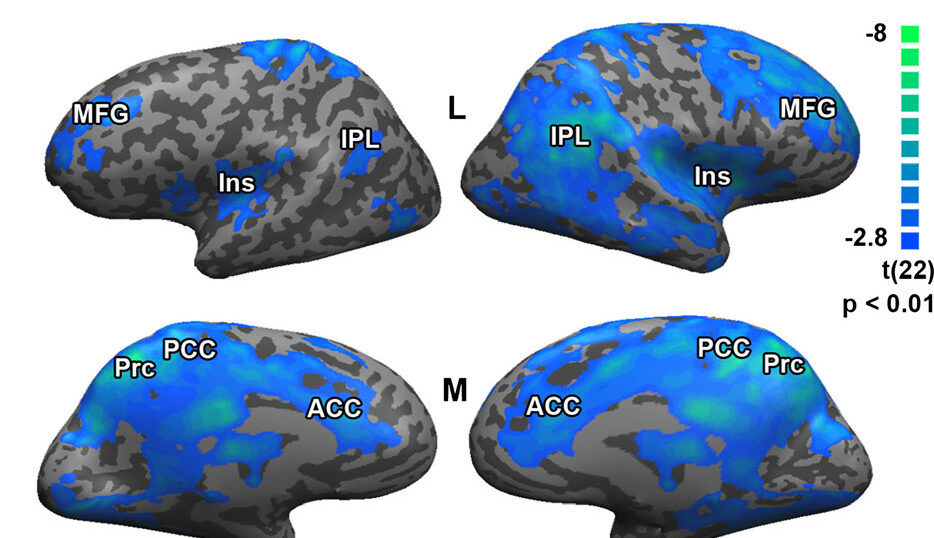
The striking part was what did not happen. Most tasks that quiet the default mode network also switch on other areas that do the work, and the two tend to rise and fall in opposition. Here, no cortical or subcortical area was significantly more active during repetition than at rest. The authors put it this way:
Our fMRI results show that a surprising level of widespread negative responses can emerge in the human cortex when participants perform a repetition of a single word.
Word generation, the comparison task, behaved like a typical task. It strongly activated frontal language areas, including
Broca’s area
Broca’s area is a region of the left frontal lobe, in the inferior frontal gyrus, long linked to producing speech. It is involved in planning and articulating words, in grammar, and in inner speech, and is typically active when people generate words, aloud or silently.
More on Wikipedia
Read more in the glossary
and the
dorsolateral prefrontal cortex
The dorsolateral prefrontal cortex (dlPFC) is a region on the upper outer sides of the frontal lobes. It is a core part of the brain’s executive control network, supporting working memory, directing attention and regulating emotion. Stronger dlPFC activity and connectivity have been associated with lower pain, negative emotion and stress.
More on Wikipedia
Read more in the glossary
, while also lowering activity in regions that largely matched the default mode network. The depth of the drops looked roughly similar in the two tasks. In other words, repeating a word didn’t quiet the default mode network more than generating words did. What set it apart was that the quieting came without a matching rise elsewhere.
The team checked this with a count of every cortical voxel (a small cube of brain tissue) in each person. During repetition there were significantly more voxels with a significant drop than with a significant rise (p = 0.014); during word generation the two counts were similar (p = 0.8). An index of how lopsided the counts were differed sharply between the tasks (p < 0.0005). In a region of Broca’s area defined in each person, repetition produced only a marginal rise (t = 2.6, p = 0.06 after correction), against a strong rise for word generation (t = 11.0).
Miscellaneous Interesting Takeaways
Breathing and the Baseline Didn’t Explain It Away
A change in breathing can shift the fMRI signal across the whole brain, and a monotonous task might plausibly slow it. In the 12 participants whose breathing was recorded, none of five measures (pace, inhale length, depth and two others) differed significantly between repetition and rest. When the analysis used the pooled rest periods from both runs, the difference between the tasks in how lopsided their voxel counts were remained significant, but more weakly (p < 0.05). The authors acknowledge that differences in the rest baseline “might account partly” for the effect.
What It Felt Like
The participants’ comments after the scan were brief and varied. Some examples: “it was easy to do, but monotonous and boring”; “it was similar to the rest, just deeper, there were no thoughts”; and “it was more relaxed and easy compared to the rest period.”
Fewer Thoughts, but Also Fewer Sensations
To put numbers on the experience, the team asked 30 research students (average age 26, 17 women) to sit with their eyes closed for one minute of resting and one minute of silently repeating “one,” in counterbalanced order. The paper doesn’t say whether they had meditated. After each minute they rated 27 questions, written by the first author, of the form “To what extent did you experience…”, from 1 (low) to 5 (high). Eleven questions were later judged ambiguous and dropped, and four of the authors grouped the rest into “Thoughts” (seven questions) and “Sensations” (three).
Thoughts were rated as less frequent during repetition than during rest (p < 0.0001), with the clearest drops for thoughts about oneself and about the future. Sensations, such as bodily and sensory awareness, also dropped (p < 0.0005). Control and concentration went the other way, higher during repetition. During rest, people who reported more thoughts tended to report fewer sensations (r = −0.24); during repetition that tradeoff all but disappeared (r = −0.04).
The paper’s abstract summarizes this study as showing “a significant reduction in intrinsic thought processes,” but the ratings show a broader dampening: outward-facing sensations dropped too. The form did include an item on physical relaxation, and the paper’s Figure 6 marks no significant difference on it between repetition and rest. The authors flag the bigger limitation themselves:
Importantly, it should be cautioned that our inference about the cognitive manifestations of the fMRI results was limited by having the detailed behavioral reports obtained in a separate experiment.
A “Gate” Rather Than a Seesaw
The usual account of default mode deactivation is a seesaw: task areas switch on and push inward-focused areas down. Because repetition lowered activity without raising any, the authors propose a different idea, a gate. Small activity in one key bottleneck region might shut down every competing process that depends on it, much as, in the
gate control theory
The gate control theory of pain, proposed by Ronald Melzack and Patrick Wall in 1965, holds that nerve circuits in the spinal cord act as a gate that can let pain signals through to the brain or hold them back. Input from touch fibers can partly close the gate, which is why rubbing a bumped elbow eases the pain. The idea of a gate that blocks competing signals has since been borrowed to explain other effects in the brain.
More on Wikipedia
Read more in the glossary
of pain, a light touch can block pain signals. They suggest Broca’s area or the dorsolateral prefrontal cortex as candidate gatekeepers, but this study couldn’t identify one, and they say further research is needed.
Why Earlier Mantra Studies Hadn’t Seen This
Previous brain-imaging studies of mantra meditation mostly reported increases in activity, and a meta-analysis the authors cite found no significant deactivations. The authors offer an explanation: those studies usually compared mantra meditation with other language tasks, such as repeating pseudo-words or generating words, rather than with rest. As their own word-generation task showed, such tasks also lower default mode activity, so subtracting one from the other could hide drops that both produce. They also note a study in which a looser, nondirective form of mantra meditation, which allows the mind to wander, raised default mode activity compared with a concentrated form. “Mantra meditation” covers practices that may not act alike.
Final Reflection
This is a neat, focused experiment. By removing the tradition, the teacher and the meaningful word, it showed that the plain act of silently repeating a word, done by people who had never meditated, was enough to lower activity across large parts of the cortex, centered on the default mode network, without switching on any other region to a significant degree. That fits other work on this site: in experienced Insight meditators, default mode activity was lower during meditation than during an active task.
How far it speaks to mantra meditation is a separate question, and the authors’ own answer varies. In the discussion they are careful:
This intentionally omitted the wider context and spiritual orientations of commonly practiced Mantra practices. Hence, the comparison with commonly practiced Mantra studies should be done with caution.
Their conclusions go further, saying the study “suggests a neuronal mechanism that may account for the uniquely calming effect of Mantra meditative practice, explaining its wide use across cultural and historical boundaries.” The data are thinner than that. Calm and relaxation were never measured in the scanner, the questionnaire’s relaxation item showed no significant change, and the repetition lasted 21 seconds at a time, against the many minutes of real practice. The authors raise the block length themselves, noting that 30-second blocks have been used in other mantra studies. The scanned group was 23 people, breathing was checked in only about half of them, and the experience ratings came from a different group after a single minute of each condition.
The question mark in the title is the right note to end on. The study offers a plausible piece of the puzzle: repetition alone seems to quiet the brain’s inward-focused systems in an unusually one-sided way. Whether that is what makes mantra practice calming, in trained meditators practicing for real, is something this study raises rather than settles.
Citation
Berkovich-Ohana, A., Wilf, M., Kahana, R., Arieli, A., & Malach, R. (2015). Repetitive speech elicits widespread deactivation in the human cortex: The “Mantra” effect? Brain and Behavior, 5(7), e00346. 10.1002/brb3.346
Get the next summary by email
One or two new paper summaries every couple of weeks, sent to your inbox when they go up.
No spam, and you can unsubscribe at any time. Prefer a feed reader? Use the RSS feed.