
Background Information
When long-term Tibetan Buddhist practitioners were recorded during compassion meditation, their brains produced unusually strong gamma waves.
Gamma
Gamma brain waves are a type of brainwave pattern that oscillate at approximately 25 to 100 Hz. Gamma waves are associated with states of heightened perception, problem-solving, and consciousness. Gamma waves play a crucial role in cognitive functioning, including memory, and information processing, and are thought to integrate thoughts and information from different parts of the brain.
More on Wikipedia
Read more in the glossary
waves are the fastest of the brain’s electrical rhythms, and they have been linked to attention, perception and conscious awareness, though the authors of this paper note that their role “remains controversial.” Other studies have since found more gamma in meditators practicing Vipassana and
mindfulness
Mindfulness is the psychological process of purposely bringing one’s attention to experiences occurring in the present moment without judgment. It involves maintaining awareness of thoughts, feelings, bodily sensations, and surrounding environment with an attitude of curiosity and acceptance. In meditation contexts, mindfulness practices typically involve focusing attention on the breath or body sensations as anchors to the present moment while acknowledging and releasing distracting thoughts.
More on Wikipedia
Read more in the glossary
, and even in meditators’ sleep.
Most of those studies looked at a single style of practice. Meditation comes in many forms, which researchers often place along a line running from
focused attention
Focused attention is a style of meditation in which you keep your attention on one chosen object, such as the breath or a point in front of you, notice when the mind has wandered, and bring it back. It trains steady concentration, and Buddhist shamatha practice is a well-known example. Researchers often contrast it with open monitoring meditation.
Read more in the glossary
on a single object to
open monitoring
Open monitoring is a style of meditation in which attention isn’t fixed on any one object. You stay aware of whatever arises from moment to moment, such as sounds, sensations and thoughts, and let each come and go without reacting to it, holding on to it or pushing it away. Researchers often contrast it with focused attention meditation.
Read more in the glossary
, where nothing in particular is held. If gamma shows up only in some styles, it may reflect what those practices ask of attention. If it shows up across very different styles, it may point to something they share.
This study recorded
EEG
An electroencephalogram (EEG) is a recording of brain activity. During this painless test, small sensors are attached to the scalp to pick up the electrical signals produced by the brain.
More on Wikipedia
Read more in the glossary
from practitioners of three traditions placed at different points on that line:
- Himalayan Yoga Tradition: silently repeating a
mantra
A mantra is a sound, word or phrase that is repeated, aloud or silently, as a spiritual or meditative practice. Mantras are central to Hindu and Buddhist traditions and appear in many others. In mantra meditation, the repetition itself serves as the object of attention, and practitioners often describe it as calming.
More on Wikipedia
Read more in the glossary , with or without awareness of the breath, a focused practice. -
Vipassana
Vipassana is a form of Buddhist meditation focused on the cultivation of insight through moment-to-moment awareness of bodily sensations, thoughts, and emotions. It emphasizes non-reactivity and equanimity, helping practitioners observe mental and physical phenomena without attachment.
More on Wikipedia
Read more in the glossary as taught by S. N. Goenka: scanning attention through the body from head to toe and back, observing sensations with equanimity. The authors describe it as a mix of focused attention and open monitoring. - Isha Shoonya: a practice of conscious “non-doing” in which the meditator does not respond to any inner or outer stimulus, with no specific object of focus. The authors compare it to
Zen
Zen is a school of Mahayana Buddhism that developed in China (as Chan) and spread to Japan, Korea and Vietnam. Its central practice is seated meditation (zazen), such as shikantaza, “just sitting” in open awareness without a particular object, or working with koans, paradoxical questions meant to cut through ordinary conceptual thinking.
More on Wikipedia
Read more in the glossary shikantaza; both names translate as variations on “nothingness” or “doing nothing.”
What They Did
The recordings took place at the Meditation Research Institute in Rishikesh, India. The team recorded 20 Vipassana meditators, 27 Himalayan Yoga meditators, 20 Isha practitioners and 32 people with no meditation practice. To compare like with like, they matched people by age and sex into four groups of 16, leaving out some of the non-meditators and Himalayan Yoga meditators. Average ages ran from 40 to 49. The meditators’ estimated lifetime practice differed widely by tradition: about 15,500 hours on average in the Himalayan Yoga group, 9,200 in the Vipassana group and 2,600 in the Isha group.
Everyone sat with eyes closed in a dark, soundproof room for two 20-minute sessions, in counterbalanced order:
- Meditation: 10 minutes of attention to the breath, a basic practice common to all three traditions, to settle in. Then the meditators switched to their own practice for 10 minutes. The non-meditators stayed with the breath for the full 20 minutes.
- Instructed
mind-wandering
Mind wandering is the spontaneous shift of attention away from a current task or external environment to internally generated thoughts, memories, or fantasies. This common cognitive process is associated with default mode network activation and has been extensively studied in relation to meditation practices, which often aim to reduce mind wandering.
More on Wikipedia
Read more in the glossary : recalling everyday memories from childhood to the recent past, avoiding emotionally charged ones.
The mind-wandering task was there instead of plain rest for a specific reason:
This was preferred to just using resting state instructions to prevent meditators from slipping into a meditative state while at rest (a common phenomenon reported by many practitioners).
The researchers compared the last 10 minutes of each session, measuring EEG power from 2 to 110 Hz across 64 electrodes. They focused on high gamma, 60–110 Hz, well above the 25–45 Hz range where most earlier studies had found more gamma in meditators. After each session, participants rated how deep their meditation was, how crowded their thoughts were, and how relaxed or hindered (for example, bored or drowsy) they felt.
One Big Result: All Three Meditator Groups Had More Gamma Activity Over the Back of the Head Than Non-Meditators
Taking the two sessions together, each of the three meditator groups had more 60–110 Hz gamma power over the parietal and occipital areas at the back of the head than the non-meditators. Over frontal electrodes, the overall difference between groups was not significant, though the Isha group alone also showed extra gamma over central and frontal sites.
During the meditation session on its own, all three meditator groups again had more gamma than the non-meditators, mainly over the back of the head, and in a less robust way over frontal and midline sites. During mind-wandering on its own, the same difference appeared only as a trend that fell short of significance.
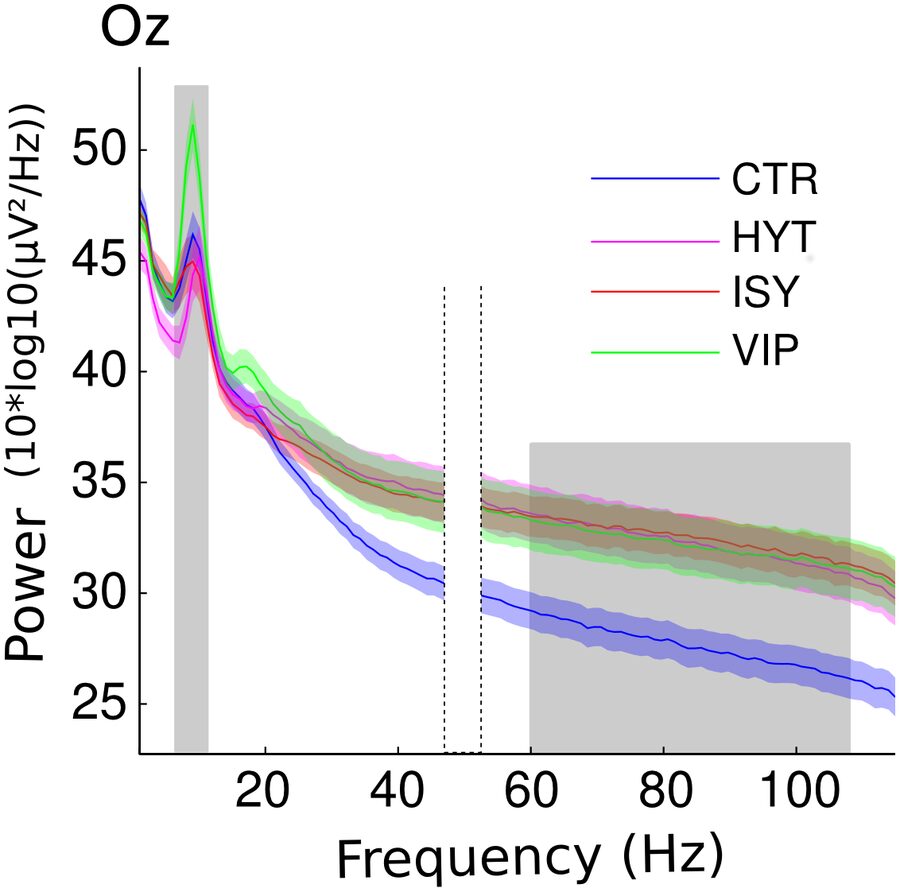
Within each group, gamma did not differ significantly between meditation and mind-wandering. Together with the combined result and the trend during mind-wandering, the authors read this as a sign that the extra gamma was less like something the meditators switched on while meditating (a state effect) and more like a lasting difference that showed up whatever they were doing (a trait effect). Individuals varied a lot within every group, but the typical meditator in each tradition had more gamma than most of the non-meditators.
Experience tracked gamma too. Among the meditators, those with more estimated lifetime hours of practice had more gamma over the back of the head, a modest
correlation
A correlation measures how closely two things rise and fall together across people or over time. Pearson’s r runs from −1 to +1: values near +1 mean that people high on one measure tend to be high on the other, values near −1 mean the reverse, and values near 0 mean no straight-line relationship. A correlation alone can’t show that one thing causes the other.
More on Wikipedia
Read more in the glossary
(r = 0.33). It held during mind-wandering alone (r = 0.31) but not during meditation alone (r = 0.15).
Was It Really the Brain?
High-frequency EEG is easily contaminated by muscles in the scalp, face and temples and by eye movements, which can mimic gamma. The team used
independent component analysis
Independent component analysis (ICA) is a statistical method that splits a mix of recorded signals into separate underlying sources, much as one might pick out single voices in a crowded room. In EEG research it is used to find and remove activity that doesn’t come from the brain, such as eye blinks, eye movements and muscle tension, which would otherwise contaminate the brain-wave recordings.
More on Wikipedia
Read more in the glossary
(ICA) to pull out and remove signals that clearly came from the eyes and from the temple muscles before analyzing the data. They then checked those discarded signals: neither the eye nor the muscle components differed between the groups. As the authors reason:
If muscle activity from the scalp were responsible for the difference in gamma activity we observed between meditators and control subjects, it should have been visible (and amplified) in these components.
Temple-muscle activity also didn’t track gamma. Eye-related activity did correlate with gamma at the back of the head (r = 0.33), but not with meditation experience, which the authors take as a sign that their gamma signal was mostly genuine brain activity. They acknowledge two gaps. They didn’t record the neck muscles, though they argue that the stiller meditators should, if anything, have produced less neck-muscle activity. And 14 of the 16 non-meditators sat on a chair, compared with 2 Himalayan Yoga, 8 Isha and 4 Vipassana meditators; the Himalayan Yoga group, who sat on the floor most, didn’t have more gamma than the other meditator groups, so the authors conclude posture doesn’t primarily explain the results, while saying it deserves more study.
Miscellaneous Interesting Takeaways
Vipassana Meditators Had More Alpha, Too
One difference set a single tradition apart. Vipassana meditators had more 7–11 Hz
alpha
Alpha waves are rhythmic electrical brain activity at roughly 8–13 cycles per second, recorded with EEG. They are often strongest when the eyes are closed and the mind is relaxed, and are thought to help filter out or hold back information as part of top-down control. Meditation studies have reported both increases and decreases in alpha, depending on the practice.
More on Wikipedia
Read more in the glossary
power than every other group, at all electrodes during meditation and at least over frontal and central sites during mind-wandering. The authors know of no earlier study showing more alpha in Vipassana meditators than in meditators of other traditions. They suggest it may come from Vipassana’s training in attending to body sensations, which could strengthen the brain’s ability to tune out distracting input.
Switching From the Breath to Their Own Practice
Comparing the first 10 minutes of breath focus with the 10 minutes of each tradition’s own practice, the Himalayan Yoga and Isha meditators had less gamma during their own practice than during breath focus. The Vipassana group showed no difference. The authors suggest that breath awareness, central to Vipassana, may have taken more effort for the other two groups.
What the Meditators Reported
All three meditator groups said their thoughts were less crowded after meditating than after mind-wandering; the non-meditators showed no significant difference. Meditators rated the depth of their meditation in the lab about the same as at home, on average around 6 to 7.5 out of 10. The Himalayan Yoga group may have found the lab hardest: they reported more hindrances, including drowsiness and mind-wandering, after meditating than after the mind-wandering session.
Final Reflection
What makes this study stand out is the comparison. Rather than asking whether one kind of meditation changes the brain, it set a mantra practice, a
body-scanning
The body scan is a meditation practice in which attention is moved slowly through the body, part by part, noticing whatever sensations are present without trying to change them. It is a core exercise in mindfulness programs such as MBSR.
More on Wikipedia
Read more in the glossary
practice and an objectless “non-doing” practice side by side, with the same equipment, protocol and comparison group. The common thread was more high-frequency gamma over the back of the head. The authors offer a tentative interpretation:
In the light of this literature, we suggest that the trait parieto-occipital increase in high gamma we observe in meditators is a marker of an overall attentive state, the parietal cortex being associated with the focus of attention on a given object.
Several cautions apply. The groups were small, with 16 people each. Everyone was recorded once, and the authors note that their participants were self-selected, so people drawn to years of meditation may have differed in other ways from the start; longitudinal studies that follow people as they learn to meditate would be needed to show cause. The trait conclusion leans on the two sessions combined, since mind-wandering alone gave only a trend. And although the team checked carefully for eye and muscle artifacts, they say more work is needed to be sure the EEG is free of muscle contamination, and neck muscles weren’t measured.
Still, the paper adds to earlier reports of more gamma in long-term meditators, and here the difference appeared across three traditions at once. Whether that signal reflects a common change in how meditators’ brains handle attention is the next question to answer.
Citation
Braboszcz, C., Cahn, B. R., Levy, J., Fernandez, M., & Delorme, A. (2017). Increased gamma brainwave amplitude compared to control in three different meditation traditions. PLoS ONE, 12(1), e0170647. 10.1371/journal.pone.0170647
Get the next summary by email
One or two new paper summaries every couple of weeks, sent to your inbox when they go up.
No spam, and you can unsubscribe at any time. Prefer a feed reader? Use the RSS feed.