
Background Information
Popular
mindfulness
Mindfulness is the psychological process of purposely bringing one’s attention to experiences occurring in the present moment without judgment. It involves maintaining awareness of thoughts, feelings, bodily sensations, and surrounding environment with an attitude of curiosity and acceptance. In meditation contexts, mindfulness practices typically involve focusing attention on the breath or body sensations as anchors to the present moment while acknowledging and releasing distracting thoughts.
More on Wikipedia
Read more in the glossary
programs such as
Mindfulness-Based Stress Reduction (MBSR)
Mindfulness-Based Stress Reduction (MBSR) is a program designed to help individuals cope with stress, pain, and illness. Developed by Jon Kabat-Zinn in the 1970s, it combines meditation and yoga to promote awareness and stress management. The eight-week program teaches participants to focus on the present moment non-judgmentally, enhancing their ability to manage difficulties.
More on Wikipedia
Read more in the glossary
and
mindfulness-based cognitive therapy (MBCT)
Mindfulness-based cognitive therapy (MBCT) is an 8-week group program that combines mindfulness meditation, adapted from Mindfulness-Based Stress Reduction (MBSR), with elements of cognitive behavioral therapy. It was developed to help people who have recovered from depression avoid relapse, by learning to notice and step back from patterns of negative thinking. Classes usually meet weekly, with daily meditation practice at home.
More on Wikipedia
Read more in the glossary
teach two quite different ways of paying attention. In
focused attention
Focused attention is a style of meditation in which you keep your attention on one chosen object, such as the breath or a point in front of you, notice when the mind has wandered, and bring it back. It trains steady concentration, and Buddhist shamatha practice is a well-known example. Researchers often contrast it with open monitoring meditation.
Read more in the glossary
, you keep attention on one object, usually the breath, and come back to it whenever the mind wanders. In
open monitoring
Open monitoring is a style of meditation in which attention isn’t fixed on any one object. You stay aware of whatever arises from moment to moment, such as sounds, sensations and thoughts, and let each come and go without reacting to it, holding on to it or pushing it away. Researchers often contrast it with focused attention meditation.
Read more in the glossary
, you don’t hold any one object but stay aware of whatever arises (sounds, sensations, thoughts, feelings) without reacting to it.
The two treat emotions in almost opposite ways. Focused attention steps away from an upsetting thought or feeling and returns to the breath. Open monitoring deliberately stays with it, on the theory that repeated, non-reactive exposure wears down automatic reactions. Standard courses teach focused attention first and open monitoring later, so nobody can tell which one, if either, does the work. Kirk Warren Brown, Willoughby Britton and colleagues set out to pull a course apart, in what researchers call a dismantling trial.
To measure emotional reactions in the brain, they used
frontal alpha asymmetry
Frontal alpha asymmetry compares the strength of alpha waves, recorded with EEG, over the left and right sides of the front of the head. Alpha is thought to be weaker where the cortex is more active, so relatively less alpha on the left is read as relatively more left-sided activity. That pattern has been linked with approach motivation, the pull toward things, and with positive emotion (and also with anger), while relatively more right-sided activity has been linked with withdrawal, emotions such as sadness and fear, and risk of depression. It is an indirect marker, and studies of it have often disagreed.
More on Wikipedia
Read more in the glossary
, a long-studied
EEG
An electroencephalogram (EEG) is a recording of brain activity. During this painless test, small sensors are attached to the scalp to pick up the electrical signals produced by the brain.
More on Wikipedia
Read more in the glossary
marker.
Alpha waves
Alpha waves are rhythmic electrical brain activity at roughly 8–13 cycles per second, recorded with EEG. They are often strongest when the eyes are closed and the mind is relaxed, and are thought to help filter out or hold back information as part of top-down control. Meditation studies have reported both increases and decreases in alpha, depending on the practice.
More on Wikipedia
Read more in the glossary
are thought to be weaker where the cortex is more active, so relatively less alpha over the left front of the head is read as more left-sided activity. That pattern has been linked with approach and positive emotion, and the opposite pattern with withdrawal, sadness and depression. An early MBSR trial reported a leftward shift after an 8-week course, though the authors of this paper note that it appeared at central and temporal sites rather than over the front of the head, and that later MBCT studies have given mixed results, mostly measuring the brain at rest. Here the team measured it while people faced emotional pictures.
What They Did
The participants were 104 adults aged 18–65 from the northeastern United States, recruited through flyers at primary care clinics, community announcements and online ads. All had mild to severe depression symptoms or high levels of negative emotion, and none meditated regularly. People with bipolar disorder,
psychosis
Psychosis is a state in which a person loses touch with reality in important ways, most often through hallucinations (perceiving things that aren’t there, such as hearing voices) and delusions (fixed false beliefs, such as being persecuted). It is a feature of several conditions, including schizophrenia, bipolar disorder and severe depression, and can also be brought on by drugs, extreme sleep loss or physical illness. It is usually treated with antipsychotic medication and psychological support.
More on Wikipedia
Read more in the glossary
, PTSD, panic disorder and several other conditions were screened out. This is the same trial whose participants were later interviewed about unwanted effects of meditation.
Because the courses were taught in groups, one after another, the team randomized clusters rather than individuals, a version of a
cluster randomized trial
A cluster randomized trial randomly assigns whole groups, such as schools, classes, clinics or villages, rather than individual people, to receive a program or to serve as the comparison. It suits programs delivered to a group at once, and it keeps people in the comparison group from picking up the program from those who get it. Because people in the same group tend to resemble each other, these trials need more participants than ordinary ones, and the analysis has to account for the grouping.
More on Wikipedia
Read more in the glossary
: each batch of 4–16 people who had finished their first lab visit was assigned to one course, nine times over. Of the 104, 32 went to MBCT, 36 to focused attention and 36 to open monitoring. The three programs were built to the same frame: eight weeks of 3-hour weekly classes, a silent day in week 6 or 7 and 45 minutes a day of guided home practice. The first four weeks taught the techniques, and the last four applied them to difficult emotions.
- MBCT was the standard program, which includes both kinds of practice.
- Focused attention trained people to rest attention on one of six “anchors” (the feet, the hands, the breath at the belly, chest or nostrils, or sounds) and return to it whenever the mind wandered.
- Open monitoring used “noting”: labeling each experience as seen, heard, felt, tasted, smelled or thought, first out loud, then silently, and finally without words.
The same woman, an experienced MBSR and MBCT teacher, led every course, with a different male co-teacher in each program. All four teachers had over 20 years of meditation practice.
Before and after training, everyone did an emotion task while wearing a 19-electrode EEG cap. They saw 125 photographs from a standard research set: 75 negative (at three levels of intensity), 25 positive and 25 neutral. Each picture appeared for 4 seconds of plain watching, which measured reactivity. Then, for 10 more seconds, an instruction appeared. With negative pictures it was “label” (name your own emotion, taken from open monitoring), “breathe” (attend to breathing sensations, taken from focused attention) or “watch” (no regulation). Positive and neutral pictures always got “watch.” Finally, people rated how they felt on a 1–9 scale from unhappy to happy.
The team computed alpha asymmetry at two pairs of electrodes over the front of the head (F8–F7 and F4–F3), and at central and parietal pairs to check whether any change was specific to the front. After removing 15 people’s data for technical problems or noisy recordings, 89 were analyzed: 26 MBCT, 28 focused attention and 35 open monitoring.
One Big Result: Focused Attention and MBCT Shifted Frontal Activity Leftward; Open Monitoring Didn’t
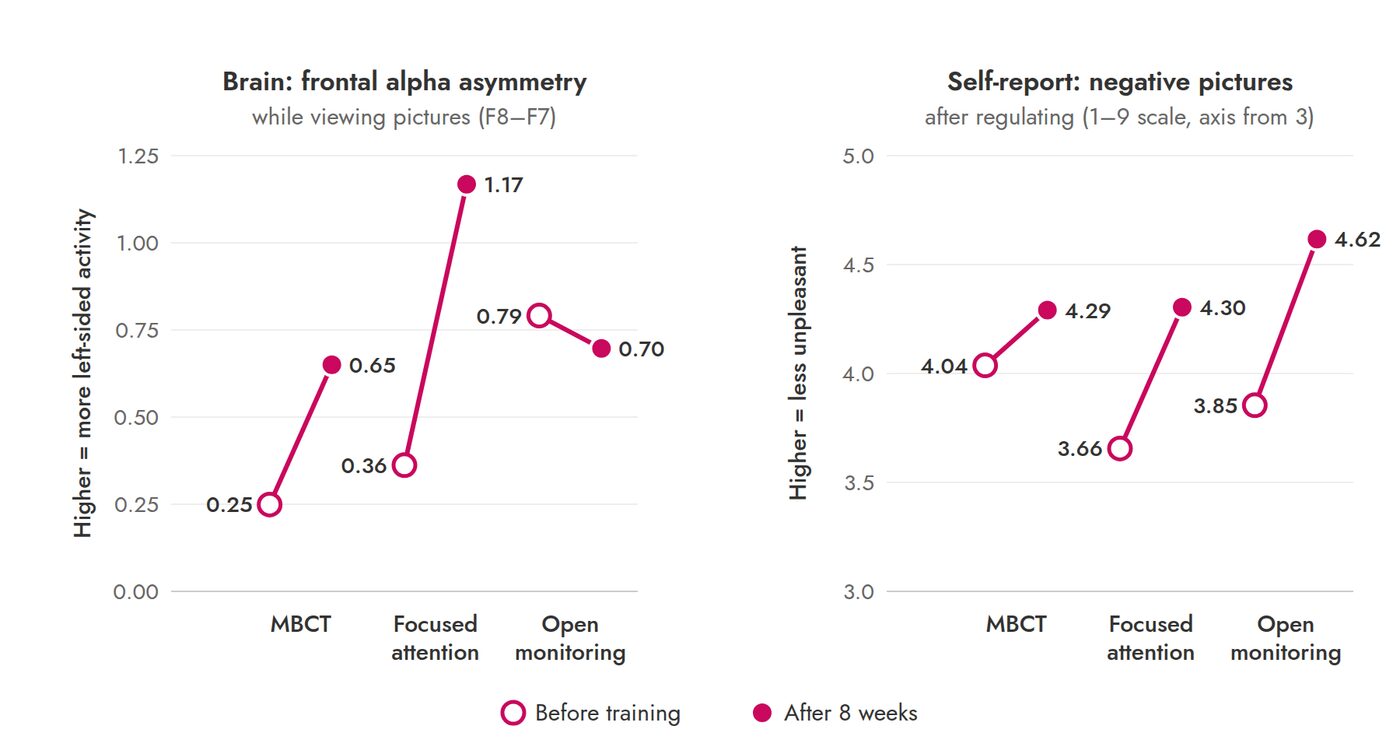
During plain watching, at the outer frontal pair (F8–F7), activity shifted to the left after focused-attention training (d = 0.175, p < .0001) and after MBCT (d = 0.087, p = .003), across positive, negative and neutral pictures alike. Open-monitoring trainees showed no change (p = .428).
The same pattern held when people regulated their reactions to negative pictures. At F8–F7, focused attention (d = 0.300) and MBCT (d = 0.171) shifted leftward and open monitoring didn’t (p = .624), and at the inner frontal pair (F4–F3) the results were similar (focused attention d = 0.183, MBCT d = 0.195, open monitoring p = .558). The shifts didn’t depend much on how intense the pictures were or which instruction people had been given. With positive pictures at F8–F7, MBCT (d = 0.247) and focused attention (d = 0.193) again shifted left, and open monitoring again didn’t.
This was the reverse of what the team expected. Because MBCT and open monitoring both train people to stay open to difficult experience, they had predicted those two would show the biggest changes:
Unexpectedly, FA training produced leftward shifts in FAA equal to, and in some analyses, more strongly than MBCT.
(FA is focused attention and FAA frontal alpha asymmetry.)
Two cautions. First, the brain changes were small. By the usual benchmarks for
effect sizes
Effect size is a statistical concept that quantifies the magnitude or strength of a relationship, difference, or intervention outcome. Unlike p-values which only indicate statistical significance, effect sizes measure how meaningful a result is in practical terms. Common measures include Cohen’s d (standardized mean difference), correlation coefficients (r), and odds ratios. In meditation research, effect sizes help quantify the practical impact of different meditation practices on psychological or physiological outcomes.
More on Wikipedia
Read more in the glossary
, a d of 0.2 counts as small, and the frontal shifts here ranged from about 0.05 to 0.30. Second, the picture is not quite as clean as the paper’s summary. The abstract says open monitoring’s benefits were restricted to self-reports, but during plain watching at F4–F3, open-monitoring trainees did show a small, significant leftward shift (d = 0.053, p = .039), while the focused-attention shift there was only marginal (p = .060). At that pair, MBCT showed the clearest change (d = 0.139).
Miscellaneous Interesting Takeaways
People’s Own Ratings Favored Open Monitoring
What people said about their feelings told a different story from their brain activity. After regulating their reactions, all three groups rated negative pictures as less unpleasant after training than before. The change was smallest after MBCT (d = 0.211) and larger after focused attention (d = 0.538) and open monitoring (d = 0.633).
Positive pictures split the two single-technique groups. After open-monitoring training, people rated them as more pleasant (d = 0.347). After focused-attention training, they rated them as slightly less pleasant (d = −0.275), and MBCT made no significant difference. The authors call these effects small and interpret them cautiously. They don’t know why open monitoring’s benefits showed up only in self-reports, but offer one guess:
OM is often considered a more advanced practice than FA, and it is possible that without the stabilization of attention accrued through FA (c.f., Bostanov et al., 2012), OM practice for novice trainees may result in unhealthy over-exposure to psychological contents.
They also raise the opposite possibility, that MBCT works mainly through the focused-attention training inside it. The trial can’t tell these apart.
Calm, or Blunted?
The drop in pleasure from positive pictures after focused-attention training could be read two ways. Earlier studies have found that attending to the breath while viewing emotional pictures turns down their intensity across the board, and the authors link this to equanimity, an even-minded steadiness that some forms of meditation training aim for. But they also note a risk: practiced too much, or without the balance of open awareness, focused attention can lead to dullness, emotional blunting and loss of pleasure. Emotional blunting was one of the experiences the interview study from this trial asked about.
Naming Feelings Helped, Barely
Across all three groups, negative pictures felt slightly less unpleasant when people were told to label their emotions than when they just watched (4.17 against 4.11 on the 1–9 scale, d = 0.062, p = .033). “Breathe” did no better than “watch,” and the gap between “label” and “breathe” wasn’t significant (p = .074), although the paper’s summary of these results describes labeling as more effective than both. Either way, the difference was tiny.
Not Just the Front of the Head
The team also measured asymmetry at central and parietal electrode pairs, to check whether the changes reflected emotion specifically or something broader such as attention. The results there were mixed. MBCT shifted leftward at the central pair in every analysis and at the parietal pair during regulation, while open monitoring shifted rightward at the central pair (for example d = −0.283 with negative pictures) and focused attention didn’t change there. The authors conclude the evidence was strongest over the front of the head, but say they didn’t statistically compare regions, so more research is needed.
Final Reflection
The authors describe this as the first study to take a standard mindfulness course apart and compare it with its component practices on emotional outcomes, in a randomized design with programs matched for time and structure. Its brain results suggest that focused attention, usually considered the simpler practice, may carry more of MBCT’s effect on emotional reactions than open monitoring does, and that it can do so in people who are new to meditation and struggling with low mood or distress.
But the case is weaker than the paper’s headline. The frontal shifts were small. The self-reports, the outcome people actually feel, improved in all three groups and most after open monitoring, so the abstract’s suggestion that MBCT “may derive its greatest benefit from training in FA rather than OM” rests on the brain measure alone. Frontal alpha asymmetry is itself an indirect marker of approach and withdrawal. The EEG analyses weren’t listed in the trial’s registration, and each program had its own co-teacher, so teacher and technique can’t be fully separated. And because every group meditated, nothing here shows how much of any change came from meditation itself. The authors say so plainly:
Without a passive control condition, the possibility remains that the changes observed were at least in part due to non-specific factors associated with the trainings.
There was also no follow-up. The authors note that a separate analysis of this same sample found that self-reported emotional gains had deteriorated by a 20-week follow-up. Replication with a non-meditating comparison group and longer follow-up would show whether focused attention really is the active ingredient, or whether its brain signature simply differs from open monitoring’s after eight weeks.
Citation
Brown, K. W., Berry, D., Eichel, K., Beloborodova, P., Rahrig, H., & Britton, W. B. (2022). Comparing impacts of meditation training in focused attention, open monitoring, and mindfulness-based cognitive therapy on emotion reactivity and regulation: Neural and subjective evidence from a dismantling study. Psychophysiology, 59(7), e14024. 10.1111/psyp.14024
Get the next summary by email
One or two new paper summaries every couple of weeks, sent to your inbox when they go up.
No spam, and you can unsubscribe at any time. Prefer a feed reader? Use the RSS feed.