
Background Information
Children who can manage their attention, feelings and impulses tend to do better, at school and long afterward. The authors cite long-term studies in which self-regulation in childhood predicted health, financial stability and education in adulthood, and children who could wait longer for a reward at age 4 had better attention and self-control as teenagers. These skills rest on what psychologists call
executive functions
Executive functions are the mental skills used to control and direct thinking and behavior toward a goal. The three core ones are usually given as inhibitory control (holding back an automatic response or ignoring a distraction), working memory (keeping information in mind and using it) and cognitive flexibility (switching between rules, tasks or points of view). They develop rapidly in early childhood, rely heavily on the prefrontal cortex, and predict how well children do at school.
More on Wikipedia
Read more in the glossary
, such as cognitive flexibility and inhibitory control, which develop rapidly in early childhood. Yet, the authors point out, they are rarely taught explicitly in school.
Their candidate for teaching them was
mindfulness
Mindfulness is the psychological process of purposely bringing one’s attention to experiences occurring in the present moment without judgment. It involves maintaining awareness of thoughts, feelings, bodily sensations, and surrounding environment with an attitude of curiosity and acceptance. In meditation contexts, mindfulness practices typically involve focusing attention on the breath or body sensations as anchors to the present moment while acknowledging and releasing distracting thoughts.
More on Wikipedia
Read more in the glossary
. In their description, mindfulness practice trains attention by noticing when the mind has wandered from its focus and bringing it back, a skill that overlaps with self-regulation. The same practice can also be used to cultivate kindness and care. In a curriculum for young children, the paper explains:
Young children, for instance, engage in setting daily intentions and age-appropriate practices to extend care and well wishes.
The authors point to adult research on compassion training, including a study in which two weeks of practice made people more generous to a stranger (Weng et al. 2013). Whether something similar works in a classroom of four-year-olds is a different question. Earlier studies of mindfulness with children, they note, were mostly limited by a lack of randomized trials and by relying on questionnaires. This study, from the Center for Investigating Healthy Minds at the University of Wisconsin–Madison, aimed to address both, combining teacher ratings with behavioral tasks the children did themselves.
What They Did
Seven preschool classrooms in six public elementary schools in a medium-sized Midwestern city took part. In these schools, 37.9% of children were considered socioeconomically disadvantaged. Of 99 children invited, the parents of 68 enrolled them. The children were about four and a half years old on average, half were girls, and 59% were white.
Randomization was by classroom, not by child, which makes this a
cluster-randomized trial
A cluster randomized trial randomly assigns whole groups, such as schools, classes, clinics or villages, rather than individual people, to receive a program or to serve as the comparison. It suits programs delivered to a group at once, and it keeps people in the comparison group from picking up the program from those who get it. Because people in the same group tend to resemble each other, these trials need more participants than ordinary ones, and the analysis has to account for the grouping.
More on Wikipedia
Read more in the glossary
. Three classrooms (30 children) got the Kindness Curriculum, and four classrooms (38 children) formed a
wait-list control group
A wait-list control group is a comparison group that receives the program being studied only after the study period, so participants who are waiting can be compared with those already taking part. It controls for the passage of time and repeated testing, but not for the attention, expectations and setting that come with taking part in any program, which an active control group can address.
More on Wikipedia
Read more in the glossary
.
The curriculum was built on mindfulness practice for attention and
emotion regulation
Emotion regulation is the set of ways people influence which emotions they have, when they have them, and how they experience and express them. Psychologist James Gross’s process model groups the strategies into five families: choosing situations, changing situations, shifting attention (attentional deployment), changing how one thinks about a situation (reappraisal), and changing one’s response, such as suppressing an expression.
More on Wikipedia
Read more in the glossary
, combined with kindness practices such as empathy, gratitude and sharing, taught through children’s books, music and movement. Experienced mindfulness instructors taught it, in a secular way, to the whole class during the regular school day: two lessons of 20 to 30 minutes a week for 12 weeks, about 10 hours in all.
Before and after the 12 weeks, the researchers measured:
- Social competence, rated by the children’s teachers on a 6-point scale, with two parts: prosocial behavior (such as showing empathy for others’ feelings) and emotion regulation (such as calming down when upset).
- Sharing, with a task designed for this study. In four rounds, each child got 10 stickers to divide between an envelope marked “me” and an envelope for someone else: their most-liked classmate, their least-liked classmate, an unfamiliar child and a sick child. The score was the average number kept.
- Self-control, with a
delay of gratification
Delay of gratification is the ability to resist a smaller reward now in order to get a larger one later. It is often tested in young children by offering a choice, such as one treat now or two later, and counting how often they choose to wait. Walter Mischel’s “marshmallow” studies from the late 1960s onward found that preschoolers who waited longer tended to do better years later, though the strength of that link has been debated.
More on Wikipedia
Read more in the glossary task of nine choices between a small reward now (one item of food, crayons or tokens) and a bigger one later (two, three or five). - Cognitive flexibility, with a computerized card-sorting task in which children sort pictures by one feature, such as shape, and then switch to another, such as color.
- Inhibitory control, with a computerized
flanker task
The flanker test is a cognitive task used to measure interference control—the ability to focus attention on relevant stimuli while suppressing responses to irrelevant distractions. Participants respond to a central target stimulus surrounded by distracting ‘flanker’ stimuli. Performance on this task reflects the efficiency of controlled and automatic attentional processes.
More on Wikipedia
Read more in the glossary : children pressed a button to show which way a middle fish or arrow pointed while those on either side pointed the same or the opposite way.
Finally, the researchers collected the children’s report-card grades for the second half of the school year, in five areas. These were available only at the end, so they couldn’t be compared with grades before the curriculum.
One Big Result: The Curriculum Group Gained a Little More in Social Skills, and Didn’t Become Less Generous
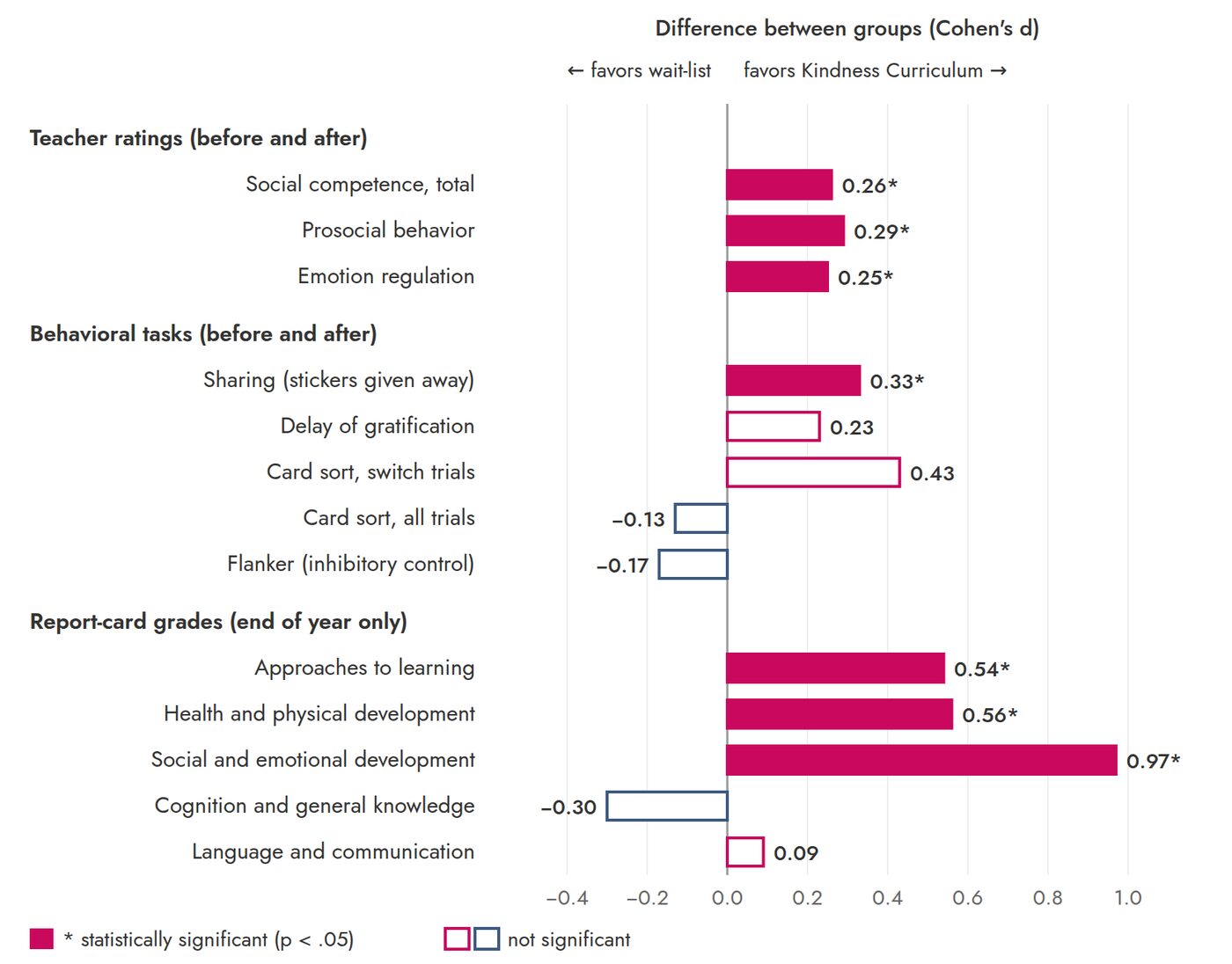
Teacher ratings of social competence rose a lot in both groups over the 12 weeks (within-group effect sizes of d = 1.31 and 1.05). The curriculum group’s rose more: from 3.23 to 4.32 on the 6-point scale, against 3.10 to 3.91 for the wait-list group. The difference between the groups was statistically significant for the total score (p = .011) and for both parts, prosocial behavior (p = .041) and emotion regulation (p = .002). Its size was small, an
effect size
Effect size is a statistical concept that quantifies the magnitude or strength of a relationship, difference, or intervention outcome. Unlike p-values which only indicate statistical significance, effect sizes measure how meaningful a result is in practical terms. Common measures include Cohen’s d (standardized mean difference), correlation coefficients (r), and odds ratios. In meditation research, effect sizes help quantify the practical impact of different meditation practices on psychological or physiological outcomes.
More on Wikipedia
Read more in the glossary
of d = 0.26 for the total score. When the analysis also accounted for children’s gender and age, the prosocial behavior part was no longer significant (p = .105); the total score and emotion regulation still were.
The sharing task gave the result most directly about kindness, though it came from the comparison group changing. Children on the wait-list kept more stickers for themselves at the end than at the start, 6.20 of 10 on average against 5.42, a significant rise (p = .029). The curriculum group’s change, from 4.84 to 5.13, was not significant. The difference between the groups’ changes was significant (p = .013), with a small effect size (d = 0.33), and it held when gender and age were taken into account. In the abstract’s words, “the control group exhibited more selfish behavior over time.”
Miscellaneous Interesting Takeaways
Better Report Cards in Three of Five Areas
At the end of the year, about three months after the curriculum finished, teachers gave the curriculum children higher grades (on a 4-point scale) in three areas: approaches to learning (3.55 against 3.33, d = 0.54), health and physical development (3.60 against 3.40, d = 0.56) and social and emotional development (3.51 against 3.16, d = 0.97, the largest difference in the study). The groups didn’t differ in cognition and general knowledge, where the wait-list group was slightly ahead (d = −0.30), or in language and communication (d = 0.09). Because there were no grades from before the curriculum, these show where the groups ended up, not how much each changed.
The Thinking Tasks Didn’t Show Significant Differences
None of the three tests of self-control and thinking skills showed a significant difference between the groups. On delay of gratification, the curriculum children’s choices to wait for the bigger reward rose more than the wait-list group’s (within-group d = 0.42 against 0.19), but the difference between them was small (d = 0.23) and not significant (p = .244). On the card-sorting task, the curriculum group improved more on the trials after the switch in sorting rule (d = 0.43, p = .222). Only 44 children were included in that comparison, because many didn’t sort accurately enough to reach the switch, and across all trials the wait-list group was slightly ahead (d = −0.13). On the flanker task, both groups improved, the wait-list group a little more (d = −0.17).
The abstract presents the delay and card-sorting results as “small to medium effects favoring the KC group.” Those effect sizes are as reported, but neither was statistically significant, and the medium-sized card-sorting result came from the subset of trials and children that reached the switch. The authors’ own summary in the discussion is careful:
Overall, however, inspection of effect sizes lends support to a general pattern of change favoring the intervention group, even though not all outcomes were significant in the omnibus test of the group by time interaction, which highlights the need for larger samples in future studies.
Children Who Started Lower Gained More
The researchers expected the curriculum to help most the children who began with weaker skills, and in a
moderation analysis
Moderation analysis is a statistical method that tests whether the link between two variables changes depending on a third, called the moderator. For example, it can ask whether the link between craving and smoking is weaker in people who practice mindfulness more often. It is usually tested by adding an interaction term (the product of the two predictors) to a regression. It shows that a relationship differs between people, not why.
More on Wikipedia
Read more in the glossary
it did. Curriculum children with lower teacher-rated social competence, or lower cognitive flexibility or inhibitory control on the computer tasks, at the start gained more in social competence than similar children on the wait-list. The authors note that earlier research has found the same pattern of larger gains for children who start further behind.
Teachers Knew Which Children Were in the Program
The teacher ratings and report-card grades came from teachers who knew whether their class was getting the curriculum. The authors argue this didn’t simply produce a halo effect: the grades were given three months after the program ended, they weren’t higher in every area, and the gains in social competence varied with children’s starting skills rather than rising evenly. Still, teacher-rated outcomes clustered by classroom. The researchers measured this with the
intraclass correlation
The intraclass correlation coefficient (ICC) measures how much people within the same group, such as children in one classroom, resemble each other compared with people in other groups. It runs from 0 to 1: an ICC of 0 means the group someone belongs to tells you nothing about their score, while larger values mean a sizeable share of the differences between people lies between groups. It is also used to measure how consistently a test gives the same score twice.
More on Wikipedia
Read more in the glossary
, the share of differences between children that lay between classrooms. It was 0.19 to 0.35 for the social competence ratings and 0.17 to 0.48 for grades, but close to zero for most of the behavioral tasks. The authors concluded that classroom effects alone don’t explain the pattern of results, but added a caution:
However, the sizeable ICCs for some teacher-rated outcomes highlights potential limitations of relying on teacher-based measures when conducting research in schools.
With three classrooms in one group and four in the other, the paper says there were too few classrooms to use multilevel models, the kind of analysis that accounts for children being grouped in classrooms.
Final Reflection
This was a small, early randomized test of teaching mindfulness and kindness to very young children in ordinary public schools. About 10 hours of lessons over 12 weeks went with slightly larger gains in teacher-rated social skills, better end-of-year grades in three of five areas, and children who held on to their generosity in a sharing game while children on the wait-list grew a little less generous. The behavioral tests of self-control and thinking skills, which didn’t depend on teachers’ judgments, pointed in mixed directions and none reached significance.
The strengths are real. The program was delivered in regular classrooms, the groups were randomized and similar at the start, and the authors report effect sizes for every outcome, including those that went the other way. But the evidence comes from seven classrooms, the clearest results depend on teachers who knew which children were in the program, the grades have no starting point to compare with, and the wait-list group didn’t receive any alternative activity. As the authors say, larger studies with more classrooms and longer follow-up were needed.
The sharing result fits other studies on this site in which brief practice changed how people treat others, from two weeks of compassion training after which adults gave more to a stranger than a comparison group did to a mindfulness app after which more students gave up their seat to someone in pain. Here the change came in four-year-olds, measured with stickers, and it showed up mainly as the comparison group becoming less generous rather than the curriculum group becoming more so.
Citation
Flook, L., Goldberg, S. B., Pinger, L., & Davidson, R. J. (2015). Promoting prosocial behavior and self-regulatory skills in preschool children through a mindfulness-based kindness curriculum. Developmental Psychology, 51(1), 44–51. 10.1037/a0038256
Get the next summary by email
One or two new paper summaries every couple of weeks, sent to your inbox when they go up.
No spam, and you can unsubscribe at any time. Prefer a feed reader? Use the RSS feed.