
Background Information
Getting older brings well-documented changes in attention. Drawing on decades of work by the attention researcher Raja Parasuraman and others, Stephanie Fountain-Zaragoza and Ruchika Prakash of Ohio State University describe how older adults are worse at shifting attention from one place to another, less able to widen or narrow their focus on demand, and worse at some kinds of
executive control
Executive functions are the mental skills used to control and direct thinking and behavior toward a goal. The three core ones are usually given as inhibitory control (holding back an automatic response or ignoring a distraction), working memory (keeping information in mind and using it) and cognitive flexibility (switching between rules, tasks or points of view). They develop rapidly in early childhood, rely heavily on the prefrontal cortex, and predict how well children do at school.
More on Wikipedia
Read more in the glossary
, such as juggling two tasks at once. In the brain, older adults tend to recruit attention regions more broadly, and they quiet the
default mode network
The default mode network (DMN) is a system of connected brain areas that show increased activity when a person is not focused on what is happening around them, such as during daydreaming and mind-wandering. It can also be active when the individual is thinking about others or themselves, remembering the past, and planning for the future.
More on Wikipedia
Read more in the glossary
, a set of regions active during rest and self-focused thought, less well during demanding tasks.
Emotion tells a different story. Older adults often regulate their emotions as well as or better than younger people, and according to
socioemotional selectivity theory
Socioemotional selectivity theory, developed by the psychologist Laura Carstensen, holds that as people come to see their time as limited, as typically happens with age, their goals shift from gathering information and new experiences toward emotionally meaningful ones. It helps explain why older adults often report emotional well-being as good as or better than younger adults’, and why they tend to favor a smaller circle of close relationships.
More on Wikipedia
Read more in the glossary
they increasingly prioritize emotional goals. In an earlier paper, Prakash’s group proposed that
mindfulness
Mindfulness is the psychological process of purposely bringing one’s attention to experiences occurring in the present moment without judgment. It involves maintaining awareness of thoughts, feelings, bodily sensations, and surrounding environment with an attitude of curiosity and acceptance. In meditation contexts, mindfulness practices typically involve focusing attention on the breath or body sensations as anchors to the present moment while acknowledging and releasing distracting thoughts.
More on Wikipedia
Read more in the glossary
training is well suited to later life for both reasons: it exercises attention, by repeatedly noticing when the mind has wandered and bringing it back, and it builds on
emotion-regulation
Emotion regulation is the set of ways people influence which emotions they have, when they have them, and how they experience and express them. Psychologist James Gross’s process model groups the strategies into five families: choosing situations, changing situations, shifting attention (attentional deployment), changing how one thinks about a situation (reappraisal), and changing one’s response, such as suppressing an expression.
More on Wikipedia
Read more in the glossary
skills that age tends to preserve.
This review asks how well the evidence supported that idea by 2016. It covers three areas that matter for healthy aging: attention, psychological well-being, and
inflammation
Inflammation is a biological response of the immune system to injury, infection, or stress, characterized by the release of signaling molecules called cytokines. Chronic inflammation is linked to impaired cognitive function, increased risk of disease, and accelerated aging.
More on Wikipedia
Read more in the glossary
, which is linked to social isolation and to a range of health problems.
What They Did
The authors searched PubMed, PsycInfo and Web of Science using keywords such as mindfulness, older adults, aging, attentional control, cognition, well-being and inflammation, and checked the reference lists of the articles they found. They included English-language articles published before September 2016. Rather than pooling results in a
meta-analysis
A meta-analysis statistically combines the results of many earlier studies on the same question. Pooling the data can estimate an overall effect more precisely than any single study and show whether results agree across studies. Its conclusions are only as good as the studies it includes and how similar they are.
More on Wikipedia
Read more in the glossary
, they described the studies in turn and listed them in a table, grouped by outcome, with each study’s design, sample, program and main findings.
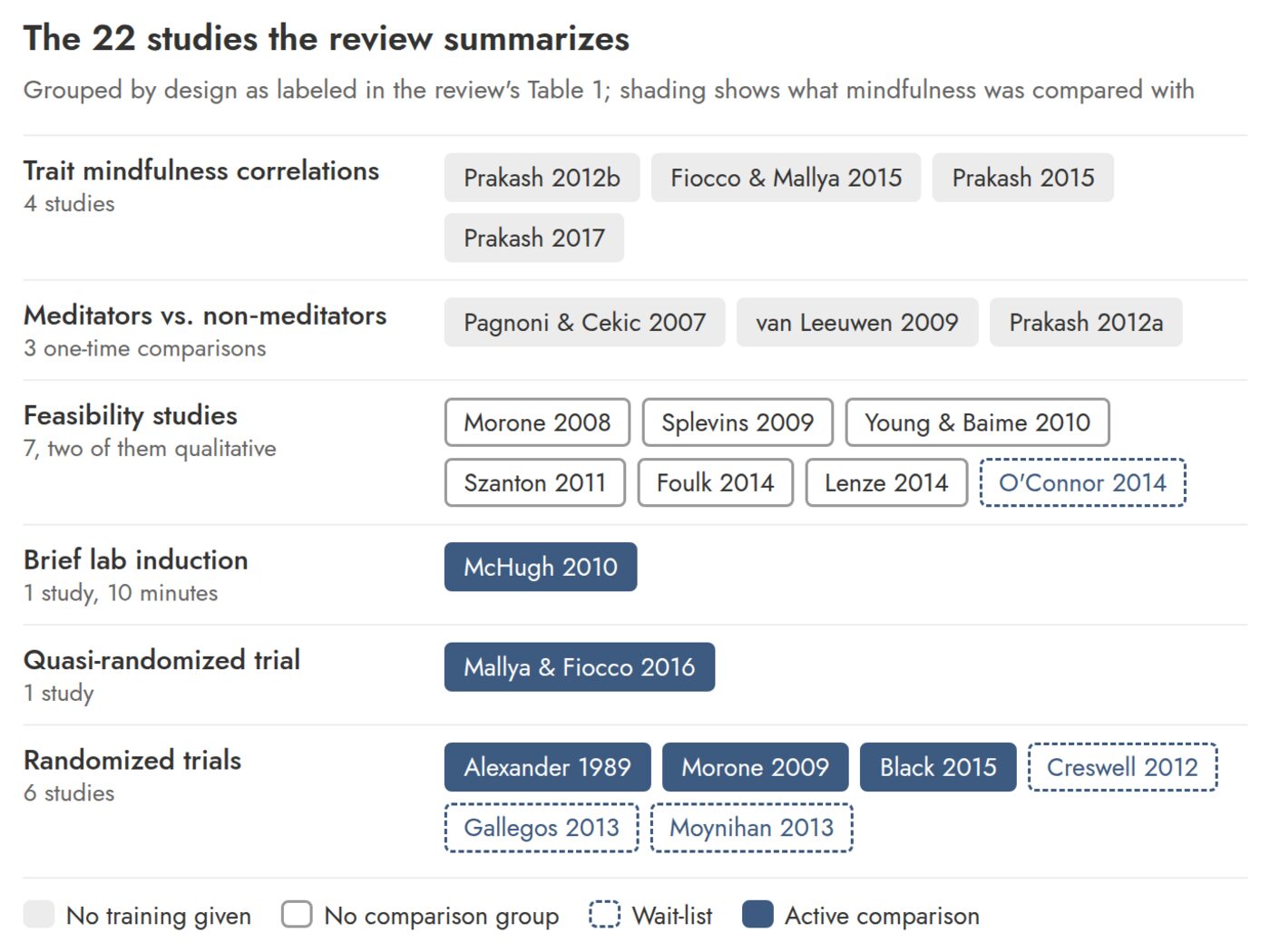
That table holds 22 distinct studies (a few appear under more than one outcome). They range widely in design. Some simply asked whether older adults who describe themselves as more mindful, on questionnaires, do better on attention tasks or report better well-being. Some compared long-term meditators with non-meditators at a single point in time, a
cross-sectional
A cross-sectional study measures a group of people at a single point in time. It can show which things tend to go together, but not which came first or whether one causes the other.
More on Wikipedia
Read more in the glossary
design. Seven were feasibility studies that tested a program, usually without a comparison group, and six were randomized trials. Most of the programs were 8-week courses of Mindfulness-Based Stress Reduction (
MBSR
Mindfulness-Based Stress Reduction (MBSR) is a program designed to help individuals cope with stress, pain, and illness. Developed by Jon Kabat-Zinn in the 1970s, it combines meditation and yoga to promote awareness and stress management. The eight-week program teaches participants to focus on the present moment non-judgmentally, enhancing their ability to manage difficulties.
More on Wikipedia
Read more in the glossary
) or Mindfulness-Based Cognitive Therapy (
MBCT
Mindfulness-based cognitive therapy (MBCT) is an 8-week group program that combines mindfulness meditation, adapted from Mindfulness-Based Stress Reduction (MBSR), with elements of cognitive behavioral therapy. It was developed to help people who have recovered from depression avoid relapse, by learning to notice and step back from patterns of negative thinking. Classes usually meet weekly, with daily meditation practice at home.
More on Wikipedia
Read more in the glossary
). Samples included healthy community volunteers, but also older adults with anxiety, depression,
chronic pain
Chronic pain is pain that lasts longer than about three months, or beyond the time tissues normally take to heal. It can follow an injury or illness, accompany conditions such as arthritis or fibromyalgia, or have no clear cause. Because the nervous system can become more sensitive over time, chronic pain often persists even when the original damage has healed, and it is frequently accompanied by depression, poor sleep and reliance on pain medication.
More on Wikipedia
Read more in the glossary
, poor sleep or recent bereavement.
One Big Result: Mostly Positive Findings, but Few Fair Tests
The authors’ overall verdict balances promise against a thin evidence base:
Although the majority of the reviewed studies provide positive results for mindfulness training in each of these domains, the field is currently limited in its scope and much more work is needed in order to establish the causal impact of mindfulness practice on these outcomes.
The recurring problem is the comparison group. A program that gathers older adults in a group every week, gives them homework and is billed as improving attention or mood can help for reasons that have nothing to do with mindfulness: social contact, practice of any kind, expectations,
demand characteristics
Demand characteristics are cues in an experiment that hint at what the researchers expect, which can lead participants to behave the way they think they are supposed to rather than how they normally would. Researchers reduce them by disguising the study’s purpose, measuring behavior unobtrusively, or using comparison conditions that seem just as plausible.
More on Wikipedia
Read more in the glossary
and simply getting better at tests taken twice. A
wait-list group
A wait-list control group is a comparison group that receives the program being studied only after the study period, so participants who are waiting can be compared with those already taking part. It controls for the passage of time and repeated testing, but not for the attention, expectations and setting that come with taking part in any program, which an active control group can address.
More on Wikipedia
Read more in the glossary
controls for none of these; an
active control group
An active control group is a comparison group that takes part in a different program designed to be just as engaging as the one being tested. In meditation research, it might involve exercise, music, or education classes with the same time commitment, teachers, and expectations of benefit. Comparing against an active control helps separate the effects of meditation itself from the general effects of joining a course.
More on Wikipedia
Read more in the glossary
doing a similar but non-mindfulness program controls for many of them. Only three of the six randomized trials used one, along with a quasi-randomized trial and a brief lab study. Across the three areas, the pattern looked like this.
Attention. Questionnaire studies were mixed: self-rated mindfulness went with better set-shifting (switching between tasks) in one study of 73 older adults but showed no link to
working memory
Working memory is the small, short-lived mental workspace that holds information while you use it, such as a phone number you are about to dial or the running total of a sum done in your head. It holds only a few items at once and depends on attention, so a distraction or a wandering mind can quickly empty it. Psychologists measure it with tasks such as digit span and the n-back.
More on Wikipedia
Read more in the glossary
, inhibitory control or set-shifting in another of 48. In one-time comparisons, older adults with more than 10 years of meditation did better than non-meditators of the same age on most attention tests, and older meditators showed a smaller
attentional blink
The attentional blink is a brief gap in awareness that follows spotting something. When people watch a rapid stream of items for two targets, they often miss the second one if it appears within about half a second of the first, as if attention had blinked while the brain was still taking in the first target. It is thought to arise because the two targets compete for limited attention.
More on Wikipedia
Read more in the glossary
than both their peers and young non-meditators. Such comparisons can’t show that meditation caused the difference.
The trials were mixed too. In the largest, with 201 older adults, MBSR improved the ratio of Part B to Part A on the
Trail Making Test
The Trail Making Test is a timed pencil-and-paper test of attention and mental flexibility. In Part A, a person draws a line connecting numbered circles in order (1, 2, 3…) as fast as possible; in Part B, they alternate between numbers and letters (1, A, 2, B…). Part A mainly measures processing speed, while Part B adds the need to switch between two sequences and is used as a measure of executive function. Scores are the seconds taken, so lower is better.
More on Wikipedia
Read more in the glossary
, a measure of mental flexibility, more than waiting did, but the difference was gone 3 and 24 weeks later. In a quasi-randomized trial of 97 older adults, MBSR did no better than a reading and relaxation group on any measure. A study of anxious older adults found improvements on almost every cognitive test after MBSR but had no control group. The authors suggest that benefits seen in the wait-list and uncontrolled studies may have come from these general features of taking part rather than from mindfulness itself. The oldest trial, from 1989, did find that
Transcendental Meditation
Transcendental Meditation (TM) is a trademarked form of mantra meditation taught through a standardized course by certified teachers. Practitioners sit with eyes closed for about 20 minutes twice a day, silently repeating a mantra (a sound or word) in a way meant to be effortless, letting the mind settle rather than holding attention on an object. Researchers usually group it with other mantra-based techniques, separate from mindfulness meditation.
More on Wikipedia
Read more in the glossary
and a “mindfulness” method focused on creative problem solving both improved learning and one measure of flexibility more than relaxation or no treatment, with transcendental meditation ahead.
Well-being. MBSR reduced loneliness more than a wait-list in 40 older adults (Creswell et al., 2012). Uncontrolled studies reported large improvements: after MBSR, the number of older adults with clinically significant depression and anxiety fell by more than half in one study of 141, and worry eased in another. Qualitative studies, built from diaries and focus groups, described better mood, sleep and coping. But when 40 older adults with chronic
low back pain
Low back pain is pain between the bottom of the ribs and the buttocks, and a leading cause of disability worldwide. Most cases are called non-specific because no particular cause, such as a fracture, infection or nerve compression, can be found. Pain lasting more than three months is called chronic.
More on Wikipedia
Read more in the glossary
were randomly assigned to a mindfulness program or a health education group, both groups improved on quality of life, disability and pain, with no difference between them. The authors point out that the social support participants valued in the qualitative studies is not specific to mindfulness, and that such effects “are undetectable when mindfulness training is not tested against an active comparison condition.”
Inflammation. In the same loneliness trial, MBSR turned down activity of genes controlled by
NF-κB
NF-κB is a family of proteins that act as a master switch for inflammation inside cells. When a cell senses infection, injury or stress signals, NF-κB moves into the nucleus and turns on genes for inflammatory messengers such as IL-6 and TNF-α. Psychological stress has been linked to more NF-κB activity in immune cells, so researchers studying stress and meditation often look at the genes it controls.
More on Wikipedia
Read more in the glossary
, a master switch for inflammation, compared with the wait-list. The review describes a significant drop in
C-reactive protein (CRP)
C-reactive protein (CRP) is a protein made by the liver that rises in the blood during inflammation. A high-sensitivity test (hsCRP) can detect the low levels found in healthy people, and modestly raised levels are linked to a higher risk of heart disease. Researchers use it as a general marker of inflammation in the body.
More on Wikipedia
Read more in the glossary
, and
interleukin-6 (IL-6)
Interleukin-6 (IL-6) is a signaling protein (a cytokine) that immune cells release to coordinate inflammation. It is measured from a blood sample, usually in picograms per milliliter. Persistently elevated IL-6 is associated with chronic stress, aging and a higher risk of cardiovascular disease, which makes it a common marker in studies of whether meditation affects health.
More on Wikipedia
Read more in the glossary
didn’t change. A second MBSR trial also found no effect on IL-6. The most telling result came from a sleep trial of 49 older adults with poor sleep, randomly assigned to six weeks of mindful awareness practices or
sleep hygiene
Sleep hygiene is a set of everyday habits and conditions thought to support good sleep, such as keeping regular sleep and wake times, limiting caffeine, alcohol and screens before bed, and keeping the bedroom dark, quiet and cool. Sleep hygiene advice is a common part of insomnia treatment, but on its own it usually helps less than structured therapies such as CBT-I.
More on Wikipedia
Read more in the glossary
education. Mindfulness improved sleep quality, insomnia, depression and fatigue more, but NF-κB activity fell significantly in both groups. The authors draw the lesson directly:
This finding highlights the sizable influences that can result from non-specific factors arising from participation in group-based interventions.
The abstract’s statement that improvements in inflammation accompany the gains in well-being therefore rests on few studies: one wait-list trial with a gene-activity result, two trials in which IL-6 didn’t change, and an NF-κB drop that a sleep-education class matched.
Miscellaneous Interesting Takeaways
Brain Studies Were Scarce
Only one randomized trial in older adults had measured brain activity. In it, MBSR participants showed less of a shift toward greater right-sided frontal
alpha
Alpha waves are rhythmic electrical brain activity at roughly 8–13 cycles per second, recorded with EEG. They are often strongest when the eyes are closed and the mind is relaxed, and are thought to help filter out or hold back information as part of top-down control. Meditation studies have reported both increases and decreases in alpha, depending on the practice.
More on Wikipedia
Read more in the glossary
activity, a pattern linked to withdrawal, than wait-listed participants, and kept the left-sided pattern linked to approach, though the difference had faded by follow-up. Two cross-sectional studies hinted that mindfulness might protect the aging brain: in 25 older adults, higher self-rated mindfulness went with stronger connectivity in the default mode network, centered on the
posterior cingulate cortex
The posterior cingulate cortex (PCC) is a region toward the back of the brain’s midline. It is a central hub of the default mode network and tends to be active during self-related thought and mind-wandering. Many meditation studies track PCC activity or connectivity as a window onto the DMN.
More on Wikipedia
Read more in the glossary
and
precuneus
The precuneus is a region on the inner surface of the parietal lobe, toward the back of the brain’s midline, next to the posterior cingulate cortex. Together they form a core hub of the default mode network, and the precuneus is often active during self-related thinking, memory recall and imagining one’s own point of view.
More on Wikipedia
Read more in the glossary
; and in a comparison of
Zen
Zen is a school of Mahayana Buddhism that developed in China (as Chan) and spread to Japan, Korea and Vietnam. Its central practice is seated meditation (zazen), such as shikantaza, “just sitting” in open awareness without a particular object, or working with koans, paradoxical questions meant to cut through ordinary conceptual thinking.
More on Wikipedia
Read more in the glossary
meditators with non-meditators,
gray matter
Gray matter is brain tissue made up mostly of nerve cell bodies and their connections. It forms the brain’s outer layer (the cortex) and several deeper structures. Structural MRI can estimate gray matter volume (how big a region is), density (how concentrated the tissue is), and cortical thickness (how deep the outer layer is).
More on Wikipedia
Read more in the glossary
volume and attention declined with age in the non-meditators but not in the meditators. The authors note that it’s unclear how old the oldest participants in the second study were (the meditators averaged 37), and that both studies were one-time snapshots.
Mind Wandering Falls With Age
Mind wandering
Mind wandering is the spontaneous shift of attention away from a current task or external environment to internally generated thoughts, memories, or fantasies. This common cognitive process is associated with default mode network activation and has been extensively studied in relation to meditation practices, which often aim to reduce mind wandering.
More on Wikipedia
Read more in the glossary
decreases markedly with age, the authors note, and in their own earlier work older adults with higher self-rated mindfulness showed the least task-unrelated mind wandering. They also mention an unpublished study of theirs, then under review, in which four weeks of mindfulness training reduced task-unrelated mind wandering during a cognitive task compared with an active control group. They suggest future studies test whether mindfulness adds to the age-related drop in mind wandering, and whether that helps attention.
One Practice Was Linked to a Weaker Immune Response
A trial that tracked which parts of MBSR older adults practiced found that more yoga and sitting meditation went with higher levels of IGF-1, a growth factor involved in forming new neurons and preserving cognition that declines with age, and more yoga with a bigger rise in positive mood. But more
body scanning
The body scan is a meditation practice in which attention is moved slowly through the body, part by part, noticing whatever sensations are present without trying to change them. It is a core exercise in mindfulness programs such as MBSR.
More on Wikipedia
Read more in the glossary
was linked to weaker antibody responses three weeks after the course, an effect the authors call negative, which had disappeared by 24 weeks. These were associations within the MBSR group, not comparisons with a control group.
A Small Inconsistency
The review is not entirely consistent about one trial of MBCT in bereaved older adults. Its table lists better working memory after training in the mindfulness group than in the wait-list group, while its text says the study “found no significant improvements in attentional control, measured via working memory, compared to a waitlist comparison group.”
What the Authors Want Next
The authors call for randomized trials with both an active comparison group, matched for length, group size and instructor expertise, and a wait-list group; standardized training manuals; attention measures grounded in research on aging, such as tests of shifting and scaling attention and of
vigilance
The vigilance decrement is the decline in performance as time goes on during a long, monotonous task that requires watching for rare targets, such as a radar operator looking for a blip. People typically miss more targets or make more false alarms after only a few minutes. It is the standard laboratory measure of how well sustained attention holds up.
More on Wikipedia
Read more in the glossary
; fairly homogeneous samples of healthy older adults; and longer follow-up to see whether any benefits last and carry over to everyday life, such as understanding medical information.
Final Reflection
This review is most useful as a map of how little had been tested. Of 22 studies, seven involved no training at all, looking instead at self-rated mindfulness or at existing meditators; six of the seven feasibility studies had no comparison group; and only three randomized trials pitted mindfulness against an active alternative. In those three, mindfulness came out ahead on some measures (learning and flexibility in 1989; sleep, depression and fatigue in the sleep trial) but not on others, including the pain and quality-of-life outcomes in the back pain trial and the inflammatory gene activity that sleep hygiene classes matched.
The authors end on an optimistic note:
we assert that mindfulness represents a potential intervention for not only reducing emotional distress in older adults, but for allowing them to flourish.
“Potential” is the key word. The evidence they gathered supports trying mindfulness with older adults, many of whom report finding it helpful, but it doesn’t yet show that mindfulness itself, rather than the group, the routine or the expectations around it, sharpens attention or calms inflammation in later life. The authors’ own prescription, trials with matched comparison programs, is the right test for anyone weighing these claims.
Citation
Fountain-Zaragoza, S., & Prakash, R. S. (2017). Mindfulness training for healthy aging: Impact on attention, well-being, and inflammation. Frontiers in Aging Neuroscience, 9, 11. 10.3389/fnagi.2017.00011
Get the next summary by email
One or two new paper summaries every couple of weeks, sent to your inbox when they go up.
No spam, and you can unsubscribe at any time. Prefer a feed reader? Use the RSS feed.