
Background Information
Loneliness is more than an unpleasant feeling. In older adults it is a risk factor for illness and early death: the authors cite studies linking it to cardiovascular disease, Alzheimer’s disease and higher overall mortality. Loneliness here means perceived isolation, a gap between the relationships a person wants and the ones they have, rather than how many people they actually see. Earlier attempts to reduce loneliness in older adults, the authors note, had met with limited success.
Mindfulness-Based Stress Reduction (
MBSR
Mindfulness-Based Stress Reduction (MBSR) is a program designed to help individuals cope with stress, pain, and illness. Developed by Jon Kabat-Zinn in the 1970s, it combines meditation and yoga to promote awareness and stress management. The eight-week program teaches participants to focus on the present moment non-judgmentally, enhancing their ability to manage difficulties.
More on Wikipedia
Read more in the glossary
) had been shown to reduce distress and negative mood, and in one study to improve relationships in couples, but no one had tested whether it could reduce loneliness. That was the study’s primary aim.
There was also a biological reason to look. Earlier work by members of this team had found that immune cells from lonely older adults showed greater
gene expression
Gene expression is the process by which a cell reads a gene and uses it to make a product, usually by copying it into a messenger molecule (mRNA) that is then used to build a protein. Every cell carries the same DNA, but cells turn genes up and down within hours in response to signals such as hormones, infection or stress. Researchers often measure a gene’s mRNA to see how active it is; that says nothing about the DNA sequence itself, which doesn’t change.
More on Wikipedia
Read more in the glossary
of genes involved in
inflammation
Inflammation is a biological response of the immune system to injury, infection, or stress, characterized by the release of signaling molecules called cytokines. Chronic inflammation is linked to impaired cognitive function, increased risk of disease, and accelerated aging.
More on Wikipedia
Read more in the glossary
. Computer analyses of those genes pointed to a common controller:
NF-κB
NF-κB is a family of proteins that act as a master switch for inflammation inside cells. When a cell senses infection, injury or stress signals, NF-κB moves into the nucleus and turns on genes for inflammatory messengers such as IL-6 and TNF-α. Psychological stress has been linked to more NF-κB activity in immune cells, so researchers studying stress and meditation often look at the genes it controls.
More on Wikipedia
Read more in the glossary
, a protein that switches on inflammatory genes, working in white blood cells called
monocytes
Monocytes are white blood cells, made in the bone marrow, that circulate in the blood and can move into tissues, where they become macrophages that engulf microbes and debris. They are part of the innate immune system, the body’s fast, first-line defense, and are a major source of the signaling proteins (cytokines) that drive inflammation.
More on Wikipedia
Read more in the glossary
. Chronic inflammation is thought to drive many of the diseases of later life. So the team asked a second question: if MBSR reduces loneliness, does it also turn down this inflammatory gene program, and the inflammation markers
C-reactive protein (CRP)
C-reactive protein (CRP) is a protein made by the liver that rises in the blood during inflammation. A high-sensitivity test (hsCRP) can detect the low levels found in healthy people, and modestly raised levels are linked to a higher risk of heart disease. Researchers use it as a general marker of inflammation in the body.
More on Wikipedia
Read more in the glossary
and
interleukin-6 (IL-6)
Interleukin-6 (IL-6) is a signaling protein (a cytokine) that immune cells release to coordinate inflammation. It is measured from a blood sample, usually in picograms per milliliter. Persistently elevated IL-6 is associated with chronic stress, aging and a higher risk of cardiovascular disease, which makes it a common marker in studies of whether meditation affects health.
More on Wikipedia
Read more in the glossary
in the blood?
What They Did
In this
randomized controlled trial
A Randomized Controlled Trial is a scientific study design that randomly assigns participants to either an experimental group receiving an intervention or a control group, allowing researchers to measure the true effect of the intervention while minimizing bias.
More on Wikipedia
Read more in the glossary
, run in Los Angeles from October 2007 to January 2008, the team recruited 40 healthy adults aged 55 to 85 (average age 65) through newspaper ads. They were mostly women, and all had said they were interested in learning
mindfulness
Mindfulness is the psychological process of purposely bringing one’s attention to experiences occurring in the present moment without judgment. It involves maintaining awareness of thoughts, feelings, bodily sensations, and surrounding environment with an attitude of curiosity and acceptance. In meditation contexts, mindfulness practices typically involve focusing attention on the breath or body sensations as anchors to the present moment while acknowledging and releasing distracting thoughts.
More on Wikipedia
Read more in the glossary
meditation. Nobody could already be practicing meditation, yoga or another mind–body therapy more than once a week, smoke, or take medications affecting the immune, cardiovascular, hormonal or psychiatric systems. Participants also did brain-scanning tasks that are described in a separate report.
After baseline questionnaires and a blood sample, a computerized number generator assigned each person to the 8-week MBSR course or to a
wait-list control group
A wait-list control group is a comparison group that receives the program being studied only after the study period, so participants who are waiting can be compared with those already taking part. It controls for the passage of time and repeated testing, but not for the attention, expectations and setting that come with taking part in any program, which an active control group can address.
More on Wikipedia
Read more in the glossary
, which received the course once the study was over. MBSR, taught by one of three trained instructors over three groups, involved eight weekly 2-hour classes of guided meditation, mindful yoga and stretching, and group discussion, plus a day-long retreat late in the course. Participants were asked to practice at home for 30 minutes a day, six days a week. Wait-listed people were asked not to start any new health programs.
Everyone was measured before and after the 8 weeks, with the second blood sample taken by staff who didn’t know who was in which group:
- Loneliness, on the 20-item revised UCLA Loneliness Scale (sample item: “I lack companionship”), where scores run from 20 to 80 and higher means lonelier.
- Mindfulness skills, on a 39-item questionnaire, to check that the course taught what it was meant to.
- Gene activity across the whole genome in white blood cells from a 10 ml blood sample. The analyses took account of sex, age, race/ethnicity,
body mass index
Body mass index (BMI) is a person’s weight in kilograms divided by the square of their height in meters. Adults with a BMI of 25 to 29.9 are classed as overweight and 30 or more as obese. It is a quick screening measure that does not distinguish fat from muscle.
More on Wikipedia
Read more in the glossary and the mix of white-cell types in each sample. - CRP and IL-6, two inflammatory proteins in the blood.
The loneliness analysis followed
intent-to-treat principles
An intention-to-treat analysis counts every randomized participant in the group they were assigned to, whether or not they completed or even started the treatment. It keeps the benefit of randomization, since dropping people who didn’t follow their plan can leave groups that differ in other ways, and it estimates what happens when a treatment is offered in practice rather than when it is taken exactly as intended.
More on Wikipedia
Read more in the glossary
, keeping everyone who was randomized in their assigned group.
One Big Result: Loneliness Fell After MBSR and Rose Slightly While Waiting
Six people dropped out before the final measures: five from MBSR and one from the wait-list, leaving 15 and 19. Those who finished MBSR attended 7.2 of the 8 classes on average, and all of them went to the day-long retreat. The course did what it was meant to: self-reported mindfulness skills rose in the MBSR group (from 137 to 148 on the questionnaire’s total) and dipped slightly in the wait-list group (138 to 134).
Loneliness moved in opposite directions in the two groups. In the MBSR group the average score fell from 42.4 to 37.4, while in the wait-list group it rose from 38.4 to 40.8. The difference between the groups’ changes was statistically significant (p = .008).
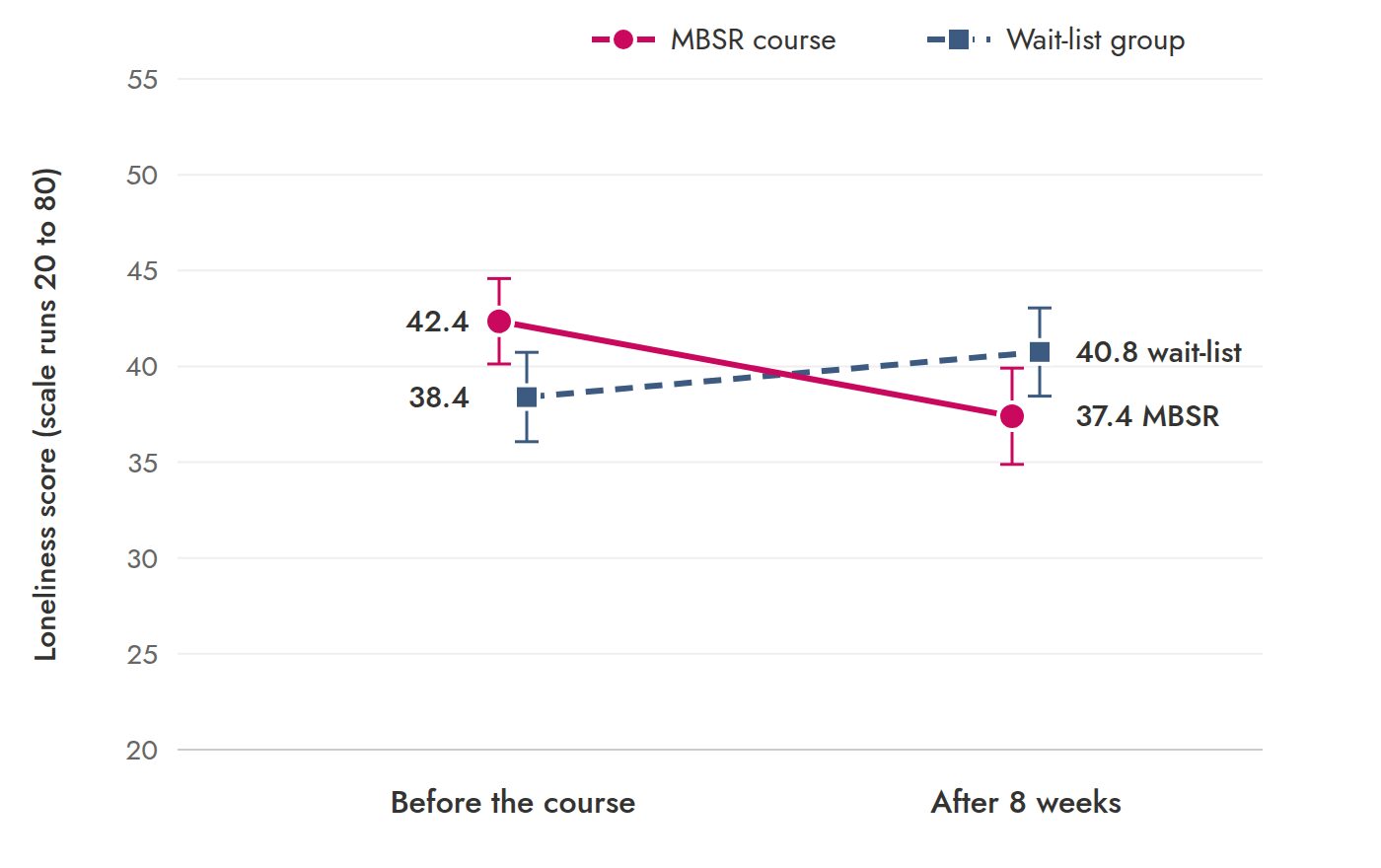
The MBSR group started out somewhat lonelier than the wait-list group (by about 4 points), a difference that was not statistically significant (p = .23). As a further check, the team compared the 33 participants with complete before-and-after loneliness scores, adjusting for where each person started. After the course, the MBSR group’s adjusted average was 35.7 against 42.3 for the wait-list group (p = .02), an
effect size
Effect size is a statistical concept that quantifies the magnitude or strength of a relationship, difference, or intervention outcome. Unlike p-values which only indicate statistical significance, effect sizes measure how meaningful a result is in practical terms. Common measures include Cohen’s d (standardized mean difference), correlation coefficients (r), and odds ratios. In meditation research, effect sizes help quantify the practical impact of different meditation practices on psychological or physiological outcomes.
More on Wikipedia
Read more in the glossary
the authors describe as large.
Miscellaneous Interesting Takeaways
Lonelier People Showed More Inflammatory Gene Activity
Before anyone was randomized, the team checked whether this sample showed the link between loneliness and gene activity seen in earlier studies. It did. Across the range of loneliness scores, 256 genes differed in activity by at least 25%: 87 were more active in lonelier people and 169 in less lonely people. Genes carrying NF-κB’s binding sites were more common among those that were more active in lonelier people, and these genes came mainly from monocytes.
After MBSR, Genes Switched On by NF-κB Were Less Active
The team then compared how gene activity changed over the 8 weeks in the two groups. They identified 143 genes whose change differed between the groups by at least 25%: 69 that went down in MBSR participants relative to the wait-list group, and 74 that went down in the wait-list group relative to MBSR. A bioinformatics tool then checked how often each set carried the DNA sequences that NF-κB binds to. Among the genes that became relatively more active in the MBSR group, those binding sites were less common than among the genes that became relatively more active in the wait-list group (about two-thirds and about half as common, for the two versions of the binding sequence tested). Monocytes were again the main source of the genes that went down with MBSR.
In other words, the course appeared to reverse part of the pattern linked with loneliness at baseline. This is a pattern across a set of genes, though, not a measured change in inflammation, and the paper doesn’t say how many participants’ samples went into the gene analyses. The authors are clear about what the gene result can’t yet show:
The functional significance of the change in pro-inflammatory gene expression is not clear, as this study did not assess whether these gene expression effects translate into meaningful differences on inflammatory biology or disease outcomes.
The Blood Markers Barely Moved
The inflammatory proteins told a weaker story. Average CRP fell from 2.98 to 2.09 mg/L in the MBSR group and from 3.42 to 3.06 mg/L in the wait-list group. The difference between the groups’ changes was only a trend (p = .075), which the paper calls marginally significant. IL-6 showed no difference at all (p = .57). The authors suggest that the sample’s IL-6 levels were low to begin with and that single IL-6 measurements vary a lot from day to day, while CRP reflects inflammation over the previous several days. They also note that CRP was elevated at baseline in this sample, which may point to raised cardiovascular risk.
Sleep and Exercise Didn’t Explain It
Could the course have worked simply by getting people to sleep better or exercise more? The team checked self-reported sleep quality and vigorous exercise, and neither changed differently in the two groups.
A Lonelier Sample Than Expected
The study had no loneliness requirement for joining. Even so, the sample’s average baseline loneliness score was 41, compared with 37 in a sample of older adults in the U.S. Midwest and 37 in a student sample.
Home Practice and Dropouts
MBSR participants who finished the course logged 737 minutes of home practice on average over the 8 weeks, with wide variation between people. That is about half of the half hour a day, six days a week that was asked of them. More people dropped out of MBSR than out of the wait-list (5 vs. 1), a difference that fell just short of significance, and men were more likely to drop out than women (3 of 8 vs. 3 of 32). Once the trial was over, five wait-listed participants also dropped out of the MBSR course they were then offered.
What a Wait-List Can’t Rule Out
The authors name the wait-list as a limitation:
It is possible that observed changes in loneliness in MBSR vs. WL control could be explained by non-specific factors (e.g., social support, participant contact with an instructor).
Weekly group classes might ease loneliness simply by bringing people together. The authors think this unlikely, citing an earlier review in which social support and social skills programs did not reduce loneliness, and a study of people with psoriasis in which mindfulness taught individually, rather than in a group, still reduced stress symptoms. But only a comparison with an equally social, equally engaging program could settle it.
Final Reflection
This was the first trial to test whether mindfulness training reduces loneliness, and its main result is clear: over 8 weeks, older adults who took MBSR reported less loneliness than those who waited. The biological findings are more tentative. The gene analysis suggested that MBSR turned down an inflammatory program in immune cells that was linked with loneliness in the same people, but the inflammatory proteins in the blood barely moved: CRP showed only a trend and IL-6 nothing.
Later studies on this site fit that mixed picture. In another trial with older adults, a six-week mindfulness course improved sleep more than sleep hygiene classes, yet NF-κB fell similarly in both groups. Creswell’s team later found that a three-day mindfulness retreat, compared with a matched relaxation retreat, was followed by lower IL-6 four months on, linked to a change in brain connectivity. And when MBSR was compared with a closely matched health program rather than a wait-list, skin inflammation rose less after mindfulness but inflammatory proteins didn’t differ.
With 40 people, a wait-list for comparison and no follow-up after the course, this is, as its own title says, a small trial. The authors close on the same note:
Although promising, it will be important for future studies to replicate and extend these initial findings in larger samples with active control groups.
Citation
Creswell, J. D., Irwin, M. R., Burklund, L. J., Lieberman, M. D., Arevalo, J. M. G., Ma, J., Breen, E. C., & Cole, S. W. (2012). Mindfulness-Based Stress Reduction training reduces loneliness and pro-inflammatory gene expression in older adults: A small randomized controlled trial. Brain, Behavior, and Immunity, 26(7), 1095–1101. 10.1016/j.bbi.2012.07.006
Get the next summary by email
One or two new paper summaries every couple of weeks, sent to your inbox when they go up.
No spam, and you can unsubscribe at any time. Prefer a feed reader? Use the RSS feed.