
Background Information
Meditation retreats are often credited with making people calmer and healthier, and a few studies had found signs of this in the body, such as higher activity of
telomerase
Telomerase is an enzyme that helps maintain telomere length by adding repetitive DNA sequences to the ends of chromosomes. It plays a crucial role in cellular aging and longevity, as it can counteract the natural shortening of telomeres that occurs with cell division. This enzyme is particularly active in stem cells, germline cells, and cancer cells, while its activity is typically low in most mature somatic cells, contributing to cellular senescence and aging.
More on Wikipedia
Read more in the glossary
, an enzyme that helps maintain the protective caps on chromosomes (
telomeres
Telomeres are protective caps at the end of chromosomes that shorten with each cell division. Telomere length is associated with aging and health, with longer telomeres linked to better health and longevity. Stress and lifestyle factors can affect telomere length, making them a potential marker of health and aging.
More on Wikipedia
Read more in the glossary
). But a residential retreat bundles meditation together with something else that might help on its own: time away from work, chores and the demands of daily life. The authors noted that the short spell of relaxation often used as a comparison “may not lead to the powerful changes that prolonged vacation could,” and that no study they knew of had asked whether a meditation retreat does anything a relaxing vacation doesn’t.
They also wanted a broad view of the body’s response. Rather than measure a handful of chosen markers, they looked at
gene expression
Gene expression is the process by which a cell reads a gene and uses it to make a product, usually by copying it into a messenger molecule (mRNA) that is then used to build a protein. Every cell carries the same DNA, but cells turn genes up and down within hours in response to signals such as hormones, infection or stress. Researchers often measure a gene’s mRNA to see how active it is; that says nothing about the DNA sequence itself, which doesn’t change.
More on Wikipedia
Read more in the glossary
across the whole genome in blood. Every cell carries the same DNA, but it turns individual genes up or down within hours in response to hormones, infection or stress. Measuring the messenger molecules (mRNA) that active genes produce shows which genes the blood cells are using at that moment. It says nothing about the DNA itself, which doesn’t change. Alongside the genes, they measured several blood markers tied to aging and stress: telomerase, two forms of
amyloid beta
Amyloid beta (Aβ) is a family of small protein fragments cut from a larger protein made by many cells, including nerve cells. In Alzheimer’s disease they clump together into the plaques found in the brain. Two common forms, Aβ40 and Aβ42, also circulate in the blood, and researchers have studied their levels and the ratio between them as possible markers of dementia risk.
More on Wikipedia
Read more in the glossary
(protein fragments linked to Alzheimer’s disease) and the
inflammation
Inflammation is a biological response of the immune system to injury, infection, or stress, characterized by the release of signaling molecules called cytokines. Chronic inflammation is linked to impaired cognitive function, increased risk of disease, and accelerated aging.
More on Wikipedia
Read more in the glossary
signal
TNF-α
Tumor necrosis factor alpha (TNF-α) is a signaling protein (a cytokine) that immune cells release early in inflammation. It helps fight infection and repair tissue, but high or persistent levels contribute to inflammatory diseases such as rheumatoid arthritis, psoriasis and inflammatory bowel disease.
More on Wikipedia
Read more in the glossary
.
What They Did
The researchers recruited healthy women aged 30 to 60, mostly from the San Diego and San Francisco areas, who had little or no experience of meditation. They had no chronic illnesses and weren’t taking antidepressants or hormone therapy. In this
randomized controlled trial
A Randomized Controlled Trial is a scientific study design that randomly assigns participants to either an experimental group receiving an intervention or a control group, allowing researchers to measure the true effect of the intervention while minimizing bias.
More on Wikipedia
Read more in the glossary
, each was assigned by chance to spend six days at the same resort in Carlsbad, California, in one of two ways:
- Novice meditators joined a large meditation retreat run by the Chopra Center for Wellbeing, led by Deepak Chopra and colleagues. Over four days, it added up to 12 hours of primordial sound meditation, which the paper describes as similar to
mantra
A mantra is a sound, word or phrase that is repeated, aloud or silently, as a spiritual or meditative practice. Mantras are central to Hindu and Buddhist traditions and appear in many others. In mantra meditation, the repetition itself serves as the object of attention, and practitioners often describe it as calming.
More on Wikipedia
Read more in the glossary meditation, up to 9 hours of yoga, and lectures and self-reflection exercises each day. - The vacation group, an
active control
An active control group is a comparison group that takes part in a different program designed to be just as engaging as the one being tested. In meditation research, it might involve exercise, music, or education classes with the same time commitment, teachers, and expectations of benefit. Comparing against an active control helps separate the effects of meditation itself from the general effects of joining a course.
More on Wikipedia
Read more in the glossary , stayed at the same resort without taking part in the retreat. They had a 1.5-hour afternoon lecture on health behaviors each day and an optional morning activity, such as a leisurely walk.
Both groups had similar rooms and ate the same ayurvedic meals in the same dining room, and everyone was asked not to exercise more than usual. The randomized women didn’t pay for their stay.
A third group wasn’t randomized. Regular meditators were women in the same age range who had already signed up and paid for the same retreat. They had to have meditated at least four times a week, for at least 15 minutes, for the past six months; on average they had practiced for 2.3 years (from six months to seven years), and 58% meditated daily. Including them let the researchers ask whether experienced practitioners respond to a retreat differently from beginners.
Of 102 women enrolled, 94 began the study: 31 in the vacation group, 33 novice meditators and 30 regular meditators. Two more dropped out once the retreat had started. Nobody was blinded: the participants and the study staff knew who was in which group, although the retreat teachers didn’t know which of their several hundred students were in the study.
Fasting blood was drawn at the same time of day on day 1 and day 5. The team sequenced the mRNA in it to measure the activity of genes across the genome, and measured telomerase in immune cells, amyloid beta and TNF-α in plasma, and counts of each type of white blood cell. Before the stay, on day 5 and a month later, the women filled in questionnaires on depressive symptoms (the
CES-D
The Center for Epidemiologic Studies Depression Scale (CES-D) is a 20-item questionnaire asking how often, over the past week, people have had symptoms of depression such as poor sleep, low mood or feeling that everything was an effort. Total scores range from 0 to 60, with higher scores meaning more symptoms. It was designed for screening and research in the general population, not for diagnosing depression.
More on Wikipedia
Read more in the glossary
), stress (the
Perceived Stress Scale
The Perceived Stress Scale (PSS) is a widely used questionnaire that asks how often, over the past month, people have felt their lives were unpredictable, out of control or overloaded. It comes in 14-, 10- and 4-item versions, each answered from never (0) to very often (4); higher totals mean more stress. It measures how stressed people feel, not physical signs of stress such as hormone levels.
More on Wikipedia
Read more in the glossary
), everyday
mindfulness
Mindfulness is the psychological process of purposely bringing one’s attention to experiences occurring in the present moment without judgment. It involves maintaining awareness of thoughts, feelings, bodily sensations, and surrounding environment with an attitude of curiosity and acceptance. In meditation contexts, mindfulness practices typically involve focusing attention on the breath or body sensations as anchors to the present moment while acknowledging and releasing distracting thoughts.
More on Wikipedia
Read more in the glossary
and vitality. Ten months later, 83% of them answered the depression and stress questionnaires again.
One Big Result: Vacation and Retreat Shifted Gene Activity in the Same Way
Between day 1 and day 5, the activity of 390 genes changed significantly across the women as a whole, using a
false discovery rate
The false discovery rate (FDR) is the expected share of false positives among the results a study declares significant. FDR corrections, such as the Benjamini–Hochberg method, are a common way to handle multiple comparisons. They are less strict than corrections that try to avoid even a single false positive (such as Bonferroni), so they miss fewer real effects, while accepting that a small fraction of the reported findings may be due to chance.
More on Wikipedia
Read more in the glossary
of 5% to allow for the thousands of genes tested. The authors call this the “vacation effect”, and it was largely shared by all three groups. When they compared how gene activity changed in the vacation group with how it changed in the novice meditators, they found no more differences than would be expected by chance. Learning to meditate didn’t add a detectable gene signature to the vacation.
The changes pointed in a consistent direction. To make sense of hundreds of genes, the researchers grouped genes that tend to rise and fall together into modules (a
gene co-expression network
A gene co-expression network is a map of which genes tend to become more or less active together across many samples. Researchers group tightly linked genes into modules and then look at what the genes in each module do, such as fighting infection or building proteins. This turns thousands of individual gene measurements into a smaller number of biological themes, though genes rising and falling together doesn’t by itself show that one controls another.
More on Wikipedia
Read more in the glossary
) and looked at what the genes in each module do. The modules tied to the vacation effect were rich in genes for the body’s defense and injury responses: inflammation, wound healing, blood clotting and the response to stress. These were turned down after the stay. Individual genes that fell included FOXO3 and MME, both known to respond to stress, and three genes in the pathway that makes polyamines. The authors offer a plain reading:
A parsimonious interpretation of these data is that, while on vacation, genes that are normally needed for dealing with stress, wound healing and injury are downregulated.
The shift was consistent enough to be recognizable. A machine-learning program trained on part of the samples could tell a day-1 sample from a day-5 sample in the rest with 96% accuracy. The authors also note that some genes linked to Alzheimer’s disease were among those turned down, including CLU and PSEN1.
What this shows is that six days at a resort, with or without meditation, changed which genes the women’s blood cells were using. It doesn’t show that the changes lasted, or that they make anyone healthier: the blood was tested only before and right after the stay.
Miscellaneous Interesting Takeaways
Everyone Felt Much Better; the Novices Stayed Better Longer
On the questionnaires, all three groups improved a great deal by day 5, on every measure. Across everyone, the average depressive-symptom score fell from 12.0 to 5.5, and perceived stress from 14.9 to 5.9, with vitality and mindfulness rising. Scores drifted back up somewhat over the next month but stayed better than before. The vacation, in other words, did most of the immediate work. The one short-term difference was in mindfulness: the novices’ self-rated mindfulness had risen more than either other group’s a month later.
The clearest difference between the randomized groups came ten months later, among the women who answered. The novices’ depressive symptoms were still 4.8 points lower than before the study on average, while the vacation group’s had returned to about where they started (1.9 points higher, not a significant change). The difference between the groups was significant (p = .037); the regular meditators’ improvement (4.3 points) also held up better than the vacation group’s. Perceived stress followed a similar pattern, with the novices 5.4 points below their starting level and the vacation group 1.2 points below, but the overall test of differences among the three groups just missed significance (p = .054), though the novices differed significantly from the vacation group in follow-up comparisons. The authors describe the novices’ lasting improvement in depressive symptoms as clinically meaningful.
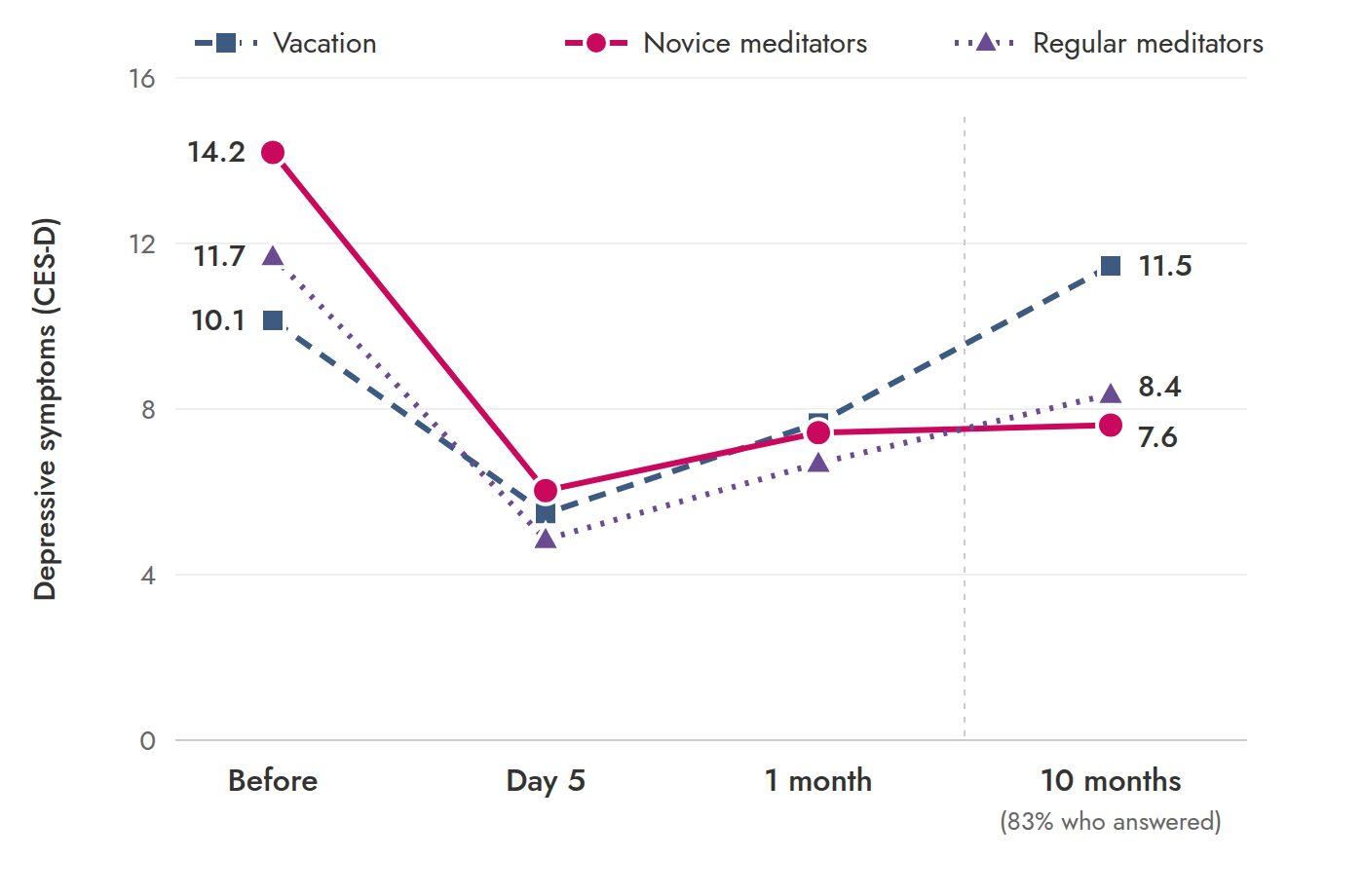
These are self-reported scores from women who knew which group they were in, and the paper doesn’t report what the novices did in the ten months afterward, such as whether they kept meditating. The novices also started with the highest average depression score of the three groups, though the paper reports no significant differences between the groups at the start.
Regular Meditators Showed a Gene Pattern of Their Own
Where a separate “meditation effect” did appear was in the regular meditators. After the retreat, their gene activity differed from the vacation group’s in 479 genes and from the novices’ in 855. The module that stood out most was full of genes for building proteins (translation) and for processes involved in viral infection, and these were less active in the regular meditators. The authors also highlight a cluster of connected genes involved in maintaining telomeres. A machine-learning program could tell regular meditators from the other women after the retreat with 85% accuracy.
This comparison has a weakness that the paper’s supplement spells out. The researchers first tested whether the regular meditators’ gene activity changed differently over the stay, and found only marginal differences. The stronger signature came from comparing the groups’ day-5 samples, without accounting for where each person started. The authors report that a comparison at day 1 didn’t show the same pathways, and conclude that the difference became visible after the retreat. Still, it is a comparison of different groups of women, and the regular meditators weren’t randomized. The authors are frank about that:
In addition, comparing regular meditators to non-meditators is somewhat problematic, given regular meditators likely differ on many lifestyle factors that make such comparisons complicated.
A Telomerase Rise in Regular Meditators, Not a Clear Group Difference
The regular meditators began with the lowest telomerase activity of the three groups and were the only group whose activity rose significantly by day 5 (p = .004). The novices’ and vacationers’ didn’t change significantly. But the overall test of whether the three groups changed differently was only marginal (p = .08), and in pairwise comparisons the regular meditators’ change differed significantly from the novices’ but not from the vacation group’s. The abstract accordingly calls it “a trend”. It echoes a three-month retreat study on this site, which three of this paper’s authors (Epel, Lin and Blackburn) also worked on, where meditators had higher telomerase than wait-listed controls afterward.
Amyloid and TNF-α Moved in the Randomized Women
The blood markers tended to change in the two randomized groups rather than in the regular meditators. In the vacation and novice groups, plasma levels of one form of amyloid beta (Aβ40) fell significantly, so the ratio of Aβ42 to Aβ40 rose. The paper cites studies in which a higher ratio in the blood went with a lower risk of dementia, and suggests the change “may be salutary to brain health”. The regular meditators started with a higher ratio, and theirs didn’t change.
TNF-α, an inflammatory signal, rose significantly in the vacation and novice groups, most in the vacation group, and didn’t change in the regular meditators. That sits awkwardly beside the turned-down inflammation genes, a contrast the authors acknowledge. They propose possible reasons, such as a stress reaction to the blood draw, too much sun or exercise, but didn’t test them. They add that, like a review of randomized trials of mindfulness, they found no fall in inflammatory proteins in the blood.
Who Funded It
The study was funded by the Chopra Foundation and by Marc and Lynn Benioff. The Chopra Center ran the retreat, and the supplement says that Dr. Chopra assisted with the study design; the acknowledgments thank him for supporting “all aspects of the endeavor”. Three of the authors (Epel, Schadt and Tanzi) had received an award from the Chopra Foundation in the past. One author held a small stake (under $10,000) in a telomere-testing company that had no role in the study, and another worked for a pharmaceutical company. The paper states that the funders had no role in collecting or analyzing the data, deciding to publish or preparing the manuscript.
Some Questions the Design Leaves Open
The supplement describes the study as exploratory, given how many outcomes it measured, and the authors say it was powered only to detect medium-to-large effects and needs replicating in larger studies. The retreat wasn’t only sitting meditation: it included yoga, lectures and self-reflection, so any meditation effect is really an effect of that whole program. The randomized women stayed for free while the regular meditators paid, and the regular meditators chose the retreat themselves. And the authors acknowledge the basic uncertainty about what the blood markers mean:
The changes in biomarkers and GE patterns appear salutary; however, no studies have tracked these markers to see how well they predict disease or longevity in a healthy sample.
Final Reflection
This study’s most useful contribution is its control group. By sending randomly chosen women on the same resort stay without the retreat, it showed that much of what a retreat seems to do in the short term, both in how people feel and in which genes their blood cells are using, also happens on a good vacation. Six days away turned down genes tied to stress, injury and inflammation in everyone, and lifted mood dramatically in all three groups.
What learning to meditate added was slower to show: ten months later, the women who had been randomized to the retreat reported fewer depressive symptoms than those who had been randomized to the vacation, whose scores had returned to where they started. That is a randomized comparison, though a small, unblinded and self-reported one, and the stress result was weaker. The distinct gene pattern and telomerase rise in the regular meditators are more tentative, because those women chose the retreat, paid for it and differ from beginners in many ways.
Similar caution applies to other studies of gene activity on this site. In a study of experienced meditators on a day of practice, some inflammation-related genes were less active by the end of the day than in non-meditators who spent the day at leisure, but that comparison wasn’t randomized either. Trials that, like this one, give the comparison group a restful stay of its own are rarer; in one, stressed job seekers were randomized to a three-day mindfulness retreat or a matched relaxation retreat. Taken together, this paper is a reminder to ask of any retreat study: compared with what? Here, a vacation alone accounted for most of the immediate changes in body and mood, while learning meditation was linked to lower depressive symptoms months later.
Citation
Epel, E. S., Puterman, E., Lin, J., Blackburn, E. H., Lum, P. Y., Beckmann, N. D., Zhu, J., Lee, E., Gilbert, A., Rissman, R. A., Tanzi, R. E., & Schadt, E. E. (2016). Meditation and vacation effects have an impact on disease-associated molecular phenotypes. Translational Psychiatry, 6(8), e880. 10.1038/tp.2016.164
Get the next summary by email
One or two new paper summaries every couple of weeks, sent to your inbox when they go up.
No spam, and you can unsubscribe at any time. Prefer a feed reader? Use the RSS feed.