
Background Information
Most evidence that
mindfulness
Mindfulness is the psychological process of purposely bringing one’s attention to experiences occurring in the present moment without judgment. It involves maintaining awareness of thoughts, feelings, bodily sensations, and surrounding environment with an attitude of curiosity and acceptance. In meditation contexts, mindfulness practices typically involve focusing attention on the breath or body sensations as anchors to the present moment while acknowledging and releasing distracting thoughts.
More on Wikipedia
Read more in the glossary
programs help health rests on what people say about themselves: less stress, less pain, better sleep. Self-reports are useful, but they can be biased, and they don’t show whether anything has changed in the body. The immune system is an obvious place to look. Chronic
inflammation
Inflammation is a biological response of the immune system to injury, infection, or stress, characterized by the release of signaling molecules called cytokines. Chronic inflammation is linked to impaired cognitive function, increased risk of disease, and accelerated aging.
More on Wikipedia
Read more in the glossary
and weakened immune defenses have been implicated in illnesses from asthma and rheumatoid arthritis to metabolic disorders, some cancers and depression, and chronic stress can weaken immune defenses.
By 2015, a scattering of randomized trials had measured immune markers before and after mindfulness training, but nobody had pulled them together. David Black and George Slavich set out to do that. They limited themselves to
randomized controlled trials
A Randomized Controlled Trial is a scientific study design that randomly assigns participants to either an experimental group receiving an intervention or a control group, allowing researchers to measure the true effect of the intervention while minimizing bias.
More on Wikipedia
Read more in the glossary
, where people are assigned to mindfulness or a comparison group by chance, so that differences afterwards are more likely to come from the training itself.
What They Did
This is a
systematic review
A systematic review gathers all the studies on a question using a search method and inclusion rules set out in advance, so that readers can see how the studies were found and why each was kept or left out. It may or may not go on to combine the results statistically; a review that does is also a meta-analysis, while one that doesn’t describes and tallies the findings instead.
More on Wikipedia
Read more in the glossary
: the authors searched for every trial that met rules set in advance, then described what each one found. It is not a
meta-analysis
A meta-analysis statistically combines the results of many earlier studies on the same question. Pooling the data can estimate an overall effect more precisely than any single study and show whether results agree across studies. Its conclusions are only as good as the studies it includes and how similar they are.
More on Wikipedia
Read more in the glossary
. They didn’t combine the results statistically into an overall
effect size
Effect size is a statistical concept that quantifies the magnitude or strength of a relationship, difference, or intervention outcome. Unlike p-values which only indicate statistical significance, effect sizes measure how meaningful a result is in practical terms. Common measures include Cohen’s d (standardized mean difference), correlation coefficients (r), and odds ratios. In meditation research, effect sizes help quantify the practical impact of different meditation practices on psychological or physiological outcomes.
More on Wikipedia
Read more in the glossary
; they tallied, marker by marker, how many trials found a change.
The search covered papers from January 1966 to July 2015 in the American Mindfulness Research Association’s database, which collects mindfulness studies from PubMed, PsycINFO, Web of Science and other sources, using terms such as immune, inflammation, cytokine and telomere. The authors also checked bibliographies, journal contents pages and suggestions from other researchers. A trial counted if it was randomized, made mindfulness meditation the main part of the program, measured an immune marker objectively and was published in English. Six non-randomized studies were set aside.
Twenty trials qualified, with 1,602 participants in all. They were small: 80 people on average, ranging from 21 to 201. Half recruited people with a disease, such as breast cancer, HIV, ulcerative colitis or rheumatoid arthritis. Five recruited people with a risk factor, such as older age, poor sleep, loneliness, overweight or cardiovascular risk, and five recruited healthy volunteers. Women outnumbered men in most of them: 14 of the 20 samples were at least 60% female.
The programs were similar. All but three were
MBSR
Mindfulness-Based Stress Reduction (MBSR) is a program designed to help individuals cope with stress, pain, and illness. Developed by Jon Kabat-Zinn in the 1970s, it combines meditation and yoga to promote awareness and stress management. The eight-week program teaches participants to focus on the present moment non-judgmentally, enhancing their ability to manage difficulties.
More on Wikipedia
Read more in the glossary
or a course built on it, met as a group once a week for 6 to 10 weeks, and in eight cases included a day-long retreat. The exception in length was a three-month residential meditation retreat. Nineteen of the 20 trials measured immune activity in blood, one of them also in nasal washes; the twentieth used fluid from a small blister raised on the skin.
The authors grouped the results into five kinds of marker:
- Inflammatory proteins, such as
C-reactive protein (CRP)
C-reactive protein (CRP) is a protein made by the liver that rises in the blood during inflammation. A high-sensitivity test (hsCRP) can detect the low levels found in healthy people, and modestly raised levels are linked to a higher risk of heart disease. Researchers use it as a general marker of inflammation in the body.
More on Wikipedia
Read more in the glossary , IL-6 Interleukin-6 (IL-6) is a signaling protein (a cytokine) that immune cells release to coordinate inflammation. It is measured from a blood sample, usually in picograms per milliliter. Persistently elevated IL-6 is associated with chronic stress, aging and a higher risk of cardiovascular disease, which makes it a common marker in studies of whether meditation affects health.
More on Wikipedia
Read more in the glossary and TNF-α Tumor necrosis factor alpha (TNF-α) is a signaling protein (a cytokine) that immune cells release early in inflammation. It helps fight infection and repair tissue, but high or persistent levels contribute to inflammatory diseases such as rheumatoid arthritis, psoriasis and inflammatory bowel disease.
More on Wikipedia
Read more in the glossary . - Transcription factors, switches inside immune cells that turn inflammatory genes on, chiefly
NF-κB
NF-κB is a family of proteins that act as a master switch for inflammation inside cells. When a cell senses infection, injury or stress signals, NF-κB moves into the nucleus and turns on genes for inflammatory messengers such as IL-6 and TNF-α. Psychological stress has been linked to more NF-κB activity in immune cells, so researchers studying stress and meditation often look at the genes it controls.
More on Wikipedia
Read more in the glossary . - Immune cell counts, such as
CD4+ T cells
CD4+ T cells, also called helper T cells, are white blood cells that coordinate the immune response by signaling to other immune cells. HIV infects and destroys them, so the number of CD4+ T cells in a sample of blood is a standard measure of how far HIV infection has progressed and how well the immune system is holding up.
More on Wikipedia
Read more in the glossary . - Immune cell aging: the length of
telomeres
Telomeres are protective caps at the end of chromosomes that shorten with each cell division. Telomere length is associated with aging and health, with longer telomeres linked to better health and longevity. Stress and lifestyle factors can affect telomere length, making them a potential marker of health and aging.
More on Wikipedia
Read more in the glossary , the protective caps on chromosomes, and the activity of telomerase Telomerase is an enzyme that helps maintain telomere length by adding repetitive DNA sequences to the ends of chromosomes. It plays a crucial role in cellular aging and longevity, as it can counteract the natural shortening of telomeres that occurs with cell division. This enzyme is particularly active in stem cells, germline cells, and cancer cells, while its activity is typically low in most mature somatic cells, contributing to cellular senescence and aging.
More on Wikipedia
Read more in the glossary , the enzyme that maintains them. - Antibody responses, for example to a flu vaccine.
One Big Result: Four Markers Shifted in Three or More Trials; Most Others Didn’t
The authors set a bar for calling an effect replicated: at least three trials finding it, where a trend that fell short of statistical significance, or an effect seen only in people who practiced more, still counted. Four markers cleared it:
When using the criteria of three or more RCTs showing that mindfulness meditation has at least a trend-level or dosage-dependent effect on immune parameters, we identified … effects for the following four parameters: reductions in the activity of the cellular transcription factor NF-kB, reductions in circulating levels of CRP, increases in CD4+ T cell count (in HIV-diagnosed individuals), and increases in telomerase activity
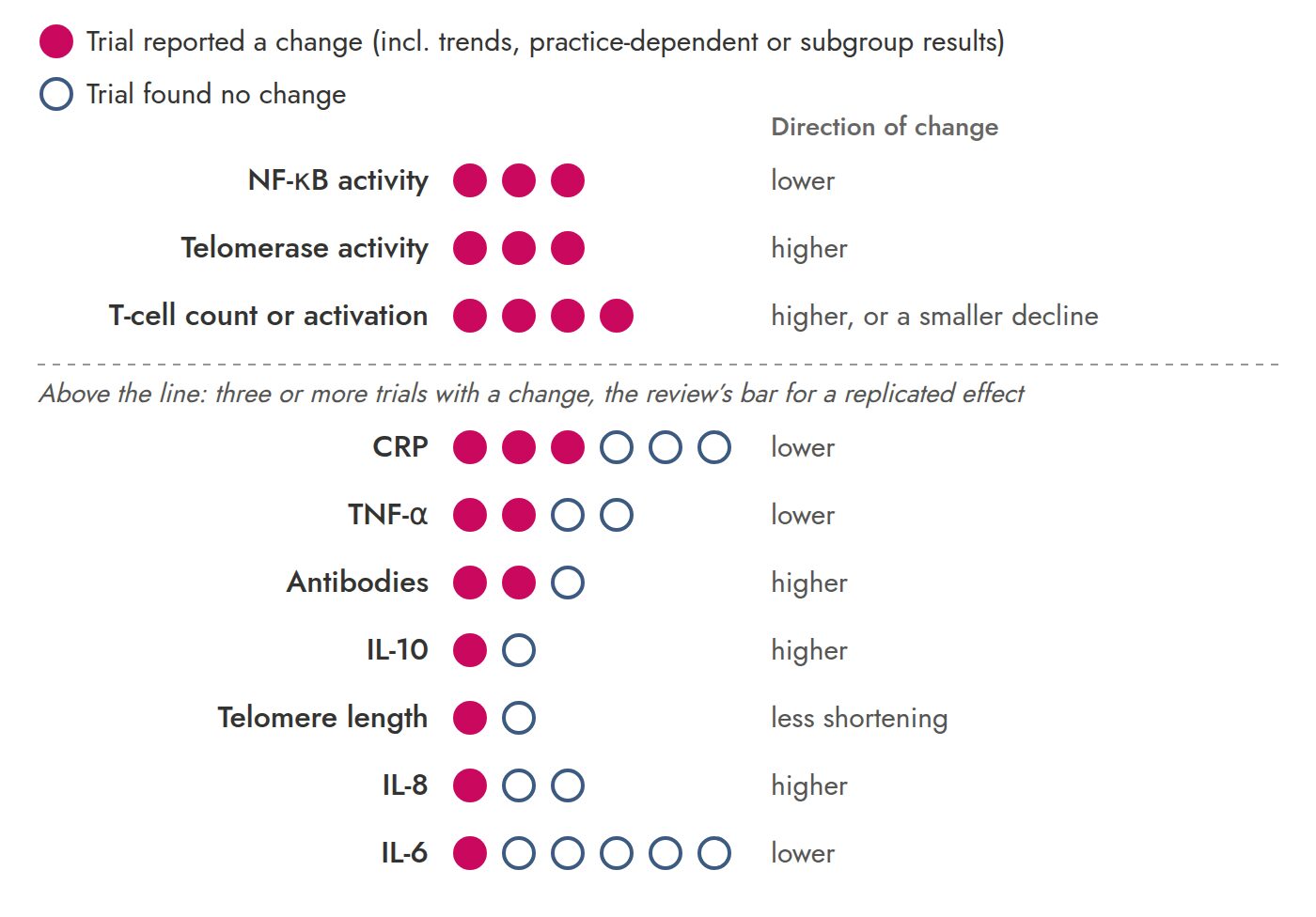
Looking at each of the four more closely shows how tentative the support is:
- NF-κB. All three trials that measured it found lower activity after training. Two compared mindfulness with a
wait-list group
A wait-list control group is a comparison group that receives the program being studied only after the study period, so participants who are waiting can be compared with those already taking part. It controls for the passage of time and repeated testing, but not for the attention, expectations and setting that come with taking part in any program, which an active control group can address.
More on Wikipedia
Read more in the glossary : one in breast cancer patients, the other in lonely older adults. In the third, a sleep trial in older adults led by Black himself, NF-κB also fell significantly in the sleep hygiene Sleep hygiene is a set of everyday habits and conditions thought to support good sleep, such as keeping regular sleep and wake times, limiting caffeine, alcohol and screens before bed, and keeping the bedroom dark, quiet and cool. Sleep hygiene advice is a common part of insomnia treatment, but on its own it usually helps less than structured therapies such as CBT-I.
More on Wikipedia
Read more in the glossary comparison group. - CRP. Six trials measured it and three found reductions. One of those was only in ulcerative colitis patients whose illness hadn’t flared, and the other two were trends that fell short of significance. The other three trials found no change.
- CD4+ T cells. Four trials counted T cells in blood, and all found more of them, more activated ones, or a smaller decline than in the comparison group. Three of the four were in people with HIV, for whom CD4+ T-cell counts are a standard measure of how far the disease has progressed.
- Telomerase. All three trials that measured it found higher activity, at least at the trend level. They were a three-month retreat (Jacobs et al., 2011), a trial in women with overweight or obesity, and a trial in breast cancer patients. In the overweight trial, the rise was a trend seen only among the women who stuck most closely to the program.
Everything else, the authors write, either showed no effect or wasn’t replicated. That covers IL-6,
IL-8
Interleukin-8 (IL-8) is a signaling protein (a cytokine) that draws white blood cells, especially neutrophils, to a site of infection or injury. Its levels rise in inflamed tissue, so researchers measure it as a marker of local inflammation.
More on Wikipedia
Read more in the glossary
, IL-10, TNF-α, interferon, antibodies and most cell counts. Not every single result pointed toward less inflammation. One trial found relatively higher IL-8, an inflammatory signal, in nasal fluid from older adults with acute respiratory infections after mindfulness training than after exercise.
The authors’ own summary is cautious:
Considered together, these data point to promising areas of future investigation, but we caution against exaggerating the positive effects of mindfulness meditation on immune system dynamics until these effects are further replicated and additional studies are performed.
Miscellaneous Interesting Takeaways
IL-6 Mostly Didn’t Budge
Along with CRP, IL-6 was the inflammatory protein these trials measured most often. Six trials measured it, and only one found a reduction, in breast cancer patients, where it depended on how often they practiced. The other five found no change relative to the comparison group.
Mixed Results for Antibodies
Two trials looked at the antibody response to a flu vaccine. One, Davidson et al. (2003), found a greater rise in antibodies after MBSR than in a wait-list group of company employees. The other, in older adults, found no difference. A third trial gave older adults a harmless test substance (keyhole limpet hemocyanin) to provoke an antibody response and found a greater increase in one antibody type, IgG, right after MBSR. The paper isn’t consistent about the later result: its text describes a smaller increase at 24 weeks, while its table marks it as a decrease.
Several Effects Depended on Practice
The review counted results that appeared only in people who practiced more. Besides the IL-6 and telomerase results above, it counts a TNF-α reduction from a skin inflammation trial that compared MBSR with a matched health program (Rosenkranz et al., 2013). There, TNF-α in blister fluid didn’t differ between the groups, but among MBSR participants more practice went with a bigger drop. The authors take such results as a reason for future trials to record attendance and home practice and to report effects both overall and by amount of practice.
What the Trials Couldn’t Show
The authors list the weaknesses of the field plainly. Only 8 of the 20 trials (40%) compared mindfulness with a program matched for time, attention and group support, such as exercise, sleep hygiene or health education. Half used a wait-list or usual care, which can’t separate mindfulness from the general effects of joining a group. Many trials were designed around something else, such as stress, sleep or pain, and added immune markers on the side:
immune biomarkers were often included as ancillary measures and, consequently, hypothesis tests were frequently underpowered.
That means a trial could easily miss a real effect. The trials also differed widely in who took part, how they were designed and how blood samples were processed, and several described their lab procedures too thinly for others to repeat them. The replicated findings, the authors add, are restricted to particular populations, subgroup analyses and disease types. The CD4+ T-cell result, for example, applies to people with HIV.
Final Reflection
This review is a useful map of what had been tested by 2015, and an honest one. Twenty trials sounds like a lot, but they were spread across a dozen different markers, so no marker was measured in more than six of them, and several were measured in only two or three. The four “replicated” effects rest on three or four small trials each, counting trends and subgroups, and the review didn’t combine the trials statistically to estimate how large any effect was.
The authors’ conclusion is accordingly modest: mindfulness may nudge the immune system toward a healthier profile, with less inflammatory signaling, stronger cell-mediated defenses and more of the enzyme that protects chromosomes. Whether those shifts are large or lasting enough to matter for health is, they write, a question for future trials that make immune markers their main outcome, recruit enough people and compare mindfulness with an equally engaging program. Some later trials covered on this site use the kind of matched comparison the authors call for: Creswell et al. (2016), for example, compared a three-day mindfulness retreat with a matched relaxation retreat and measured IL-6 four months later.
Citation
Black, D. S., & Slavich, G. M. (2016). Mindfulness meditation and the immune system: A systematic review of randomized controlled trials. Annals of the New York Academy of Sciences, 1373(1), 13–24. 10.1111/nyas.12998
Get the next summary by email
One or two new paper summaries every couple of weeks, sent to your inbox when they go up.
No spam, and you can unsubscribe at any time. Prefer a feed reader? Use the RSS feed.