
Background Information
In the 1970s, the cardiologist Herbert Benson described what he called the
Relaxation Response
The relaxation response is a term coined by the cardiologist Herbert Benson in the 1970s for a state of physical rest, the opposite of the stress response, that can be brought on by sitting quietly, breathing slowly and repeating a word or phrase. It is marked by slower breathing and heart rate and lower oxygen use. Researchers sometimes ask whether meditation’s benefits come from this general calming rather than from anything specific to the practice.
More on Wikipedia
Read more in the glossary
: a state of physical rest that is the opposite of the fight-or-flight stress response. In his account, many practices bring it on, from meditation, yoga and repetitive prayer to tai chi and
progressive muscle relaxation
Progressive muscle relaxation (PMR) is a relaxation technique in which a person tenses and then releases groups of muscles in turn, noticing the contrast between tension and relaxation. With practice, fewer and larger muscle groups are used, until relaxation can be brought on by recall alone. It was developed by the physician Edmund Jacobson in the early 20th century and is often used as a comparison treatment in meditation trials.
More on Wikipedia
Read more in the glossary
, as long as they involve two steps: focusing on a word, sound, phrase, prayer or movement, and letting everyday thoughts go. It is marked by slower breathing and heart rate and lower oxygen use, and the paper cites studies in which practices that elicit it helped with high blood pressure, anxiety and insomnia.
What happens inside the body’s cells is less clear. One way to look is to measure
gene expression
Gene expression is the process by which a cell reads a gene and uses it to make a product, usually by copying it into a messenger molecule (mRNA) that is then used to build a protein. Every cell carries the same DNA, but cells turn genes up and down within hours in response to signals such as hormones, infection or stress. Researchers often measure a gene’s mRNA to see how active it is; that says nothing about the DNA sequence itself, which doesn’t change.
More on Wikipedia
Read more in the glossary
. Every cell carries the same DNA, but each one uses only some of its genes at a time. When a gene is in use, the cell copies it into a messenger molecule (mRNA), and measuring mRNA shows how active the gene is at that moment. Immune cells in the blood turn genes up and down in response to hormones, infection and stress, so they are an accessible place to look for the body’s response to a mental practice. None of this involves the DNA sequence itself, which doesn’t change.
The team, from the Benson-Henry Institute for Mind Body Medicine at Massachusetts General Hospital and Beth Israel Deaconess Medical Center in Boston, had earlier compared gene activity at rest between long-term practitioners and novices before and after training. This time they asked a narrower question: does gene activity in blood shift within a single 20-minute session, and does the shift depend on how long a person has practiced? As the authors put it:
No study so far, however, has examined the acute changes in gene expression within one session of RR-eliciting practice and the impact of the length of previous practices on these immediate effects.
What They Did
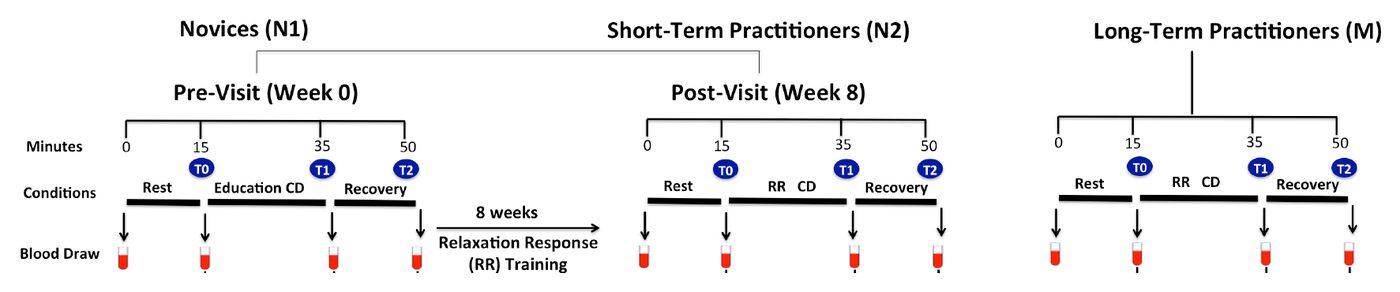
The study had three sets of measurements from two groups of healthy adults, recruited through newspaper, online and posted advertisements in the Boston area:
- Novices (26 people). They had no prior experience of practices that elicit the relaxation response, and were tested once before training.
- The same novices after 8 weeks of training. They had eight weekly one-to-one sessions with an experienced clinician, who guided them through a sequence of
diaphragmatic breathing
Diaphragmatic breathing, also called belly or abdominal breathing, is breathing driven mainly by the diaphragm, the dome-shaped muscle under the lungs. As it contracts, the belly rather than the chest rises, and breaths become deeper and slower. It is taught in yoga, tai chi and many relaxation and meditation practices, and is often used as a way to calm the body.
More on Wikipedia
Read more in the glossary , a body scan The body scan is a meditation practice in which attention is moved slowly through the body, part by part, noticing whatever sensations are present without trying to change them. It is a core exercise in mindfulness programs such as MBSR.
More on Wikipedia
Read more in the glossary , repeating a mantra A mantra is a sound, word or phrase that is repeated, aloud or silently, as a spiritual or meditative practice. Mantras are central to Hindu and Buddhist traditions and appear in many others. In mantra meditation, the repetition itself serves as the object of attention, and practitioners often describe it as calming.
More on Wikipedia
Read more in the glossary and mindfulness Mindfulness is the psychological process of purposely bringing one’s attention to experiences occurring in the present moment without judgment. It involves maintaining awareness of thoughts, feelings, bodily sensations, and surrounding environment with an attitude of curiosity and acceptance. In meditation contexts, mindfulness practices typically involve focusing attention on the breath or body sensations as anchors to the present moment while acknowledging and releasing distracting thoughts.
More on Wikipedia
Read more in the glossary meditation, “while passively ignoring intrusive thoughts.” They also listened to a 20-minute recording of the same sequence at home once a day. - Long-term practitioners (26 people). They had practiced regularly for 4 to 20 years, using various kinds of meditation, yoga or repetitive prayer, and had no training as part of the study.
Each lab session took place in the morning. After 15 minutes of rest, participants listened to a 20-minute recording and then rested for 15 more minutes. Blood was drawn just before the recording, right after it, and 15 minutes later. The long-term practitioners, and the novices after training, heard a recording that guided them through the relaxation sequence. At their first visit, before training, the novices heard a 20-minute health-education recording instead, which served as the control condition:
The healthy subjects served as their own controls since the identical temporal transcriptome analysis was performed on the novice subjects listening to a health education CD at baseline.
From each blood sample, the team isolated peripheral blood mononuclear cells, white blood cells with a single round nucleus (mainly lymphocytes and
monocytes
Monocytes are white blood cells, made in the bone marrow, that circulate in the blood and can move into tissues, where they become macrophages that engulf microbes and debris. They are part of the innate immune system, the body’s fast, first-line defense, and are a major source of the signaling proteins (cytokines) that drive inflammation.
More on Wikipedia
Read more in the glossary
), and measured the activity of more than 22,000 gene transcripts on microarrays, chips that measure thousands of mRNAs at once. They also measured the nitric oxide in each person’s breath at the same three times. Nitric oxide widens blood vessels and can affect immune responses, and an earlier study by the group had found preliminary evidence that it rises with relaxation practice.
The analysis came in several layers:
- Gene by gene. Each gene was compared between groups at each time point, and between time points within each group. A difference counted if its p-value was below 0.01, computed from 1,000 random reshufflings of the data.
- Patterns. Genes that differed were sorted by the shape of their changes. A “progressive” pattern meant a gene rose or fell step by step from novices to trained novices to long-term practitioners. A “long-term” pattern meant only the long-term practitioners stood out.
- Pathways. Because many biological effects involve small, coordinated shifts in many genes, the team also used
gene set enrichment analysis (GSEA)
Gene set enrichment analysis (GSEA) is a way of analyzing gene activity data in which, instead of testing thousands of genes one at a time, researchers test predefined sets of genes that work together, such as all the genes in one biological pathway. It asks whether the genes in a set tend to shift in the same direction between two conditions, so it can pick up small, coordinated changes that single-gene tests would miss. Results are usually judged with a false discovery rate.
More on Wikipedia
Read more in the glossary , which tests whether the genes in a predefined set, such as one biological pathway, tend to move together. They tested 880 such pathways. A difference between groups counted if its false discovery rate The false discovery rate (FDR) is the expected share of false positives among the results a study declares significant. FDR corrections, such as the Benjamini–Hochberg method, are a common way to handle multiple comparisons. They are less strict than corrections that try to avoid even a single false positive (such as Bonferroni), so they miss fewer real effects, while accepting that a small fraction of the reported findings may be due to chance.
More on Wikipedia
Read more in the glossary was below 25% (along with a nominal p-value below 0.05). A change across time points within a group counted at p < 0.05. - Networks. Finally, they mapped how the genes in the flagged pathways interact, using databases of known protein interactions, and picked out the 20 most connected “hub” genes in each network.
One Big Result: Inflammation-Related Pathways Were Least Active in Long-Term Practitioners and Fell During Their Session
The clearest pattern involved genes linked to
inflammation
Inflammation is a biological response of the immune system to injury, infection, or stress, characterized by the release of signaling molecules called cytokines. Chronic inflammation is linked to impaired cognitive function, increased risk of disease, and accelerated aging.
More on Wikipedia
Read more in the glossary
. Several pathways tied to inflammatory signaling, including those for the pro-inflammatory switches
NF-κB
NF-κB is a family of proteins that act as a master switch for inflammation inside cells. When a cell senses infection, injury or stress signals, NF-κB moves into the nucleus and turns on genes for inflammatory messengers such as IL-6 and TNF-α. Psychological stress has been linked to more NF-κB activity in immune cells, so researchers studying stress and meditation often look at the genes it controls.
More on Wikipedia
Read more in the glossary
and RELA, a receptor for
TNF-α
Tumor necrosis factor alpha (TNF-α) is a signaling protein (a cytokine) that immune cells release early in inflammation. It helps fight infection and repair tissue, but high or persistent levels contribute to inflammatory diseases such as rheumatoid arthritis, psoriasis and inflammatory bowel disease.
More on Wikipedia
Read more in the glossary
(TNF R2), the immune messenger IL-7 and the receptor CCR5, along with T-cell signaling pathways, were most active in the novices, less active after training and least active in the long-term practitioners. In the long-term practitioners, their activity also fell across the session.
A second set of pathways was lower in the long-term practitioners than in the novices at two or three of the time points, and fell significantly from before the recording to 15 minutes after it. These included many immune pathways, among them antigen processing and presentation, Toll receptor signaling, and pathways for the inflammatory messenger
IL-6
Interleukin-6 (IL-6) is a signaling protein (a cytokine) that immune cells release to coordinate inflammation. It is measured from a blood sample, usually in picograms per milliliter. Persistently elevated IL-6 is associated with chronic stress, aging and a higher risk of cardiovascular disease, which makes it a common marker in studies of whether meditation affects health.
More on Wikipedia
Read more in the glossary
and for IL-10, as well as pathways for programmed cell death and stress responses (the “stress pathway” and p38 MAPK).
When the team mapped how the genes in the downregulated pathways interact, many of the most connected hubs were molecules that act upstream or downstream of NF-κB. The authors conclude that “reduced NF-κB activity may be associated with RR elicitation,” and note that it fits other studies of mind-body programs that found less NF-κB-related gene activity in blood cells.
Long-term practitioners also showed the most change over the session in individual genes. Comparing the three time points within each group, more genes differed in the long-term practitioners than in either set of novice measurements, and more differed 15 minutes after the recording than right after it, which the authors read as a delayed effect. Trained novices had fewer consistent changes, which the authors suggest may reflect how differently people get on with the practice after only eight weeks.
These results describe the activity of genes, measured as mRNA in blood cells. The study didn’t measure NF-κB activity itself, inflammatory proteins in the blood, or any sign of health. A lower-active pathway in this sense means its genes, taken together, tended to show less mRNA.
Miscellaneous Interesting Takeaways
Energy Metabolism and Insulin Genes Were Higher in Practitioners, but Didn’t Rise During the Session
The paper’s title and abstract highlight genes linked to energy metabolism and insulin secretion. The abstract says that relaxation practice “enhanced expression” of these genes, and the network analysis picked out ATP synthase, an enzyme in the cell’s
mitochondria
Mitochondria are tiny structures inside most cells that turn nutrients and oxygen into ATP, the molecule cells use for energy. Their final steps, a chain of proteins called the electron transport chain that powers an enzyme called ATP synthase, also produce reactive oxygen species, by-products that can damage cells when they build up (oxidative stress).
More on Wikipedia
Read more in the glossary
that makes the energy molecule ATP, and the insulin gene (INS) as top hubs among the upregulated pathways.
The results paint a more mixed picture. The pathways for energy metabolism (including the electron transport chain) and insulin secretion were more active in the long-term practitioners than in the novices before and right after the recording, that is, already before the session began. Within the session, they drifted the other way:
Although there was a slight downregulation in gene expression across the three time points in M, the gene expression values remained higher in the M group than the N1 and N2 groups.
Pathways linked to telomere maintenance, which helps protect the ends of chromosomes, behaved similarly: higher in the long-term practitioners than in the novices, but some of them fell within the session. Other upregulated pathways, such as the cytochrome P450 enzyme family, steroid hormones, retinol metabolism and cell adhesion, were higher in both trained novices and long-term practitioners, more so in the long-term practitioners, and most of them also changed significantly during the session, particularly in the long-term practitioners.
So the energy and insulin findings mostly describe differences between groups of people, not changes brought on by the 20-minute session. And a hub in a gene network is a gene with many known connections to the other genes in the flagged pathways. The study did not measure insulin, blood sugar, ATP production or mitochondrial function.
How the Pathway Results Were Tested
Testing 880 pathways, across three pairs of groups, three time points and three pairs of time points, raises the problem of
multiple comparisons
The multiple comparisons problem arises when researchers run many statistical tests at once. Each test has a small chance of a false positive, so across thousands of tests, such as one for every point in a brain scan, some “significant” results will turn up by chance alone. Corrections raise the bar for significance to keep the overall false-positive rate down, at the cost of making small real effects harder to detect.
More on Wikipedia
Read more in the glossary
: some results will cross a threshold by chance. The team used a false discovery rate below 25% for differences between groups. By definition, that threshold allows that up to about a quarter of the flagged differences could be false positives. The authors describe the criteria differently, writing that they “ensure that there is minimal chance of identifying false positives.” For changes within a session they used p < 0.05, and the paper doesn’t report a correction for those. The authors also argue that looking for changes that appear at several time points “reduces the likelihood of identifying false positives.”
The text doesn’t report how large any of the gene changes were, and the pathway results are given mostly as lists of names and as dots and asterisks in the figures, some of which mark results at p < 0.09. The authors themselves describe the findings as preliminary and close with a call for confirmation:
To confirm this molecular mechanism of RR, validation of the results using secondary biochemical testing will be necessary.
The Control Condition Changed Two Things at Once
Using the novices as their own controls means their before-training and after-training sessions differed in two ways: what they heard in the lab (health education, then the relaxation recording) and whether they had trained for eight weeks. The health-education session also always came first. The design can’t separate the effect of training from the effect of the recording, or from getting used to the lab. No one heard the health-education recording after training or as a long-term practitioner, so it doesn’t show how the experienced groups’ genes would have behaved during an ordinary 20 minutes of sitting and listening.
The long-term practitioners are compared with the novices at a single point in time. They chose to practice for years, and could differ from the novices in age, lifestyle, health or other ways; the paper doesn’t report the groups’ characteristics. The numbers are also small, and they aren’t stated consistently: the main text reports enrolling 26 novices, while the supplementary methods list 27 at the first visit and 26 after training.
Nitric Oxide in the Breath Rose After Relaxation
The amount of nitric oxide in the breath rose from before to right after the recording in both the long-term practitioners (by an average of 1.93, p < 0.01) and the trained novices (by 3.24, p < 0.001). In the novices at their first visit, it rose by 1.52, which wasn’t significant. Fifteen minutes later, it stayed up in the long-term practitioners but dropped back significantly in both novice measurements.
In some groups and time windows, larger rises in nitric oxide went with larger falls in a few inflammation-related pathways, including RELA, TNF R2 and IL-7. The authors read these negative
correlations
A correlation measures how closely two things rise and fall together across people or over time. Pearson’s r runs from −1 to +1: values near +1 mean that people high on one measure tend to be high on the other, values near −1 mean the reverse, and values near 0 mean no straight-line relationship. A correlation alone can’t show that one thing causes the other.
More on Wikipedia
Read more in the glossary
as support for the biological relevance of the pathways they identified. They are associations between two measures taken in the same people, drawn from 10 selected pathways, and don’t show that one caused the other.
A Corrected Conflict-of-Interest Statement
When the paper was published, it stated that the authors had no competing interests. In 2017, the journal published a correction. Five of the authors held or had held positions at the Benson-Henry Institute, which is paid for running relaxation and mindfulness programs, sells related books, DVDs and CDs, and holds a patent pending, filed in 2012, titled “Quantitative Genomics of the Relaxation Response.” That doesn’t make the findings wrong, but it is relevant context for a study that interprets its results as a mechanism for the health benefits of the institute’s approach.
Final Reflection
This was one of the first studies to track gene activity in blood minute by minute through a single session of a mind-body practice. Its most consistent finding is that inflammation-related gene pathways, especially those connected to NF-κB, were less active in people who practiced techniques that elicit the relaxation response, most of all in those with years of practice, and that in the long-term practitioners they dipped further over a 20-minute session.
It sits alongside other gene-activity studies on this site. In the study by Kaliman and colleagues, experienced meditators had lower activity in two inflammation-related genes and three genes that help control other genes after an 8-hour day of practice than non-meditators who spent the day at leisure. Another comparison found that long-term meditators had longer telomeres and more active telomere-maintenance genes than non-meditators. Like this one, both were small and not randomized.
The authors go further, proposing that relaxation practice builds “mitochondrial resiliency” by boosting energy production and dampening NF-κB, and that this may explain its health benefits. The data here can’t carry that much weight. The energy and insulin pathways differed between groups but didn’t rise during the session; nothing beyond gene activity and breath nitric oxide was measured; the comparison session for the novices used a different recording; and the pathway results were judged at a false discovery rate of up to 25%. Taken on its own terms, the study is a hypothesis-generating map of which gene pathways might be worth testing, ideally in randomized trials with a matched comparison session and with measures of the proteins and health outcomes the genes are thought to affect.
Citation
Bhasin, M. K., Dusek, J. A., Chang, B.-H., Joseph, M. G., Denninger, J. W., Fricchione, G. L., Benson, H., & Libermann, T. A. (2013). Relaxation response induces temporal transcriptome changes in energy metabolism, insulin secretion and inflammatory pathways. PLoS ONE, 8(5), e62817. 10.1371/journal.pone.0062817
Get the next summary by email
One or two new paper summaries every couple of weeks, sent to your inbox when they go up.
No spam, and you can unsubscribe at any time. Prefer a feed reader? Use the RSS feed.