
Background Information
Telomeres
Telomeres are protective caps at the end of chromosomes that shorten with each cell division. Telomere length is associated with aging and health, with longer telomeres linked to better health and longevity. Stress and lifestyle factors can affect telomere length, making them a potential marker of health and aging.
More on Wikipedia
Read more in the glossary
are the protective caps of repeated DNA at the ends of chromosomes. They wear down a little each time a cell divides, and when they get too short the cell stops dividing or dies. In older adults, shorter telomeres have been tied to a higher risk of death and of diseases of aging such as heart disease, cancer and Alzheimer’s disease. Long-term studies also suggest that chronic psychological stress is one route by which telomeres get damaged.
That makes telomeres an appealing target for meditation research. If meditation eases stress, could it also slow this kind of cellular aging? Over the previous 15 years, studies in young and middle-aged adults had suggested it might help stabilize or lengthen telomeres. On this site, for example, a three-month retreat was followed by higher activity of
telomerase
Telomerase is an enzyme that helps maintain telomere length by adding repetitive DNA sequences to the ends of chromosomes. It plays a crucial role in cellular aging and longevity, as it can counteract the natural shortening of telomeres that occurs with cell division. This enzyme is particularly active in stem cells, germline cells, and cancer cells, while its activity is typically low in most mature somatic cells, contributing to cellular senescence and aging.
More on Wikipedia
Read more in the glossary
, the enzyme that rebuilds telomeres (Jacobs et al., 2011), and long-term meditators had telomeres about 32% longer than matched non-meditators (Dasanayaka et al., 2023). But the first measured telomerase only after the retreat, and the second was a one-time comparison of people who had chosen to meditate. Neither could show that meditation itself made the difference.
This paper tests the idea in the setting where it matters most and with the strongest design: a long
randomized controlled trial
A Randomized Controlled Trial is a scientific study design that randomly assigns participants to either an experimental group receiving an intervention or a control group, allowing researchers to measure the true effect of the intervention while minimizing bias.
More on Wikipedia
Read more in the glossary
in people over 65.
What They Did
The data come from the Age-Well trial, run in Caen, France, as part of the European Medit-Ageing project. Its main results, on brain volume and blood flow, are in our summary of Chételat et al., 2022. This paper is a secondary analysis of the same participants, looking at telomeres in their blood.
The trial enrolled 137 adults aged 65 and over between 2016 and 2018. All were native French speakers with at least seven years of education, scored in the normal range on cognitive tests and had no major neurological, psychiatric or other chronic disease. Each was assigned at random to one of three groups:
- Meditation: an 18-month secular program designed for the study, aimed at managing stress and supporting well-being by training attention and
emotion regulation
Emotion regulation is the set of ways people influence which emotions they have, when they have them, and how they experience and express them. Psychologist James Gross’s process model groups the strategies into five families: choosing situations, changing situations, shifting attention (attentional deployment), changing how one thinks about a situation (reappraisal), and changing one’s response, such as suppressing an expression.
More on Wikipedia
Read more in the glossary - English lessons: an
active control
An active control group is a comparison group that takes part in a different program designed to be just as engaging as the one being tested. In meditation research, it might involve exercise, music, or education classes with the same time commitment, teachers, and expectations of benefit. Comparing against an active control helps separate the effects of meditation itself from the general effects of joining a course.
More on Wikipedia
Read more in the glossary matched to the meditation course in length, class time, homework and delivery - No intervention: a passive control group asked to carry on as before and not to take up meditation or language training
Both courses ran in groups of 14, with a 2-hour class each week and 20 minutes of daily practice at home for 18 months.
Blood was drawn before the courses began and again after 18 months. From each sample, the lab isolated peripheral blood mononuclear cells, white blood cells with a single round nucleus (mainly lymphocytes and
monocytes
Monocytes are white blood cells, made in the bone marrow, that circulate in the blood and can move into tissues, where they become macrophages that engulf microbes and debris. They are part of the innate immune system, the body’s fast, first-line defense, and are a major source of the signaling proteins (cytokines) that drive inflammation.
More on Wikipedia
Read more in the glossary
), and froze them. The people handling the samples didn’t know who was in which group. Telomeres were measured on individual chromosomes with a high-throughput imaging method (quantitative fluorescent in situ hybridization) that lights up telomeric DNA with a fluorescent probe, and each measurement was done five times.
The team looked at three numbers for each person:
- Median telomere length (the 50th percentile)
- The 20th percentile, the length below which the shortest fifth of telomeres fall
- The percentage of critically short telomeres, those under 3,000 base pairs
The authors chose the last two because the shortest telomeres, rather than the average, are the ones most closely tied to cell survival and to health and mortality risks.
They also collected three things that might explain why some people responded more than others: how many hours of class each person attended, a “training-responsiveness” score measuring the skills each person had acquired by the end (built from different questionnaires for meditation and for English, so the two can’t be compared directly), and a 44-item questionnaire on the Big Five personality traits taken at the start.
The main analysis used a
mixed-effects model
A mixed-effects model is a statistical method for data in which the same people are measured many times, such as a daily rating over a month. It separates effects that apply to everyone, such as which group a person was in, from each person’s own baseline and ups and downs, so that people who contributed more days don’t count as extra independent evidence and people who skipped days can still be included.
More on Wikipedia
Read more in the glossary
to ask whether telomere length changed differently in the three groups over time. The follow-up questions used partial
correlations
A correlation measures how closely two things rise and fall together across people or over time. Pearson’s r runs from −1 to +1: values near +1 mean that people high on one measure tend to be high on the other, values near −1 mean the reverse, and values near 0 mean no straight-line relationship. A correlation alone can’t show that one thing causes the other.
More on Wikipedia
Read more in the glossary
, which relate each person’s telomere length at the end to their attendance, responsiveness or personality while taking their starting telomere length into account. All p-values were Bonferroni-corrected for
multiple comparisons
The multiple comparisons problem arises when researchers run many statistical tests at once. Each test has a small chance of a false positive, so across thousands of tests, such as one for every point in a brain scan, some “significant” results will turn up by chance alone. Corrections raise the bar for significance to keep the overall false-positive rate down, at the cost of making small real effects harder to detect.
More on Wikipedia
Read more in the glossary
, a strict adjustment that raises the bar for significance.
Of the 137 people randomized, 128 were analyzed: 42 in meditation, 43 in English lessons and 43 with no intervention. One was excluded for not meeting an eligibility rule, one died during follow-up, one in the no-intervention group had attended the English course, and six had missing or poor-quality blood samples.
One Big Result: Meditation Didn’t Slow Telomere Shortening Compared With English Lessons or No Training
Over 18 months, median telomere length fell in all three groups, a clear effect of time (F = 80.72, adjusted p < .001). The meditation group’s median went from 10,717 to 10,026 base pairs, the English group’s from 10,667 to 10,136, and the no-intervention group’s from 10,679 to 10,129. The groups didn’t differ, and neither did the way they changed over time (group × time F = 0.48, p = .621 before correction).
The shortest telomeres told the same story. Neither the 20th percentile nor the percentage of critically short telomeres showed a significant effect of group, of time or of the two together. Age didn’t change the picture either.
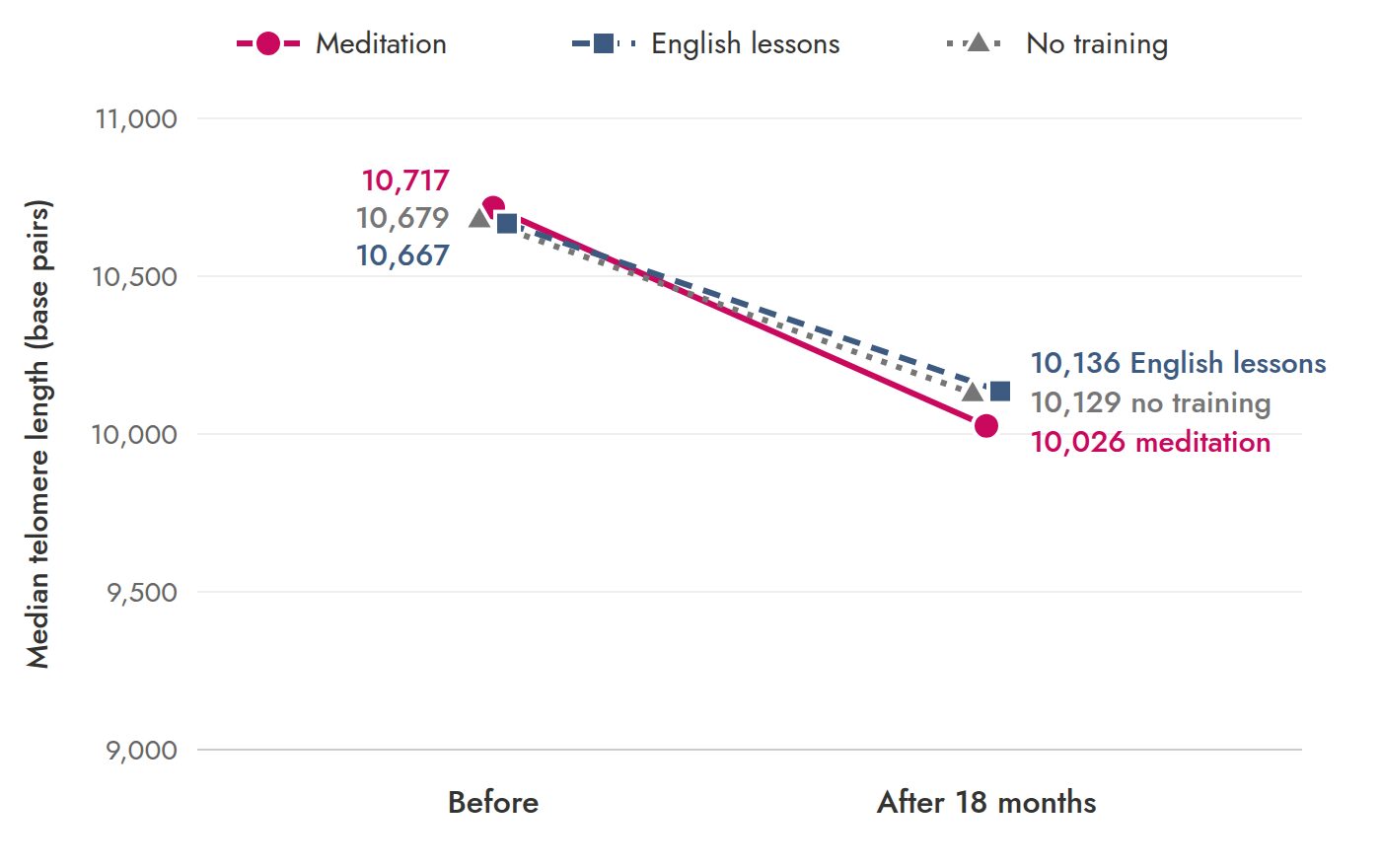
The authors put the conclusion plainly, in the context of the wider literature (TL is their abbreviation for telomere length):
Taken together, currently there is no evidence for a benefit of long-term meditation trainings on TL in meditation-naïve older adults in rigorous randomized controlled longitudinal trials.
They note that this matches an earlier randomized trial in which nine months of meditation training didn’t change telomere length (Puhlmann et al., 2019). Age-Well’s design makes its null result a meaningful one: it was long, compared meditation with both an engaging matched course and no course at all, kept almost everyone and analyzed the samples blind.
Miscellaneous Interesting Takeaways
The Shortest Telomeres Held Steady
Median telomere length fell, but the short end of the distribution barely moved: the share of critically short telomeres was about 10% at both time points in every group. The authors read this as a sign that healthy older adults didn’t accumulate the short telomeres that carry the health risks over 18 months, and they urge other studies to look beyond average telomere length, which can hide what is happening to the shortest ones.
Meditators Who Attended More Classes Kept More Telomere Length
The meditation and English groups attended similar amounts of class. But within the meditation group, people who attended more hours of class had a longer median telomere length at the end, relative to where they started (r = 0.45, adjusted p = .011). There was no such link in the English group (r = 0.05), and none when the two course groups were pooled. The link with the 20th percentile (r = 0.33) did not survive correction for multiple comparisons.
The training-responsiveness score showed a similar pattern. In the meditation group, people who had acquired more of the skills the course taught, who were also the ones who had attended more classes (r = 0.51), ended with longer median (r = 0.46, adjusted p = .010) and 20th-percentile telomeres (r = 0.41, adjusted p = .029). A link with fewer critically short telomeres didn’t survive correction. Again, there was nothing comparable in the English group.
The authors draw a cautiously hopeful conclusion from this:
These findings suggest that individual differences that lead to a greater commitment to the practice may result in a protective effect of long-term meditation training on TL in older adults without cognitive impairment.
That needs care. People weren’t randomly assigned to attend more classes, so the people who attended more may have differed in other ways, such as health, motivation or daily routines. In a model that included both course groups, more class attendance went with longer median telomeres, but its link was not significantly different between meditation and English. The authors acknowledge the problem in their limitations (MG is the meditation group):
In particular, the lack of a significant group × class attendance interaction does not rule out the possibility that the TL–class attendance correlation detected in the MG may be related to confounding factors.
The paper’s plain-language summary is less careful, saying that “a greater commitment to the practice led to a protective effect.” The data show a correlation within the meditation group, which is a reason to test the idea, not evidence that more practice protects telomeres.
Less Open Personalities, Fewer Short Telomeres
The team also checked whether personality at the start shaped the results, because a previous study had found that personality may have moderated telomere changes after a meditation retreat. Across all three groups,
openness to experience
Openness to experience is one of the five broad personality traits in the widely used Big Five model. People high in openness tend to be imaginative, curious, attentive to their inner feelings, drawn to variety and new ideas, and sensitive to art and beauty. It is measured with personality questionnaires such as the NEO Five-Factor Inventory.
More on Wikipedia
Read more in the glossary
had an effect on median telomere length in the mixed model that didn’t survive correction (adjusted p = .20). Within the meditation group only, people lower in openness ended with a smaller share of critically short telomeres (r = 0.44, adjusted p = .015). They also ended with a longer 20th percentile (r = −0.37), which the text calls significant, though its adjusted p-value was .08. None of the other four traits mattered in any group.
The authors offer two speculative explanations. Low openness has been linked to shorter lives and poorer self-rated health, so those people may have had more room to improve. And people low in openness tend to enjoy routine, which may have helped them stick with 20 minutes of practice a day for 18 months. Neither idea was tested here.
Limits the Authors Acknowledge
The authors list the study’s strengths as its length, its two control groups, its very low dropout and blinded sample handling. Its limits:
- An unusually healthy sample. Everyone was well educated and free of major disease, which may have made changes harder to detect.
- A trial sized for something else. Age-Well’s size was set to detect effects on brain volume and blood flow, its main outcomes, not on telomeres.
- Other influences went unmeasured. For example, levels of a brain growth factor (BDNF) have predicted telomere changes during a meditation retreat.
- One cell type. Telomeres were measured only in blood immune cells, which the authors note are particularly sensitive to stress.
- Telomeres are only part of cellular aging. Some tissues show aging-related DNA damage at their telomeres without the telomeres getting shorter.
Final Reflection
Most of the encouraging evidence linking meditation to telomeres on this site comes from designs that can’t separate meditation from the people who choose it: long-term meditators compared once with non-meditators (Dasanayaka et al., 2023), or retreat participants whose telomerase was measured only afterward (Jacobs et al., 2011). Even when healthy women were randomly assigned to a meditation retreat or a resort vacation, the telomerase rise in regular meditators on the retreat was only a trend (Epel et al., 2016).
Age-Well is a much harder test, and meditation didn’t pass it: 18 months of classes and daily practice left older adults’ telomeres shortening no differently than English lessons or no training did. That matches the trial’s main result, in which meditation didn’t significantly slow shrinkage in two target brain regions (Chételat et al., 2022).
The dose-like links are the most intriguing part of the paper. Within the meditation group, more class time and more acquired skill went with longer telomeres, echoing the finding that meditators with more years of practice had longer telomeres (Dasanayaka et al., 2023). But both are correlations, and in this trial attendance’s link wasn’t significantly stronger for meditation than for English lessons. Until a trial shows otherwise, the fair summary is the authors’ own: in rigorous randomized trials, there is no evidence yet that taking up meditation late in life protects telomeres.
Citation
Kaliman, P., Álvarez-López, M. J., Lehodey, A., Fernández, D., Chocat, A., Schlosser, M., de La Sayette, V., Vivien, D., Marchant, N. L., Chételat, G., Lutz, A., Poisnel, G., & Medit-Ageing Research Group. (2025). Effect of an 18-month meditation training on telomeres in older adults: A secondary analysis of the Age-Well randomized controlled trial. Biological Psychiatry Global Open Science, 5(1), 100398. 10.1016/j.bpsgos.2024.100398
Get the next summary by email
One or two new paper summaries every couple of weeks, sent to your inbox when they go up.
No spam, and you can unsubscribe at any time. Prefer a feed reader? Use the RSS feed.