
Background Information
Looking after a relative with dementia takes a well-documented toll on family members’ health and well-being. The paper notes that at least five million Americans do it, and that among family dementia caregivers the rate of clinical depression approaches 50%. Many existing support programs for caregivers bring only modest benefits. The same research group at UCLA had earlier found that an antidepressant, escitalopram, helped caregivers’ depression more than a
placebo
A placebo is an inactive treatment, such as a sugar pill or a cream with no drug in it, made to look like a real one. The placebo effect is the improvement people feel after receiving it, driven by their expectations, by learning from past experiences of real treatment, and by the setting of care. Pain is especially responsive: placebo pain relief is well documented in the lab and has been linked to prefrontal brain areas and the brain’s own opioids.
More on Wikipedia
Read more in the glossary
, but they point out that many caregivers would rather avoid medication because of its cost and side effects.
Chronic stress may also show up in the body’s cells.
Telomeres
Telomeres are protective caps at the end of chromosomes that shorten with each cell division. Telomere length is associated with aging and health, with longer telomeres linked to better health and longevity. Stress and lifestyle factors can affect telomere length, making them a potential marker of health and aging.
More on Wikipedia
Read more in the glossary
are protective caps on the ends of chromosomes, and
telomerase
Telomerase is an enzyme that helps maintain telomere length by adding repetitive DNA sequences to the ends of chromosomes. It plays a crucial role in cellular aging and longevity, as it can counteract the natural shortening of telomeres that occurs with cell division. This enzyme is particularly active in stem cells, germline cells, and cancer cells, while its activity is typically low in most mature somatic cells, contributing to cellular senescence and aging.
More on Wikipedia
Read more in the glossary
is the enzyme that maintains them. Shorter telomeres and lower telomerase have been linked to a range of diseases and earlier death, and earlier work had tied both to psychological stress, including in caregivers. An earlier study of a three-month meditation retreat had found higher telomerase in the meditators than in a
wait-list group
A wait-list control group is a comparison group that receives the program being studied only after the study period, so participants who are waiting can be compared with those already taking part. It controls for the passage of time and repeated testing, but not for the attention, expectations and setting that come with taking part in any program, which an active control group can address.
More on Wikipedia
Read more in the glossary
.
Lavretsky and colleagues at UCLA, with telomerase measured at the Blackburn Laboratory at UCSF, tested a far smaller dose of practice: 12 minutes a day of Kirtan Kriya, a chanting meditation from
Kundalini Yoga
Kundalini yoga is a style of yoga that combines breathing exercises, postures, chanting of mantras, hand positions (mudras) and meditation. It draws on older Hindu and Sikh traditions and was popularized in the West from the late 1960s by Yogi Bhajan. Its practices include Kirtan Kriya, a short meditation that pairs chanting the sounds “Saa, Taa, Naa, Maa” with repeated finger movements.
More on Wikipedia
Read more in the glossary
. Rather than compare it with doing nothing, they compared it with 12 minutes of relaxing to music. As they explain:
The relaxation control group was selected to test whether relaxation response was responsible for the effect of Kirtan Kriya on distress and cognition in caregivers, in which case both groups would have similar outcomes.
The
relaxation response
The relaxation response is a term coined by the cardiologist Herbert Benson in the 1970s for a state of physical rest, the opposite of the stress response, that can be brought on by sitting quietly, breathing slowly and repeating a word or phrase. It is marked by slower breathing and heart rate and lower oxygen use. Researchers sometimes ask whether meditation’s benefits come from this general calming rather than from anything specific to the practice.
More on Wikipedia
Read more in the glossary
is the general state of physical rest that many calming activities produce. If meditation helped only by relaxing people, the two groups should end up about the same.
What They Did
Over a year, the team screened 69 family caregivers and recruited 49, aged 45 to 91. Of these, 36 were adult children of the person with dementia and 13 were spouses; only 2 were men. All were in contact with their relative at least three days a week. To take part, caregivers had to have mild-to-moderate depressive symptoms (a score of 5 to 17 on the 24-item
HAM-D
The Hamilton Depression Rating Scale (HAM-D or HRSD) is a questionnaire that a clinician fills in after interviewing a patient, rating the severity of depressive symptoms such as low mood, guilt, poor sleep, loss of interest, anxiety and physical complaints. It was introduced by Max Hamilton in 1960 and comes in several lengths, most often 17 or 24 items; higher scores mean more severe depression. It is one of the most widely used outcome measures in depression trials, which often count a fall of 50% or more as a response to treatment.
More on Wikipedia
Read more in the glossary
) but not major depression, which was ruled out in a clinical interview, and they had to score at least 26 out of 30 on the
MMSE
The Mini-Mental State Examination (MMSE) is a brief pencil-and-paper test of overall thinking ability, scored out of 30. It asks about orientation (the date and place), memory for a few words, attention and arithmetic, language and copying a drawing, and takes about ten minutes. It is widely used to screen for dementia, with scores below about 24 suggesting impairment. Healthy adults usually score near the top, so it is not designed to pick up small changes in people without impairment.
More on Wikipedia
Read more in the glossary
, a screening test for dementia. People with other psychiatric illness, substance misuse or serious medical illness were excluded.
At screening, everyone was given sample CDs of both practices, and only those comfortable with either one were enrolled. A statistician then randomly assigned them, using a computer-generated table, to one of two practices, each done for 12 minutes a day, at the same time of day, for eight weeks:
- Kirtan Kriya meditation. After a minute of “tuning in,” participants chanted the
mantra
A mantra is a sound, word or phrase that is repeated, aloud or silently, as a spiritual or meditative practice. Mantras are central to Hindu and Buddhist traditions and appear in many others. In mantra meditation, the repetition itself serves as the object of attention, and practitioners often describe it as calming.
More on Wikipedia
Read more in the glossary “Saa, Taa, Naa, Maa” (meaning “Birth, Life, Death, and Rebirth”), first aloud, then in a whisper, then silently, with repeated finger movements (mudras). The session ended with deep breathing and visualizing light. A CD guided the practice. - Relaxation. Participants sat in a quiet place with their eyes closed and listened to instrumental music on a CD, trying to relax. The authors chose music because Kirtan Kriya involves melodic chanting.
Both groups also received education about the course of dementia and about caregivers’ own health, and kept daily diaries of their practice.
The main outcomes were mental health and depression. On each of two measures, the team counted a caregiver as a “responder” if their score improved by 50% or more: the Hamilton scale, which a clinician scores after an interview, and the mental health summary of the
SF-36
The SF-36 (Short Form 36) is a widely used 36-item questionnaire in which people rate their own health and how it affects daily life. Its eight scales cover physical functioning, pain, general health, energy, social functioning, emotional well-being and how much physical or emotional problems limit everyday roles. These combine into two summary scores, one for physical and one for mental health (the mental component summary, or MCS); higher scores mean better health.
More on Wikipedia
Read more in the glossary
, a questionnaire people fill in about their own health. Thinking skills were a secondary outcome, measured with the MMSE, the
Trail Making Test
The Trail Making Test is a timed pencil-and-paper test of attention and mental flexibility. In Part A, a person draws a line connecting numbered circles in order (1, 2, 3…) as fast as possible; in Part B, they alternate between numbers and letters (1, A, 2, B…). Part A mainly measures processing speed, while Part B adds the need to switch between two sequences and is used as a measure of executive function. Scores are the seconds taken, so lower is better.
More on Wikipedia
Read more in the glossary
(Part A for attention and speed, Part B for switching between sequences, a measure of
executive function
Executive functions are the mental skills used to control and direct thinking and behavior toward a goal. The three core ones are usually given as inhibitory control (holding back an automatic response or ignoring a distraction), working memory (keeping information in mind and using it) and cognitive flexibility (switching between rules, tasks or points of view). They develop rapidly in early childhood, rely heavily on the prefrontal cortex, and predict how well children do at school.
More on Wikipedia
Read more in the glossary
) and a test of delayed verbal recall. As an exploratory measure, the team drew blood before and after the eight weeks and measured telomerase activity in immune cells (peripheral blood mononuclear cells).
Of 45 people randomized, 39 finished: 23 in the meditation group and 16 in the relaxation group. Two dropped out of the meditation group and four out of the relaxation group, citing lack of interest or the study’s schedule. The analyses include only the 39 who finished. The groups didn’t differ significantly at the start on age, education, years of caregiving, depression or thinking scores. For the comparisons of change over the eight weeks, the authors used
one-tailed tests
A one-tailed (or one-sided) test checks for a difference in only one direction, for example whether a treatment group improved more than a control group, and ignores the possibility that it did worse. When the result goes in the predicted direction, its p-value is typically half that of the usual two-tailed test, which looks for a difference in either direction, so a result is easier to call significant. It is appropriate only when a difference in the other direction is ruled out or of no interest in advance, and many journals and reviewers prefer two-tailed tests.
More on Wikipedia
Read more in the glossary
, which test only for the meditation group doing better, in line with their predictions.
One Big Result: More Meditators Improved by Half on Mental Health and Depression
On the SF-36 mental health summary, 12 of 23 meditators (52.2%) improved by half or more, against 3 of 16 in the relaxation group (18.7%, p = .02). On the Hamilton depression scale, 15 of 23 meditators (65.2%) improved by half or more, against 5 of 16 (31.2%, p = .03).
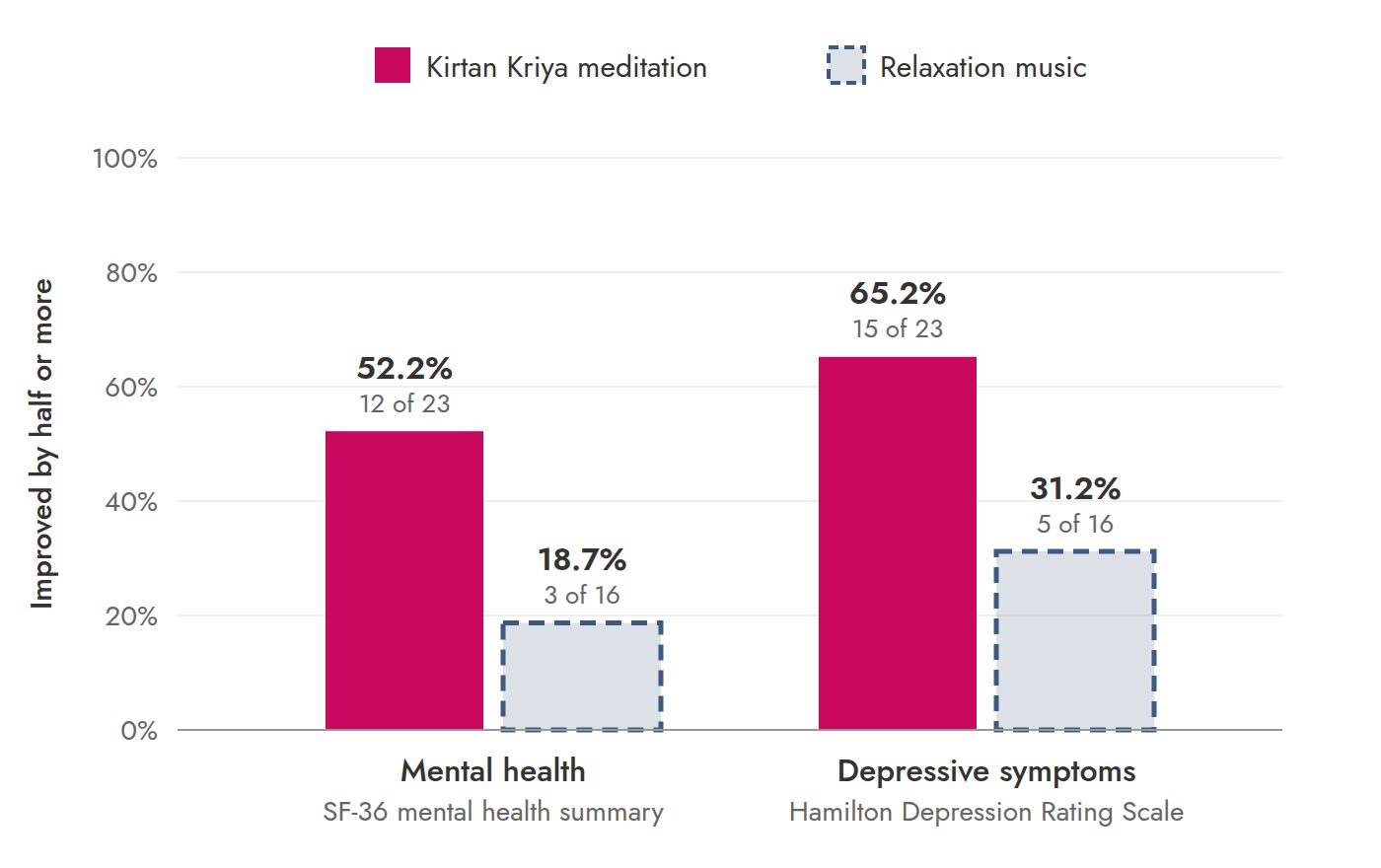
The average changes tell a more mixed story. Depression scores fell in both groups, by 7.4 points in the meditation group and 5.3 in the relaxation group (from about 12 at the start), and that difference was not statistically significant (p = .06). The SF-36 mental health summary rose by 12.8 points with meditation and 6.3 with relaxation, a significant difference (p = .03,
effect size
Effect size is a statistical concept that quantifies the magnitude or strength of a relationship, difference, or intervention outcome. Unlike p-values which only indicate statistical significance, effect sizes measure how meaningful a result is in practical terms. Common measures include Cohen’s d (standardized mean difference), correlation coefficients (r), and odds ratios. In meditation research, effect sizes help quantify the practical impact of different meditation practices on psychological or physiological outcomes.
More on Wikipedia
Read more in the glossary
d = 0.64). Two parts of the SF-36 showed the largest differences: the scale for how much emotional problems limit daily activities improved by 33.3 points with meditation and not at all with relaxation, and the energy scale rose by 19.6 points against 5.0.
So most caregivers in both groups felt better, but more of the meditators crossed the line of a large improvement.
Miscellaneous Interesting Takeaways
Small Gains in Thinking Skills, Partly From a Dip in the Relaxation Group
Taken together, the four thinking tests changed differently in the two groups (p = .01), and two of them drove the difference. On Trail Making Part B, the meditators got 11.2 seconds faster on average, while the relaxation group got 9.9 seconds slower. On the MMSE, the meditation group’s scores rose by 0.2 points and the relaxation group’s fell by 0.9. Both groups started near the top of the MMSE’s 30-point scale (about 29.5), so this difference reflects a small drop among the relaxation group more than a gain among the meditators. Trail Making Part A and delayed verbal recall didn’t differ between the groups.
Telomerase Rose More With Meditation, in an Exploratory Analysis
Telomerase activity in the meditators’ immune cells rose by an average of 0.9 units (from 2.7 at the start), while in the relaxation group it changed little (−0.2 units, from 3.0). The authors express this as a 43.3% improvement against 3.7%. The difference between groups was right at the study’s threshold for significance (p = 0.05), and the authors list telomerase as an exploratory outcome.
Across all 39 caregivers, those whose telomerase rose more also tended to have larger drops in depression (r = −0.33) and larger gains in SF-36 mental health (r = 0.44). The link with mental health was significant within the meditation group (r = 0.59) but not within the relaxation group. These are
correlations
A correlation measures how closely two things rise and fall together across people or over time. Pearson’s r runs from −1 to +1: values near +1 mean that people high on one measure tend to be high on the other, values near −1 mean the reverse, and values near 0 mean no straight-line relationship. A correlation alone can’t show that one thing causes the other.
More on Wikipedia
Read more in the glossary
, so they can’t show that better mood raised telomerase or the reverse.
Whether a short-term rise in telomerase activity in blood cells matters for health over the long run is a separate question. The authors suggest that higher telomerase “likely promotes” telomere maintenance and immune cell longevity over the long term, but this study measured neither telomere length nor health outcomes.
Was It the Chanting, or Just Relaxing?
The authors read their results as showing effects beyond relaxation:
Some of the observed effects could be due to the relaxation response in both groups (e.g., improved depression), while the effects on cognitive and mental functioning and telomerase activity … were specific to the Kirtan Kriya.
They go on to suggest that the chanting, finger movements and visualization added a “brain fitness” effect on top of stress reduction, which they plan to test with brain imaging. That is a hypothesis rather than something this trial tested: Kirtan Kriya differs from listening to music in several ways at once (chanting, finger movements, visualization and the mantra’s meaning), and the design can’t say which mattered. Participants also knew which practice they were doing.
What the Study Can’t Say
The authors acknowledge the main weakness themselves:
Other limitations of our study include the relatively large number of assessment instruments given the relatively small pilot sample that may introduce the possibility of finding a significant difference by chance alone, especially with respect to telomerase levels.
They also note that the relaxation group, though not significantly different, had more chronic medical illness at the start, which may have contributed to the differences between groups. Beyond that:
- Small and completers only. The analyses cover the 39 people who finished, not everyone randomized, and more people dropped out of the relaxation group. The abstract describes 39 caregivers as randomized, but the Results section reports that 45 were randomized and 39 finished.
- One-sided tests. Testing only for an advantage of meditation makes significance easier to reach, and the telomerase result landed right at the threshold.
- No long-term follow-up. Everything was measured at the end of eight weeks, so it’s unknown whether the benefits lasted.
- Practice amounts aren’t reported. Participants kept diaries, but the paper doesn’t say how often they actually practiced.
- A small slip. The discussion mentions improvement in “inflammatory biomarkers,” but this paper reports no inflammatory measures.
Final Reflection
This is an encouraging pilot. A practice that takes 12 minutes a day and needs only a CD was followed by large improvements in mental health and depression in more caregivers than a relaxation routine of the same length, along with hints of better mental flexibility and higher telomerase.
But it is a pilot, and the authors say so: their results “need to be confirmed in a larger sample.” The most solid finding is the higher response rate on mental health and depression. The average drop in depression was similar in both groups, the thinking-skills difference was small, and the telomerase result was exploratory and borderline. For caregivers, the practical message is modest: a short daily practice may be worth trying, and even simply relaxing to music for 12 minutes a day was followed by some improvement.
Citation
Lavretsky, H., Epel, E. S., Siddarth, P., Nazarian, N., St. Cyr, N., Khalsa, D. S., Lin, J., Blackburn, E., & Irwin, M. R. (2013). A pilot study of yogic meditation for family dementia caregivers with depressive symptoms: Effects on mental health, cognition, and telomerase activity. International Journal of Geriatric Psychiatry, 28(1), 57–65. 10.1002/gps.3790
Get the next summary by email
One or two new paper summaries every couple of weeks, sent to your inbox when they go up.
No spam, and you can unsubscribe at any time. Prefer a feed reader? Use the RSS feed.