
Background Information
Stress shows up in the blood. When people are put through a stressful task in the lab, their levels of stress hormones such as
cortisol
Cortisol is a hormone released by the adrenal glands, especially in response to stress. It mobilizes energy and helps regulate the immune system. Because it can be measured in saliva, researchers often use it to gauge how strongly someone reacts to a stressful task, such as timed mental arithmetic. Levels also follow a daily rhythm, so studies try to test everyone at the same time of day.
More on Wikipedia
Read more in the glossary
and
adrenocorticotropic hormone (ACTH)
Adrenocorticotropic hormone (ACTH) is a hormone released by the pituitary gland, at the base of the brain, when the body is under stress. It travels in the blood to the adrenal glands and signals them to release cortisol, making it the middle step of the HPA axis. ACTH rises and falls within minutes, faster than cortisol, and is measured in blood rather than saliva.
More on Wikipedia
Read more in the glossary
rise, and so do
inflammation
Inflammation is a biological response of the immune system to injury, infection, or stress, characterized by the release of signaling molecules called cytokines. Chronic inflammation is linked to impaired cognitive function, increased risk of disease, and accelerated aging.
More on Wikipedia
Read more in the glossary
markers such as
IL-6
Interleukin-6 (IL-6) is a signaling protein (a cytokine) that immune cells release to coordinate inflammation. It is measured from a blood sample, usually in picograms per milliliter. Persistently elevated IL-6 is associated with chronic stress, aging and a higher risk of cardiovascular disease, which makes it a common marker in studies of whether meditation affects health.
More on Wikipedia
Read more in the glossary
and
TNF-α
Tumor necrosis factor alpha (TNF-α) is a signaling protein (a cytokine) that immune cells release early in inflammation. It helps fight infection and repair tissue, but high or persistent levels contribute to inflammatory diseases such as rheumatoid arthritis, psoriasis and inflammatory bowel disease.
More on Wikipedia
Read more in the glossary
. The authors, a team at Massachusetts General Hospital led by Elizabeth Hoge, point out that chronic or repeated stress has been tied to abnormal levels of these hormones and markers, and that those abnormalities have in turn been tied to heart disease and metabolic syndrome.
People with
Generalized Anxiety Disorder (GAD)
Generalized anxiety disorder (GAD) is an anxiety disorder marked by excessive, hard-to-control worry about many everyday matters, such as health, work or family, lasting at least six months. The worry comes with physical and mental symptoms such as restlessness, tiring easily, trouble concentrating, irritability, muscle tension and poor sleep.
More on Wikipedia
Read more in the glossary
live with persistent, hard-to-control worry, and their bodies may overreact to stress too:
Prior research has demonstrated that patients with GAD, like other chronically stressed populations, have an exaggerated stress hormone response to the TSST or other laboratory stress provocation, compared to healthy controls
This paper comes from the same randomized trial as Hoge et al. (2013), which compared an 8-week
Mindfulness-Based Stress Reduction (MBSR)
Mindfulness-Based Stress Reduction (MBSR) is a program designed to help individuals cope with stress, pain, and illness. Developed by Jon Kabat-Zinn in the 1970s, it combines meditation and yoga to promote awareness and stress management. The eight-week program teaches participants to focus on the present moment non-judgmentally, enhancing their ability to manage difficulties.
More on Wikipedia
Read more in the glossary
course with a stress management class in adults with GAD. That paper found that the two courses lowered clinician-rated anxiety, its main outcome, about equally, but that MBSR did better on several other measures, including how anxious and distressed people felt during a laboratory stress test. It reported no physiological measures. Here, in what the authors call a separate planned analysis, they turn to the blood drawn during those same stress tests. They expected that MBSR would calm the overactive stress response seen in GAD, so that stress hormones and inflammation markers would fall more after MBSR than after the class.
What They Did
The trial recruited adults with GAD, confirmed in a structured diagnostic interview. It excluded, among others, people with psychotic, bipolar, post-traumatic stress or obsessive-compulsive disorder, people misusing alcohol or drugs, people with hormonal or chronic inflammatory diseases, and people already in psychotherapy for GAD. Participants were randomly assigned to one of two 8-week group courses:
- MBSR, in a modified form, with breath awareness, a
body scan
The body scan is a meditation practice in which attention is moved slowly through the body, part by part, noticing whatever sensations are present without trying to change them. It is a core exercise in mindfulness programs such as MBSR.
More on Wikipedia
Read more in the glossary and gentle hatha yoga, a weekend retreat day and daily home practice guided by recordings. - Stress management education (SME), an
attention control
An active control group is a comparison group that takes part in a different program designed to be just as engaging as the one being tested. In meditation research, it might involve exercise, music, or education classes with the same time commitment, teachers, and expectations of benefit. Comparing against an active control helps separate the effects of meditation itself from the general effects of joining a course.
More on Wikipedia
Read more in the glossary meant to match the group support, instructor attention and expectations of MBSR. It was taught as lectures on health and wellness, such as diet, exercise, sleep and time management, with no meditation or other mind–body practice. (The 2013 paper’s summary describes how the two were matched.)
Seventy-nine people finished treatment in the trial, and the 72 who agreed to give blood were eligible for this analysis. It left out people taking antidepressants or benzodiazepines, because those drugs can alter the hormone response to stress, and it needed both stress tests and enough blood from before the stress, right after it and later on. One person was excluded for an acute medical problem and one because of a lab error. The paper describes 70 participants, 42 in MBSR and 28 in SME, with average ages of 40 and 38; about half were men and most were white. Because of lost samples and failed assays, the number with usable data differed by marker: 68 for cortisol, 67 for ACTH, 65 for TNF-α and 62 for IL-6.
Before the courses and again after them, everyone took the
Trier Social Stress Test
The Trier Social Stress Test (TSST) is a standard laboratory stressor. After a few minutes to prepare, a person gives a short speech, often a mock job interview, and then does mental arithmetic aloud, in front of a panel of unsmiling judges and often a camera. The mix of public evaluation and lack of control reliably raises stress hormones such as cortisol, so researchers use it to compare how strongly people react to stress.
More on Wikipedia
Read more in the glossary
(TSST) in the afternoon, between 1:00 and 4:30, to limit the effect of the daily rhythm in hormones. They gave an 8-minute speech and then did 5 minutes of mental arithmetic in front of a panel of “evaluators” in white lab coats, holding clipboards, with a large video camera. To keep people from simply getting used to it, the second test had new evaluators, a different room and a different arithmetic task, and participants were told that their first speech had scored in the low range and that this was their chance to improve.
A catheter was placed in a vein so blood could be drawn repeatedly: four times while the person rested, once after the 8 minutes of speech preparation, and five times over the 40 minutes after the speech and arithmetic. The team measured cortisol and ACTH, two hormones of the
HPA axis
The hypothalamic–pituitary–adrenal (HPA) axis is the body’s main hormonal stress system. When the brain registers a threat, the hypothalamus signals the pituitary gland, which in turn signals the adrenal glands above the kidneys to release cortisol. Cortisol then feeds back to the brain to switch the response off. Because cortisol is its end product, researchers often measure cortisol in saliva to gauge how strongly the HPA axis reacts to a stressful task.
More on Wikipedia
Read more in the glossary
, the body’s main hormonal stress system, and the inflammation markers IL-6 and TNF-α. For each marker and test, they summed the rise over the session above the first resting sample as an
area under the curve
The area under the curve (AUC) sums up a series of measurements taken over time as a single number: plot the level of, say, a hormone at each sample, join the points, and measure the area beneath the line. Stress researchers often use a version calculated with respect to increase, which counts only the rise above the first sample, so it reflects how strongly and for how long a level rose during a stressful task.
More on Wikipedia
Read more in the glossary
. The key question was whether that total changed differently from the first test to the second in the two groups.
One Big Result: The Stress Hormone ACTH Rose Less at the Second Test After MBSR, and More After the Stress Class
ACTH is released by the pituitary gland and tells the adrenal glands to release cortisol. In the MBSR group, its response to the stress test shrank from an average of 1,979 at the first test to 1,688 at the second, a significant drop within the group. In the SME group, it grew from 2,148 to 2,348, a rise that wasn’t significant on its own. The difference between the groups’ changes was significant (F(1,55) = 7.75, p = 0.007).
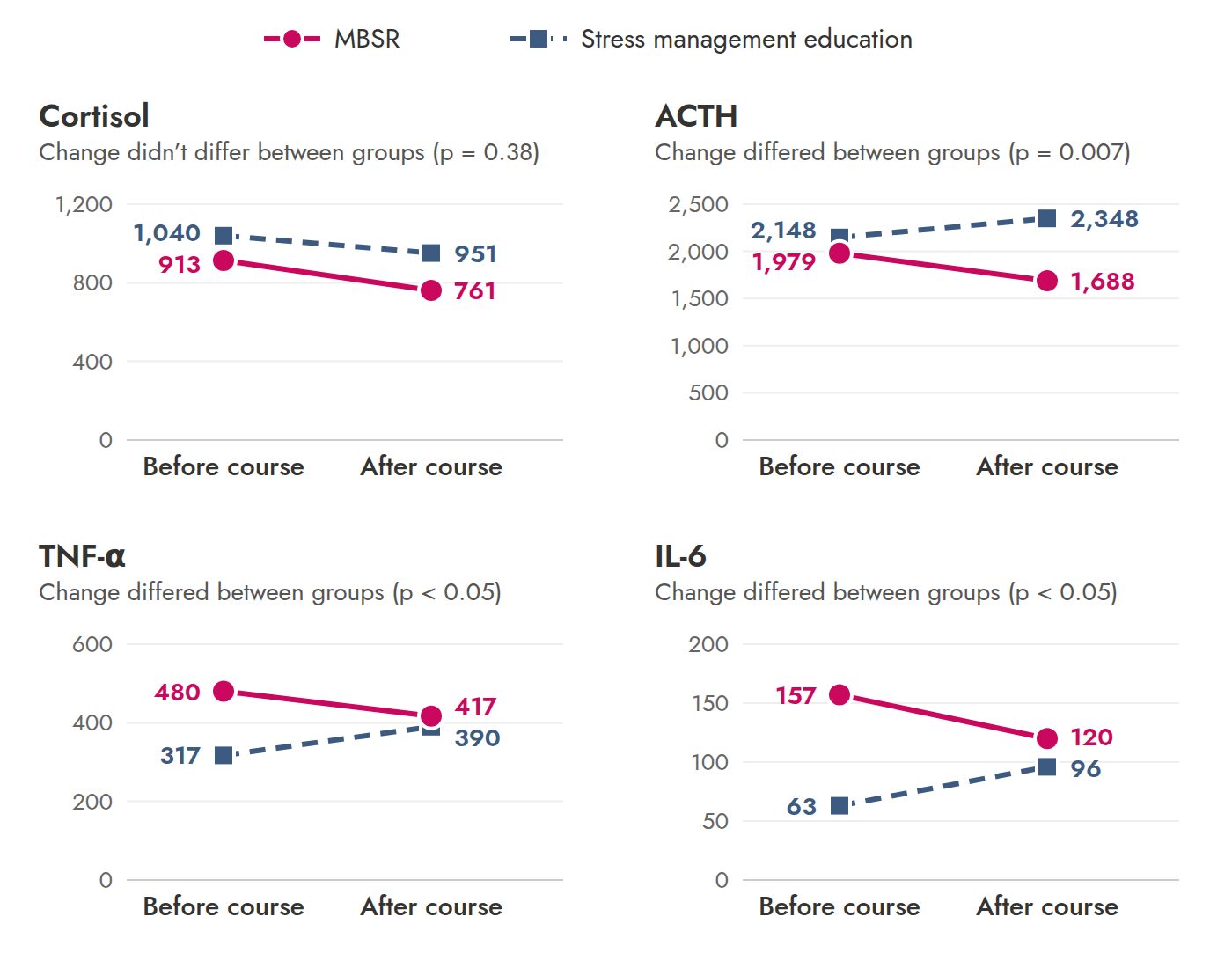
The two inflammation markers moved the same way: down in the MBSR group and up in the SME group.
- TNF-α went from 480 to 417 with MBSR and from 317 to 390 with SME (p = 0.036 for the difference in change).
- IL-6 went from 157 to 120 with MBSR and from 63 to 96 with SME (p = 0.034).
The authors read this as greater resilience: after MBSR, people’s bodies reacted less to a stressful challenge. They also offer a reading of why the SME group’s responses grew rather than shrank, as studies of repeated tests in healthy adults suggest they should:
Interestingly, participants who did not practice meditation (those in the SME group) experienced increased stress in anticipation of the second TSST, rather than a habituation-related decreased level of stress, as has been suggested by studies of repeat TSSTs with healthy adults
They link this to studies in which people with depression, trauma or “high exhaustion” reacted more strongly to the TSST, or more strongly the second time. The paper reports each marker only as a total over the whole session, though, not the anticipation phase separately.
Miscellaneous Interesting Takeaways
Cortisol Didn’t Differ
Cortisol, the hormone that ACTH triggers, fell in both groups: from 913 to 761 with MBSR, a significant drop within the group, and from 1,040 to 951 with SME. Across both groups it fell from the first test to the second, but the groups didn’t differ in how much (p = 0.38). The authors acknowledge the puzzle:
Also, it is not clear why there were no significant differences in cortisol AUC changes between the groups, when the closely related ACTH changes were significantly different.
They suggest that cortisol, which lasts longer in the blood than ACTH, may be a less reliable measure when samples are taken close together, and cite a study in which ACTH rose with stress while cortisol measured at the same moments did not. Still, cortisol is the end product of the HPA axis, and here it gave no sign of a difference between MBSR and the class. That matches a trial that compared MBSR with a closely matched health program in healthy adults, where cortisol responses to the TSST didn’t differ either.
The Inflammation Result Comes With a Catch
The groups started far apart on the two inflammation markers. At the first test, the MBSR group’s IL-6 response averaged 157 against 63 in the SME group, and its TNF-α response 480 against 317. After the courses, the MBSR group’s responses were still the larger of the two (120 against 96, and 417 against 390). The MBSR group’s drops weren’t significant on their own; of the four within-group changes in inflammation markers, only the SME group’s rise in IL-6 was. So the significant result is that the two groups moved in opposite directions from very different starting points. The paper doesn’t discuss the difference at the start.
The abstract puts it more simply, saying “the MBSR group had a greater reduction in inflammatory cytokines’ AUC concentrations.” That is true of the comparison between groups, but it describes a fall in one group and a rise in the other. The paper’s p-values for the two markers also differ slightly between the text (0.034 for IL-6, 0.036 for TNF-α) and Table 2 (0.036 and 0.033); all are just under 0.05.
Why Measure the Body at All?
The authors argue that biology can catch what questionnaires miss. People’s ratings of their own anxiety can be biased, they write, especially in GAD, where some patients may find it hard to notice or describe what is going on inside them. They cite a review finding that only about 25% of TSST studies found a
correlation
A correlation measures how closely two things rise and fall together across people or over time. Pearson’s r runs from −1 to +1: values near +1 mean that people high on one measure tend to be high on the other, values near −1 mean the reverse, and values near 0 mean no straight-line relationship. A correlation alone can’t show that one thing causes the other.
More on Wikipedia
Read more in the glossary
between stress hormone levels and how stressed people said they felt. In the clinical results of the same trial, the authors note, participants’ ratings of their stress had fallen more after MBSR than after SME. This paper adds a blood measure that moved the same way, although it doesn’t report whether the people whose ACTH fell most were the ones who felt better.
A Possible Link to Physical Health, Not Tested Here
The authors place the results in a larger argument. Anxiety disorders are linked to higher rates of heart disease and metabolic syndrome, and repeated surges of stress hormones and inflammation might be part of the reason. Treating anxiety, they write, might then improve physical health as well as mental health, “if this relationship is at all causal.” That is a hypothesis: the study measured responses to a lab stressor at the end of an 8-week course, not health outcomes, and it didn’t follow anyone afterward.
Who Was Analyzed
The abstract describes the 70 participants as randomized, but they were the part of the trial that finished treatment, gave blood at both tests and weren’t taking antidepressants or benzodiazepines. The paper reports that after randomization, 11 people dropped out of the SME group and 3 out of MBSR, so the comparison is between those who stayed, and more left the control class. The authors name other limits: the relatively small sample, entry criteria that may limit how far the results generalize, hormone levels that varied more than in other published reports, most of which studied healthy people, and no measures of possible confounds such as religious belief, stressful life events or socioeconomic status, which they expected randomization to balance. The paper tested four markers, each at the 0.05 level, without reporting any adjustment for testing several.
Who Ran the Study
The trial was registered at ClinicalTrials.gov (NCT01033851) and funded mainly by a grant from the U.S. National Institutes of Health’s National Center for Complementary and Alternative Medicine, with extra support from the Highland Street Foundation. One author reported advisory and consulting roles and equity in several companies, and royalties from or patents on two interview guides. The others reported research funding only, or nothing to disclose.
Final Reflection
This trial tested whether
mindfulness
Mindfulness is the psychological process of purposely bringing one’s attention to experiences occurring in the present moment without judgment. It involves maintaining awareness of thoughts, feelings, bodily sensations, and surrounding environment with an attitude of curiosity and acceptance. In meditation contexts, mindfulness practices typically involve focusing attention on the breath or body sensations as anchors to the present moment while acknowledging and releasing distracting thoughts.
More on Wikipedia
Read more in the glossary
changes the body’s stress response in people with an anxiety disorder, against a class that offered a group setting and attention without meditation. After MBSR, the stress hormone ACTH rose less during a public-speaking test than it had before the course, while after the class it rose more, and two inflammation markers showed the same opposite movement. The authors conclude:
these findings suggest that mindfulness meditation training, a relatively inexpensive and low-stigma treatment approach, may be a helpful strategy to decrease biological stress reactivity and improve resilience to stressors in patients with GAD.
“May” is the right word. Cortisol, the end product of the stress-hormone system, didn’t differ between the groups. The inflammation results rest on groups that started far apart and moved in opposite directions, with no significant drop within the MBSR group itself. Only people who finished the courses were analyzed, more of them dropped out of the control class, and nothing was measured afterward. Similar trials on this site point the same cautious way: against matched comparison programs, neither MBSR in healthy adults nor compassion meditation in students clearly changed cortisol or IL-6 responses to a lab stress test. Read with the trial’s clinical results and its follow-up analysis of decentering, this paper suggests MBSR’s benefits in GAD may reach the body’s stress hormones, a lead that larger trials analyzing everyone randomized would need to confirm.
Citation
Hoge, E. A., Bui, E., Palitz, S. A., Schwarz, N. R., Owens, M. E., Johnston, J. M., Pollack, M. H., & Simon, N. M. (2018). The effect of mindfulness meditation training on biological acute stress responses in generalized anxiety disorder. Psychiatry Research, 262, 328–332. 10.1016/j.psychres.2017.01.006
Get the next summary by email
One or two new paper summaries every couple of weeks, sent to your inbox when they go up.
No spam, and you can unsubscribe at any time. Prefer a feed reader? Use the RSS feed.