
Background Information
Generalized Anxiety Disorder (GAD)
Generalized anxiety disorder (GAD) is an anxiety disorder marked by excessive, hard-to-control worry about many everyday matters, such as health, work or family, lasting at least six months. The worry comes with physical and mental symptoms such as restlessness, tiring easily, trouble concentrating, irritability, muscle tension and poor sleep.
More on Wikipedia
Read more in the glossary
is defined by worry that is hard to control, along with symptoms such as poor sleep, muscle tension and irritability. The authors, a team at Massachusetts General Hospital led by Elizabeth Hoge, note that it affects 5.7% of people at some point in their lives, and that 30 to 60% of patients don’t reach remission with standard drug or talk therapy. Some people with GAD may also not seek psychiatric care because of perceived stigma.
Mindfulness
Mindfulness is the psychological process of purposely bringing one’s attention to experiences occurring in the present moment without judgment. It involves maintaining awareness of thoughts, feelings, bodily sensations, and surrounding environment with an attitude of curiosity and acceptance. In meditation contexts, mindfulness practices typically involve focusing attention on the breath or body sensations as anchors to the present moment while acknowledging and releasing distracting thoughts.
More on Wikipedia
Read more in the glossary
courses looked like an appealing alternative: low-cost, low-stigma and accessible. But the authors point out that most earlier studies of mindfulness for GAD were small or lacked a proper comparison group. An early study of
Mindfulness-Based Stress Reduction (MBSR)
Mindfulness-Based Stress Reduction (MBSR) is a program designed to help individuals cope with stress, pain, and illness. Developed by Jon Kabat-Zinn in the 1970s, it combines meditation and yoga to promote awareness and stress management. The eight-week program teaches participants to focus on the present moment non-judgmentally, enhancing their ability to manage difficulties.
More on Wikipedia
Read more in the glossary
for anxiety disorders had no comparison group at all. Another compared MBSR with a wait-list, which can’t rule out the benefits of simply expecting to get better and getting attention. Others combined mindfulness with cognitive therapy, which makes it hard to tell which part did the work.
What was missing, they argue, was a comparison with an
active control group
An active control group is a comparison group that takes part in a different program designed to be just as engaging as the one being tested. In meditation research, it might involve exercise, music, or education classes with the same time commitment, teachers, and expectations of benefit. Comparing against an active control helps separate the effects of meditation itself from the general effects of joining a course.
More on Wikipedia
Read more in the glossary
: a course that offers the same group support, instructor attention and expectation of benefit, without the meditation. To their knowledge, this was the first
randomized controlled trial
A Randomized Controlled Trial is a scientific study design that randomly assigns participants to either an experimental group receiving an intervention or a control group, allowing researchers to measure the true effect of the intervention while minimizing bias.
More on Wikipedia
Read more in the glossary
to compare mindfulness meditation, without added cognitive therapy, against such a control in GAD. They also wanted to know whether meditation training would change how people respond to stress in the moment, so they put participants through a standard laboratory stress test before and after the course.
What They Did
Between December 2008 and February 2011, the researchers recruited adults for a study on “Stress Reduction” through referrals and media advertisements. To take part, people had to have GAD as their main problem, confirmed in a structured diagnostic interview, and score at least 20 on the
Hamilton Anxiety Rating Scale (HAM-A)
The Hamilton Anxiety Rating Scale (HAM-A) is a 14-item scale that a clinician scores after interviewing a patient, rating the severity of symptoms such as worry, tension, fears, poor sleep and trouble concentrating, along with physical complaints like a racing heart, muscle aches or an upset stomach. Each item runs from 0 to 4, for a total of 0 to 56. It is one of the most widely used outcome measures in trials of treatments for anxiety, and many of its items concern bodily symptoms.
More on Wikipedia
Read more in the glossary
. They were excluded if, among other things, they were in psychotherapy for GAD, had taken more than four classes of meditation, yoga or tai chi in the past two years, or had been on a psychiatric medication at a stable dose for less than 4 weeks. People on a stable dose could take part if they stayed on it throughout.
Ninety-three people were randomly assigned to one of two 8-week group courses. The analysis included the 89 who attended at least one class: 48 in MBSR and 41 in the control course. (Three people assigned to the control course dropped out before it began, and one more turned out not to be eligible.) Their average ages were 41 and 37; about half were women, most were white, and 17 were on a stable dose of an antidepressant (SSRI) or a benzodiazepine.
- MBSR followed the standard program, with breath awareness, the
body scan
The body scan is a meditation practice in which attention is moved slowly through the body, part by part, noticing whatever sensations are present without trying to change them. It is a core exercise in mindfulness programs such as MBSR.
More on Wikipedia
Read more in the glossary and gentle hatha yoga, plus daily home practice guided by recordings. It was trimmed to make it easier to keep up: weekly classes ran 2 hours instead of 2.5, the all-day retreat became 4 hours, and home practice was cut from 45 to 20 minutes a day. The researchers also added loving-kindness (metta) Loving-kindness meditation (mettā in Pali) is a Buddhist practice of deliberately cultivating warm, unconditional goodwill. Practitioners silently repeat wishes such as “may you be happy” or picture a person, usually starting with themselves or someone close and then extending the wishes to acquaintances, strangers, difficult people and all beings. It is one of the four brahmaviharas.
More on Wikipedia
Read more in the glossary practice in the first class, with a recording for home. An instructor with over 8 years of MBSR experience taught it. - Stress Management Education (SME) contained no mindfulness. It was matched to MBSR minute for minute: eight 2-hour classes, 20 minutes of homework a day (listening to audiobook recordings) and a 4-hour weekend “Special Class.” The lectures covered stress and its effects on the body, time management, sleep, nutrition, caffeine, exercise, and things that buffer stress, such as humor, altruism and volunteering. To match MBSR’s yoga, a physical therapist led gentle strength and posture exercises for the same number of minutes, and the Special Class included stability-ball exercises, posture assessments, a short massage and a talk by a dietitian.
Both courses were audiotaped, and a fifth of the classes were checked against a list of each week’s content.
What They Measured
Anxiety was measured before the courses and at week 8, the end of treatment:
- The main outcome, chosen in advance, was the HAM-A, a 14-item scale that a clinician scores in an interview.
- The secondary outcome was the
Clinical Global Impression
The Clinical Global Impression (CGI) scales are brief ratings in which a clinician sums up a patient’s overall condition. The severity scale (CGI-S) rates how ill the person is now, from 1 (normal) to 7 (among the most extremely ill); the improvement scale (CGI-I) rates how much they have changed since treatment began, from 1 (very much improved) to 7 (very much worse). Trials often count a CGI-I of 1 or 2 as a response to treatment.
More on Wikipedia
Read more in the glossary of Severity (CGI-S), a clinician’s overall rating of how ill a patient is. At the end, clinicians also rated how much each person had improved (CGI-I). - Self-rated anxiety was measured with the 21-item
Beck Anxiety Inventory (BAI)
The Beck Anxiety Inventory (BAI) is a 21-item questionnaire on which people rate how much they have been bothered by common symptoms of anxiety over the past week, such as nervousness, fear of the worst happening, a pounding heart or feeling unsteady. Each item is scored from 0 to 3, for a total of 0 to 63. Many of its items describe the bodily side of anxiety.
More on Wikipedia
Read more in the glossary , and sleep with the Pittsburgh Sleep Quality Index (PSQI) The Pittsburgh Sleep Quality Index (PSQI) is a widely used questionnaire about how well a person has slept over the past month. It covers time to fall asleep, sleep duration, disturbances and daytime effects, and combines them into a score from 0 to 21, where higher means worse sleep. Scores above 5 are commonly taken to indicate poor sleep.
More on Wikipedia
Read more in the glossary .
The HAM-A and CGI were rated by independent evaluators who didn’t know which course each person had taken. Participants were asked not to discuss their class with them.
Before and after the courses, participants also took the
Trier Social Stress Test
The Trier Social Stress Test (TSST) is a standard laboratory stressor. After a few minutes to prepare, a person gives a short speech, often a mock job interview, and then does mental arithmetic aloud, in front of a panel of unsmiling judges and often a camera. The mix of public evaluation and lack of control reliably raises stress hormones such as cortisol, so researchers use it to compare how strongly people react to stress.
More on Wikipedia
Read more in the glossary
(TSST): an 8-minute speech followed by 5 minutes of mental arithmetic, in front of two strangers in white lab coats holding clipboards, introduced as “the evaluators,” and a large video camera. To keep people from simply getting used to it, the second test used new evaluators, a different room and a different arithmetic task, and participants were told that their first speech had scored in the low range and that this was their chance to improve. During each test, people rated their anxiety on the
State Anxiety Inventory
The State Anxiety Inventory is the half of the State-Trait Anxiety Inventory (STAI) that asks how anxious someone feels right now, rather than how anxious they tend to be in general. People rate 20 statements such as “I feel worried” from 1 (not at all) to 4 (very much so), giving a score from 20 to 80. Because it captures the moment, researchers can give it just before and just after a single session.
More on Wikipedia
Read more in the glossary
, their distress on a 0 to 100 scale (the Subjective Units of Distress Scale, SUDS), and how much they agreed with positive and negative statements about their speech, such as “I can handle everything” and “I’ll probably ‘bomb out’ anyway.”
The clinical outcomes were analyzed for everyone who attended at least one class, a modified
intention-to-treat
An intention-to-treat analysis counts every randomized participant in the group they were assigned to, whether or not they completed or even started the treatment. It keeps the benefit of randomization, since dropping people who didn’t follow their plan can leave groups that differ in other ways, and it estimates what happens when a treatment is offered in practice rather than when it is taken exactly as intended.
More on Wikipedia
Read more in the glossary
analysis. For anyone missing a final score, their last available score was carried forward. The key test was whether anxiety fell more in one group than the other.
One Big Result: On the Main Anxiety Scale, MBSR Did No Better Than the Stress Class; on Several Others, It Did
Both groups improved on the HAM-A. Scores fell from 21.46 to 13.65 in the MBSR group and from 22.12 to 16.27 in the SME group, significant drops in both (p < 0.0001). MBSR’s drop was somewhat larger, but the difference between the groups was not significant (p = 0.244). On the outcome chosen in advance as the main one, MBSR did not beat the control course.
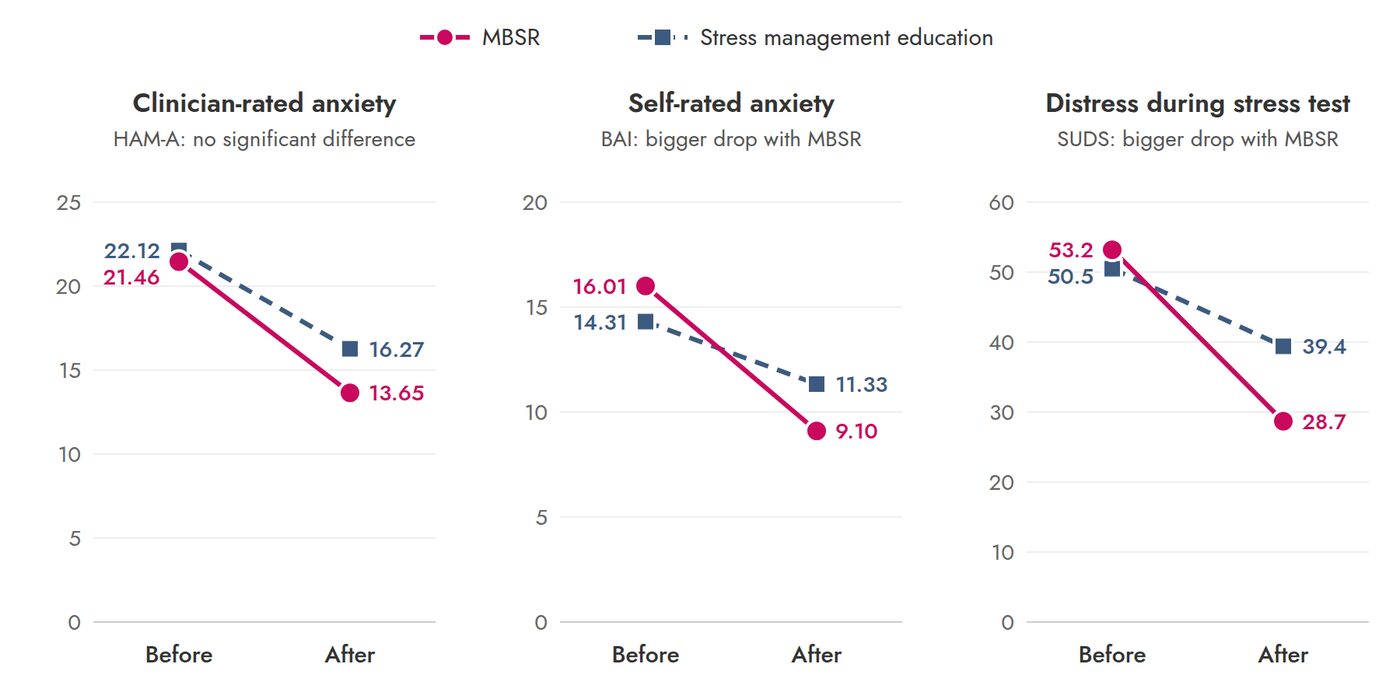
Other measures favored MBSR:
- Overall severity (CGI-S), rated by the same blinded clinicians, fell from 4.54 to 3.15 with MBSR and from 4.38 to 3.58 with SME, a significantly larger drop with MBSR (p = 0.037).
- Response to treatment, defined as a CGI-I rating of “much” or “very much improved,” was more common after MBSR: 66% (29 of 44) against 40% (14 of 35), p = 0.025. That is a
relative risk
A relative risk (or risk ratio) is the chance of an outcome in one group divided by the chance in another. A relative risk of 1 means no difference; 1.5 means the outcome was 50% more common in the first group. If 60% of one group improve and 40% of another, the relative risk is 1.5. Unlike an odds ratio, it can be read directly as how many times more likely something is.
More on Wikipedia
Read more in the glossary of 1.65 (95% CI 1.04 to 2.60) and a number needed to treat The number needed to treat (NNT) is how many people need to receive a treatment, or be offered it, for one more of them to avoid a bad outcome than would have without it. It is 1 divided by the difference in the share of each group that has the outcome: if 30% of an untreated group and 20% of a treated group have it, the NNT is 1 / 0.10, or 10. Lower numbers mean a bigger practical effect.
More on Wikipedia
Read more in the glossary of 3.9, though its confidence interval A confidence interval is the range of values that a study’s data are consistent with, given the uncertainty that comes from measuring a limited sample. A 95% confidence interval for an effect of 0.30 running from 0.00 to 0.59, for example, means the true effect could plausibly be anywhere from nothing to moderate. Narrower intervals mean more precise estimates; an interval that includes zero means the study can’t rule out no effect.
More on Wikipedia
Read more in the glossary is wide, running from 2.2 to 26.2. The paper doesn’t say why these rates are based on 44 and 35 people rather than the 48 and 41 analyzed elsewhere. - Self-rated anxiety (BAI) fell from 16.01 to 9.10 with MBSR and from 14.31 to 11.33 with SME, a significantly larger drop with MBSR (p = 0.041). BAI scores weren’t available for the first 7 participants.
So the clinicians’ scale of anxiety symptoms showed no difference, while their overall judgment of how ill people were, and people’s own reports, did. The authors suggest the main scale may have been the wrong tool:
One possible explanation is that the HAM-A, which heavily weighs somatic symptoms, was not sensitive to the change in psychological symptoms
As support, they point to analyses done after the fact, splitting the scales into their psychological items. On the HAM-A’s psychological items, scores fell by 4.8 points with MBSR and 3.9 with SME, a difference that was not significant. On the BAI’s psychological items, they fell by 3.12 and 1.51 points (p = 0.07). Both lean the way the authors suggest, but neither difference reached significance, so the explanation remains a reasonable guess rather than a finding. They also offer a second possibility: that MBSR reduced people’s overall distress and impairment in ways that a count of GAD symptoms on the HAM-A didn’t reflect. They compare this with pain research, which distinguishes how severe a symptom is from how distressing it is, and where mindfulness training has been linked to a drop in “pain unpleasantness.”
Miscellaneous Interesting Takeaways
The Stress Test Felt Less Stressful After MBSR
Both groups found the second stress test less upsetting than the first, but the MBSR group’s ratings fell further:
- State anxiety fell from 53.9 to 40.8 with MBSR and from 52.2 to 45.2 with SME (p = 0.040 for the difference).
- Distress (SUDS) fell from 53.2 to 28.7 with MBSR and from 50.5 to 39.4 with SME (p = 0.025).
- Positive self-statements about the speech rose from 15.9 to 18.6 with MBSR but didn’t rise with SME (16.9 to 16.5; p = 0.004 for the difference). Negative self-statements fell in both groups alike (p = 0.26 for the difference).
The authors read the larger gains as better coping, or “resilience,” under stress. They suggest a reason rooted in the practice itself:
it is possible that participants who learned MBSR were less likely to ruminate over negative thoughts about the speech and their performance, and treated themselves with more kindness and less self-judgment, an inherent part of the practice.
A few caveats apply. These analyses included only people who completed the stress test protocol, and they left out three people in the MBSR group who started an antidepressant or benzodiazepine during the study, because those drugs affect the stress response. (Leaving the same three out of the main clinical analyses didn’t change those results.) All of these were participants’ own ratings: this paper reports no physiological measures of the stress response. And since both groups’ ratings fell at the second test, which was changed in several ways from the first, the comparison between the groups matters more than either group’s drop.
Sleep Improved More After MBSR, in People Not on Medication
Because the allowed psychiatric drugs affect sleep, the researchers looked at sleep only in the 61 participants who weren’t taking them. Sleep quality improved in both groups, more so with MBSR: PSQI scores, where lower means better sleep, fell by 2.6 points on average with MBSR and by 1.0 with SME (p = 0.035).
A Large Effect Within the MBSR Group, but Not a Measure of MBSR’s Edge
The authors report that, on the HAM-A, the MBSR group’s improvement from before to after amounted to an
effect size
Effect size is a statistical concept that quantifies the magnitude or strength of a relationship, difference, or intervention outcome. Unlike p-values which only indicate statistical significance, effect sizes measure how meaningful a result is in practical terms. Common measures include Cohen’s d (standardized mean difference), correlation coefficients (r), and odds ratios. In meditation research, effect sizes help quantify the practical impact of different meditation practices on psychological or physiological outcomes.
More on Wikipedia
Read more in the glossary
(Cohen’s d) of 1.06, in line with studies of
cognitive behavioral therapy
Cognitive behavioral therapy (CBT) is a structured, usually short-term talk therapy that helps people notice and change unhelpful patterns of thinking and behavior. It is one of the most thoroughly tested psychological treatments and a first-line option for depression, anxiety disorders and many other conditions.
More on Wikipedia
Read more in the glossary
, where they cite values of 0.73 to 1.37. That figure compares the MBSR group with itself before the course. It doesn’t measure MBSR’s advantage over the stress class: on this scale, scores fell substantially in both groups, and the difference between them wasn’t significant.
The Conclusion Leans on the Secondary Measures
The abstract reports the null result on the HAM-A plainly. The conclusion is a little more confident:
In conclusion, our findings suggest that mindfulness meditation training, in the form of MBSR, can reduce anxiety symptoms in patients with GAD even when compared to an active control condition, and is a treatment option worth pursuing in larger investigational trials.
That “even when compared to an active control” claim rests on the CGI ratings, the BAI and the stress test, not on the scale the trial chose in advance as its main test. The second half of the sentence, calling for larger trials, is the safer reading.
Other Limits
The authors list several: the sample was relatively small; rates of other conditions alongside GAD were lower than in large population surveys, so the results may not apply to all people with GAD; some participants took psychiatric medication, too few to test whether it affected the results; and there was no diagnostic interview at the end of the trial, so it can’t say how many people no longer met criteria for GAD. In addition, anxiety was measured only at the end of the 8 weeks, so the trial says nothing about whether the gains lasted, and the paper doesn’t describe any adjustment for testing many outcomes. On the other hand, only one person in each group reported an adverse event (muscle soreness after MBSR, disrupted sleep after SME).
The Same Trial, Looked at Again
Two years later, the same group returned to this trial to ask how MBSR helped. In a smaller analysis of 38 of its participants, gains in
decentering
Decentering is the ability to observe thoughts, feelings and memories as passing events in the mind rather than as facts about reality or fixed parts of who you are: noticing “I’m having the thought that I’ll fail” rather than simply believing “I’ll fail.” It is thought to be one of the ways mindfulness-based programs and cognitive therapies work, and is usually measured by questionnaire, for example with the Experiences Questionnaire.
Read more in the glossary
, the ability to see thoughts and feelings as passing events, statistically accounted for MBSR’s larger drop in self-rated anxiety on the BAI.
Who Ran the Study
The trial was registered at ClinicalTrials.gov (NCT01033851) and funded mainly by a grant from the U.S. National Institutes of Health’s National Center for Complementary and Alternative Medicine, with extra support from the Highland Street Foundation. One author reported advisory and consulting roles and equity in several companies, and royalties on the interview guide used to administer the HAM-A. The others reported no conflicts.
Final Reflection
This trial did what the authors said earlier studies hadn’t: it compared MBSR with a course that matched it for time, group, teacher attention and even gentle movement. Against that control, the result is mixed in a way that is easy to blur. On the clinician-rated anxiety scale chosen in advance as the main test, both courses helped and MBSR’s edge wasn’t significant. On clinicians’ overall ratings, on people’s own reports of anxiety and sleep, and on how distressing a public speaking test felt, MBSR came out ahead.
That pattern is consistent with mindfulness easing how much anxiety bothers people more than the bodily symptoms a clinician’s checklist picks up, which is the authors’ reading. But the post-hoc checks behind it fell short of significance, and with 89 people, modest differences can show up on some measures and not others. Either way, a matched health course did a good share of the work, much as it did in another trial on this site that pitted MBSR against a carefully matched program. Larger trials with follow-up beyond the last class, as the authors themselves call for, would be needed to say how much mindfulness adds for people with GAD.
Citation
Hoge, E. A., Bui, E., Marques, L., Metcalf, C. A., Morris, L. K., Robinaugh, D. J., Worthington, J. J., Pollack, M. H., & Simon, N. M. (2013). Randomized controlled trial of mindfulness meditation for generalized anxiety disorder: Effects on anxiety and stress reactivity. The Journal of Clinical Psychiatry, 74(8), 786–792. 10.4088/JCP.12m08083
Get the next summary by email
One or two new paper summaries every couple of weeks, sent to your inbox when they go up.
No spam, and you can unsubscribe at any time. Prefer a feed reader? Use the RSS feed.