
Background Information
Mental health problems often begin in adolescence, and the authors note that depression, of all the disorders that emerge then, does the most damage over a lifetime. Schools reach almost every young person, so they are an obvious place to try to prevent problems before they start.
Mindfulness
Mindfulness is the psychological process of purposely bringing one’s attention to experiences occurring in the present moment without judgment. It involves maintaining awareness of thoughts, feelings, bodily sensations, and surrounding environment with an attitude of curiosity and acceptance. In meditation contexts, mindfulness practices typically involve focusing attention on the breath or body sensations as anchors to the present moment while acknowledging and releasing distracting thoughts.
More on Wikipedia
Read more in the glossary
lessons have become a popular way to do that, and earlier reviews, including one by members of this team, suggested small benefits. But the authors point out that those studies tended to be small, with short or no follow-up, mixed comparison groups and signs of
publication bias
Publication bias arises when studies with positive or striking results are more likely to be published than studies that find nothing. A meta-analysis that pools only published studies can then overestimate how well a treatment works. Researchers check for it with tools such as funnel plots and Egger’s test, which need a reasonable number of studies to be informative.
Read more in the glossary
.
The MYRIAD trial (My Resilience in Adolescence) was designed to settle the question with a large trial and a longer follow-up. It was led by Willem Kuyken, whose earlier work on
mindfulness-based cognitive therapy (MBCT)
Mindfulness-based cognitive therapy (MBCT) is an 8-week group program that combines mindfulness meditation, adapted from Mindfulness-Based Stress Reduction (MBSR), with elements of cognitive behavioral therapy. It was developed to help people who have recovered from depression avoid relapse, by learning to notice and step back from patterns of negative thinking. Classes usually meet weekly, with daily meditation practice at home.
More on Wikipedia
Read more in the glossary
for adults with recurrent depression is summarized on this site: the PREVENT trial against antidepressants and a pooled analysis of nine MBCT trials. The school program tested here was adapted from MBCT for young people “across the full spectrum of functioning from mental health problems to flourishing.” The idea was not to treat illness but to teach skills in attention and self-regulation that the team saw as underpinning mental health for everyone.
What They Did
MYRIAD was a
cluster randomized trial
A cluster randomized trial randomly assigns whole groups, such as schools, classes, clinics or villages, rather than individual people, to receive a program or to serve as the comparison. It suits programs delivered to a group at once, and it keeps people in the comparison group from picking up the program from those who get it. Because people in the same group tend to resemble each other, these trials need more participants than ordinary ones, and the analysis has to account for the grouping.
More on Wikipedia
Read more in the glossary
: whole schools, not individual students, were randomly assigned. Eighty-five mainstream UK secondary schools joined in two waves (the 2016/17 and 2017/18 school years). To take part, a school needed a permanent head teacher, an official inspection rating better than “inadequate,” and an established program of
social-emotional learning
Social-emotional learning (SEL) is teaching in schools that aims to build the skills young people need to manage their emotions, get on with others, make responsible decisions and look after their mental and physical health. It is usually offered to every student as part of the regular curriculum, covering topics such as relationships and health education, rather than only to those with problems.
More on Wikipedia
Read more in the glossary
(lessons on relationships, health and emotional well-being). Classes were chosen within each school, and every student in them was invited, before the schools were randomized. Parents could opt their children out.
An independent statistician then assigned the schools to two groups, balanced on size, inspection rating and deprivation (and, in the second wave, single-sex or mixed and UK nation):
- Mindfulness training (43 schools): 10 structured lessons, typically 30–50 minutes each, over one school term, in the first or second year of secondary school. The lessons combined teaching about the mind, class discussion and short mindfulness practices, with booklets, worksheets and online practices for students to use at home.
- Teaching as usual (42 schools): the school’s normal social-emotional learning. One of these schools withdrew soon after randomization, before any of its students’ data were used, leaving 41.
The mindfulness lessons were taught by the schools’ own teachers, chosen and trained for the role and supported through at least one practice round of teaching the course before teaching the students in the trial. Every mindfulness class was recorded, and independent assessors rated a random sample for how faithfully and competently it was taught.
In all, 8,376 students in 84 schools took part, with an average age of 12.2. The schools were broadly representative of UK secondary schools, and the two groups were well matched. Students filled in questionnaires before randomization, before and after the course, and a year after the course began. The three co-primary outcomes were all self-reported at that one-year point: risk of depression (the
CES-D
The Center for Epidemiologic Studies Depression Scale (CES-D) is a 20-item questionnaire asking how often, over the past week, people have had symptoms of depression such as poor sleep, low mood or feeling that everything was an effort. Total scores range from 0 to 60, with higher scores meaning more symptoms. It was designed for screening and research in the general population, not for diagnosing depression.
More on Wikipedia
Read more in the glossary
), social, emotional and behavioral difficulties (the Strengths and Difficulties Questionnaire, SDQ) and mental well-being (the Warwick-Edinburgh Mental Well-being Scale, WEMWBS). Secondary outcomes included anxiety, self-harm, suicidal thoughts, drug and alcohol use,
executive function
Executive functions are the mental skills used to control and direct thinking and behavior toward a goal. The three core ones are usually given as inhibitory control (holding back an automatic response or ignoring a distraction), working memory (keeping information in mind and using it) and cognitive flexibility (switching between rules, tasks or points of view). They develop rapidly in early childhood, rely heavily on the prefrontal cortex, and predict how well children do at school.
More on Wikipedia
Read more in the glossary
, mindfulness skills, school climate and teachers’ ratings of students. A health-economic analysis compared costs, including health, social care and school support services, with
quality-adjusted life years (QALYs)
A quality-adjusted life year (QALY) is a measure used in health economics that combines how long people live with how well they live. A year in full health counts as 1 QALY, and a year in poorer health counts as less, based on questionnaires such as the EQ-5D. Dividing a treatment’s extra cost by the QALYs it gains shows whether it is good value compared with other options.
More on Wikipedia
Read more in the glossary
.
The trial was planned to detect a difference of 0.2 standard deviations, a small
effect size
Effect size is a statistical concept that quantifies the magnitude or strength of a relationship, difference, or intervention outcome. Unlike p-values which only indicate statistical significance, effect sizes measure how meaningful a result is in practical terms. Common measures include Cohen’s d (standardized mean difference), correlation coefficients (r), and odds ratios. In meditation research, effect sizes help quantify the practical impact of different meditation practices on psychological or physiological outcomes.
More on Wikipedia
Read more in the glossary
, on each primary outcome with 90% power, with a stricter significance threshold to allow for testing three outcomes. It recruited more students than that plan required, and 87% of them provided data at one year. The team had intended a two-year follow-up, but COVID-19 led them to make one year the primary end point so that all the outcome data were collected before the pandemic.
One Big Result: A Year Later, the Mindfulness Schools’ Students Were No Better Off
The lessons were delivered as planned. Students attended an average of 9 of the 10 lessons, and teachers were rated as competent and stuck to 83% of the curriculum. Even so, at one year there was no difference between the groups on any of the three primary outcomes. Converted to standardized effect sizes (mindfulness minus usual teaching), the differences and their 95%
confidence intervals
A confidence interval is the range of values that a study’s data are consistent with, given the uncertainty that comes from measuring a limited sample. A 95% confidence interval for an effect of 0.30 running from 0.00 to 0.59, for example, means the true effect could plausibly be anywhere from nothing to moderate. Narrower intervals mean more precise estimates; an interval that includes zero means the study can’t rule out no effect.
More on Wikipedia
Read more in the glossary
were:
- Risk of depression: 0.005 (−0.05 to 0.06), where a higher score means more symptoms
- Social, emotional and behavioral difficulties: 0.02 (−0.02 to 0.07), where higher means more difficulties
- Well-being: 0.02 (−0.03 to 0.07), where higher means better
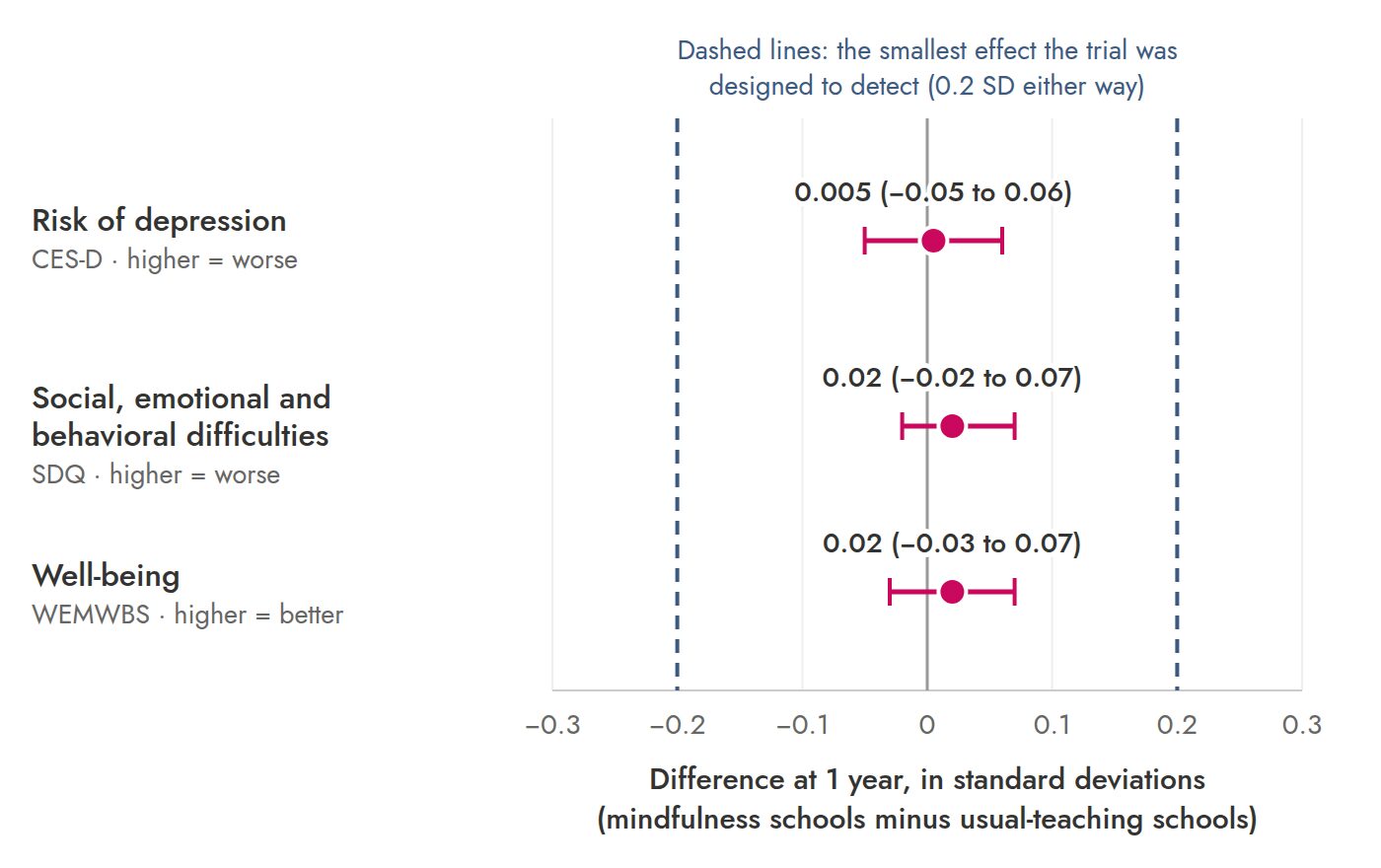
Because the trial was so large, these intervals are narrow. This is not a case of a small study failing to find an effect it couldn’t have seen. The authors put it plainly:
…we can rule out the possibility of important effects based on the 95% CIs.
The result was the same in both waves of schools, and in an analysis restricted to students with complete data. Over the year, average depression scores rose and well-being scores fell in both groups by about the same amount; the lessons did not change that course. The authors conclude that their findings “do not support the superiority” of school-based mindfulness training over usual teaching, and they draw a pointed lesson for schools:
This has significant implications for policy and for schools where the enthusiasm for SBMT has led to implementation ahead of the evidence.
(SBMT is the paper’s abbreviation for school-based mindfulness training.)
Miscellaneous Interesting Takeaways
Students Were Lukewarm and Rarely Practiced
Students rated how acceptable they found the lessons at 4.7 out of 10 on average, with answers bunched at both extremes and in the middle. Home practice, which the course encouraged, was low: an average of 1.16 out of 5 just after the course and 0.83 out of 5 a year later. The authors suggest that ten lessons may not be intensive enough to build the attention and self-regulation skills the program aimed at, especially when most students didn’t practice. They also wonder whether mindfulness, which asks people to notice their own thoughts and feelings, suits older adolescents better than 11- to 14-year-olds.
A Few Secondary Measures Were Slightly Worse in the Mindfulness Schools
Of 28 secondary outcomes, five favored the usual-teaching schools. Students in mindfulness schools reported a little more hyperactivity and inattention just after the course and a year later. Just after the course they also reported slightly higher panic and obsessive-compulsive scores on an anxiety questionnaire and slightly lower mindfulness skills. At one year, their teachers rated them as having slightly more emotional symptoms. All of these differences were small, and the authors describe the students as doing worse “although marginally.” The other secondary outcomes, including overall anxiety, self-harm, suicidal thoughts, drug and alcohol use, and executive function, showed no difference. The authors offer one possible explanation for the worse scores:
It is possible in this setting, with this curriculum and these teachers, this can exacerbate difficulties, at least for some students.
They suggest that a universal program might help some students and harm others, a pattern that an average across thousands of students could hide. In adults, too, a study of an 8-week mindfulness course found that unpleasant experiences during practice were common. No serious adverse events were linked to the lessons: the only two recorded were in teachers and were judged unrelated to the training.
School Climate Didn’t Change Either
Students also rated their school’s climate: its leadership and student involvement, how respectful it felt, relationships with peers, and whether adults cared about them. None of these differed between the groups, either just after the course or a year later. A separate MYRIAD paper reports the outcomes for teachers and for schools as a whole.
“Cost-Effective” Rests on Small Differences
The mindfulness training cost £70.73 per student. Over the year, students in the mindfulness schools had slightly higher total costs for health, social care and school support and slightly more QALYs. Neither difference was significant: £6.84 per student (−£128.04 to £141.72) and 0.012 QALYs (−0.015 to 0.038). Using QALYs, the training had an 83% probability of counting as cost-effective at the thresholds used by the National Institute for Health and Care Excellence (NICE). The abstract leads with that figure. But the authors note that it rests on small differences, and judged by the three primary outcomes instead, the probability of cost-effectiveness was below 40%.
Usual Teaching Was a Demanding Comparison
All the control schools already ran structured social-emotional lessons, and the trial asked whether mindfulness added anything to them. In practice, mindfulness was added on top of existing lessons for 53% of classes, replaced other lessons for 23%, and partly did both for 19%. The authors acknowledge that they might have found an effect against schools with no such teaching at all. Only 85 schools made it from 5,663 approached to randomization, and schools rated inadequate were excluded. The authors also note that teachers may not be ideally placed to teach mindfulness, since it calls for an approach quite unlike ordinary classroom teaching.
The lead author directs the Oxford Mindfulness Centre, and one of the senior authors formerly directed it; both receive royalties from books on mindfulness. Here the trial’s result went against the program they tested.
Final Reflection
MYRIAD is a well-run, large and well-powered trial with a clear answer. Ten mindfulness lessons, taught well by trained teachers to whole classes of 11- to 14-year-olds, did not improve depression risk, social-emotional functioning or well-being a year later compared with the schools’ existing social-emotional teaching. The confidence intervals rule out anything more than a very small effect either way. That doesn’t mean mindfulness can’t help young people. The trial tested one universal curriculum, in one age group, against an active comparison, and it couldn’t look beyond a year. And many students had mixed views of the lessons and rarely practiced.
The authors’ own conclusion is to stop asking whether school mindfulness works in general and ask “What works, for whom, and how?” They suggest that mindfulness for this age group might do better aimed at points of clear need, such as exam stress, a setting where a course offered to university student volunteers did ease distress, and that it should address students’ motivation to practice. They also make a point about asking students to take part at all: schools should not ask students to do something they don’t like or engage with when there are no clear benefits. For a program that spread through schools on the strength of small studies, this is the largest test of its kind so far, and it is a sobering one.
Citation
Kuyken, W., Ball, S., Crane, C., Ganguli, P., Jones, B., Montero-Marin, J., Nuthall, E., Raja, A., Taylor, L., Tudor, K., Viner, R. M., Allwood, M., Aukland, L., Dunning, D., Casey, T., Dalrymple, N., De Wilde, K., Farley, E.-R., Harper, J., Kappelmann, N., Kempnich, M., Lord, L., Medlicott, E., Palmer, L., Petit, A., Philips, A., Pryor-Nitsch, I., Radley, L., Sonley, A., Shackleford, J., Tickell, A., Blakemore, S.-J., The MYRIAD Team, Ukoumunne, O. C., Greenberg, M. T., Ford, T., Dalgleish, T., Byford, S., & Williams, J. M. G. (2022). Effectiveness and cost-effectiveness of universal school-based mindfulness training compared with normal school provision in reducing risk of mental health problems and promoting well-being in adolescence: The MYRIAD cluster randomised controlled trial. Evidence-Based Mental Health, 25(3), 99–109. 10.1136/ebmental-2021-300396
Get the next summary by email
One or two new paper summaries every couple of weeks, sent to your inbox when they go up.
No spam, and you can unsubscribe at any time. Prefer a feed reader? Use the RSS feed.