
Background Information
Dementia researchers have long looked for everyday habits that might lower risk. Trials of lifestyle programs have tried exercise, diet, brain training and heart-health advice. But depression, stress and anxiety, which are also linked to dementia, had not been targeted directly. Meditation, which trains attention and
emotion regulation
Emotion regulation is the set of ways people influence which emotions they have, when they have them, and how they experience and express them. Psychologist James Gross’s process model groups the strategies into five families: choosing situations, changing situations, shifting attention (attentional deployment), changing how one thinks about a situation (reappraisal), and changing one’s response, such as suppressing an expression.
More on Wikipedia
Read more in the glossary
, seemed a natural candidate.
The brain-imaging case for it was promising but thin. Studies in younger adults have tied meditation to changes in frontal and limbic areas, and a recent meta-analysis named the
insula
The insula is a region of cortex folded deep inside each side of the brain. It helps represent the body’s internal state (interoception) and is involved in emotion, empathy and compassion. Its front part, the anterior insula, comes up often in meditation research.
More on Wikipedia
Read more in the glossary
and the
anterior cingulate cortex
The anterior cingulate cortex (ACC) is a strip of cortex on the inner surface of each frontal lobe, curving around the front of the corpus callosum. It is involved in monitoring conflicts and errors, regulating attention and emotion, and processing pain, and it often turns up in brain-imaging studies of meditation.
More on Wikipedia
Read more in the glossary
(ACC) as the regions most sensitive to meditation training. Both are also especially vulnerable to aging. Two
cross-sectional studies
A cross-sectional study measures a group of people at a single point in time. It can show which things tend to go together, but not which came first or whether one causes the other.
More on Wikipedia
Read more in the glossary
had found that older expert meditators had better-preserved brains in regions including these two than non-meditators, but one-time comparisons like these can’t show that meditation caused the difference. Trials in older adults were scarce, as the authors put it:
Studies on meditation in elderly populations are sparse, with high risk of bias, and there are no randomized clinical trials (RCTs) with large samples.
The three existing trials with brain scans had used 8-week courses and reported conflicting results. Age-Well, part of the European Medit-Ageing project, was designed to give a far longer course a much tougher test.
What They Did
The researchers recruited adults aged 65 and over in Caen, France. All were native French speakers, retired for at least a year, living independently, scoring in the normal range on cognitive tests and free of major neurological or psychiatric illness. None had regular meditation experience, and none spoke fluent English. Of 157 people screened, 137 were enrolled between 2016 and 2018 (average age 69.4; 61% women).
In this
randomized controlled trial
A Randomized Controlled Trial is a scientific study design that randomly assigns participants to either an experimental group receiving an intervention or a control group, allowing researchers to measure the true effect of the intervention while minimizing bias.
More on Wikipedia
Read more in the glossary
, each person was assigned at random to one of three groups:
- Meditation: a secular program designed for the study, combining
mindfulness
Mindfulness is the psychological process of purposely bringing one’s attention to experiences occurring in the present moment without judgment. It involves maintaining awareness of thoughts, feelings, bodily sensations, and surrounding environment with an attitude of curiosity and acceptance. In meditation contexts, mindfulness practices typically involve focusing attention on the breath or body sensations as anchors to the present moment while acknowledging and releasing distracting thoughts.
More on Wikipedia
Read more in the glossary with loving-kindness Loving-kindness meditation (mettā in Pali) is a Buddhist practice of deliberately cultivating warm, unconditional goodwill. Practitioners silently repeat wishes such as “may you be happy” or picture a person, usually starting with themselves or someone close and then extending the wishes to acquaintances, strangers, difficult people and all beings. It is one of the four brahmaviharas.
More on Wikipedia
Read more in the glossary and compassion meditation - English lessons: an
active control
An active control group is a comparison group that takes part in a different program designed to be just as engaging as the one being tested. In meditation research, it might involve exercise, music, or education classes with the same time commitment, teachers, and expectations of benefit. Comparing against an active control helps separate the effects of meditation itself from the general effects of joining a course.
More on Wikipedia
Read more in the glossary of comprehension, writing and speaking exercises, built to match the meditation course in length, class time, homework and number and expertise of teachers - No intervention: a passive control group asked to carry on living as before
Both courses lasted 18 months, with a 2-hour group class each week, at least 20 minutes of practice at home every day, and one 5-hour intensive day. The investigators and the staff who measured the outcomes did not know who was in which group.
Before and after the 18 months, everyone had an MRI scan, used to measure
gray matter
Gray matter is brain tissue made up mostly of nerve cell bodies and their connections. It forms the brain’s outer layer (the cortex) and several deeper structures. Structural MRI can estimate gray matter volume (how big a region is), density (how concentrated the tissue is), and cortical thickness (how deep the outer layer is).
More on Wikipedia
Read more in the glossary
volume, and a
PET
Positron emission tomography (PET) is a brain-imaging method that tracks a small amount of a weakly radioactive tracer injected into the blood. Depending on the tracer, PET can map how much sugar brain tissue uses, how much blood reaches it, or where particular molecules, such as the amyloid deposits seen in Alzheimer disease, have built up. It shows slow, steady processes rather than moment-to-moment activity.
More on Wikipedia
Read more in the glossary
scan. The PET scan used a tracer called florbetapir. Later in the scan it shows deposits of amyloid, one of the Alzheimer disease risk factors the trial tracked, but its first few minutes of signal reflect blood flow (perfusion), which is closely tied to how much energy the brain tissue uses. The authors note that this early signal “remains a surrogate marker” of perfusion and glucose use.
The trial was planned around four main comparisons, each a
region of interest
In brain imaging, a region of interest (ROI) is an area chosen in advance for testing, such as the amygdala or hippocampus, usually because earlier research points to it. Limiting the main test to one region means fewer statistical comparisons, so real effects there are easier to detect. The trade-off is that the test says nothing about the rest of the brain, so ROI studies often add a separate, exploratory whole-brain search.
More on Wikipedia
Read more in the glossary
test set in advance. Meditation was compared with no intervention on ACC volume and perfusion, because the authors expected both courses to affect the ACC, which is considered a signature of cognitive reserve and has been found to resist aging better in people who speak two languages. Meditation was compared with English lessons on insula volume and perfusion, because they expected only meditation to affect the insula, given its role in emotion and empathy. To guard against false positives across four tests (
multiple comparisons
The multiple comparisons problem arises when researchers run many statistical tests at once. Each test has a small chance of a false positive, so across thousands of tests, such as one for every point in a brain scan, some “significant” results will turn up by chance alone. Corrections raise the bar for significance to keep the overall false-positive rate down, at the cost of making small real effects harder to detect.
More on Wikipedia
Read more in the glossary
), each result had to reach p < .0125 rather than the usual .05. The main secondary outcome was a self-report score combining attention regulation, socioemotional skills and self-knowledge, compared between meditation and English.
One Big Result: Meditation Didn’t Significantly Change Volume or Blood Flow in the Target Regions
Retention was exceptional for an 18-month trial. One participant was excluded after randomization for failing an eligibility rule, and only one other didn’t finish: a participant in the no-intervention group who died of a heart attack unrelated to the study. The analysis followed the
intention-to-treat analysis
An intention-to-treat analysis counts every randomized participant in the group they were assigned to, whether or not they completed or even started the treatment. It keeps the benefit of randomization, since dropping people who didn’t follow their plan can leave groups that differ in other ways, and it estimates what happens when a treatment is offered in practice rather than when it is taken exactly as intended.
More on Wikipedia
Read more in the glossary
principle, keeping everyone in the group they were assigned to.
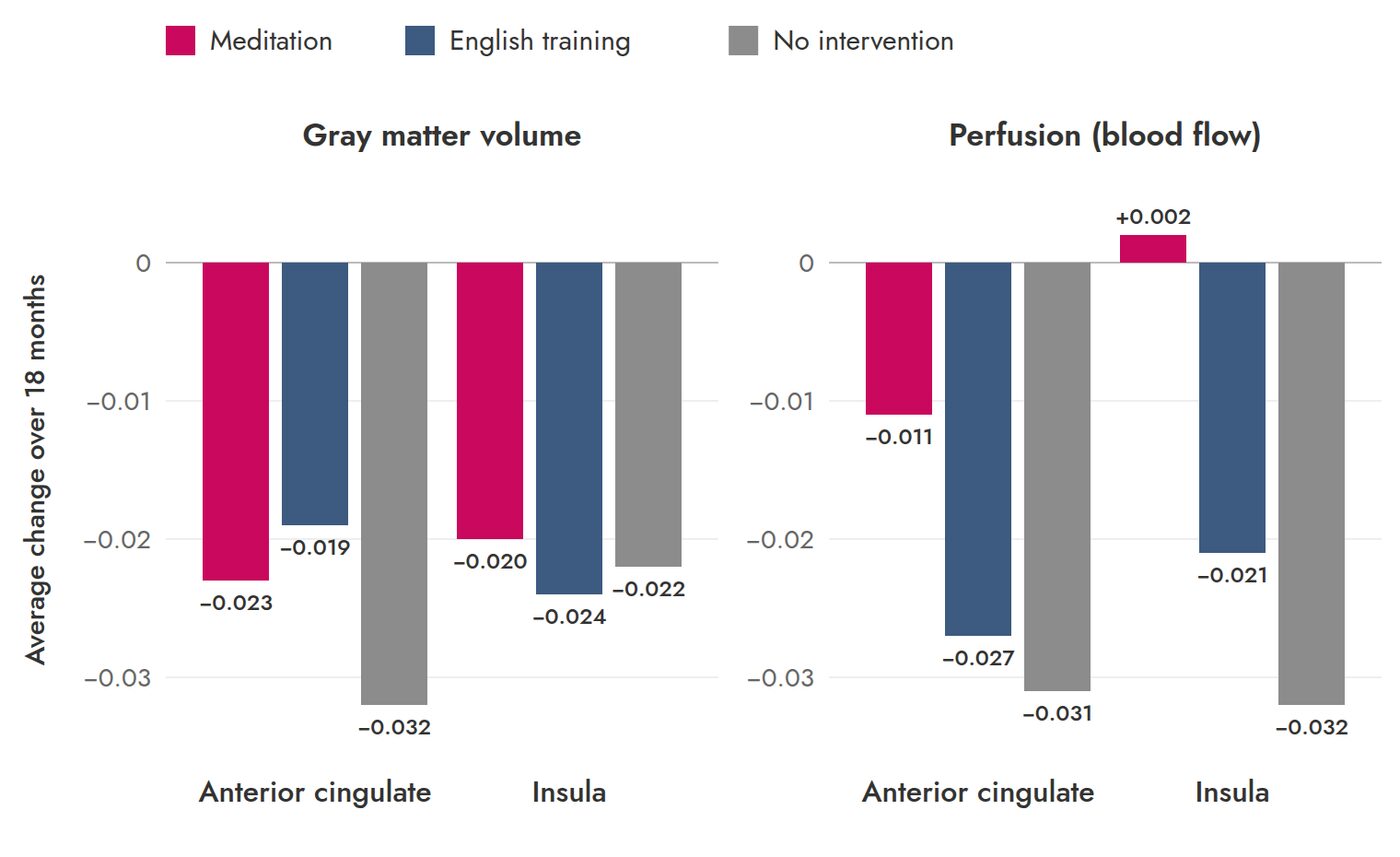
Over the 18 months, gray matter volume in both regions fell in all three groups, and meditation didn’t change that significantly. Compared with no intervention, meditation made no significant difference to ACC volume (difference 0.01, 98.75%
confidence interval
A confidence interval is the range of values that a study’s data are consistent with, given the uncertainty that comes from measuring a limited sample. A 95% confidence interval for an effect of 0.30 running from 0.00 to 0.59, for example, means the true effect could plausibly be anywhere from nothing to moderate. Narrower intervals mean more precise estimates; an interval that includes zero means the study can’t rule out no effect.
More on Wikipedia
Read more in the glossary
−0.02 to 0.05; p = .36). Compared with English lessons, it made no significant difference to insula volume (difference 0.01, −0.02 to 0.03; p = .58).
Perfusion came closer. Blood flow held up better in the meditation group in both regions, but neither difference met the trial’s threshold: for the ACC against no intervention, 0.02 (−0.01 to 0.05; p = .06), and for the insula against English lessons, 0.02 (−0.01 to 0.05; p = .09). The results looked much the same when the team handled missing data differently, limited the analysis to people who attended at least a fifth of their classes, or split participants by Alzheimer disease risk factors (the APOE ε4 gene, amyloid in the brain, or a family history of dementia).
The authors’ summary is plain:
Findings also show positive behavioral effects of meditation that were not reflected on volume, and not significantly on perfusion, of target brain areas.
This is a well-designed null result. The trial was randomized, long, tested against both an active and a passive control, measured blind, and lost almost no one. It found no evidence that 18 months of meditation preserved the volume of the two regions it targeted, and only a non-significant hint for blood flow.
Miscellaneous Interesting Takeaways
Older Brains May Be Harder to Change
Why no effect on volume, when these are supposedly the regions most responsive to meditation? The authors’ first suggestion is that 18 months may not be enough to alter how these regions age:
Meditation might alter volume in younger and more plastic brains but not halt the age- and disease-related brain volume decreases at older ages.
They also offer a more sobering reading of the earlier cross-sectional findings. The bigger brains seen in older expert meditators (for example, a shallower drop in gray matter across ages in one comparison) might reflect practice when they were younger, decades of intense practice, or other differences between the groups, such as lifestyle. And they note that the null result fits a large, rigorously controlled trial that found eight weeks of
MBSR
Mindfulness-Based Stress Reduction (MBSR) is a program designed to help individuals cope with stress, pain, and illness. Developed by Jon Kabat-Zinn in the 1970s, it combines meditation and yoga to promote awareness and stress management. The eight-week program teaches participants to focus on the present moment non-judgmentally, enhancing their ability to manage difficulties.
More on Wikipedia
Read more in the glossary
didn’t change brain structure in adults aged 25 to 66 (Kral et al., 2022).
The Perfusion Near-Miss, Read With Care
The authors point out that the perfusion differences, though small (0.023 for the ACC and 0.022 for the insula), could represent a substantial gain compared with the decline in the no-intervention group (0.031 in both regions). Assuming a steady decline, they calculate a 74% and 71% reduction in the rate of loss, which “could translate into about 13 months less loss” over the intervention. They suggest a bigger sample or longer follow-up might have produced a significant effect. That is a hypothesis for future trials, not a finding: by the trial’s own pre-set standard, the perfusion differences were not significant, and the measure itself is an indirect one.
The Trial Was Probably Too Small for Subtle Effects
The team sized the trial to detect an
effect size
Effect size is a statistical concept that quantifies the magnitude or strength of a relationship, difference, or intervention outcome. Unlike p-values which only indicate statistical significance, effect sizes measure how meaningful a result is in practical terms. Common measures include Cohen’s d (standardized mean difference), correlation coefficients (r), and odds ratios. In meditation research, effect sizes help quantify the practical impact of different meditation practices on psychological or physiological outcomes.
More on Wikipedia
Read more in the glossary
of 0.75, drawn from a 2014 meta-analysis of meditation and brain structure (Fox et al., 2014). They now think that figure was probably inflated: the meta-analysis mixed before-and-after studies with one-time comparisons of long-term experts, and
publication bias
Publication bias arises when studies with positive or striking results are more likely to be published than studies that find nothing. A meta-analysis that pools only published studies can then overestimate how well a treatment works. Researchers check for it with tools such as funnel plots and Egger’s test, which need a reasonable number of studies to be informative.
Read more in the glossary
, weak methods in earlier studies and general biases in brain imaging all tend to exaggerate effect sizes. In their words, they “may have been underpowered to observe a smaller but still clinically significant effect.” In other words, the trial may have lacked the
statistical power
Statistical power is the chance that a study will detect an effect of a given size if that effect is real. It rises with the number of participants and with the size of the effect: a small study may have good power to detect a large effect but little power to detect a modest one. A study with low power can miss a real effect, so a non-significant result from it is weak evidence that no effect exists.
More on Wikipedia
Read more in the glossary
to detect a smaller effect. The sample was also unusually healthy and well educated, the authors note, which left little room for improvement.
Meditators Reported Better Attention and Socioemotional Skills
On the main secondary outcome, meditation beat English lessons. The global self-report score rose more in the meditation group (Cohen’s d 0.52, 95% confidence interval 0.19 to 0.85; p = .002), as did the attention regulation subscore (0.38; p = .009) and the socioemotional subscore (0.31). The text gives p = .01 for the socioemotional result and Table 2 gives p = .02; either way it is significant by the usual standard. The self-knowledge subscore fell short (0.28; p = .06).
The pattern differed by subscore. Attention regulation rose only after meditation. Socioemotional scores barely moved in the meditation group but fell in the English group, so the authors read that difference as meditation maintaining these skills rather than raising them. They tie the composite score to a framework of trainable dimensions of well-being (Dahl et al., 2020).
These results need some caution. The secondary outcomes were defined after the trial began, chosen from a very large set of measures, and they rest on questionnaires filled in by people who knew which course they were taking.
Older Adults Stuck With It
Over the course, the meditation group attended an average of 62.0 of 72 classes, and the English group 57.9. No serious adverse event was judged to be related to either course. Of 170 adverse events recorded, 41 were serious, spread evenly across the groups (13 meditation, 15 English, 13 no intervention), and the 7 judged related to the study came from procedures such as scans that had to be redone. The paper doesn’t report how much home practice people actually did.
Final Reflection
Small early studies, such as one linking eight weeks of MBSR to denser gray matter in 16 people (Hölzel et al., 2011), helped popularize the idea that meditation reshapes the brain. Age-Well is a much sterner test: randomized, 18 months long, with an engaging matched course as a comparison, and almost no dropouts. Its answer for the two regions it targeted was no significant effect on volume, and a perfusion difference that leaned toward meditation without reaching significance.
That doesn’t rule out benefits elsewhere in the brain or in other measures, which the team plans to analyze, and the meditators did report gains in attention and socioemotional skills. But for anyone hoping that a meditation course late in life will measurably preserve brain tissue, this careful trial is a reason for caution. If such an effect exists, it is probably smaller than earlier studies suggested.
Citation
Chételat, G., Lutz, A., Klimecki, O., Frison, E., Asselineau, J., Schlosser, M., Arenaza-Urquijo, E. M., Mézenge, F., Kuhn, E., Moulinet, I., Touron, E., Dautricourt, S., André, C., Palix, C., Ourry, V., Felisatti, F., Gonneaud, J., Landeau, B., Rauchs, G., Chocat, A., Quillard, A., Ferrand Devouge, E., Vuilleumier, P., de La Sayette, V., Vivien, D., Collette, F., Poisnel, G., Marchant, N. L., & Medit-Ageing Research Group. (2022). Effect of an 18-month meditation training on regional brain volume and perfusion in older adults: The Age-Well randomized clinical trial. JAMA Neurology, 79(11), 1165–1174. 10.1001/jamaneurol.2022.3185
Get the next summary by email
One or two new paper summaries every couple of weeks, sent to your inbox when they go up.
No spam, and you can unsubscribe at any time. Prefer a feed reader? Use the RSS feed.