
Background Information
Does meditation make people more creative? By 2012, studies had given mixed answers. Some found a strong positive effect and others little or none. The authors of this study, psychologists at Leiden University, suspected the question was too broad. Both “meditation” and “creativity” cover several different things, and the studies had used different kinds of meditation and different kinds of people.
So they narrowed it down. On the meditation side, they compared the two main styles that researchers describe in Buddhist practice. In
focused attention
Focused attention is a style of meditation in which you keep your attention on one chosen object, such as the breath or a point in front of you, notice when the mind has wandered, and bring it back. It trains steady concentration, and Buddhist shamatha practice is a well-known example. Researchers often contrast it with open monitoring meditation.
Read more in the glossary
meditation, you hold attention on one object and keep bringing it back when it drifts. In
open monitoring
Open monitoring is a style of meditation in which attention isn’t fixed on any one object. You stay aware of whatever arises from moment to moment, such as sounds, sensations and thoughts, and let each come and go without reacting to it, holding on to it or pushing it away. Researchers often contrast it with focused attention meditation.
Read more in the glossary
meditation, attention isn’t fixed on anything: you stay open to whatever thoughts and sensations arise. (The S-ART framework on this site sets out the same distinction.)
On the creativity side, they used a distinction made by the psychologist J. P. Guilford.
Divergent Thinking
Divergent thinking is the side of creativity that produces many different ideas for an open-ended problem with no single right answer, as in brainstorming. It is often measured with the Alternate Uses Task, in which people list as many uses as they can for an everyday object such as a brick; answers are scored for how many there are, how many different categories they span and how unusual they are. The psychologist J. P. Guilford contrasted it with convergent thinking.
More on Wikipedia
Read more in the glossary
is producing many ideas where more than one answer is right, as in brainstorming.
Convergent Thinking
Convergent thinking is the side of creativity that homes in on the single best answer to a well-defined problem. It is often measured with the Remote Associates Test, in which people find one word that links three others (for example, “long” for time, hair and stretch). The psychologist J. P. Guilford contrasted it with divergent thinking, which generates many possible answers.
More on Wikipedia
Read more in the glossary
is homing in on the one right answer to a well-defined problem. The two are measured with different tasks, and the authors note that people’s scores on those tasks were uncorrelated in earlier work.
Their prediction tied the two together. Divergent thinking should benefit from loose control over attention, letting the mind “jump” from one thought to another. Convergent thinking should benefit from tight, focused control. If each style of meditation leaves the mind in the state it practices, open monitoring should help divergent thinking and focused attention should help convergent thinking.
What They Did
The participants were 19 healthy adults (13 women and 6 men, aged 30 to 56) who already practiced both focused attention and open monitoring meditation, for about 2.2 years on average. They volunteered without payment, apart from a Leiden University coffee mug.
Because everyone practiced both styles, the researchers used a
within-subject design
In a within-subject (or repeated-measures) design, every participant takes part in all of a study’s conditions, and their results under one condition are compared with their own results under the others. Because each person serves as their own comparison, it needs fewer participants than comparing separate groups. But the order of conditions can matter, through practice, fatigue or carry-over, so researchers vary the order across participants, and people may guess what is being compared.
More on Wikipedia
Read more in the glossary
: each person came for three 45-minute sessions, 10 days apart, and did a different 35-minute practice each time. The order of the sessions was varied across participants (counterbalanced with a Latin square), so that no practice always came first or last. The same certified instructor coached all three practices, with participants half-sitting on a mat, eyes closed.
- Focused attention: participants used the natural breath as an anchor to focus on particular parts of the body (“During the inhalation bring the attention to that particular area and exhale from there”).
- Open monitoring: an adapted version of Transformational Breath, a breathing practice in which the coach guides the person into a full, connected breathing pattern and invites them to observe and accept, without judgment, whatever thoughts, sensations and emotions come up. The coach also spoke affirmations such as “I am open” and “I let go.”
- Baseline: a guided visualization of household activities such as cooking and giving a dinner party, switching between picturing the activity and thinking about it (for example, “Think of who you would like to invite”), so that attention didn’t settle on any one thing.
Straight after each practice, participants spent 5 minutes on each of two creativity tests, with new items each session:
- The Alternate Uses Task, for divergent thinking: list as many uses as you can for a common household object (brick, shoe, newspaper, pen, towel, bottle; two objects per session). Answers were scored for fluency (how many), flexibility (how many different categories), originality (points for answers that few people gave) and elaboration (how much detail).
- The Remote Associates Test, for convergent thinking: find the one word that links three others, such as “long” for time, hair and stretch. They used a Dutch version, with 10 items per session.
Two scorers who didn’t know which session the answers came from marked both tests. Participants also rated how much their mood had risen, from 0 (not at all) to 5 (very much).
One Big Result: After Open Monitoring, They Listed More Ideas, in More Categories, and More Original Ones
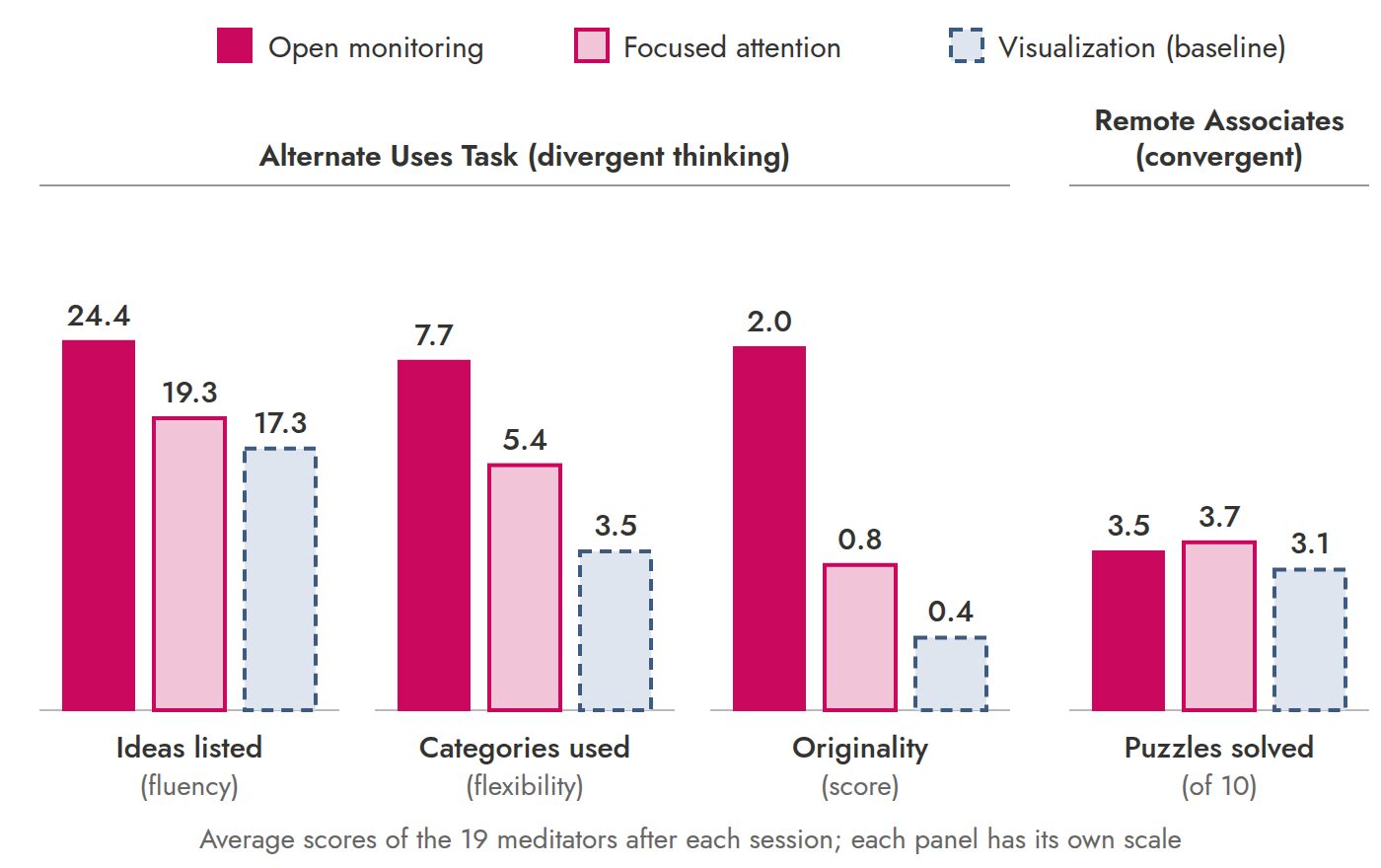
On the Alternate Uses Task, open monitoring came out ahead on all four scores, and the difference was statistically significant for three of them. After open monitoring, participants listed 24.4 uses on average, compared with 19.3 after focused attention and 17.3 after the visualization. Their ideas spanned 7.7 categories, against 5.4 and 3.5, and their originality score averaged 2.0, against 0.8 and 0.4. The
effect sizes
Effect size is a statistical concept that quantifies the magnitude or strength of a relationship, difference, or intervention outcome. Unlike p-values which only indicate statistical significance, effect sizes measure how meaningful a result is in practical terms. Common measures include Cohen’s d (standardized mean difference), correlation coefficients (r), and odds ratios. In meditation research, effect sizes help quantify the practical impact of different meditation practices on psychological or physiological outcomes.
More on Wikipedia
Read more in the glossary
(partial eta squared) ranged from 0.32 to 0.37.
Follow-up comparisons found that open monitoring beat both the baseline and focused attention on fluency, flexibility and originality. Elaboration, the amount of detail in each answer, was very low in every session (0.1 to 0.4) and didn’t differ significantly. The order of the sessions made no significant difference.
The baseline session also involved relaxing, lying on a mat and being guided by the same coach, so the authors argue that the advantage can’t simply be put down to those:
Importantly, it also suggests that the benefits of OM meditation go beyond mere relaxation and receiving attention from a supervisor, which participants also received in the other two conditions.
Their interpretation is that open monitoring loosens top-down control, leaving the mind in a state “that is less focused and ‘exclusive,’ which facilitates jumping from one thought to another – as required in divergent thinking.”
Miscellaneous Interesting Takeaways
Focused Attention Didn’t Help With the Word Puzzles
The second half of the prediction didn’t hold. Participants solved 3.7 of the 10 word puzzles after focused attention, 3.5 after open monitoring and 3.1 after the visualization, and these differences were not significant. The authors put it plainly:
Even though RAT performance was best after FA meditation, this increase was far from significant.
The paper’s abstract describes this as focused attention not sustaining convergent thinking.
Both Meditations Lifted Mood, Which Complicates the Picture
Mood rose much more after both meditations than after the visualization: on the 0-to-5 scale, the average was 4.3 after focused attention, 4.4 after open monitoring and 2.3 after the baseline, a significant difference. The authors had expected this. They cite their own earlier work finding that a better mood helps divergent thinking but not convergent thinking, and may even interfere with it.
That cuts two ways. It could partly explain why open monitoring beat the visualization. But mood rose about equally after focused attention, and open monitoring still beat focused attention on fluency, flexibility and originality, so mood alone doesn’t account for the difference between the two meditations. For the word puzzles, the authors suggest that focused attention may have helped convergent thinking while the lift in mood held it back, so that the two cancelled out. They call this “still a speculation that calls for further research, perhaps using more extended practice.”
The “Open Monitoring” Was a Breathing Practice With Affirmations
The open monitoring session wasn’t silent sitting. It was an adapted form of Transformational Breath, a technique developed in 1980, in which a coach guides a full, connected breathing pattern, invites the person to be open and repeats affirmations such as “I open and expand my consciousness.” The focused attention session also used the breath, but as an anchor for steady attention on the body. So the two practices differed in more than how attention was directed, and it’s not clear which part of the open monitoring session made the difference. The authors themselves suggest repeating the study with other open monitoring and focused attention practices.
Practitioners, Not Trainees
Despite the word “training” in the paper’s title, the study didn’t train anyone. It tested people who had already chosen to practice both styles, after one session of each. That made a within-subject comparison possible, but the authors acknowledge what it costs:
However, it needs to be mentioned that this design choice has the drawback that we cannot entirely exclude that self-selection and demand characteristics have biased our results.
In other words, these practitioners may differ from people in general (
self-selection
Self-selection bias arises when people decide for themselves whether to take part in a study, so those who do may differ from those who don’t in ways that affect the results. A survey advertised as being about the unwanted effects of meditation, for example, may draw more people who have had such effects, making them look more common than they are among meditators in general.
More on Wikipedia
Read more in the glossary
), and because they knew which practice they were doing, their expectations may have shaped how they performed (
demand characteristics
Demand characteristics are cues in an experiment that hint at what the researchers expect, which can lead participants to behave the way they think they are supposed to rather than how they normally would. Researchers reduce them by disguising the study’s purpose, measuring behavior unobtrusively, or using comparison conditions that seem just as plausible.
More on Wikipedia
Read more in the glossary
). The authors suggest that future studies train people new to meditation in one style or the other, to see whether the results hold.
Final Reflection
This small study made a simple point: “meditation” is not one thing. In 19 experienced practitioners, a session of open, unfocused awareness was followed by more, more varied and more original ideas than a session of focused attention or a guided visualization, while focused attention did nothing measurable for the single-answer word puzzles. Other work on this site has also found the two styles pulling apart, for example in how expert meditators responded to pain, and a nine-month training study found that four different practices each shifted the mind in their own way.
It also offers a different angle on attention. Much of the research in this theme asks whether meditation strengthens focused, goal-directed attention. Here the more useful state for generating ideas seemed to be a looser one, which the authors link to earlier findings, such as Slagter et al. (2007), that open monitoring practice helps people spread their attention more widely.
The limits are real, though. It was one session of each practice in 19 self-selected practitioners who knew what they were doing; the open monitoring practice was a coached breathing technique with affirmations; mood rose much more after the meditations than after the baseline; and only one of the two predictions came true. It is best read as an early, intriguing result about the immediate after-effects of a single session, not as evidence that practicing open monitoring makes people more creative over time.
Citation
Colzato, L. S., Ozturk, A., & Hommel, B. (2012). Meditate to create: The impact of focused-attention and open-monitoring training on convergent and divergent thinking. Frontiers in Psychology, 3, 116. 10.3389/fpsyg.2012.00116
Get the next summary by email
One or two new paper summaries every couple of weeks, sent to your inbox when they go up.
No spam, and you can unsubscribe at any time. Prefer a feed reader? Use the RSS feed.