
Background Information
The word
mindfulness
Mindfulness is the psychological process of purposely bringing one’s attention to experiences occurring in the present moment without judgment. It involves maintaining awareness of thoughts, feelings, bodily sensations, and surrounding environment with an attitude of curiosity and acceptance. In meditation contexts, mindfulness practices typically involve focusing attention on the breath or body sensations as anchors to the present moment while acknowledging and releasing distracting thoughts.
More on Wikipedia
Read more in the glossary
is used for many different things. It can mean a passing state of non-judgmental, present-moment attention, a lasting personality trait, a kind of meditation, or an eight-week course such as
MBSR
Mindfulness-Based Stress Reduction (MBSR) is a program designed to help individuals cope with stress, pain, and illness. Developed by Jon Kabat-Zinn in the 1970s, it combines meditation and yoga to promote awareness and stress management. The eight-week program teaches participants to focus on the present moment non-judgmentally, enhancing their ability to manage difficulties.
More on Wikipedia
Read more in the glossary
. By 2012 there were at least eight questionnaires measuring mindfulness as a trait, and their scores often didn’t agree with each other. That makes it hard to study: if researchers don’t agree on what mindfulness is, they can’t easily work out how it works.
David Vago and David Silbersweig, of the Functional Neuroimaging Laboratory in the psychiatry department of Brigham and Women’s Hospital in Boston, tried to bring order to this. Their paper is not a new study. It has no participants and no new data. It is a review that proposes a framework, called S-ART, and gathers evidence from brain imaging, psychology and Buddhist texts to support it. They summarize the core idea in the abstract:
Mindfulness is described through systematic mental training that develops meta-awareness (self-awareness), an ability to effectively modulate one’s behavior (self-regulation), and a positive relationship between self and other that transcends self-focused needs and increases prosocial characteristics (self-transcendence).
The framework puts the self at the center. It tries to join two traditions: a roughly 2,500-year-old Buddhist model of training the mind and the roughly 25-year-old clinical model that grew out of Jon Kabat-Zinn’s MBSR course. The authors argue that both aim to reduce suffering, and that both trace much of it to a distorted, biased sense of self.
What They Did
Starting point: a self that keeps reinforcing itself
The authors begin with a model of suffering borrowed from Aaron Beck’s cognitive theory of depression. People carry beliefs about themselves, their world and their future. Those beliefs bias what they notice and how they interpret it, and the biased experiences then confirm the beliefs. Over time this loop makes a fixed, often negative self-story feel solid and true. The authors compare it to “kindling”: each time the pattern runs, the vulnerability grows and the self-story becomes harder to change.
A key ingredient is biased attention. Someone prone to anxiety may be drawn quickly to anything threatening (hypervigilance), steer away from it (avoidance), or find it hard to let go once caught. The authors note that this last tendency is similar to what meditators call “mental stickiness.” Such biases are not only a feature of mental illness. The authors see them on a spectrum: most people have them to some degree, and even meditators with no risk of a disorder likely have subtler versions. On this view, mindfulness training is a way to notice and loosen these habits.
Three self-systems in the brain
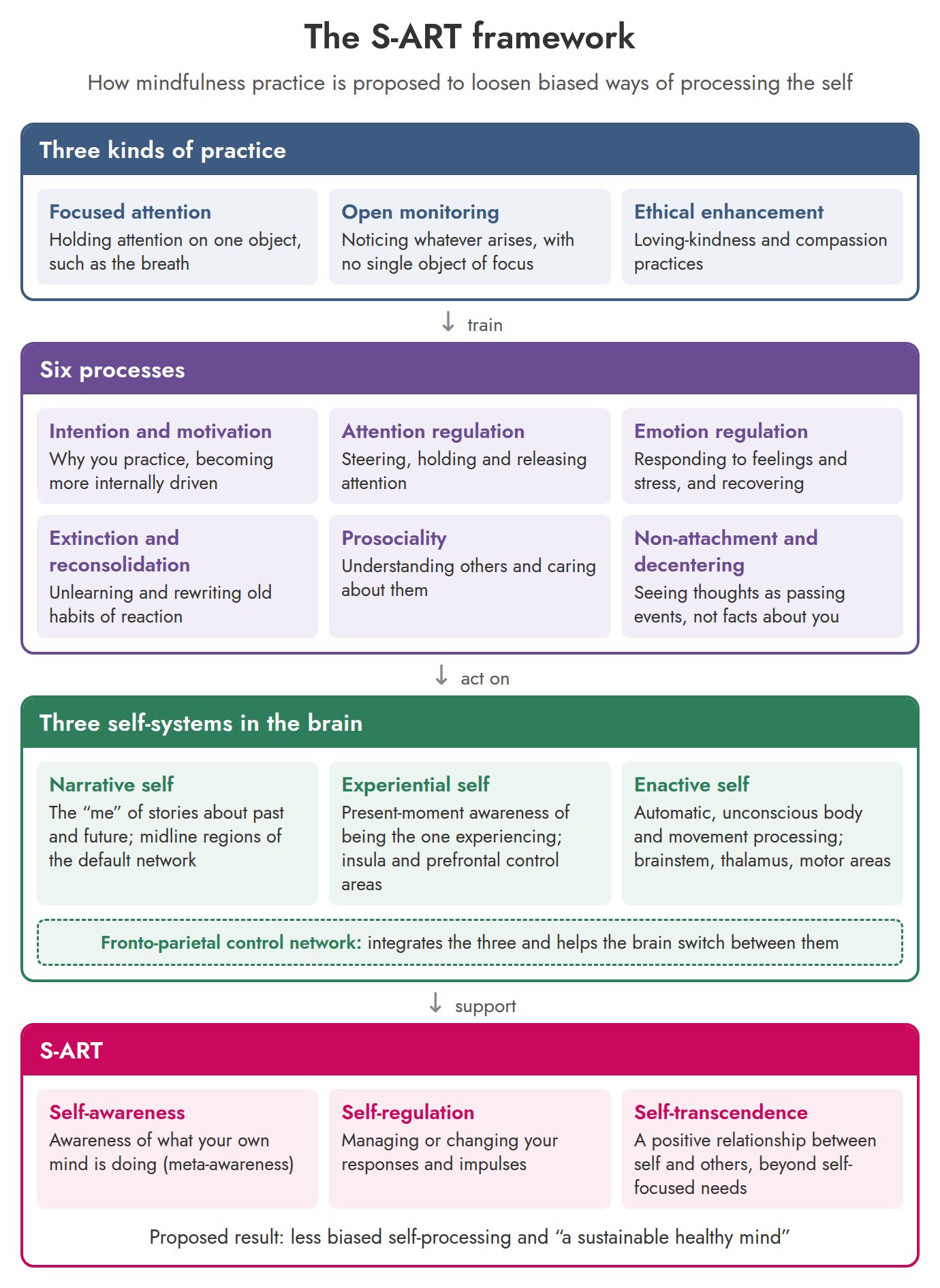
The framework then splits the self into three systems, each tied to brain networks. The authors say this is “a simplified parcellation,” not a complete account of the self.
- The narrative self is the “me” we think and tell stories about, the self that wonders “Am I a nice guy?” or decides “I have a bad memory.” It links the past and imagined future into a stable identity. The authors place it in midline brain regions that form part of the
default mode network (DMN)
The default mode network (DMN) is a system of connected brain areas that show increased activity when a person is not focused on what is happening around them, such as during daydreaming and mind-wandering. It can also be active when the individual is thinking about others or themselves, remembering the past, and planning for the future.
More on Wikipedia
Read more in the glossary , including the posterior cingulate cortex (PCC) The posterior cingulate cortex (PCC) is a region toward the back of the brain’s midline. It is a central hub of the default mode network and tends to be active during self-related thought and mind-wandering. Many meditation studies track PCC activity or connectivity as a window onto the DMN.
More on Wikipedia
Read more in the glossary and parts of the medial prefrontal cortex. When this network stays active during tasks that need outward attention, it is often linked with repetitive negative thinking Repetitive negative thinking is a habit of dwelling on problems and negative experiences, through worry about the future or rumination about the past, in a way that feels hard to stop and gets nowhere. It is common across many mental health problems, especially depression and anxiety. Researchers often measure it with the Perseverative Thinking Questionnaire.
More on Wikipedia
Read more in the glossary and rumination. - The experiential self is the sense of being the one having an experience, right now, without reflecting on it or judging it. The authors link it to the anterior
insula
The insula is a region of cortex folded deep inside each side of the brain. It helps represent the body’s internal state (interoception) and is involved in emotion, empathy and compassion. Its front part, the anterior insula, comes up often in meditation research.
More on Wikipedia
Read more in the glossary , which they describe, drawing on earlier work, as representing a “global emotional moment,” and to control regions such as the dorsolateral prefrontal cortex (dlPFC) The dorsolateral prefrontal cortex (dlPFC) is a region on the upper outer sides of the frontal lobes. It is a core part of the brain’s executive control network, supporting working memory, directing attention and regulating emotion. Stronger dlPFC activity and connectivity have been associated with lower pain, negative emotion and stress.
More on Wikipedia
Read more in the glossary and the dorsal anterior cingulate cortex The anterior cingulate cortex (ACC) is a strip of cortex on the inner surface of each frontal lobe, curving around the front of the corpus callosum. It is involved in monitoring conflicts and errors, regulating attention and emotion, and processing pain, and it often turns up in brain-imaging studies of meditation.
More on Wikipedia
Read more in the glossary . - The enactive self is the body’s automatic, mostly unconscious processing of the senses, movement and
interoception
Interoception is the sense of the body’s internal state: feeling your heartbeat, breathing, hunger, warmth, tension and other sensations from inside the body. Interoceptive awareness is how much attention a person pays to these signals. Practices such as the body scan, which moves attention through the body part by part, aim to strengthen it.
More on Wikipedia
Read more in the glossary (signals from inside the body, such as heartbeat and digestion). It runs through the brainstem, thalamus, hypothalamus, the back of the insula and motor regions.
The narrative system and the systems that handle outward, task-focused attention tend to work in opposition: when one is active, the other tends to quiet. The authors add a fourth piece, a fronto-parietal control network (the network also known as the
central executive network
The central executive network (also called the frontoparietal control network) is a set of brain regions in the lateral prefrontal and parietal cortex, including the dorsolateral prefrontal cortex. It is active during demanding, goal-directed tasks, supporting working memory, directing attention and regulating emotion, and it tends to work in opposition to the default mode network.
More on Wikipedia
Read more in the glossary
). They propose that it integrates the three self-systems and helps the brain shift between them.
Three kinds of practice and six processes
The authors focus on three styles of meditation. In focused attention practice, you hold attention on one object, such as the breath, and bring it back when it wanders. In open monitoring, you notice whatever arises (sights, sounds, sensations, thoughts) without settling on any one object. Ethical enhancement practices, such as
loving-kindness meditation
Loving-kindness meditation (mettā in Pali) is a Buddhist practice of deliberately cultivating warm, unconditional goodwill. Practitioners silently repeat wishes such as “may you be happy” or picture a person, usually starting with themselves or someone close and then extending the wishes to acquaintances, strangers, difficult people and all beings. It is one of the four brahmaviharas.
More on Wikipedia
Read more in the glossary
and compassion meditation, deliberately cultivate warmth toward oneself and others. Traditional loving-kindness practice moves from oneself to a good friend, a neutral person, a difficult person, all four equally, and gradually the entire universe.
For each style, the authors sketch a step-by-step model of what the mind does during practice. Early on, practice takes effort. With experience, the effort is predicted to fall, and awareness itself becomes something the practitioner can notice, a skill called
meta-awareness
Meta-awareness is awareness of what the mind is doing as it happens: noticing that you are having a thought, feeling an emotion or have drifted into mind wandering, rather than simply being caught up in it. It is a form of metacognition. Mindfulness practices train it directly, for example each time a meditator notices the mind has wandered and brings attention back.
More on Wikipedia
Read more in the glossary
.
From these models they draw six processes that are trained together and that, they propose, support S-ART: intention and motivation, attention regulation, emotion regulation, extinction and reconsolidation (unlearning old habits of reaction), prosociality, and non-attachment and decentering.
This is a narrative review. The authors don’t say how they chose the studies they cite, don’t rate their quality and don’t pool their results. Most of the brain studies they draw on are small, and many compare experienced meditators with non-meditators at a single point in time. That kind of
cross-sectional study
A cross-sectional study measures a group of people at a single point in time. It can show which things tend to go together, but not which came first or whether one causes the other.
More on Wikipedia
Read more in the glossary
can’t show that meditation caused a difference, because people who choose to meditate for years may differ in other ways. The authors declared no commercial or financial conflicts of interest.
One Big Result: Six Trainable Processes May Loosen a Biased Sense of Self
The paper’s central proposal is that mindfulness works by reducing biases in how we process the self. It does this, the authors argue, by training six processes that together build self-awareness, self-regulation and self-transcendence, and by changing how the narrative, experiential and enactive self-systems work together.
An important part of the proposal is that mindfulness doesn’t simply switch off the narrative self. A few meditation studies have reported less activity in the narrative self network during tasks, and less
mind wandering
Mind wandering is the spontaneous shift of attention away from a current task or external environment to internally generated thoughts, memories, or fantasies. This common cognitive process is associated with default mode network activation and has been extensively studied in relation to meditation practices, which often aim to reduce mind wandering.
More on Wikipedia
Read more in the glossary
, which fits a later study from Judson Brewer’s lab: in meditators, but not in non-meditators, default mode activity was lower during meditation than during a thinking task. But some studies have also found the narrative network more closely connected with control regions in meditators. The authors read this as better coordination: mindfulness may help the brain switch to whichever network suits the moment. They are clear that this is a hypothesis:
The evidence suggests state-dependent activation and integration of task positive and task negative networks support reduction of self-specific biases and may contribute to a sustainable healthy mind; however, such hypotheses need to be further tested.
The strength of the evidence differs a lot from one process to the next.
Intention and motivation
Why you practice matters. The authors propose that as practice advances, motivation becomes more internally driven and less focused on outcomes, and that wanting to engage with experience “without craving or aversion” supports self-regulation. They link motivation to prefrontal regions and to reward circuits such as the ventral striatum. But they say there “has yet to be extensive investigation” of motivation in meditation research. Among the few direct findings they cite is a brain-scanning (PET) study that found more dopamine released in the ventral striatum during Yoga Nidra meditation, along with a reported “decrease desire for action.”
Attention regulation
Attention is broken into parts: alerting, orienting toward a target, staying on it, noticing distraction, letting go and coming back. Studies using the
Attention Network Test
The Attention Network Test (ANT) is a short computer task that measures three aspects of attention at once: alerting (getting ready for something about to happen), orienting (moving attention to a location) and executive attention (resolving conflict). People press a key to show which way a central arrow points while arrows on either side point the same way or the opposite way, and cues signal when and where the arrow will appear. Subtracting reaction times between kinds of trials gives a score for each.
More on Wikipedia
Read more in the glossary
found differences between experienced meditators and controls, and changes after MBSR and after retreats. Five days of integrative body–mind training (IBMT) improved executive attention. A three-month retreat sharpened perceptual discrimination and vigilance, and another three-month retreat shrank the attentional blink while participants’ brains spent fewer resources on the first of two targets.
The authors read these as signs that skilled attention becomes less effortful. In one study, expert meditators with 10,000 to 24,000 hours of practice showed more activity than novices in the left dlPFC during focused meditation, while those with 37,000 to 52,000 hours showed less than either group. The results aren’t uniform, though. More meditation experience went with less interference on the Stroop color-word task in one study, but another found no such effect after an eight-week MBSR course.
Emotion regulation
The authors propose that beginners rely on deliberate strategies, such as rethinking a situation, while advanced practitioners rely more on simply noticing and labeling feelings as they come and go. Labeling emotions has been shown to reduce activity in the
amygdala
The amygdala is a pair of almond-shaped structures deep in the brain’s temporal lobes. It plays a central role in processing emotion, especially threat and fear. Meditation studies often look at how strongly the amygdala responds to emotional images, and sometimes at its size.
More on Wikipedia
Read more in the glossary
. In one study of experienced Zen meditators, lower pain sensitivity went with weaker connections between brain regions for evaluating pain and those that register it, as if the meditators were taking in the sensation without the usual layer of judgment. Those with the most experience showed the largest drops in activity in evaluative and emotional regions.
The authors also predict that mindfulness helps the body handle stress, and they cite studies of meditators’ physiology, including an MBSR trial in which participants made more antibodies to a flu vaccine. But they add that meditation’s effects on the body’s automatic regulation are “an aspect of self-regulation that needs further investigation.”
Extinction and reconsolidation
In
extinction
In psychology, extinction is the fading of a learned reaction when its trigger stops predicting what it used to, for example when a place once linked with danger is repeatedly experienced as safe. Extinction doesn’t erase the original memory; it adds new learning that competes with it, which is why old fears can return. Exposure therapies for anxiety rely on it.
More on Wikipedia
Read more in the glossary
, a learned reaction fades when its trigger stops predicting what it used to. It doesn’t erase the old association; it lays down new learning that competes with it.
Memory reconsolidation
Memory reconsolidation is the process by which a memory, when recalled, briefly becomes changeable before it is stored again. During that window it can be updated, weakened or linked to new associations. Researchers study it as a way to change emotional memories, for example in anxiety and addiction.
More on Wikipedia
Read more in the glossary
is the window in which a recalled memory can be changed before it is stored again. The authors propose that mindfulness uses this same machinery to rewrite habitual reactions about the self, through repeated, calm, nonreactive exposure to whatever arises.
The evidence is indirect, and the authors say “relatively few studies have explored this possibility.” It rests mainly on structural changes in brain regions involved in extinction, such as the
hippocampus
The hippocampus is a curved structure deep in each temporal lobe of the brain. It is essential for learning and forming new memories, and it also helps regulate emotion and the stress response. It can change with experience, and it tends to be smaller in people with long-term depression or post-traumatic stress disorder.
More on Wikipedia
Read more in the glossary
, amygdala and medial prefrontal cortex. Some of these come from
cross-sectional studies
A cross-sectional study measures a group of people at a single point in time. It can show which things tend to go together, but not which came first or whether one causes the other.
More on Wikipedia
Read more in the glossary
of meditators. Others come from small before-and-after studies, such as one that found denser gray matter in the hippocampus after an eight-week course (a later, much larger trial did not replicate it) and one in which people whose stress fell most showed the largest drops in amygdala gray matter density. The authors also say “the dosage and quality of meditation time required for such change remains unclear.”
Prosociality
Self-transcendence, in this framework, means a relationship with others that goes beyond self-focused needs. The authors propose that training care for others may soften the line between self and other. They point to brain regions for understanding others’ minds (
theory of mind
Theory of mind is the ability to work out what another person thinks, believes or intends. It is also called mentalizing or cognitive perspective-taking. It is usually distinguished from empathy, which involves sharing another person’s feelings rather than reasoning about their thoughts.
More on Wikipedia
Read more in the glossary
), such as the
temporoparietal junction (TPJ)
The temporoparietal junction (TPJ) is the area where the brain’s temporal and parietal lobes meet, toward the back and side of the head. It helps combine signals from the body and senses into a sense of where the self is, and it is central to theory of mind: working out what other people think and intend.
More on Wikipedia
Read more in the glossary
, and to regions for sharing others’ feelings, such as the anterior insula. In one study they describe, expert meditators generating compassion showed a stronger response in the right anterior insula to sounds of human distress, compared with other sounds, than novices did.
Later studies on this site take up the same questions. In a 2013 randomized trial, two weeks of compassion training made people more generous to a stranger. And a small EEG study of loving-kindness practitioners looked for a smaller brain bias toward one’s own face, a possible sign of a softer line between self and other, and found only hints of one.
Non-attachment and decentering
Decentering means stepping back from your thoughts and seeing them as passing events rather than facts about who you are. The authors’ example contrasts thinking “I am worthless” with recognizing “I am having the thought that I am worthless.” Non-attachment, in the Buddhist sense they draw on, means letting go of mental fixations, including fixation on a solid, unchanging self.
These processes are central to the framework’s account of the self, but the authors are candid that the brain evidence is missing:
Laboratory studies of mindfulness-based meditation practices have yet to identify biological correlates for the psychological constructs of decentering and non-attachment.
They point to a few hints, such as changes in how a part of the medial prefrontal cortex connects with body-sensing regions during attention to inner sensations. Later studies have tried to look at this directly, for example by recording the brains of experienced meditators as they set aside the sense of self.
Miscellaneous Interesting Takeaways
“Mindfulness” Originally Meant Remembering
The English word was one of the first translations of the Pali word sati, which literally means “memory.” The authors note that Buddhist accounts tie mindfulness closely to memory as well as attention: keeping something in mind without forgetting or getting distracted. Fittingly, the framework gives memory processes, such as extinction and reconsolidation, a central role.
Meditators Don’t Seem to Feel Their Heartbeat Better
Many meditators report being more aware of their bodies, but the authors note “a paucity of good evidence” that they actually are. In one study, advanced Tibetan and Kundalini practitioners with more than 15 years of practice were no better than non-meditators at detecting their own heartbeat. The authors suggest heartbeat detection may simply not capture the kind of body awareness meditation trains, which future studies would need to test.
The Raincoat and the Towel
The authors offer two metaphors for how mindfulness might protect against stress. The “raincoat effect” is protection: not getting soaked by a stressor in the first place. The “towel effect” is recovery: drying off quickly once you have gotten wet. In this view, smaller stress responses to harmless cues and a quicker return to baseline after real threats should show up in stress hormones and immune signaling molecules. They cite studies in which experienced meditators’ skin conductance fell back faster after unpleasant stimuli or their startle responses were smaller.
The Authors Flag What Isn’t Known
The conclusion lists gaps that remain open: how the networks change over time in the same people, how much practice is needed, and whether people can even report accurately on the quality of their practice. The authors also call it “critical” to study the adverse effects of long-term practice, which they say typically go unnoticed in clinical trials but are more common on longer retreats. Later research has taken this up. A study of people taking mindfulness courses found that over half reported at least one unpleasant effect.
Many of the Brain Findings Are Small and Early
The paper names the dlPFC, the anterior cingulate cortex and the insula as the three most widely cited brain areas in meditation research. Much of that evidence came from small studies comparing long-term meditators with non-meditators. A later meta-analysis of 21 such brain-structure studies found differences in a handful of regions, including the insula, but they were modest and possibly overstated.
Final Reflection
S-ART doesn’t show that mindfulness changes the self. What it offers is a map: it breaks a vague idea into three skills, lists the processes thought to train them, and ties each to brain systems that can be measured. That turns “does meditation work?” into sharper questions, such as which practice trains which process, and which brain changes go with which experiences.
Read that way, its value lies as much in what it marks as unknown as in what it claims. The attention evidence was the most developed when it was written. The ideas closest to the self, that meditation rewrites old habits of reaction and loosens identification with thoughts, were mostly hypotheses, and the authors said so. Much of the later research on meditation and the self, including several studies on this site, has been an effort to test the kind of claims this framework laid out.
Citation
Vago, D. R., & Silbersweig, D. A. (2012). Self-awareness, self-regulation, and self-transcendence (S-ART): A framework for understanding the neurobiological mechanisms of mindfulness. Frontiers in Human Neuroscience, 6, 296. 10.3389/fnhum.2012.00296
Get the next summary by email
One or two new paper summaries every couple of weeks, sent to your inbox when they go up.
No spam, and you can unsubscribe at any time. Prefer a feed reader? Use the RSS feed.