
Background Information
Much of the early science of meditation looked at attention, thinking and the brain. Yet in Buddhist tradition, as this paper points out, a primary goal of meditation is to increase virtuous states and behavior. More recently, researchers have begun testing that directly. In one study, two weeks of compassion training made people give more money to a stranger who had been treated unfairly (Weng et al. 2013). In another, by the same lab as this paper (Condon et al. 2013, not covered on this site), people who took an eight-week course in either
mindfulness
Mindfulness is the psychological process of purposely bringing one’s attention to experiences occurring in the present moment without judgment. It involves maintaining awareness of thoughts, feelings, bodily sensations, and surrounding environment with an attitude of curiosity and acceptance. In meditation contexts, mindfulness practices typically involve focusing attention on the breath or body sensations as anchors to the present moment while acknowledging and releasing distracting thoughts.
More on Wikipedia
Read more in the glossary
or compassion meditation were more likely to help a stranger in pain, even when other people nearby did nothing, a situation known to make helping less likely.
David DeSteno’s group at Northeastern University followed up with two questions. The first was about mechanism:
Does meditation increase compassionate responding because it enhances empathic accuracy (i.e., the ability to correctly infer what another is feeling) or is there a different route?
The second was about scale. Most people can’t attend a meditation course taught by an expert, so the team asked whether the same benefit could come from a smartphone app.
The study changed three things from the 2013 experiment. That study compared meditators with a waiting list; this one gave the comparison group an
active control
An active control group is a comparison group that takes part in a different program designed to be just as engaging as the one being tested. In meditation research, it might involve exercise, music, or education classes with the same time commitment, teachers, and expectations of benefit. Comparing against an active control helps separate the effects of meditation itself from the general effects of joining a course.
More on Wikipedia
Read more in the glossary
, a brain-training app, since simply doing any regular activity might change people’s mood or motivation. Instruction came from an app, Headspace, designed by someone with Buddhist monastic training, rather than from a Buddhist lama. And the meditation was mindfulness only, with no compassion practice. The authors’ reason was
demand characteristics
Demand characteristics are cues in an experiment that hint at what the researchers expect, which can lead participants to behave the way they think they are supposed to rather than how they normally would. Researchers reduce them by disguising the study’s purpose, measuring behavior unobtrusively, or using comparison conditions that seem just as plausible.
More on Wikipedia
Read more in the glossary
: compassion training explicitly urges people to attend to others’ feelings and act kindly, so kinder behavior afterward might partly reflect people guessing what the researchers hoped to see.
What They Did
Sixty-nine Northeastern undergraduates with no meditation experience signed up for what they were told was a three-week study of “mind training and cognitive skills.” They earned course credit and an entry in a lottery for a $100 gift voucher. Each was randomly assigned to one of two apps, both used on their own:
- Mindfulness meditation (Headspace). Fourteen guided sessions from the app’s “Take 10” and “Take 15” programs, averaging 12 minutes each. The sessions taught focusing on an object such as the body or the breath, watching the activity of the mind, noticing
mind-wandering
Mind wandering is the spontaneous shift of attention away from a current task or external environment to internally generated thoughts, memories, or fantasies. This common cognitive process is associated with default mode network activation and has been extensively studied in relation to meditation practices, which often aim to reduce mind wandering.
More on Wikipedia
Read more in the glossary , and taking a non-judgmental attitude toward experience. They made no mention of loving-kindness or compassion. After each session, participants took a short quiz on its content. - Brain training (Lumosity). Fourteen sessions of five mini-games for memory, attention, speed, flexibility and problem solving, about 10 minutes each, followed by a short questionnaire about how tired and attentive they had been.
Everyone was asked to do one session a day, 14 in all, within three weeks. Because the researchers had set up the accounts, they could check each person’s progress every day, and they sent reminder emails in the first two weeks. Six people dropped out, and seven more were excluded for completing fewer than 12 of the 14 sessions. That left 56 (30 women, 26 men; average age 19.4): 27 in the meditation group and 29 in the brain-training group.
After the three weeks, each participant came back to the lab alone, supposedly for tests of cognitive ability. The real test came first, in a public waiting area in the hallway outside the lab. There were three chairs, two already taken by men who were in fact confederates, actors working for the researchers, so the participant took the last free seat. After a minute, a woman came around the corner on crutches, wearing a large walking boot. She walked with some difficulty, wincing, stopped by the chair farthest from the participant, sighed audibly and leaned against the wall as if she too were waiting for an experiment. The two seated men ignored her. Once she was in place, one of them started a timer. The scene ended when the participant offered her their seat, or after two minutes without help. The only outcome recorded was whether or not the participant gave up the seat.
The two indifferent men turned this into a version of the
bystander effect
The bystander effect is the finding that people are less likely to help someone in need when other people are present, especially when those others do nothing. Each person may feel less responsible, or take the others’ inaction as a sign that help isn’t needed. Experiments often recreate it with actors who are told to ignore the person in need.
More on Wikipedia
Read more in the glossary
situation, in which people are less likely to help when others around them do nothing. In the 2013 study the seated actors were women; using men here was meant to test whether the effect held up with different bystanders.
Inside the lab, participants then took the Emotion Recognition Index, a test of
empathic accuracy
Empathic accuracy is how well a person can correctly infer what someone else is thinking or feeling. Researchers often measure it with tests that ask people to identify the emotion shown in photographs of faces, recordings of voices or videos, and score how many they get right. It is a skill of perception, distinct from caring about the other person’s feelings.
More on Wikipedia
Read more in the glossary
. It has 60 items: 30 photographs of faces and 30 recordings of non-verbal vocal expressions, each scored for whether the participant correctly recognized the emotion expressed. Scores run from 0 (none right) to 1 (all right). Participants weren’t told about the staged scene until the whole study had ended, by email, to avoid raising suspicion among those still to be tested.
One Big Result: The Meditation Group Gave Up Their Seat More Than Twice as Often
Ten of the 27 meditators (37%) gave their seat to the woman on crutches, compared with 4 of the 29 brain trainers (14%). The difference was statistically significant (χ²(1, N = 56) = 4.03, p < .05), with a modest
effect size
Effect size is a statistical concept that quantifies the magnitude or strength of a relationship, difference, or intervention outcome. Unlike p-values which only indicate statistical significance, effect sizes measure how meaningful a result is in practical terms. Common measures include Cohen’s d (standardized mean difference), correlation coefficients (r), and odds ratios. In meditation research, effect sizes help quantify the practical impact of different meditation practices on psychological or physiological outcomes.
More on Wikipedia
Read more in the glossary
(φ = .27).
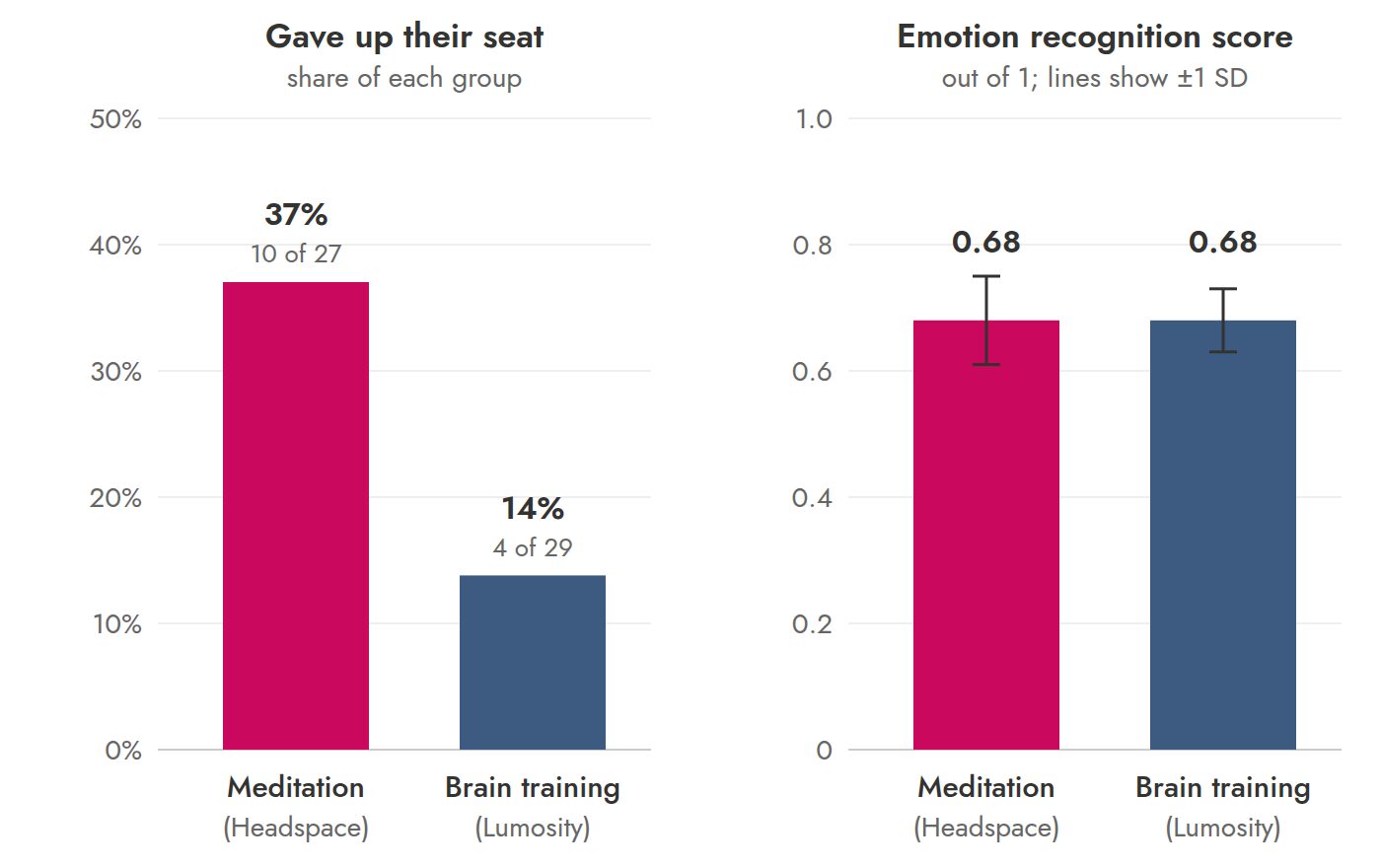
One worry with an active control is that the control activity itself might make people less helpful, making meditation look good by comparison. The authors addressed this by pointing out that the brain-training group’s helping rate, 14%, was close to the 16% seen in the waiting-list group of their 2013 study, so they read the meditators’ higher rate as a genuine increase over the norm. As in 2013, men and women did not differ in how often they helped.
The numbers are small, though. Only 14 people helped in total, and the test statistic corresponds to a p-value just under the conventional .05 cutoff: had one fewer meditator, or one more brain trainer, given up their seat, the difference would have fallen short of significance. The paper’s description of the study as “a robust replication” of the 2013 result is fair in direction, since the finding came out the same way under a stricter design, but on its own this single small experiment can’t pin down how big the effect is. The paper’s “23% increase in helping” is the difference in percentage points (37% minus 14%).
Miscellaneous Interesting Takeaways
Reading Emotions Better Didn’t Explain the Kindness
The two groups scored exactly the same on the Emotion Recognition Index (both averaged 0.68). They also matched on its voice part (0.66 each) and were close on its face part (0.69 for the meditators, 0.71 for the brain trainers), with no significant differences. So the meditators weren’t helping because they had become better at reading what others feel:
That is, increased motivations to relieve the suffering of others did not stem from a concomitant sharpening of skills in reading the emotions of others.
That conclusion comes with caveats. Emotion recognition was measured only after training, and after the seat test, so there is no before-and-after change to compare. A test of labeling emotions in photos and recordings is also a narrow slice of empathy, and a study of 56 people can’t rule out a small difference. The paper didn’t test whether individuals’ scores related to whether they helped. The authors themselves note that longer training might change empathic abilities; their point is only that such a change isn’t needed for mindfulness to make people more helpful.
What might explain it instead? The authors suggest, without testing, that mindfulness could increase attention to everything in one’s surroundings (citing the three-month retreat study that found sharper perception and sustained attention), or reduce emotional biases toward oneself. They speculate that compassion meditation may work differently, through empathy and caring emotions.
Mindfulness With No Mention of Kindness
Because the Headspace sessions never mentioned compassion and participants believed the study was about cognitive skills, it’s harder to argue that the meditators simply worked out that they were supposed to be kind. The test also took place in a hallway, before the “experiment” officially began, rather than as a task in the lab. The paper doesn’t report asking participants afterward whether they suspected the woman on crutches was part of the study, though.
An App Instead of a Teacher
The finding that a commercial app produced a similar effect to an in-person course led the authors to suggest that meditation could be a scalable way to build a more compassionate society. Headspace gave the researchers free use of the app, and the authors state that none of them had any financial relationship with the company and that it had no role in the research. They also added a note of caution:
Of note, however, such investigation need also consider the potential of deleterious side effects that might arise from extended meditation practice that does not include the ability for dynamic, personalized give-and-take between an instructor and pupil…
They mention, for example, the need to watch for mental health problems arising from difficulty regulating emotions. Later research on unwanted effects of meditation has looked at how often such experiences occur.
What the Design Leaves Open
- One act, once. Helping was measured with a single opportunity, shortly after training. The study can’t say whether the effect lasts, or whether it extends to other kinds of kindness.
- Who was counted. Thirteen of the 69 who enrolled (19%) were left out: six dropped out and seven did fewer than 12 sessions. The paper doesn’t say how many came from each group. Analyzing only those who completed the training, rather than everyone randomized (an
intention-to-treat analysis
An intention-to-treat analysis counts every randomized participant in the group they were assigned to, whether or not they completed or even started the treatment. It keeps the benefit of randomization, since dropping people who didn’t follow their plan can leave groups that differ in other ways, and it estimates what happens when a treatment is offered in practice rather than when it is taken exactly as intended.
More on Wikipedia
Read more in the glossary ), can leave groups that differ in ways other than the training. - Who took part. All were undergraduates at one university, earning course credit. The person in pain was always a woman and the bystanders were always men; the authors note it’s unknown what would happen with a man in pain.
- What the control controls for. Brain-training games are a credible daily activity, but they differ from guided meditation in many ways, such as how calm or relaxed they leave people. The comparison shows the app made a difference; it can’t single out which ingredient did it.
Final Reflection
This short paper adds a practical twist to a striking finding. In the 2013 study, an eight-week course with a Buddhist teacher made people more likely to help a stranger in pain. Here, about three hours of a mindfulness app spread over three weeks seemed to do something similar, against a comparison group that also spent its time on a daily app, and without any instruction in compassion. The meditators weren’t better at reading emotions, which suggests the change lay in their readiness to act rather than in noticing what the woman felt.
The evidence is still thin: one small experiment, one act of helping, with only 14 helpers in all and a result just past the usual statistical threshold. Alongside Weng et al.’s compassion-training study, it fits a growing picture in which brief meditation practice, even without explicit kindness training, can nudge people toward helping. Larger studies with longer follow-up and several kinds of helping are needed to show how strong and lasting that nudge is.
Citation
Lim, D., Condon, P., & DeSteno, D. (2015). Mindfulness and compassion: An examination of mechanism and scalability. PLOS ONE, 10(2), e0118221. 10.1371/journal.pone.0118221
Get the next summary by email
One or two new paper summaries every couple of weeks, sent to your inbox when they go up.
No spam, and you can unsubscribe at any time. Prefer a feed reader? Use the RSS feed.