
Background Information
Buddhism teaches
anattā
Anattā, usually translated as “no-self” or “non-self”, is the Buddhist teaching that there is no permanent, unchanging self or soul. What we take to be a self is, on this view, a changing stream of bodily sensations, feelings, perceptions, thoughts and awareness. Buddhist traditions hold that clinging to the sense of a lasting self is a root of suffering, and that seeing through it brings freedom from that suffering.
More on Wikipedia
Read more in the glossary
, or no-self: there is no lasting, unchanging self, only a changing stream of bodily and mental events. Buddhist philosophers have long argued that this matters for how we face death. If no self persists even from one day to the next, there is nothing for death to destroy, and the fear of dying, which rests on the illusion of a lasting self, should lose its grip. The Western philosopher Derek Parfit argued along similar lines in Reasons and Persons (1984): coming to believe that there is no unitary, enduring self should change our practical attitudes, including our regard for others and our fear of death.
That is a claim about psychology, and it can be tested. Shaun Nichols, Nina Strohminger, Arun Rai and Jay Garfield, working with the Central University of Tibetan Studies in India, asked whether people whose religious tradition denies a lasting self actually fear death less. They compared groups whose traditions teach very different things about the self. Christianity holds that a soul survives the body. Hinduism holds that an unchanging soul, the atman, passes from one life to the next. Tibetan Buddhism holds that there is no self to survive at all.
This is not a meditation study. Nobody was taught to meditate, and the paper didn’t measure anyone’s practice. It is included here because it tests a belief that meditation traditions hope to instill, among people trained in that tradition, and because the authors’ explanation of its result separates believing there is no self from no longer feeling like one.
What They Did
Who Took Part
The study surveyed five populations:
- Tibetan Buddhist monastics from monasteries in Bylakuppe and Mundgod, India. The authors refer to them as monks and nuns, and in one figure caption as “monastics-in-training.” The paper doesn’t report their ages, how long they had lived in the monastery, or how much they meditated. In their conclusion, the authors state that none of the participants they studied were long-term meditators.
- Lay Tibetans living in northern India.
- Bhutanese Tibetan Buddhists, in Bhutan.
- Orthodox Hindus from around Varanasi, India.
- Americans recruited online through Amazon Mechanical Turk, analyzed as Christians and as nonreligious (atheist, agnostic, “spiritual but not religious” or none).
In addition, 30 senior Tibetan monastic scholars answered some of the questionnaires not for themselves but “the way that a good Buddhist ought to.” Their answers serve as a benchmark for what the doctrine predicts.
Not everyone answered every questionnaire: each participant filled in a packet of several, so each measure had its own, partly overlapping sample. The self questions went to 520 people, including 60 monastics. The fear of death scale went to 1,585 people, including 300 monastics, 300 Hindus, 200 lay Tibetans, 99 Bhutanese and 695 Americans. The trade-off task went to 1,181 people (240 monastics, 240 Hindus and 701 Americans); lay Tibetans and Bhutanese didn’t do it. Questionnaires were written in English, translated into Standard Tibetan, Hindi or Dzongkha by bilingual assistants, checked by independent translators and tested on people who spoke only the local language.
What They Were Asked
Beliefs about the self. Participants rated how connected they felt to the person they expected to be in 1 week, 1 year and 5 years, thinking of their personality, beliefs, values and goals, from 0 (“I will be completely different in the future”) to 100 (“I will be exactly the same”). They also rated, from 1 to 7, how much they agreed that “There is some essential core that is your self that stays exactly the same throughout your life,” and that their core self would be exactly the same in a year.
Coping with death. A checklist of 10 reasons not to fear death included one that states the Buddhist doctrine: “There is no self that stays the same across time anyway.” Participants ticked every reason that applied to them.
Fear of death. The Fear of Personal Death scale asks, in 31 items, what would frighten people about dying a year from now. Its items group into six
factors
Factor analysis is a statistical method for finding a smaller number of underlying dimensions, called factors, behind answers to many questions. Questions that people tend to answer in similar ways are grouped onto the same factor. Researchers choose how many factors to keep and name them by the questions that load on each, so the result involves judgment as well as arithmetic.
More on Wikipedia
Read more in the glossary
: loss of self-fulfillment, loss of social identity, consequences for family and friends, transcendental consequences, punishment in the hereafter, and self-annihilation. The authors focused on self-annihilation, the fear that Buddhist teaching targets most directly. Its four items include “Dying 1 year from now frightens me because of the loss and destruction of the self.” Answers were scored from 1 to 7, with higher numbers meaning more fear; the four items hung together well (
Cronbach’s alpha
Cronbach’s alpha is a measure of how consistently a set of questionnaire items measures the same thing, based on how strongly people’s answers to them go together. It runs from 0 to 1; values of about 0.7 or higher are usually considered acceptable for research.
More on Wikipedia
Read more in the glossary
0.84).
Generosity with one’s own life. Participants imagined having a terminal disease that would kill them in 6 months. A single dose of medicine would give them 6 more months. If they didn’t take it, it would go to a stranger “very much like you” with the same condition. They then made 10 choices, in which the medicine would extend the stranger’s life by anything from “1 month or less” to “more than 5 years.” Each time they kept the medicine counted as one point, so a score of 10 meant keeping it even if it would give the stranger 5 or more years.
Groups were compared with pairwise tests, corrected for
multiple comparisons
The multiple comparisons problem arises when researchers run many statistical tests at once. Each test has a small chance of a false positive, so across thousands of tests, such as one for every point in a brain scan, some “significant” results will turn up by chance alone. Corrections raise the bar for significance to keep the overall false-positive rate down, at the cost of making small real effects harder to detect.
More on Wikipedia
Read more in the glossary
.
One Big Result: The Monastics Who Most Denied a Lasting Self Feared Its End the Most
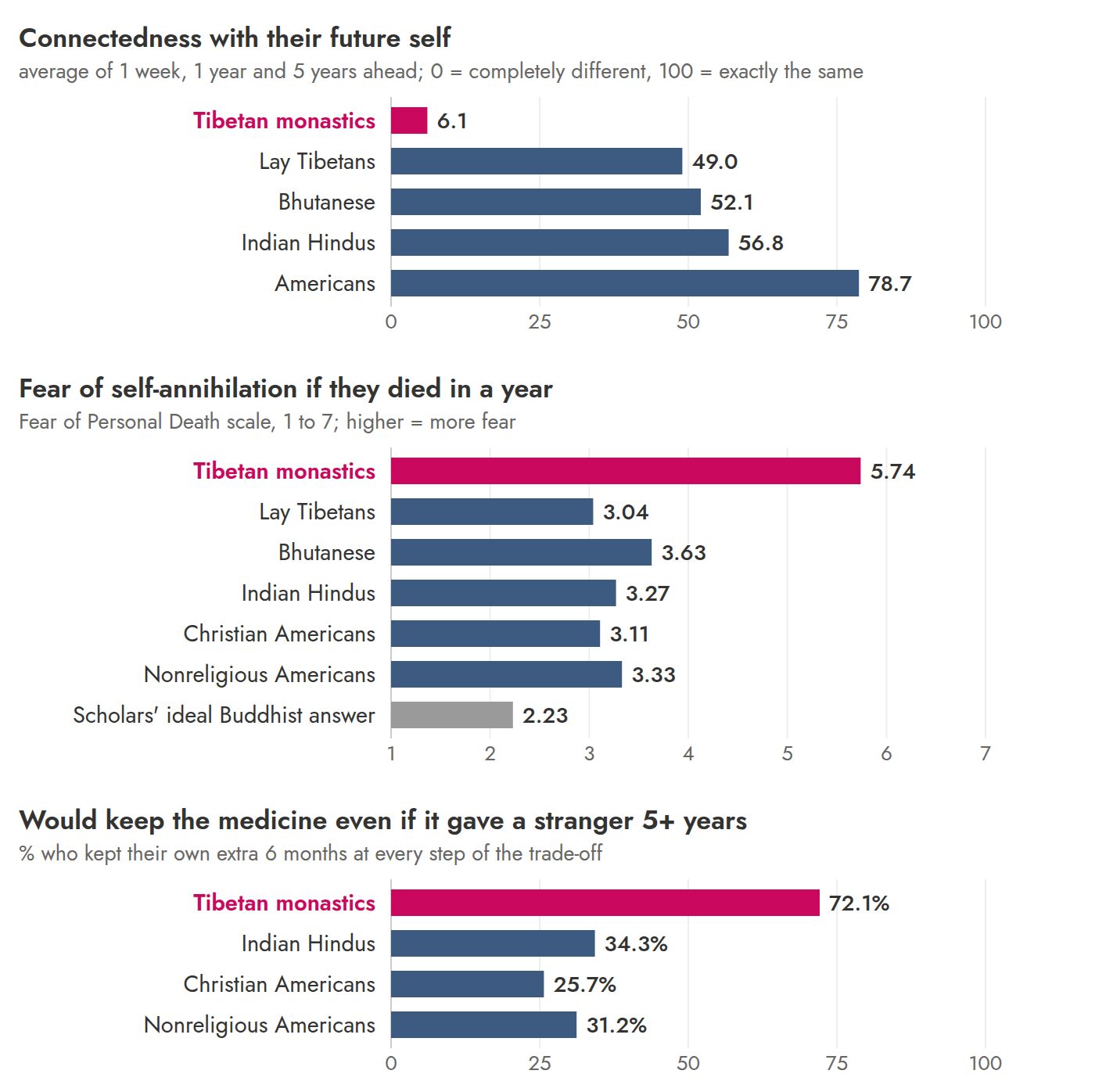
On every measure of the self, the monastics stood out as the doctrine predicts. Their average connectedness with their future self was 6.1 out of 100, against 49.0 for lay Tibetans, 52.1 for Bhutanese, 56.8 for Hindus and 78.7 for Americans. Asked about 5 years ahead, every monastic answered zero. They also rejected a lasting core self (1.71 on the 1–7 scale), close to the scholars’ ideal Buddhist answer (1.53) and far below Hindus (5.38) and Americans (5.45), with lay Tibetans (3.11) and Bhutanese (2.99) in between. And 95% of monastics said that “there is no self that stays the same across time anyway” helps them face death, about the same as the 90% of scholars who said a good Buddhist should, compared with 75% of Bhutanese, 67% of Hindus, 45% of lay Tibetans, 9% of nonreligious Americans and no Christian Americans.
The researchers therefore predicted that the monastics would fear death least. They found the opposite. The monastics scored 5.74 out of 7 on fear of self-annihilation, far higher than every other group, none of which differed significantly from each other: Bhutanese 3.63, nonreligious Americans 3.33, Hindus 3.27, Christian Americans 3.11 and lay Tibetans 3.04. The scholars, answering as a good Buddhist should, put the ideal at 2.23. The authors write:
It is particularly striking that even nonreligious Westerners reported much less fear of self-annihilation than the monastic Buddhists we studied.
Miscellaneous Interesting Takeaways
The Monastics Were Also the Least Willing to Give Up Time for a Stranger
Buddhist philosophers such as Śāntideva hold that seeing through the self should also make people less self-centered and more willing to give. In the medicine trade-off, the monastics were the most likely to keep the medicine. On a standardized (Z) scale, their scores averaged 0.67, against −0.15 for Hindus, −0.24 for Christian Americans and −0.18 for nonreligious Americans; the other three groups didn’t differ from each other. Most strikingly, 72.1% of monastics said they would keep their extra 6 months even if the medicine would give the stranger 5 years or more, compared with 34.3% of Hindus, 25.7% of Christian Americans and 31.2% of nonreligious Americans. Because so many monastics chose the most self-favoring answer available, the authors note that the task can’t show how far their preference goes, and may understate the gap.
The authors consider two alternative readings. The monastics might simply be more honest about what they would really do, though that would mean all three other groups were less honest, which the authors see no reason to suspect, and it isn’t obvious which answer looks better. Or the monastics might value their own lives more because they expect to contribute more to the world than a randomly chosen stranger. The authors say neither can be ruled out without further studies, for example of real behavior, or with a fellow Buddhist as the stranger.
Their Overall Fear of Death Was Not Higher
The difference was specific to the fear that the self will be destroyed. Across all six kinds of fear in the scale combined, the monastics’ scores were indistinguishable from most other groups, differing significantly only from the Hindus and from the scholars’ ideal answer. The breakdown by factor is in the paper’s supplementary material.
Belief in an Afterlife Doesn’t Explain It
One possible explanation would be that the monastics simply believe less in life after death, so death seems more final to them. But on a 1–7 question about belief in life after death, the monastics reported no less belief than the other religious groups.
Age Mattered Only for Non-Buddhists
Older Hindus, Christian Americans and nonreligious Americans were less afraid of self-annihilation than younger ones. Among the Buddhist groups, monastic or lay, age made no reliable difference.
How the Authors Explain the Paradox
The authors think a chance result is unlikely, partly because the monastics came from two separate monasteries and mainly because the fear and trade-off results pointed the same way. They also consider whether the monastics don’t really believe the no-self teaching. They think there may be something to this, but urge caution: the monastics endorsed no-self on every measure, and the doctrine is as central to Buddhism, they write, as the belief that Jesus is the son of God is to Christianity.
Their preferred explanation is that a sense of self survives the belief that there is none:
We think that it is because, despite their training and explicit claims, they retain a powerful sense of personal identity across the biological lifespan.
They locate that sense in
episodic memory
Episodic memory is memory for particular events you lived through, such as your last birthday, recalled with a sense of when and where they happened and of re-experiencing them. It differs from semantic memory, which stores general facts. Episodic memory is closely tied to imagining one’s own future, and both are thought to help give people a sense of being the same person over time.
More on Wikipedia
Read more in the glossary
and in imagining one’s future: remembering an experience makes it feel like your experience, however much you have changed since. (Philosophers call this remembered, story-like self the narrative self; a review of meditation and psychedelics explains how it differs from the more basic, bodily sense of being a self.) As an example, they point to Tibetan Buddhist autobiographies, including The Life of Milarepa, whose author recalls finding his mother’s bones with overwhelming grief, hardly the detached report of someone who feels no continuity with his past self.
The authors then suggest that the no-self teaching may succeed in undermining belief in a self that continues between lives, while the felt sense of a self within this life holds firm. If so, death would mean the end of the only self the monastics still believe in, a more final prospect than Christians and Hindus face, since they expect a soul to survive. They note that this fits a traditional Buddhist distinction between “philosophical” self-grasping, a belief that reflection can remove, and “innate” self-grasping, which is said to yield only to prolonged meditation:
None of the participants we studied were long-term meditators (Tsongkhapa, 1991), and one important question for future research will be whether highly experienced practitioners of meditation would in fact show reduced fear of self-annihilation.
What the Study Can’t Say
This was a
cross-sectional study
A cross-sectional study measures a group of people at a single point in time. It can show which things tend to go together, but not which came first or whether one causes the other.
More on Wikipedia
Read more in the glossary
of self-reported attitudes, so it shows how groups differed, not why. The groups differed in many ways besides belief about the self, including culture, education, way of life and how they were recruited (in person in Asia, online in the US). The self measures and the fear measure came from partly different people, with only 60 monastics answering the self questions, and the paper doesn’t report whether the individuals who most denied a lasting self were the ones who feared death most. The trade-off was hypothetical. And it covered one tradition, Tibetan Buddhism as practiced in exile in India and in Bhutan; the authors call for studies of other Buddhist traditions.
Final Reflection
The headline result is easy to misread as “meditation makes people fear death more.” The study doesn’t show that. It didn’t measure meditation, and by the authors’ own account the monastics weren’t long-term meditators. What it shows is that holding the no-self doctrine firmly, firmly enough to match senior scholars’ ideal Buddhist answers on the core self and on using no-self to face death, did not go with less fear of the self’s destruction among the people studied. The opposite was true.
The authors’ explanation turns this into an open question rather than a verdict. As they note, Buddhist tradition itself holds that reflection can remove the belief in a self, but that only prolonged meditation loosens the innate sense of one. Studies such as one of long-term Vipassana meditators deliberately dropping the sense of being “in the center” suggest that experienced practitioners can at least report altering that felt sense. Whether doing so changes how they face death is the experiment this paper points toward but couldn’t run. A later brain study took a first step: in 38 experienced Insight meditators, death-related words didn’t disrupt the brain’s response to their own face, as they had in non-meditators, though that study had no new control group and didn’t measure fear of death directly.
Citation
Nichols, S., Strohminger, N., Rai, A., & Garfield, J. (2018). Death and the self. Cognitive Science, 42(S1), 314–332. 10.1111/cogs.12590
Get the next summary by email
One or two new paper summaries every couple of weeks, sent to your inbox when they go up.
No spam, and you can unsubscribe at any time. Prefer a feed reader? Use the RSS feed.