
Background Information
Humans are probably the only animals that know they will die. Hundreds of studies, mostly within
Terror Management Theory
Terror management theory is a social psychology theory, proposed in 1986, that people’s awareness that they will die could cause paralyzing dread, which they manage by holding on to shared cultural beliefs that make the world feel orderly and meaningful and by building self-esteem through living up to those beliefs. Its best-known prediction, tested in many experiments, is that reminders of death make people cling more tightly to their worldview and defend it against others.
More on Wikipedia
Read more in the glossary
, describe automatic mental processes that buffer people against that knowledge, usually without their noticing. Fear of death has also been proposed as a hidden thread running through many mental health problems.
The Israeli team behind this paper wanted to know how early in the brain this protection begins. Their approach draws on
predictive coding
Predictive coding (or predictive processing) is the theory that the brain constantly predicts what it is about to sense and compares those predictions with what actually arrives. Mismatches, called prediction errors, are passed on to update its model of the world and of the self. A surprise response to an unexpected stimulus is therefore taken as a sign that the brain had formed a prediction in the first place.
More on Wikipedia
Read more in the glossary
, the idea that the brain is constantly predicting what it will sense next and reacting when its predictions are wrong. Show someone the same face several times and the brain comes to expect it. Then show a slightly different face, and the visual system produces a small “surprise” signal about a quarter of a second later, a visual cousin of the
mismatch negativity
The mismatch negativity (MMN) is a brain response, recorded with EEG, to a sound that breaks a repeating pattern, such as a change in pitch after a run of identical tones. It shows up as a negative dip roughly 100 to 300 milliseconds after the odd sound and arises automatically, even when the person isn’t paying attention, so it is used to test whether the brain still processes sound during sleep, in coma or in a vegetative state.
More on Wikipedia
Read more in the glossary
. That signal shows the brain had built a prediction in the first place.
In a 2019 study of people who didn’t meditate, the team recorded this signal with
MEG
Magnetoencephalography (MEG) records the tiny magnetic fields produced by electrical activity in the brain, using very sensitive sensors in a helmet-shaped device. Like EEG, it tracks brain activity millisecond by millisecond, but because magnetic fields pass through the skull with little distortion, it can usually locate where in the brain the activity comes from more accurately.
More on Wikipedia
Read more in the glossary
while faces appeared under a word that was either related to death or merely negative. The surprise signal showed up under negative words, whether the face was the person’s own or a stranger’s, and under death words when the face was a stranger’s. But in one combination it disappeared:
Crucially, the presentation of self-images displayed under a death-related word (DS condition) resulted in a sharp attenuation of this basic predictive perceptual mechanism as indicated by a lack of a detectable vMMR effect.
The authors’ reading was that the brain holds a deep, automatic assumption that “death concerns others, but not our self.” Faced with a run of one’s own face paired with death, it declines to form the prediction at all. A behavioral experiment in the same study found that death words biased how people judged blended self–other faces, tilting them toward “other,” and the gap between the stranger and self responses under death words, which they called a death-denial index, predicted an implicit fear of death.
Buddhist traditions treat the opposite, a direct recognition that one’s own body is impermanent, as a central goal. The Satipatthana Sutta, a foundation of modern mindfulness practice, includes contemplating a body at various stages of decay with the reflection that one’s own body will go the same way. Tibetan traditions go further, with practices for the moment of death and the belief that some masters remain in meditation afterward, in
Tukdam
Tukdam (Tibetan thugs dam, also spelled thukdam) is a state that Tibetan Buddhists believe some advanced meditators enter at death, remaining in meditation after breathing has stopped. According to the tradition, the body of someone in tukdam stays fresh, with supple skin and warmth around the heart, and doesn’t begin to decay for days or even weeks. The state is understood to have ended when signs of decomposition appear.
More on Wikipedia
Read more in the glossary
(a claim one EEG study has tested), and with practitioners said to enter near-death experiences at will. Earlier questionnaire studies had linked mindfulness to less self-reported death anxiety. This study asked whether meditation also changes the brain’s automatic defense.
What They Did
The participants were 38 meditators (20 women, aged 26 to 72, average 40) from Tovana, the Israel Insight Meditation Society, which teaches mindfulness in the Theravada
Vipassana
Vipassana is a form of Buddhist meditation focused on the cultivation of insight through moment-to-moment awareness of bodily sensations, thoughts, and emotions. It emphasizes non-reactivity and equanimity, helping practitioners observe mental and physical phenomena without attachment.
More on Wikipedia
Read more in the glossary
tradition. All had practiced daily for at least a year, 15 to 120 minutes a day, and attended at least one residential retreat of a week or more. Lifetime practice ranged from 115 to 24,837 hours, averaging about 4,100. None had been on a retreat focused on death.
They came from the team’s earlier project on dissolving the sense of self. After specially designed training, these meditators had alternated between keeping and dissolving the felt boundary between themselves and the world in the MEG scanner and then described the experience in long interviews. Researchers turned those descriptions into scores, including how deep the dissolution went and how pleasant or unpleasant it felt. Shortly after dissolving the boundary in the lab, they had also filled in a questionnaire on altered states that includes an “anxious ego dissolution” scale. Those interviews took place between November 2018 and December 2019; the death study was recorded between November 2019 and July 2020.
In the new session, each meditator lay in the MEG scanner and watched faces. Each trial began with a word, either death-related or merely negative, which stayed on screen. Below it, either the person’s own face or a stranger’s face appeared three to six times, a quarter of a second each, followed by an odd one out: a 50/50 blend of the two faces. To keep attention up, people pressed a button whenever a face wore sunglasses. That gave four conditions: death–self, negative–self, death–other and negative–other.
They also rated their general well-being and trait anxiety, and placed themselves on a new scale from −10 (certain that consciousness ends at death) through 0 (“I don’t know”) to +10 (certain that it continues).
The main hypothesis, that meditators would show a surprise response in the death–self condition, was preregistered, along with the sample size and the MEG analysis, which followed the 2019 study. The links with well-being and with the earlier meditation experiences were labeled exploratory. No new comparison group was recruited.
One Big Result: Death Words Didn’t Mute the Brain’s Response to Meditators’ Own Faces
First, the basic signal replicated. Across all conditions, the odd face produced a surprise response between 247 and 288 milliseconds after it appeared, over the back left of the head, just as in the 2019 study.
Then the key test. In the death–self condition, where non-meditators had shown no response, the meditators showed a clear one, a medium-sized
effect size
Effect size is a statistical concept that quantifies the magnitude or strength of a relationship, difference, or intervention outcome. Unlike p-values which only indicate statistical significance, effect sizes measure how meaningful a result is in practical terms. Common measures include Cohen’s d (standardized mean difference), correlation coefficients (r), and odds ratios. In meditation research, effect sizes help quantify the practical impact of different meditation practices on psychological or physiological outcomes.
More on Wikipedia
Read more in the glossary
(Cohen’s d = 0.59). In fact, it was their largest response of the four conditions.
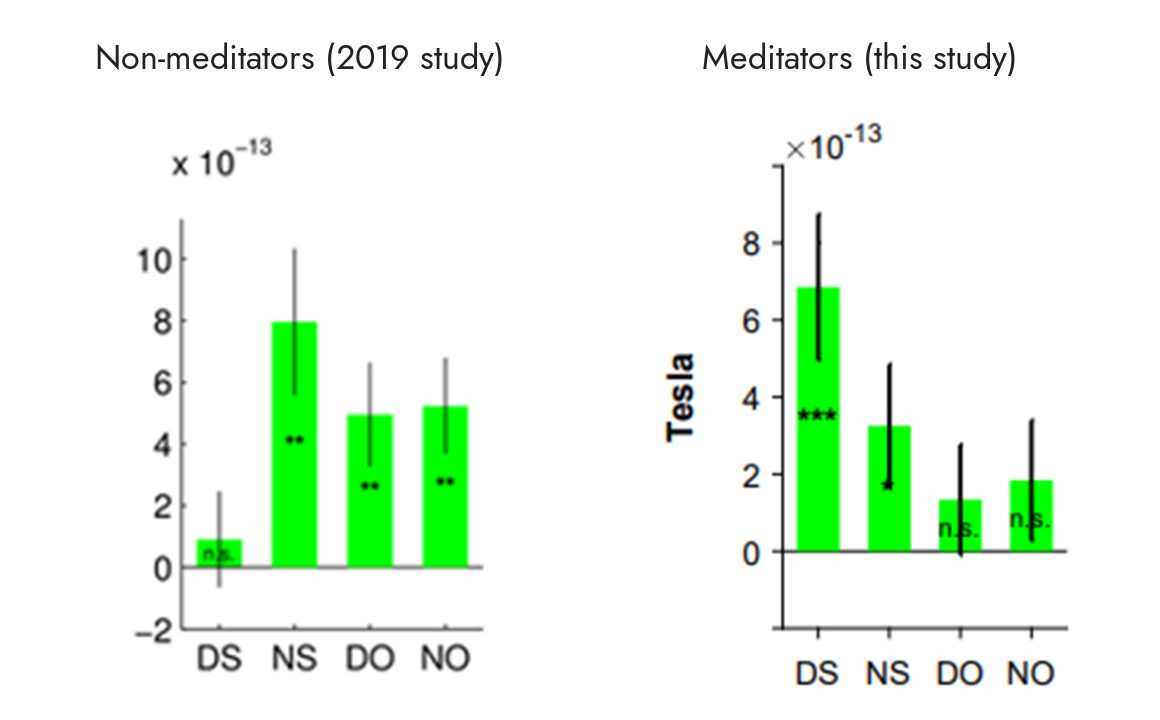
To compare the groups formally, the team went back to the 2019 data. After putting each group’s results on a common scale, they found that the groups differed specifically in how death words and one’s own face combined. The death–self response was larger in meditators (d = 0.69, 95%
confidence interval
A confidence interval is the range of values that a study’s data are consistent with, given the uncertainty that comes from measuring a limited sample. A 95% confidence interval for an effect of 0.30 running from 0.00 to 0.59, for example, means the true effect could plausibly be anywhere from nothing to moderate. Narrower intervals mean more precise estimates; an interval that includes zero means the study can’t rule out no effect.
More on Wikipedia
Read more in the glossary
0.14 to 1.24), while the other three conditions did not differ significantly between the groups.
Within the meditators, death words and merely negative words made no measurable difference. What mattered was whose face it was: the meditators’ brains responded to their own face under either kind of word (more weakly, just reaching significance, under negative words), but not significantly to the stranger’s face. Brain-source estimates placed the self-face response mainly in right-side visual and face-recognition areas, extending into the
precuneus
The precuneus is a region on the inner surface of the parietal lobe, toward the back of the brain’s midline, next to the posterior cingulate cortex. Together they form a core hub of the default mode network, and the precuneus is often active during self-related thinking, memory recall and imagining one’s own point of view.
More on Wikipedia
Read more in the glossary
, and the death–self and negative–self responses looked alike. In other words, for these meditators death was just another negative word, not a special threat to be kept away from the self. The authors were careful in how they put it:
These results lead us to cautiously suggest that meditators’ brains signal an acceptance of death rather than its denial.
That caution is warranted. The study measured a split-second response to blended faces, not how anyone felt about dying, and it included no questionnaire on death anxiety. Calling the response “acceptance” rests on the 2019 interpretation of its absence as denial. And the comparison with non-meditators is weaker than a two-group study would be. The non-meditators were tested separately, for an earlier study, and the paper doesn’t say they were matched to the meditators in age, sex or beliefs. The authors acknowledge “the lack of a proper control group” and call the group comparison exploratory, while arguing that the meditators’ pattern was different in kind, not merely in degree.
Miscellaneous Interesting Takeaways
More Practice Didn’t Mean More Acceptance
The team had predicted that meditators with more lifetime practice would show less denial. They didn’t: the death acceptance measure (the death–self response minus the death–stranger response) was unrelated to hours of practice (Spearman correlation −0.07). The authors grant that it is therefore unclear whether meditation itself is what made the difference. They suggest two possibilities: a few hundred hours might be enough, so the effect levels off early, or what matters is the felt understanding of impermanence that this style of practice cultivates, rather than hours on the cushion. A third possibility is simpler. People who take up meditation, or who stick with it, may already relate to death differently. A
cross-sectional study
A cross-sectional study measures a group of people at a single point in time. It can show which things tend to go together, but not which came first or whether one causes the other.
More on Wikipedia
Read more in the glossary
can’t tell these apart; the authors call for longitudinal studies.
Not Explained by Belief in an Afterlife
Belief in literal life after death is known to soften people’s defenses against mortality, so the team checked it. Most of these meditators were quite sure consciousness continues after death. Only one leaned slightly toward annihilation (−2), five said “I don’t know” (0), and the rest scored positive, with a median of 8.5 out of 10. As predicted, the strength of this belief was unrelated to the death acceptance measure. With so few doubters, though, the sample could not really test whether belief matters, and the authors call for samples more balanced in their beliefs.
The More “Accepting” Brains Had Gentler Experiences of Self-Dissolution
The most striking finding links the brain measure to what happened in the earlier project, when these meditators deliberately dissolved their sense of a boundary between self and world. Some found that blissful; a few found it frightening. How deep people went had not predicted how it felt. Meditators with higher death acceptance had described their dissolution experiences as more pleasant (Spearman correlation 0.52) and had scored lower on the anxious ego dissolution scale (−0.42). Depth of dissolution and the other altered-state scales were unrelated to death acceptance.
The authors see this as a first, data-based answer to why
ego dissolution
Ego dissolution (also called ego death) is a temporary loss of the ordinary sense of being a separate self, often described as the boundary between self and world melting away, sometimes with a feeling of oneness. It is reported at high doses of psychedelic drugs and in some deep meditative states, and researchers usually measure it with questionnaires.
More on Wikipedia
Read more in the glossary
is wonderful for some people and terrifying for others, with implications for psychedelic therapy, where such states are often induced deliberately:
Facing one’s fear, denial and anxiety of death prior to engaging in practices or therapeutics which may induce states of self/ego-death might reduce the risks involved and yield better clinical outcomes.
It is an intriguing hypothesis, but the evidence is a pair of
correlations
A correlation measures how closely two things rise and fall together across people or over time. Pearson’s r runs from −1 to +1: values near +1 mean that people high on one measure tend to be high on the other, values near −1 mean the reverse, and values near 0 mean no straight-line relationship. A correlation alone can’t show that one thing causes the other.
More on Wikipedia
Read more in the glossary
in 38 people, among several tests with no reported correction for
multiple comparisons
The multiple comparisons problem arises when researchers run many statistical tests at once. Each test has a small chance of a false positive, so across thousands of tests, such as one for every point in a brain scan, some “significant” results will turn up by chance alone. Corrections raise the bar for significance to keep the overall false-positive rate down, at the cost of making small real effects harder to detect.
More on Wikipedia
Read more in the glossary
, and the experiences were recorded in an earlier phase of the project (2018–2019) than the brain responses (2019–2020). It can’t show which way, if either, the influence runs.
Less Self-Favoritism Went With More Well-Being
Brains usually respond more strongly to one’s own face than to other faces, and so did these meditators’. Those with a smaller gap between their self and stranger responses reported higher well-being (a moderate negative correlation, r = −0.39), though not lower trait anxiety. That echoes an EEG study in which loving-kindness meditators showed less of a brain bias toward their own face. Note, though, that this was the self-versus-stranger gap, not the death acceptance measure. The abstract’s statement that the death-related responses corresponded “to increased self-reported well-being” runs the two together a little, and the correlation itself was modest and exploratory.
Final Reflection
This is an imaginative study. It takes a big question, whether meditation changes how we face death, and pins it to a specific, measurable process: whether the brain will let “death” and “me” sit together long enough to form a prediction. The main hypothesis was preregistered, the basic brain signal replicated cleanly, and the result went in the predicted direction with a respectable effect.
How far it reaches depends on things the design can’t settle. The non-meditators came from a separate, earlier study, the brain measure didn’t track how much people had practiced, and “acceptance” is an interpretation of a quarter-second visual response rather than something the meditators reported. The links with well-being and with the feel of self-dissolution are exploratory correlations in a modest sample.
Still, the pattern is suggestive. It hints that one of the brain’s most basic defenses against mortality may not be fixed, and that people whose brains don’t flinch from it may also find letting go of the self less frightening. A longitudinal study, following people as they learn to meditate, with matched controls and direct measures of death anxiety, would show whether meditation can teach the brain to stop turning away.
Citation
Dor-Ziderman, Y., Schweitzer, Y., Nave, O., Trautwein, F.-M., Fulder, S., Lutz, A., Goldstein, A., & Berkovich-Ohana, A. (2025). Training the embodied self in its impermanence: Meditators evidence neurophysiological markers of death acceptance. Neuroscience of Consciousness, 2025(1), niaf002. 10.1093/nc/niaf002
Get the next summary by email
One or two new paper summaries every couple of weeks, sent to your inbox when they go up.
No spam, and you can unsubscribe at any time. Prefer a feed reader? Use the RSS feed.