
Background Information
Death has a central place in early Buddhist teaching. According to the early discourses, the facts of old age, disease and death were what prompted the Buddha to leave home, and what he announced after his awakening was the “deathless”: not immortality, the authors explain, but complete freedom from fear of death, achieved while still alive. The texts describe him meeting his own death with composure, passing through one meditative absorption after another.
Death also became a meditation theme in its own right, known in the Pali tradition as
maranasati
Maranasati (Pali maraṇasati, “mindfulness of death” or recollection of death) is a Buddhist meditation in which practitioners deliberately bring to mind that they will die and that death could come at any time. Early Buddhist texts describe it both as a reflection, at its most urgent the thought that death could come with the next breath, and as contemplating a corpse in stages of decay as a reminder that one’s own body will share that fate. It is traditionally meant to counter complacency and to loosen fear of and clinging to life.
More on Wikipedia
Read more in the glossary
, mindfulness or recollection of death. The paper describes a discourse, preserved in Pali and Chinese versions, in which the Buddha finds some disciples practicing it while imagining that death would come at some distant time, and calls them negligent:
According to his instruction, mindfulness of death should be practiced with the thought that it could happen with the next breath.
The Satipaṭṭhāna-sutta, the classic discourse on establishing mindfulness, goes further, asking the meditator to picture a corpse in stages of decay and to recognize that their own body will share the same fate.
Psychology has approached the fear of death from another direction.
Terror Management Theory
Terror management theory is a social psychology theory, proposed in 1986, that people’s awareness that they will die could cause paralyzing dread, which they manage by holding on to shared cultural beliefs that make the world feel orderly and meaningful and by building self-esteem through living up to those beliefs. Its best-known prediction, tested in many experiments, is that reminders of death make people cling more tightly to their worldview and defend it against others.
More on Wikipedia
Read more in the glossary
proposes that people manage the dread of knowing they will die by clinging to shared cultural beliefs and to self-esteem. A meta-analysis of 164 studies cited in the paper found that reminders of death had moderate effects on how people defend their worldview and self-esteem. Some earlier studies had linked
mindfulness
Mindfulness is the psychological process of purposely bringing one’s attention to experiences occurring in the present moment without judgment. It involves maintaining awareness of thoughts, feelings, bodily sensations, and surrounding environment with an attitude of curiosity and acceptance. In meditation contexts, mindfulness practices typically involve focusing attention on the breath or body sensations as anchors to the present moment while acknowledging and releasing distracting thoughts.
More on Wikipedia
Read more in the glossary
to less anxiety about death, but the authors found little research testing whether a brief mindfulness practice could reduce fears of death and dying.
The study’s idea, its Buddhist background and its mindfulness practices came from the first author, Bhikkhu Anālayo of the Numata Center for Buddhist Studies at the University of Hamburg, according to the paper’s statement of author contributions. (Bhikkhu is the Pali title for a Buddhist monk.) The practices were recorded by another teacher. The research itself was run by Oleg Medvedev at the University of Waikato in New Zealand, and the authors declare no competing interests.
What They Did
Undergraduate psychology students answered an announcement on their university’s website. They earned bonus course marks for each survey they completed, 1% per survey, and could write about their practice for their coursework instead of doing a literature review. Of 103 who completed the first survey, 14 who declined to do the practice were excluded. The remaining 89 (82% women, average age 27) were randomly assigned to one of two groups. About half said they had meditated for more than a year, and 22% had never meditated. The study ran during the COVID-19 pandemic.
Each group was asked to listen to a 20-minute recording every day for six weeks, with a new recording each week.
- Mindfulness (44 students): an introduction to whole-body awareness, then five weeks of mindfulness of breathing, each with a theme: a first introduction, impermanence, letting go, the importance of the breath for staying alive, and the fact that each breath keeps ending. The instructions did not explicitly mention death or dying.
- Contemplation (45 students): reflective exercises based on the Daily Examen of St. Ignatius, a Jesuit practice of reviewing one’s day, recorded by a psychologist. The weekly themes were mother nature and one’s inner landscape; allowing painful thoughts and emotions and observing them; allowing mental events to dissolve; recognizing humanity in others and developing empathy; acting virtuously and respecting oneself; and experiencing anger and guilt and letting them go.
The contemplation group was designed as an
active control
An active control group is a comparison group that takes part in a different program designed to be just as engaging as the one being tested. In meditation research, it might involve exercise, music, or education classes with the same time commitment, teachers, and expectations of benefit. Comparing against an active control helps separate the effects of meditation itself from the general effects of joining a course.
More on Wikipedia
Read more in the glossary
, matched to the mindfulness group in the number and length of sessions. There was no group that did no practice at all.
Students filled in online questionnaires at the start, after the six weeks, and again 1 to 3 weeks later. The main measure was the Collett–Lester Fear of Death Scale, which rates how anxious various thoughts make a person, from 1 (not anxious) to 5 (very anxious). It separates four fears, distinguishing death (the event) from dying (the process): fear of one’s own death, of one’s own dying, of the deaths of others, and of others’ dying. With this group’s answers, the two scales about others were not reliable enough, so the authors dropped one item from the first and four from the second; even then the scale for others’ dying was, in their words, “only marginally acceptable.” The students also completed the
Five Facet Mindfulness Questionnaire (FFMQ)
The Five Facet Mindfulness Questionnaire (FFMQ) is a widely used 39-item self-report questionnaire that measures mindfulness as an everyday tendency. It gives scores for five facets: observing experiences, describing them in words, acting with awareness rather than on autopilot, not judging one’s inner experience, and not reacting to it. Because it relies on self-report, scores can reflect how people see themselves, and can shift with what they have learned about mindfulness.
More on Wikipedia
Read more in the glossary
and a short form of the Self-Compassion Scale.
One Big Result: Both Practices Eased Fear of Dying Equally, but Fear of One’s Own Death Didn’t Change
The two groups changed in almost exactly the same way, and on no fear did the change differ between them. Taking the four fears in turn (average scores, mindfulness group first, then contemplation):
- Fear of one’s own dying fell from 22.2 and 22.8 at the start to 16.9 and 17.1 after six weeks, a drop of about a quarter. It crept back up a little by follow-up (18.3 and 18.1) but stayed significantly below where it began. This was the largest change, a large
effect
Effect size is a statistical concept that quantifies the magnitude or strength of a relationship, difference, or intervention outcome. Unlike p-values which only indicate statistical significance, effect sizes measure how meaningful a result is in practical terms. Common measures include Cohen’s d (standardized mean difference), correlation coefficients (r), and odds ratios. In meditation research, effect sizes help quantify the practical impact of different meditation practices on psychological or physiological outcomes.
More on Wikipedia
Read more in the glossary of time (η² = 0.54) shared by both groups. - Fear of others’ deaths fell from 42.0 and 41.4 to 33.4 and 33.1, but rose again by follow-up (40.1 and 38.3), still significantly below the start (η² = 0.51).
- Fear of others’ dying rose, from 26.5 and 25.8 to 32.6 in both groups, and stayed up at follow-up (31.1 and 31.8; η² = 0.26).
- Fear of one’s own death didn’t change. Scores hovered around 32 to 34 throughout, with no significant effect of time, group, or their combination.
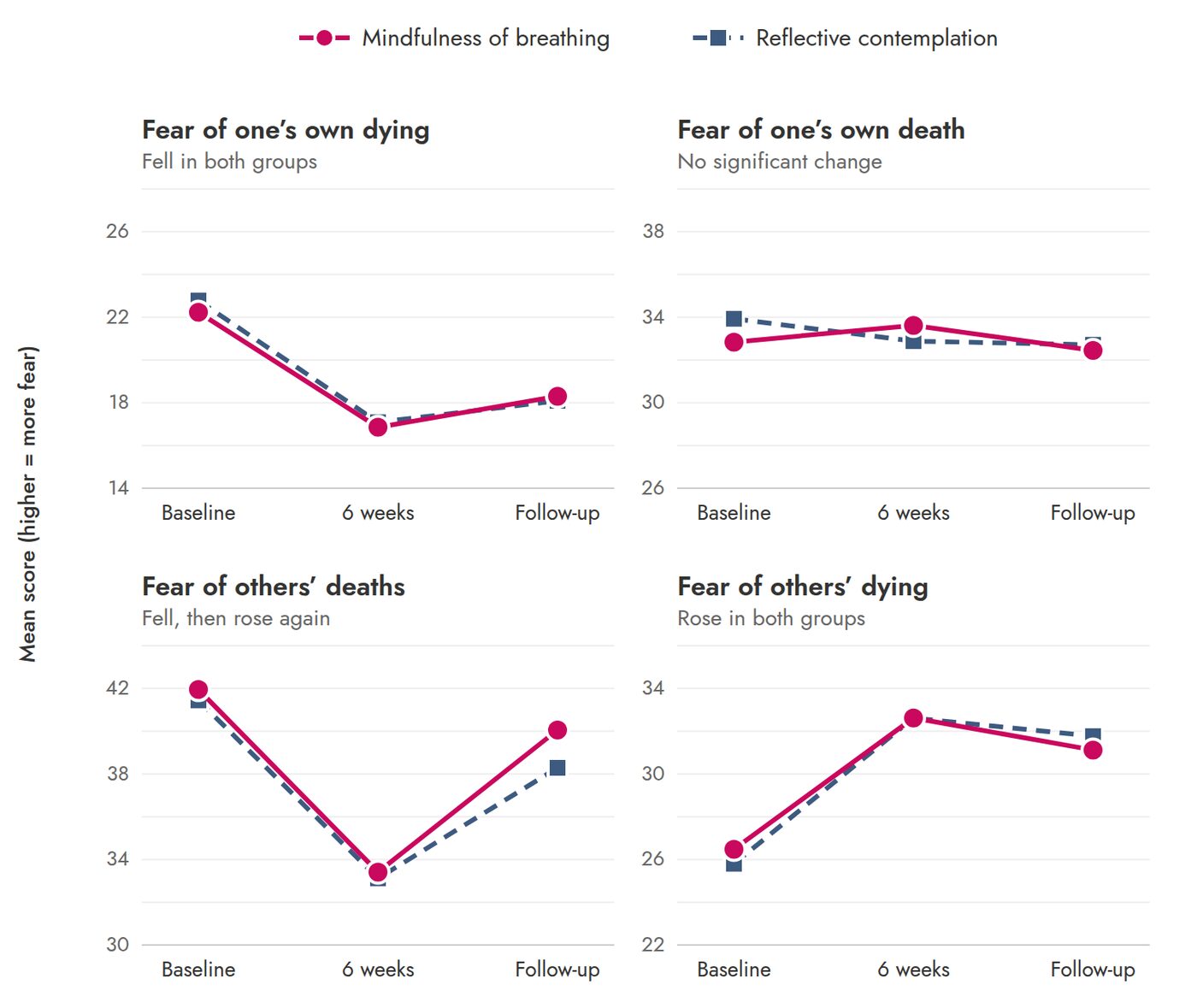
The abstract describes both practices as “equally effective” at reducing two of the fears. That is a fair summary of the comparison between them, but the design can’t show that either practice caused the change. Scores could also shift simply with time, with filling in the same questionnaire a second time, or with events outside the study. The authors say so themselves:
While using an active control condition is a strength of this study, it did not enable us to determine if either intervention is better than a no-intervention condition.
The study was set up with mindfulness as the treatment and contemplation as the control, and the abstract states the hypothesis that mindfulness would reduce fear of death more. It didn’t. The authors suggest one reason: viewed from a Buddhist perspective, three of the six contemplation themes (observing painful thoughts and emotions, letting mental events dissolve, and letting anger and guilt go) overlapped substantially with mindfulness, so the comparison “may not have provided a true differential test.”
Miscellaneous Interesting Takeaways
Neither Group Actually Practiced Mindfulness of Death
Despite the paper’s title and its Buddhist framing, no one in the study was asked to contemplate death. The mindfulness recordings pointed toward it only obliquely, through impermanence, letting go and the ending of each breath. The authors explain why:
However, due to ethical constraints, the instructions did not explicitly raise the topic of death and dying in the present study. As a result, the mindfulness intervention did not include an actual mindfulness of death practice.
So the trial tests brief, general practices against fear of death, not the traditional practice of recollecting death. The authors call for future studies that find an ethical way to test that practice directly.
One Fear Went Up
Fear of others’ dying rose by about a quarter in both groups and stayed higher at follow-up. The paper reports this increase but doesn’t offer an explanation for it. It was also the least reliable of the four scales, measured with only the items left after four were removed, so it is hard to know how much weight to give it.
Mindfulness and Self-Compassion Rose in Both Groups Too
Scores on all five facets of the FFMQ rose over time in both groups, most clearly for not judging and not reacting to one’s inner experience. Self-compassion rose as well (η² = 0.19), and again the groups didn’t differ. The authors see self-compassion as a possible buffer against the fear of death, since terror management theory’s other proposed buffer, self-esteem, has drawbacks such as a tendency to see one’s own group as superior. Like the fear scores, these changes can’t be attributed to either practice without a group that didn’t practice.
What the Study Can’t Say
Beyond the missing no-practice group, there are several other reasons for caution:
- Dropout: only 68 of the 89 students (76%) completed the 6-week survey, and about 65 the follow-up. The authors had calculated that they needed 86 participants to detect a small effect.
- Practice: the paper doesn’t report how often students actually listened to the recordings.
- Many outcomes: ten scores (four fears, five mindfulness facets and self-compassion) were each tested at the conventional p < 0.05, with no correction for
multiple comparisons
The multiple comparisons problem arises when researchers run many statistical tests at once. Each test has a small chance of a false positive, so across thousands of tests, such as one for every point in a brain scan, some “significant” results will turn up by chance alone. Corrections raise the bar for significance to keep the overall false-positive rate down, at the cost of making small real effects harder to detect.
More on Wikipedia
Read more in the glossary . The main changes in fear were large (p < 0.001), so this matters less for them than for the smaller changes in mindfulness facets. - Self-report: everything was measured with questionnaires in the same online survey, which the authors note can inflate relationships between measures. Students in a psychology course earning credit, and in some cases writing about their practice for coursework, may also have known what answers the researchers hoped for.
- Sample: psychology students who chose to take part, 82% of them women, during a pandemic, half of them with more than a year of meditation experience already.
- Loose ends in the published numbers: the F statistics are listed with degrees of freedom of (60, 1), which doesn’t fit a comparison across three time points. The spread of fear scores narrows sharply at six weeks and widens again at follow-up (for fear of one’s own death, a standard deviation of about 3 at six weeks against about 10 before and after). And the table’s self-compassion figures at follow-up (15.8 and 17.7, listed for all 89 students) are lower than at the start, which doesn’t match the text’s statement that self-compassion kept increasing after the practice ended. None of this alters the main finding that the groups didn’t differ, but it makes the exact sizes of the changes harder to rely on.
Final Reflection
This is a small, honest first step rather than a test of the Buddhist claim that inspired it. Students who spent six weeks on short daily practices, whether Buddhist-style mindfulness of breathing or Ignatian-style reflection, reported less fear of their own dying and, for a while, of losing others. But their fear of their own death, the fear at the heart of terror management theory and of the Buddhist “deathless”, did not change, and their fear of watching others die went up. Because both groups changed in step and no group went without practice, the study can’t say whether either practice did any of this.
The traditional practice of recollecting death, with death imagined as close as the next breath, remains untested here. Studies of practitioners who deliberately work with death, such as the Buddhist meditators who report entering near-death experiences at will, come from the other end of the spectrum: experienced practitioners rather than students, but without any randomized comparison. A trial with a no-practice group, a practice that actually addresses death, and a way to do that safely is what the authors themselves call for next.
Citation
Anālayo, B., Medvedev, O. N., Singh, N. N., & Dhaussy, M. R. (2022). Effects of mindful practices on terror of mortality: A randomized controlled trial. Mindfulness, 13(12), 3043–3057. 10.1007/s12671-022-01967-8
Get the next summary by email
One or two new paper summaries every couple of weeks, sent to your inbox when they go up.
No spam, and you can unsubscribe at any time. Prefer a feed reader? Use the RSS feed.