
Background Information
Tibetan Buddhists hold that some advanced meditators, at the moment of death, enter a meditative state called
Tukdam
Tukdam (Tibetan thugs dam, also spelled thukdam) is a state that Tibetan Buddhists believe some advanced meditators enter at death, remaining in meditation after breathing has stopped. According to the tradition, the body of someone in tukdam stays fresh, with supple skin and warmth around the heart, and doesn’t begin to decay for days or even weeks. The state is understood to have ended when signs of decomposition appear.
More on Wikipedia
Read more in the glossary
(thugs dam) and can remain in it for days or weeks. In the tradition’s account, the coarse levels of body and mind have dissolved by then, but a very subtle mind and a very subtle energy, called “wind,” remain at the heart. The Dalai Lama described the outward signs to the neuroscientist Richard Davidson in 1995: the body, often sitting upright, keeps supple, elastic and radiant skin, stays warm, most of all around the heart, gives off a fragrant rather than putrid odor, and doesn’t follow the usual timeline of changes after death. When the practitioner releases the state, the body begins to smell and decompose. He has likened someone in tukdam to “someone asleep” yet “no longer breathing, like a corpse but, unlike a corpse, not smelling.”
That conversation led to the Tukdam Study, formally begun in 2007 by the Center for Healthy Minds at the University of Wisconsin-Madison with the Office of the Dalai Lama, Men-Tsee-Khang (the Tibetan Medical and Astro-Science Institute) and Delek Hospital. It follows senior practitioners in monasteries across India in old age and examines cases after death when the team is notified. Its first published results, EEG recordings in seven people in tukdam, found no detectable brain activity, though the earliest recording began 26 hours after death. More recently, at the request of the Dalai Lama’s office, it expanded to include neuroscientists from the Russian Academy of Sciences and Moscow State University. The team now numbers more than 60, over half of them Tibetan monks and physicians. Monks trained in science are now the main field investigators, Tibetan physicians collect the health data, and the US and Russian leaders advise from a distance, largely absent when a case arises.
This paper, by Tawni Tidwell of the Center for Healthy Minds, is mostly not a results paper. Its central aim is to compare what counts as valid evidence in each tradition. Biomedicine relies on measurable “biomarkers.” Tibetan medicine and Buddhism rely on “perceptual cues” read by trained observers, drawing on a Buddhist theory of valid knowledge called pramāṇa. The two also disagree about what death is: for biomedicine, mainly an event marked by brainstem, heart and lung function; for the Tibetan tradition, a gradual process in which mind can shape what the body does afterwards. The paper’s empirical core is two case reports from 2021, above all the longest tukdam case the study has seen.
What They Did
The Usual Timeline After Death
The paper sets out the textbook sequence of changes after death that the team’s forensic experts keep in mind. The skin pales within 15 to 25 minutes. Blood settles into the lowest parts of the body,
livor mortis
Livor mortis (also called lividity) is the purplish discoloration that appears on the lowest parts of a body after death, as the blood stops circulating and settles under gravity. It usually becomes visible within half an hour to two hours and reaches its full color within about 8 to 12 hours, so forensic pathologists use it, along with rigor mortis and other changes, to estimate how long ago someone died.
More on Wikipedia
Read more in the glossary
, visible within 30 minutes to 2 hours and at its most intense by 8 to 12 hours. The body stiffens (rigor mortis) over the first 2 to 12 hours and relaxes again after 24 to 48 hours. In the first 24 to 36 hours a greenish discoloration starts on the lower abdomen, and general bloating tends to follow within 60 to 72 hours, though cold slows all of this.
Most forensic methods for timing death are invasive, and the study must respect the community’s wish to leave the body undisturbed. So the team relies on visual measures. Its forensic anthropologist adapted the Munsell color system, a set of standardized color scales, to track paling and blood pooling and to quantify the Tibetan quality of “radiance” (mdangs). Results from that method are to be published separately.
The 37-Day Case
In February 2021, with India under COVID-19 lockdowns and international travel stopped, the team switched to a streamlined protocol based on images. A month later came its longest case.
The man was a senior monk born in 1935 in a village in Kham, on the southeastern edge of the Tibetan Plateau. He trained at Drepung Loseling and then at Gyutö, a tantric college, followed the Dalai Lama into exile in 1959, and became his monastery’s ritual specialist, known for drawing and constructing mandalas and for the teaching materials he made on tantric practice. At nearly 70 he did a three-year retreat on Vajrabhairava, a meditational deity regarded as a destroyer of death, and in later years he focused on the
Guhyasamāja
The Guhyasamāja Tantra (Sanskrit for “secret assembly”), called the King of Tantras, is a central text and practice cycle of tantric Buddhism, especially important in the Geluk school of Tibetan Buddhism. Practitioners visualize themselves as a deity within a mandala of deities, work with a visualized subtle anatomy of channels and energies, and finally dissolve the whole visualization into emptiness, a sequence the tradition sees as a rehearsal for death.
More on Wikipedia
Read more in the glossary
practice. He had had diabetes and high blood pressure for years. In early 2021, at 86, he caught COVID-19 and asked to go back from the hospital to his monastery. He died there on March 10, 2021, in a quarantined cement room, lying down rather than sitting in meditation posture, with a single attendant. Tibetan Buddhist and medical experts still considered the signs that followed remarkable.
The team could arrange to assess the body only from the seventh day after death, and had no access to its EEG, heart, oxygen or skin-temperature equipment. Instead the researchers instructed the attendant remotely. Each day he photographed and filmed every part of the body, with close-ups of the face, limbs, chest, abdomen, hands and feet, and took readings with a locally bought infrared thermometer, along with the room’s temperature, humidity and pressure.
One Big Result: For About a Month, the Photos Showed Almost None of the Usual Signs of Decay
The first photographs arrived a week after death:
Upon receiving the initial photographs even a full week into the postmortem phase, the team was struck by how fresh his body appeared.
His skin looked supple, his limbs were flexible, and no part of the body showed discoloration. In particular there was no blood pooling on the lowest surfaces, which ordinarily appears within hours and is fixed within the first day. The room stayed at about 70–74°F (21–23°C), and the body’s temperature hovered around 72°F; over the whole period it tracked the room’s, with minor fluctuations.
For weeks, image after image showed the same state, though from around the third week the body began to dry, first at the fingertips and around the cuticles, then slowly up the hands, legs and other outer parts. Even so, no skin slipped, and the skin of the trunk stayed elastic. Around day 33 the body warmed to 77°F (25°C); then the skin paled, turned bluish, and by day 36 showed the purple color of a corpse. Blisters formed on the limbs, the cuticles came away in places on the fingers, and the hands and feet began to mummify. Yet even on day 37 there was no bloating, and the upper chest and abdomen still looked fresh.
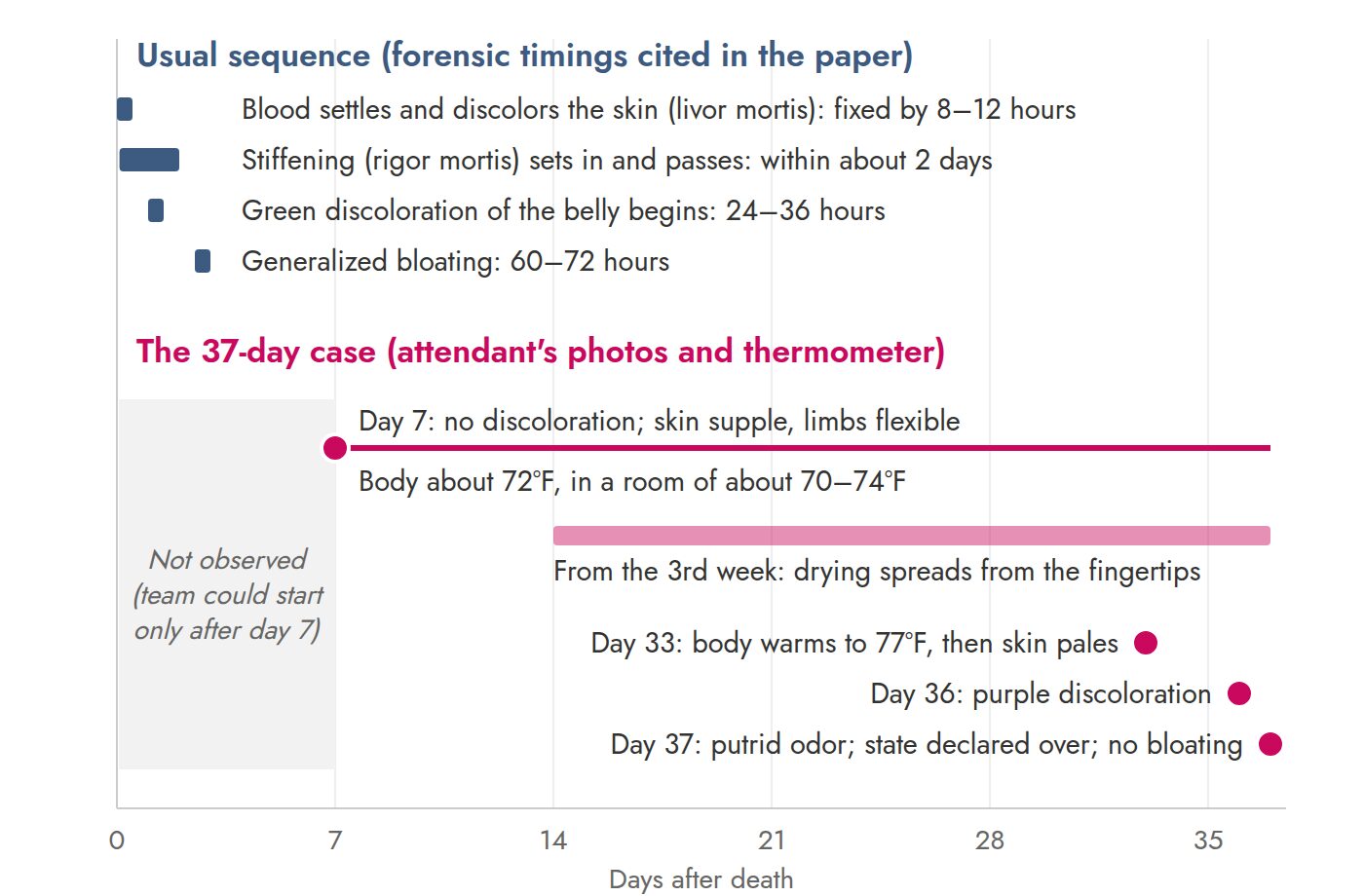
Meanwhile the Dalai Lama had begun reciting the Root Tantra of Guhyasamāja, which in his Geluk school is a way to prompt a practitioner to release tukdam. On day 37 a putrid odor appeared and the skin of the chest lost some of its color. The state was declared over, and the body was cremated the next morning.
In the Tibetan tradition’s terms, it mattered that the upper torso changed least, because the heart is understood as the seat of the remaining subtle mind. Although no warmth could be detected there, its resistance to decay was taken as an important sign that the subtlest mind was still mounted on its subtle “wind” at the heart, “like a rider on a horse.” The author’s summary is that, despite the limited tools, the visual markers led both the Western and the Tibetan medical assessments to see “a phenomenon distinct from the normal processes” that follow the end of heart and lung function. She adds that this was the longest case of its kind but that a lack of the usual paling and blood pooling has been commonly documented in the study’s other tukdam cases. Like more than fifty other cases the team has assessed, this one was first examined too late to see rigor mortis set in and pass. Results from those cases are under review and not reported here.
Miscellaneous Interesting Takeaways
Photographs Alone Wouldn’t Usually Make the Case
The author is candid about how thin this evidence is by forensic standards:
However, in other contexts, documentation of visual details would rarely be sufficient evidence to substantiate a claim of an unusual postmortem state.
A convincing case, she writes, would need tissue or fluid samples, or devices that capture the gases a decomposing body gives off. Without them, and within what the community found acceptable, the team settled on an approach that “by default, privileged the epistemology of the Tibetan tradition by relying on perceptual cues.”
A few other limits are worth adding. This is one body, recorded by one attendant with a phone and an infrared thermometer, starting a week after death. There is no comparison with other bodies kept in similar rooms. The paper notes that warmth speeds these changes and cold slows them, and that many forensic measures are highly sensitive to temperature and humidity, but it doesn’t report the room’s humidity readings or weigh how the room, the man’s illnesses or his condition before death might have shaped what was seen.
Felt Warmth at the Heart Didn’t Show Up on the Thermometer
Warmth at the heart is one of tukdam’s classic signs, and the attendant did feel it:
The attendant reported that during daily body temperature assessments, he detected a higher temperature through gentle palpation with the back of his hand at the heart region compared to other regions of the chest and the lower abdomen. However, the infrared thermometer readings could not confirm this observation.
The author says such reports of warmth to the touch have been frequent in the study’s cases. But in earlier cases where the team used infrared cameras, they found no difference between the body’s temperature and the room’s.
The Tradition Has Its Own Skeptics
Tibetan texts don’t treat every fresh-looking body as a sign of tukdam. The paper summarizes the 17th-century scholar-yogi Karma Chakmé, who warned that an upright posture can just mean attendants propped the body well, that diet, fasting and an emaciated state change how a body looks, and that fluid from the nose or mouth may simply be the last food or drink. He even warned that a body that only appears to be in tukdam might be possessed by a spirit. He called a healthy complexion, the “same as that of a living person” and lasting through the state, the most reliable indicator, and relics found in the ashes after cremation the principal “secret” sign. Custom also calls for leaving any body, practitioner or not, undisturbed for just over three days before cremation, which helps explain why the study’s assessments often begin days after death.
A Case Judged Not to Be Tukdam
The second case, in November 2021, was a 37-year-old Rinpoche (an honorific for a revered teacher). His attendants and family couldn’t say whether he had done the advanced tantric practices; they spoke instead of his kindness, humility and devotion to his teachers. When the team first received photographs, his body was already blue from head to toe, and the monastic and Tibetan medical colleagues judged that he was not in tukdam. Yet after cremation his ashes yielded many pearl-like
Ringsel
Ringsel (Tibetan ring bsrel) are small, pearl-like beads that Tibetan Buddhists say are sometimes found among the cremated remains of accomplished practitioners. They are venerated and enshrined as relics, and the tradition treats them as a sign of the person’s spiritual attainment.
More on Wikipedia
Read more in the glossary
and other relics, including his skull, which the author describes as inscribed with signs of mantra and deity. The Russian collaborators, seeing such relics for the first time, wanted to analyze them chemically, but his attendants carried them off to be enshrined. The 37-day case, by contrast, produced no relics, which surprised the Tibetan collaborators. The two cases show the traditions’ measures pointing in different directions: by the visible signs of decay only the first body was unusual, while by one of the tradition’s principal signs, the relics, the second was.
The Practice Credited for the Long Tukdam
Of everything in the monk’s life, the monastic and physician field team singled out his experience with Guhyasamāja practice as most noteworthy. The Dalai Lama has linked this practice to extended tukdam states, citing its training in single-pointed concentration, or
shamatha
Shamatha (Pali samatha, “calm abiding”) is a Buddhist family of concentration practices that train attention to settle and stay on a chosen object, such as the sensations of the breath. Practitioners notice when the mind has wandered and bring it back, aiming for attention that is both stable and vivid. It is often paired with vipassana, or insight, practice.
More on Wikipedia
Read more in the glossary
, and its detailed visualization of a mandala that is finally dissolved. In the tradition’s account, this final dissolution rehearses death, and the clear, luminous nature of mind it reveals is the state a practitioner rests in during tukdam. Monks from his own monastery on the study team also learned that he had received instructions in
tummo
g-Tummo, often written tummo and known in English as “inner fire” or “psychic heat,” is a meditation practice of Tibetan Buddhism and Bön associated with sensations of intense bodily heat. It combines a breath-holding technique with muscle contractions (“vase breathing”) and visualization of flames in the body, and it is traditionally taught in long retreats.
More on Wikipedia
Read more in the glossary
, or inner fire, a practice whose heat has been measured in living meditators, and in a visualized mantra recitation. These are accounts from within the tradition; the paper doesn’t test them.
Who Was Doing the Observing
The observations in the main case came from the monk’s attendant, and the judgments about tukdam came from Tibetan monastic and medical experts, not from a measured cutoff. The author argues that in earlier Tibetan–Western collaborations Western methods dominated, leaving Tibetan ways of knowing as “largely theoretical bystanders,” and presents the Tukdam Study as an effort to give both a place. Families or attendants gave written consent for both cases, as did the abbots of the monasteries.
Final Reflection
This paper is best read as a carefully told case report inside an essay about evidence, not as a test of whether tukdam exists. What it documents is striking on its own terms. In a body photographed daily from the seventh day after death, the blood pooling that normally appears within hours was absent, and the trunk still looked fresh after five weeks. It also reports plainly what didn’t match the tradition: the thermometer found no warmth at the heart, and the ashes held no relics.
But a single case, recorded on a phone by one attendant with no comparison body and no laboratory tests, can’t say why the body changed so slowly. The author herself says such visual evidence would rarely be enough to establish an unusual postmortem state. The study’s forensic papers, including the color measurements and the other cases under review, will matter more for that question. Together with the EEG study, which found no brain activity a day or more after death, the project so far has neither confirmed nor ruled out the tradition’s account of tukdam. What it has done is show that such cases can be documented respectfully, by the communities themselves, which is the groundwork any firmer answer will need.
Citation
Tidwell, T. L. (2025). Life in suspension with death: Biocultural ontologies, perceptual cues, and biomarkers for the Tibetan tukdam postmortem meditative state. Culture, Medicine, and Psychiatry, 49(2), 434–464. 10.1007/s11013-023-09844-2
Get the next summary by email
One or two new paper summaries every couple of weeks, sent to your inbox when they go up.
No spam, and you can unsubscribe at any time. Prefer a feed reader? Use the RSS feed.