
Background Information
Insomnia means trouble falling asleep or staying asleep, despite enough opportunity to sleep, along with distress or problems during the day. The authors cite surveys from several countries in which 20–40% of adults report insomnia symptoms and 10–15% meet the criteria for an insomnia disorder. The standard treatments are sleep medications and
cognitive behavioral therapy for insomnia
Cognitive behavioral therapy for insomnia (CBT-I) is a structured, usually short-term talk therapy for chronic sleeplessness. It combines changes to sleep habits and schedules, such as limiting time in bed, with work on unhelpful thoughts about sleep. It is widely recommended as a first-line treatment for insomnia.
More on Wikipedia
Read more in the glossary
(CBT-I), a structured talk therapy that reshapes sleep habits and unhelpful thoughts about sleep.
Mindfulness
Mindfulness is the psychological process of purposely bringing one’s attention to experiences occurring in the present moment without judgment. It involves maintaining awareness of thoughts, feelings, bodily sensations, and surrounding environment with an attitude of curiosity and acceptance. In meditation contexts, mindfulness practices typically involve focusing attention on the breath or body sensations as anchors to the present moment while acknowledging and releasing distracting thoughts.
More on Wikipedia
Read more in the glossary
, intentional, non-judgmental attention to present-moment experience, had been proposed as another option. By the mid-2010s a handful of
randomized controlled trials
A Randomized Controlled Trial is a scientific study design that randomly assigns participants to either an experimental group receiving an intervention or a control group, allowing researchers to measure the true effect of the intervention while minimizing bias.
More on Wikipedia
Read more in the glossary
had tested mindfulness programs in people with sleep problems, but nobody had yet pooled them. Hong Gong and colleagues at the Second Military Medical University in Shanghai set out to do that in what they describe as the first quantitative
meta-analysis
A meta-analysis statistically combines the results of many earlier studies on the same question. Pooling the data can estimate an overall effect more precisely than any single study and show whether results agree across studies. Its conclusions are only as good as the studies it includes and how similar they are.
More on Wikipedia
Read more in the glossary
of mindfulness meditation for insomnia. Three of the six trials they pooled are summarized on this site: Ong et al., 2014, Black et al., 2015 and Britton et al., 2012.
What They Did
The team searched four research databases (PubMed, EMBASE, the Cochrane Library and PsycINFO) for studies published up to July 2015. They kept randomized trials with more than 20 participants that taught mindfulness meditation to people diagnosed with insomnia or a sleep disorder, or who simply complained of poor sleep, and that reported sleep measures before and after. From 1,516 records, six trials qualified, with 330 participants in total.
The trials were small and varied:
- Programs: four used
mindfulness-based stress reduction
Mindfulness-Based Stress Reduction (MBSR) is a program designed to help individuals cope with stress, pain, and illness. Developed by Jon Kabat-Zinn in the 1970s, it combines meditation and yoga to promote awareness and stress management. The eight-week program teaches participants to focus on the present moment non-judgmentally, enhancing their ability to manage difficulties.
More on Wikipedia
Read more in the glossary (MBSR), one used mindfulness-based cognitive therapy Mindfulness-based cognitive therapy (MBCT) is an 8-week group program that combines mindfulness meditation, adapted from Mindfulness-Based Stress Reduction (MBSR), with elements of cognitive behavioral therapy. It was developed to help people who have recovered from depression avoid relapse, by learning to notice and step back from patterns of negative thinking. Classes usually meet weekly, with daily meditation practice at home.
More on Wikipedia
Read more in the glossary (MBCT) and one a mindfulness meditation course. They lasted six to eight weeks. - Participants: four trials enrolled people with chronic or primary insomnia or sleep disturbances (one of them adults aged 75 and over), one enrolled antidepressant users with sleep complaints, and one people with insomnia alongside cancer.
- Comparisons: three trials compared mindfulness with a
wait-list
A wait-list control group is a comparison group that receives the program being studied only after the study period, so participants who are waiting can be compared with those already taking part. It controls for the passage of time and repeated testing, but not for the attention, expectations and setting that come with taking part in any program, which an active control group can address.
More on Wikipedia
Read more in the glossary , one with a sleep hygiene education course (an “attention control”), and two with an active treatment: sleep medication in one trial (Gross et al., 2011), CBT-I in the other (Garland et al., 2014).
The team pooled every sleep measure that at least two trials had reported, right after the programs ended. They described these as the measures recorded in sleep diaries and questionnaires: time to fall asleep, total sleep time, time awake after first falling asleep,
sleep efficiency
Sleep efficiency is the share of time in bed actually spent asleep: total sleep time divided by time in bed, given as a percentage. It can be measured in a sleep lab or estimated from sleep diaries or wrist-worn devices. Taking a long time to fall asleep or lying awake during the night lowers it, and values below about 85–90% are often taken as a sign of disturbed sleep.
More on Wikipedia
Read more in the glossary
(the share of time in bed spent asleep), a sleep quality rating, total time awake, the Insomnia Severity Index (ISI), the
Pittsburgh Sleep Quality Index
The Pittsburgh Sleep Quality Index (PSQI) is a widely used questionnaire about how well a person has slept over the past month. It covers time to fall asleep, sleep duration, disturbances and daytime effects, and combines them into a score from 0 to 21, where higher means worse sleep. Scores above 5 are commonly taken to indicate poor sleep.
More on Wikipedia
Read more in the glossary
(PSQI) and a scale of unhelpful beliefs about sleep (DBAS). Measures reported by only one trial, such as
slow-wave sleep
Slow-wave sleep (SWS), often called deep sleep, is the deepest stage of non-REM sleep (stage N3, or stages 3 and 4 under older scoring rules), when the EEG is dominated by large, slow delta waves. People are hardest to wake from it. It is concentrated in the first part of the night, declines with age, and is thought to support physical restoration and memory.
More on Wikipedia
Read more in the glossary
from sleep-lab recordings, were left out, and the paper doesn’t say whether any pooled number came from the sleep-lab or wrist-monitor recordings some trials also made.
Results were expressed as a standardized mean difference (SMD), a kind of
effect size
Effect size is a statistical concept that quantifies the magnitude or strength of a relationship, difference, or intervention outcome. Unlike p-values which only indicate statistical significance, effect sizes measure how meaningful a result is in practical terms. Common measures include Cohen’s d (standardized mean difference), correlation coefficients (r), and odds ratios. In meditation research, effect sizes help quantify the practical impact of different meditation practices on psychological or physiological outcomes.
More on Wikipedia
Read more in the glossary
that gives the difference between the mindfulness and comparison groups in standard-deviation units. By common convention, 0.2 is small, 0.5 medium and 0.8 large. Where the trials disagreed with one another substantially (
heterogeneity
In a meta-analysis, heterogeneity is how much the results of the pooled studies differ from one another beyond what chance alone would produce, for example because they enrolled different people or compared the treatment with different things. It is often summarized by the I² statistic, the share of the variation due to real differences between studies; values of 50% or more are usually read as substantial. High heterogeneity makes a single pooled number harder to interpret.
More on Wikipedia
Read more in the glossary
, I² of 50% or more), the team used a random-effects model, which allows for real differences between trials and gives wider uncertainty ranges.
One Big Result: Across All Six Trials, Only Two Sleep Measures Improved
Pooling all six trials, mindfulness beat the comparison groups on two of the nine measures:
- Sleep quality ratings: an effect size of 0.68 in mindfulness’s favor (95% confidence interval 0.24 to 1.13; p = 0.003), from 2 trials with 83 people.
- Total time awake at night: 0.44 in mindfulness’s favor (0.04 to 0.83; p = 0.03), from 3 trials with 102 people.
The other seven, including time to fall asleep, total sleep time, sleep efficiency, the ISI and the PSQI, showed no significant difference. Several of these estimates came with very wide confidence intervals (for the ISI, an effect size anywhere from about 1.4 in mindfulness’s favor to 1.8 against), a sign of how much the trials disagreed.
The authors traced much of that disagreement to the two trials with active comparisons. In those trials, the results tended to favor the sleep medication and CBT-I groups. So the team re-ran the analysis on the other four trials, where mindfulness was compared with a wait-list or the education course. There, the picture looked much better for mindfulness: it shortened time to fall asleep (effect size 0.53, p = 0.02), raised sleep efficiency (0.85, p = 0.002), improved PSQI scores (1.09, p < 0.001) and improved sleep quality ratings (0.68, p = 0.003), with no disagreement between trials (I² = 0). Total sleep time still didn’t change significantly (0.28, p = 0.30).
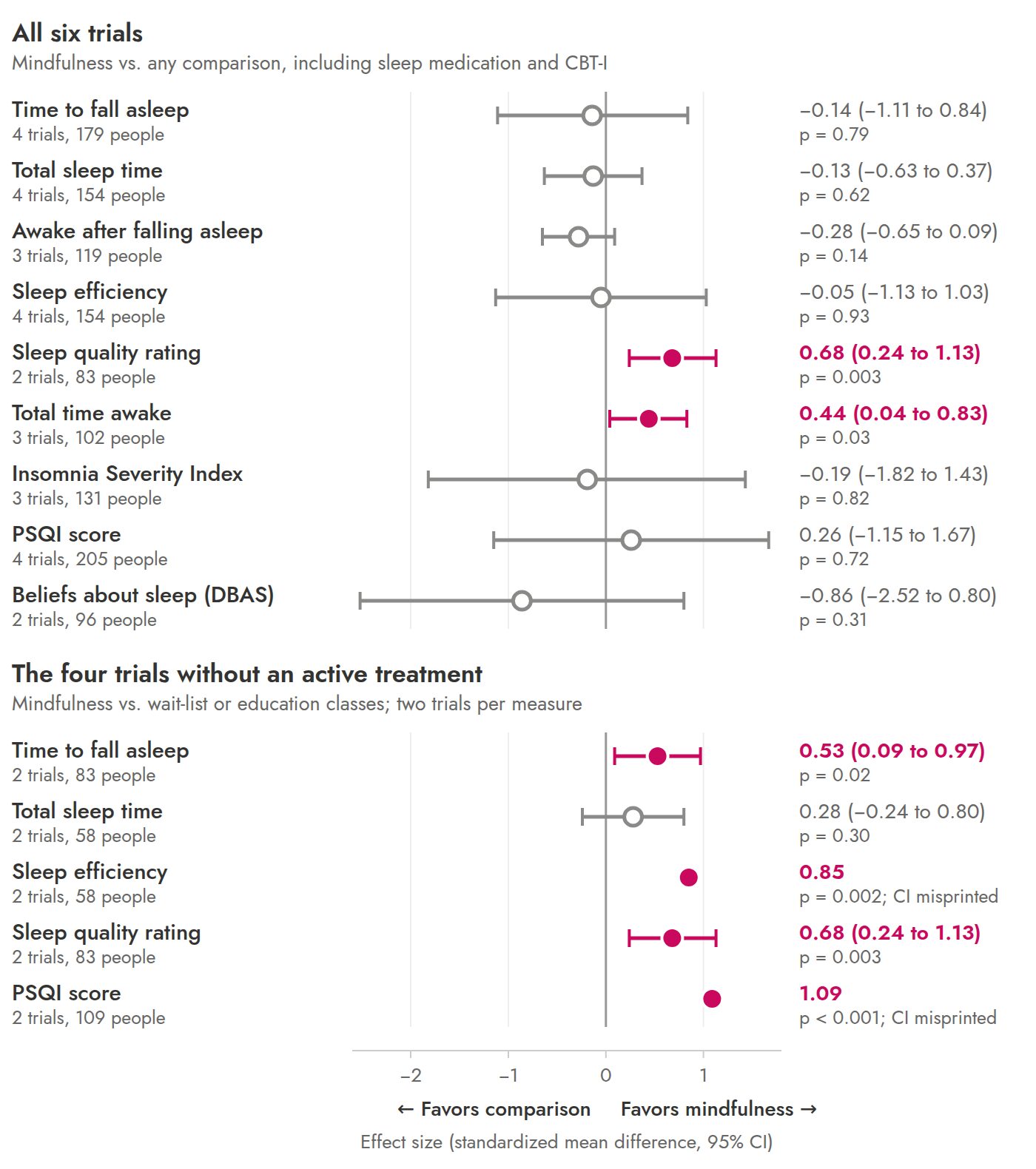
That subgroup analysis carries the paper’s positive conclusion, and it is thin. Every result in it rests on just two trials, with 58 to 109 people in all. The sleep quality result is identical in both analyses, because the same two trials supplied it. The authors’ overall verdict is suitably cautious:
The results suggest that MM may mildly improve some sleep parameters in patients with insomnia.
(MM is the paper’s abbreviation for mindfulness meditation.)
Miscellaneous Interesting Takeaways
Against Sleep Medication and CBT-I, Mindfulness Didn’t Come Out Ahead
The authors argue that pooling the two active-treatment trials with the rest “masked” the real effect of mindfulness, since medication and CBT-I are already known to help. Another way to read the same data is that the two analyses answer different questions. The subgroup asks whether mindfulness beats waiting or an education course; the active-treatment trials ask whether it beats established insomnia treatments, and in those two trials it didn’t. The authors acknowledge as much:
Though these original trials have found that pharmacotherapy or cognitive behavioral therapy may be more helpful in the treatment of insomnia compared to MM, more trials are needed before solid conclusions can be established.
A later, larger meta-analysis of 18 trials reached a similar split: mindfulness improved sleep quality more than matched classes, but showed no clear difference from established sleep treatments (Rusch et al., 2019).
The paper’s abstract also says mindfulness “can serve as an auxiliary treatment to medication.” None of the six trials tested mindfulness added to medication; the one trial involving medication compared the two head to head.
Moderate-Quality Trials, With High Dropout in Two
The team rated each trial on 12 criteria for risk of bias. Scores ranged from 6 to 9 (median 7), and all but one trial (the study of adults aged 75 and over) were rated moderate rather than high quality. Five of the six trials used an adequate method to generate the random allocation, but only two adequately concealed which group people would be assigned to. Two blinded the people delivering the program and two blinded those assessing the results. Dropout was 10% or less in three trials but 30% or more in two, which can skew results if the people who leave differ from those who stay.
Because there were so few trials, the team didn’t check for
publication bias
Publication bias arises when studies with positive or striking results are more likely to be published than studies that find nothing. A meta-analysis that pools only published studies can then overestimate how well a treatment works. Researchers check for it with tools such as funnel plots and Egger’s test, which need a reasonable number of studies to be informative.
Read more in the glossary
, the tendency for trials with disappointing results to go unpublished. They are frank about what such small numbers mean:
The small samples may also result in wrong conclusions, including false positives and false negatives.
Several Numbers in the Paper Don’t Add Up
This summary was written from the accepted manuscript, which contains a number of slips. The abstract lists total time awake both among the measures that improved and among those that didn’t (the table shows it improved). It also lists total time awake among the significant subgroup results, though the subgroup table doesn’t include it. The text reports the beliefs-about-sleep result as a second PSQI result. And in the subgroup table, the confidence intervals printed for sleep efficiency (−0.31 to 1.40) and PSQI (−1.50 to 0.69) cross zero, which contradicts their very small p-values; most likely a sign error. None of this changes the overall picture, but it is a reason to lean on the tables rather than the abstract.
Short-Term Results Only
Not every trial followed participants up, and those that did used different time points, so the meta-analysis looked only at results right after the programs. The authors note that two trials (the two with active comparisons) reported that total sleep time in the mindfulness groups kept rising over five months. That observation wasn’t part of the pooled analysis. They also suggest total sleep time may lag behind other measures because mindfulness programs may at first reduce the time people spend in bed, to build up the drive to sleep, and sleep tends to lengthen only once it has consolidated.
Final Reflection
This was an early attempt to pool the first randomized trials of mindfulness for insomnia, and its main value is as a snapshot of how thin that evidence was in 2015: six trials, 330 people and three quite different kinds of comparison group. The most encouraging results, from the four trials without an active treatment, suggest mindfulness may help people fall asleep sooner, spend more of the night asleep and rate their sleep better than if they had simply waited. But each of those findings rests on two trials, mostly on what people reported about their own sleep, and only for the weeks right after the program.
The individual trials tell a richer story than the pooled numbers. In Ong et al.’s insomnia trial, self-reports changed more than recorded sleep, and in Britton et al.’s study of antidepressant users, mindfulness cut time awake at night without making sleep any deeper. The later meta-analysis of 18 trials by Rusch et al. firmed up the case that mindfulness improves how people rate their sleep more than matched classes do. Whether it can stand in for CBT-I or medication is still an open question.
Citation
Gong, H., Ni, C.-X., Liu, Y.-Z., Zhang, Y., Su, W.-J., Lian, Y.-J., Peng, W., & Jiang, C.-L. (2016). Mindfulness meditation for insomnia: A meta-analysis of randomized controlled trials. Journal of Psychosomatic Research, 89, 1–6. 10.1016/j.jpsychores.2016.07.016
Get the next summary by email
One or two new paper summaries every couple of weeks, sent to your inbox when they go up.
No spam, and you can unsubscribe at any time. Prefer a feed reader? Use the RSS feed.