
Background Information
Some people describe a single experience, sudden, vivid and deeply meaningful, after which they were never quite the same. Psychologists call these “quantum change” experiences; they have also been labeled conversion, mystical or peak experiences, or epiphanies. They are hard to study because they are rare and unpredictable: by the time a researcher hears about one, it is long over.
Psilocybin
Psilocybin is the main psychoactive compound in “magic mushrooms,” a classic psychedelic drug. In the body it is converted to psilocin, which acts mainly on the brain’s serotonin 2A receptors. At high doses it can profoundly alter perception, mood and the sense of self for about six hours, and in research settings it often brings experiences people describe as mystical or deeply meaningful. It is being studied in carefully screened, supervised settings as a possible treatment for depression and addiction, and is a controlled substance in most countries.
More on Wikipedia
Read more in the glossary
, the active compound in “magic mushrooms,” offers a way in. In earlier studies at Johns Hopkins University, carefully prepared volunteers given a high dose often had what researchers call a
mystical-type experience
A mystical experience is an experience, often described as religious or spiritual, of unity with everything, loss of the usual sense of self, timelessness, deep positive feeling and a sense of having glimpsed a deeper truth, which is typically felt to be hard to put into words. Researchers measure it with questionnaires such as Hood’s Mysticism Scale. Such experiences are reported in meditation and prayer, and after taking psychedelic drugs.
More on Wikipedia
Read more in the glossary
: a sense of unity, sacredness, timelessness and deep positive feeling that is hard to put into words. They often found it deeply meaningful and spiritually significant, and many credited it with lasting changes for the better. But when the same team measured personality and well-being with standard questionnaires, 14 months after a high dose, they found no significant change. People said they had changed; the questionnaires didn’t show it.
In this study, Roland Griffiths and colleagues at Johns Hopkins tried a different context. They gave psilocybin to people who were starting a program of meditation and other spiritual practices, and varied both the dose and how much support people got for keeping up their practice. Their question was whether a psilocybin experience, combined with regular practice, would produce lasting change on trait measures: how people describe themselves in general, not how they felt about the session.
This site is about meditation, so this summary focuses on what the study says about practice and lasting change. Nothing here is a suggestion to take psilocybin, which is a controlled substance in most countries; the volunteers were medically and psychiatrically screened and supervised throughout. A review comparing meditation and psychedelics (Millière et al., 2018) offers a broader look at how the two alter the sense of self, and asks whether such experiences leave lasting traces.
What They Did
The team recruited through flyers seeking volunteers interested in developing their spiritual lives through a study of meditation and psilocybin. Of 1,305 people screened by phone, 85 enrolled and 75 completed the study, and the results cover those 75. People were excluded if they already had a regular meditation or spiritual practice, had ever had a strong mystical-type experience, or had certain psychiatric conditions in themselves or their family. A quarter had used a psychedelic before, on average 25 years earlier. They averaged 42 years old, 40% were men, most were white, and 89% had college degrees. Nobody was paid.
Each person was randomly assigned to one of three groups of 25:
- Very low dose, standard support: 1 mg of psilocybin per 70 kg of body weight at both sessions, an amount the authors call “functionally a placebo.”
- High dose, standard support: 20 mg/70 kg at the first session and 30 mg/70 kg at the second.
- High dose, high support: the same high doses, with much more support for spiritual practice.
Everyone was given a blank journal, a book they were required to read (Easwaran’s Meditation: A Simple 8-Point Program for Translating Spiritual Ideals into Daily Life) and a page of suggestions: 10 to 30 minutes of sitting meditation a day, an awareness practice during daily activities (repeating a
mantra
A mantra is a sound, word or phrase that is repeated, aloud or silently, as a spiritual or meditative practice. Mantras are central to Hindu and Buddhist traditions and appear in many others. In mantra meditation, the repetition itself serves as the object of attention, and practitioners often describe it as calming.
More on Wikipedia
Read more in the glossary
and keeping one-pointed attention), and daily journaling about their practice. Two study “guides” met with each participant, opening and closing each meeting with a short meditation and encouraging the practice. In the standard-support groups this came to about 7 hours and 20 minutes of contact over the whole study. In the high-support group it came to 35 hours, including twice-monthly group discussions about keeping up the practice in the four months after the second session.
The two psilocybin sessions came one and two months after the practice program began. Each took place in a living-room-like setting, with the volunteer lying on a couch with an eye mask and headphones playing music, and two guides present.
The dose was
double-blind
In a double-blind study, neither the participants nor the researchers who deal with them know who is getting which treatment, for example the real drug or a placebo. This keeps expectations, on either side, from shaping the results. Blinding is hard to keep when a treatment has obvious effects, as high doses of psychedelic drugs do, so researchers sometimes compare against a very low dose or an active drug rather than an inert pill.
More on Wikipedia
Read more in the glossary
(the paper describes only the dose as blinded): neither participants nor guides were told who got which dose. To make guessing harder, everyone was told they would get psilocybin at doses ranging from very low to high over two or three sessions, with at least one moderately high or high dose. All 25 low-dose participants, plus 14 others, were later given a high-dose third session, after the 6-month assessment; its results are not in this paper.
The team measured:
- During and after each session: guides’ ratings of the volunteer’s behavior and mood, and the volunteer’s own questionnaires that evening, including the Mystical Experience Questionnaire. A person counted as having a “complete” mystical experience if they scored at least 60% of the maximum on each of its four parts.
- At 6 months: how much people had practiced over the previous four months, and any lasting changes they attributed to the sessions.
- At the start and at 6 months: a battery of about 20 questionnaires on things such as faith, religious coping, daily spiritual experience, attitudes to death, gratitude, life meaning, forgiveness, closeness to others, values, optimism,
non-attachment
In Buddhist psychology, non-attachment is freedom from clinging: being able to engage with experiences, people and things without needing to hold on to them, and to let them go when they change or end. It is not the same as indifference or emotional detachment. Researchers measure it with questionnaires such as the Non-Attachment Scale, on which higher scores mean less clinging.
More on Wikipedia
Read more in the glossary and personality. - Ratings by others: each participant named three adults who saw them regularly, such as family members, friends or colleagues. By phone, an interviewer asked each to rate the participant on 13 qualities, including inner peace, patience, compassion and anger, at the start, a few weeks after the last session and at 6 months.
One Big Result: Six Months On, the High-Dose Groups Had Changed, the High-Support Group Most
The high doses produced strong experiences: 61% of the high-dose standard-support group and 64% of the high-support group had a “complete” mystical experience at one session or both, against 4% of the low-dose group.
Six months later, the high-dose groups looked very different from the low-dose group on what they attributed to the sessions. Rating their sessions among the five most spiritually significant experiences of their lives were 12% of the low-dose group, 76% of the high-dose standard-support group and 96% of the high-support group; rating them the single most significant were 0%, 40% and 56%. And 20%, 72% and 92% respectively said the experience had moderately or greatly increased their well-being or life satisfaction.
The authors’ main interest was the before-and-after questionnaires, which didn’t ask about the sessions at all. Twenty-three scores differed between the groups at 6 months:
- The low-dose group changed significantly from the start on just one of the 23 (a measure of forgiveness).
- The high-dose, standard-support group changed on 17, and scored significantly higher than the low-dose group on 14. These included faith, religious coping, daily spiritual experience, attitudes toward death, and forgiving people who had hurt them.
- The high-dose, high-support group changed on 20, and scored higher than the low-dose group on 22 or 23 of them (the text says all 23; the table marks 22). It was higher than the standard-support high-dose group on seven. Against the low-dose group, the average
effect size
Effect size is a statistical concept that quantifies the magnitude or strength of a relationship, difference, or intervention outcome. Unlike p-values which only indicate statistical significance, effect sizes measure how meaningful a result is in practical terms. Common measures include Cohen’s d (standardized mean difference), correlation coefficients (r), and odds ratios. In meditation research, effect sizes help quantify the practical impact of different meditation practices on psychological or physiological outcomes.
More on Wikipedia
Read more in the glossary was large (Cohen’s d = 1.0).
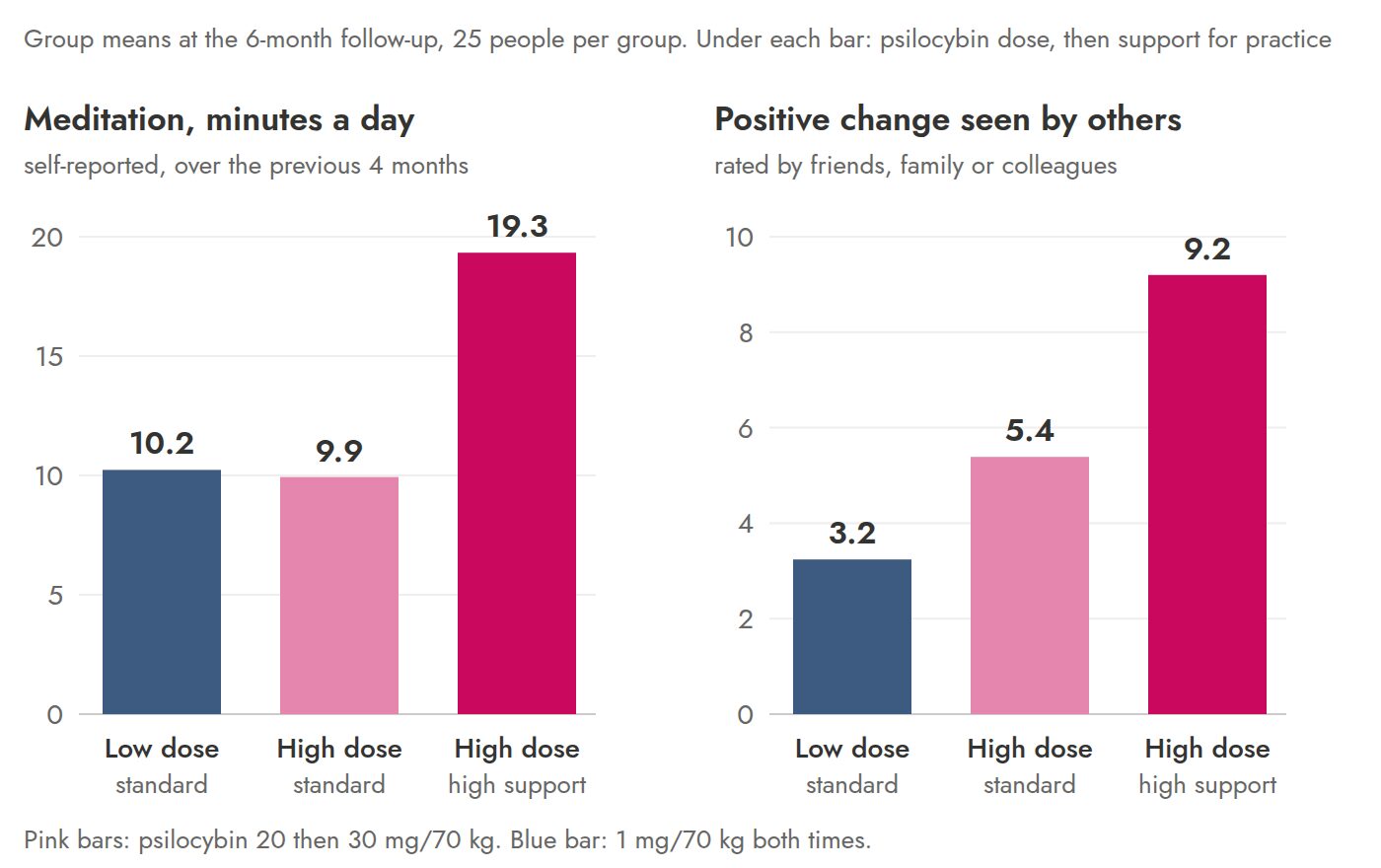
The people who knew the participants told a similar story. On their ratings of positive change in behavior and attitudes, the high-support group improved most, and only that group differed significantly from the low-dose group. On a separate questionnaire about the participant’s spiritual sentiments, answered by the observer who knew them best, both high-dose groups scored higher than the low-dose group.
The abstract states the finding more broadly than the tables. It says that compared with the low-dose group, “both high-dose groups showed large significant positive changes” on interpersonal closeness, gratitude, life meaning/purpose, forgiveness and community observer ratings, among others. In Table 6, though, the high-dose standard-support group did not differ significantly from the low-dose group on closeness to others, gratitude, life meaning, trait forgiveness or the observers’ change score; on these, only the high-support group did.
Support Doubled the Practice; the Drug Didn’t Change It
The high-support group practiced about twice as much as the other two: 19.3 minutes of meditation a day against about 10, with 64% meditating daily against 32% and 20%, and journaling 4.4 times a week against about 1.8. The two standard-support groups practiced about the same, whatever their dose:
However, the LD-SS and HD-SS groups were not significantly different on any of these six measures, indicating that, under the conditions of the study, psilocybin did not facilitate engagement with these spiritual practices.
(LD-SS and HD-SS are the low-dose and high-dose standard-support groups.) So in this study, a powerful psilocybin experience did not on its own make people meditate more. The extra meetings did.
What Went With Lasting Change?
To see what went with the changes at 6 months, the authors ran a regression across all 75 people. The three practice measures (meditation minutes, awareness practice and journaling) together explained a significant share of the differences between people on 13 of 19 outcomes, on average about 14%. Adding how intense the mystical experience had been explained a significant further share on 18 of the 19, on average about 27%. Of the three practices, meditation time stood out, significant on six outcomes in the full model. The authors conclude:
Overall, these results suggest that both mystical experience and spiritual practices contribute to positive outcomes, with mystical experience making a substantially greater contribution.
They note that the mystical experience was measured 4 to 5 months before the outcomes, which they see as strengthening their reading. Still, this is an analysis of
correlations
A correlation measures how closely two things rise and fall together across people or over time. Pearson’s r runs from −1 to +1: values near +1 mean that people high on one measure tend to be high on the other, values near −1 mean the reverse, and values near 0 mean no straight-line relationship. A correlation alone can’t show that one thing causes the other.
More on Wikipedia
Read more in the glossary
across people, not a test of cause: it shows that people with stronger experiences and more practice tended to change more. The abstract’s term for these factors, “determinants,” is stronger than such an analysis can show.
Miscellaneous Interesting Takeaways
The Design Can’t Isolate the Effect of Support for Practice
The study had three groups, not four. Missing was a group given the very low dose with high support, which would have shown what the extra meetings and practice did without a strong psilocybin experience. The authors acknowledge this:
The fourth cell of a completely balanced design would be the low-dose high-support condition. Addition of that group would have permitted evaluation of the effects of high support independent of psilocybin.
They left it out because of cost, and because they worried that people who got only a low dose might not keep up the demanding schedule of meetings. So the study can show that the high dose made a difference (with standard support), and that extra support made a further difference when given with the high dose. It can’t say whether intensive meditation support alone would have done as much. Because the high-support group discussed both their practice and their psilocybin sessions, the authors also note that the effect of group discussion of practice alone can’t be separated out. And the standard support was minimal: in the low-dose group it changed almost nothing, unlike earlier, more intensive programs built on the same book, which the authors attribute to how little teaching and support that group received.
How Blind Was It?
The authors took care to blunt expectations, a form of
demand characteristics
Demand characteristics are cues in an experiment that hint at what the researchers expect, which can lead participants to behave the way they think they are supposed to rather than how they normally would. Researchers reduce them by disguising the study’s purpose, measuring behavior unobtrusively, or using comparison conditions that seem just as plausible.
More on Wikipedia
Read more in the glossary
. After the study, the five lead guides were asked what they thought had been given: none understood the design, and several guessed wrongly, for instance that a true placebo or a different drug had been used. The paper doesn’t report asking participants which dose they thought they had received. There was no true
placebo
A placebo is an inactive treatment, such as a sugar pill or a cream with no drug in it, made to look like a real one. The placebo effect is the improvement people feel after receiving it, driven by their expectations, by learning from past experiences of real treatment, and by the setting of care. Pain is especially responsive: placebo pain relief is well documented in the lab and has been linked to prefrontal brain areas and the brain’s own opioids.
More on Wikipedia
Read more in the glossary
, and the very low dose was not inert in experience: 12% of the low-dose group rated their sessions among the five most spiritually significant experiences of their lives. The authors suggest this is unsurprising in people told they would receive psilocybin, but without a true placebo they can’t say whether the low dose had any drug effect.
Self-Report, Many Outcomes and a Narrow Sample
Nearly all outcomes were questionnaires filled in by the participants, who had signed up hoping to grow spiritually, and their practice was recalled over four months. The observers’ ratings are the main exception, and they too were reported over the phone by people the participants chose, who were told their previous ratings before rating again. The battery included many questionnaires with several scores each, and the paper reports no correction for
multiple comparisons
The multiple comparisons problem arises when researchers run many statistical tests at once. Each test has a small chance of a false positive, so across thousands of tests, such as one for every point in a brain scan, some “significant” results will turn up by chance alone. Corrections raise the bar for significance to keep the overall false-positive rate down, at the cost of making small real effects harder to detect.
More on Wikipedia
Read more in the glossary
. Several measures, including life satisfaction, optimism, purpose in life, non-attachment, positive emotions and the five main personality traits, showed no significant differences between the groups at 6 months, though some rose within the high-dose groups. The participants were mostly white, college-educated and employed.
No Turn Away From Tradition, and No Change in Openness
The authors note a result against a popular belief that psychedelic experiences lead people to reject traditional worldviews. On a values questionnaire, the importance of tradition (respect for tradition, humility, moderation, acceptance of life’s circumstances and religious belief) rose in the high-support group and was higher than in the low-dose group at 6 months. They suggest the setting, with its encouragement of spiritual practice, may explain this. In contrast to an earlier analysis of the team’s own data, the personality trait of openness did not differ between the groups at 6 months, which they suggest might reflect the practice program or another feature of the design.
Difficult Moments and Safety
The high doses were not all bliss. Guides rated more anxiety or fearfulness at the peak in the high-dose groups, and on a questionnaire scale of fearful
ego dissolution
Ego dissolution (also called ego death) is a temporary loss of the ordinary sense of being a separate self, often described as the boundary between self and world melting away, sometimes with a feeling of oneness. It is reported at high doses of psychedelic drugs and in some deep meditative states, and researchers usually measure it with questionnaires.
More on Wikipedia
Read more in the glossary
(“Dread of Ego Dissolution”), the high-dose groups scored about 21–22% of the maximum against 5% for the low dose. Blood pressure rose moderately during sessions; in one participant it rose high enough to meet the protocol’s criteria for medication, and although the session ended uneventfully, that person was withdrawn from the study. There were no serious adverse events. At the 6-month interview no one reported lingering perceptual effects or any psychedelic use outside the study. In the high-support group, a few people reported small increases in negative attitudes about themselves, though all eight who did also said the experience had increased their well-being.
Who Funded It
The study was mainly funded by the Fetzer Institute and the Council on Spiritual Practices, with some support from the Heffter Research Institute. The paper discloses that Robert Jesse, a co-author and convener of the Council on Spiritual Practices, helped design the study and write the paper but was not involved in collecting or analyzing the data, and that Griffiths was on the board of the Heffter Research Institute.
Final Reflection
This is a carefully run study that does something rare: it follows a powerful experience forward in time, with a randomized comparison group and ratings from people who know the participants. Its central finding is that high-dose psilocybin, given to people starting a meditation program, was followed six months later by higher scores on many measures of spiritual life and of how people treat others, and that the changes were largest when people also got the most help with their practice.
For meditators, two details stand out. First, the drug experience did not by itself make anyone practice more: only the extra support did. Second, both the intensity of the experience and the amount of meditation went with who changed most. What the study can’t say is how much of the change intensive support for meditation would have produced without psilocybin, because no group received it. That is the comparison a meditation reader would most want, and it is still missing.
Citation
Griffiths, R. R., Johnson, M. W., Richards, W. A., Richards, B. D., Jesse, R., MacLean, K. A., Barrett, F. S., Cosimano, M. P., & Klinedinst, M. A. (2018). Psilocybin-occasioned mystical-type experience in combination with meditation and other spiritual practices produces enduring positive changes in psychological functioning and in trait measures of prosocial attitudes and behaviors. Journal of Psychopharmacology, 32(1), 49–69. 10.1177/0269881117731279
Get the next summary by email
One or two new paper summaries every couple of weeks, sent to your inbox when they go up.
No spam, and you can unsubscribe at any time. Prefer a feed reader? Use the RSS feed.