
Background Information
Some experienced meditators describe moments in which the ordinary sense of being a separate self falls away, a state researchers call selflessness or self-dissolution. Classic
psychedelic drugs
Classic psychedelics are drugs such as psilocybin (the active compound in “magic mushrooms”), LSD, mescaline and DMT that profoundly alter perception, emotion and the sense of self, mainly by stimulating the brain’s serotonin 2A receptors. They are being studied as possible treatments for conditions such as depression and addiction, mostly in carefully controlled clinical settings, and are controlled substances in most countries.
More on Wikipedia
Read more in the glossary
such as
psilocybin
Psilocybin is the main psychoactive compound in “magic mushrooms,” a classic psychedelic drug. In the body it is converted to psilocin, which acts mainly on the brain’s serotonin 2A receptors. At high doses it can profoundly alter perception, mood and the sense of self for about six hours, and in research settings it often brings experiences people describe as mystical or deeply meaningful. It is being studied in carefully screened, supervised settings as a possible treatment for depression and addiction, and is a controlled substance in most countries.
More on Wikipedia
Read more in the glossary
can produce something that sounds similar,
ego dissolution
Ego dissolution (also called ego death) is a temporary loss of the ordinary sense of being a separate self, often described as the boundary between self and world melting away, sometimes with a feeling of oneness. It is reported at high doses of psychedelic drugs and in some deep meditative states, and researchers usually measure it with questionnaires.
More on Wikipedia
Read more in the glossary
, often with feelings of unity, bliss and insight. In deep meditation these states are rare and mostly reached by long-term practitioners, the authors note, while a high dose of psilocybin brings them on in a large share of people. Whether the two are really alike had been argued about, for example in a 2018 review by Millière and colleagues, but never tested in a prospective experiment.
A psychedelic experience is not always pleasant. The same dose that brings bliss to one person can bring fear of losing control, anxiety or panic to another, what’s colloquially called a “bad trip.” What tips it one way or the other depends partly on
set and setting
Set and setting are the two non-drug factors that shape how a psychedelic experience unfolds. “Set” is the person’s mindset: their expectations, mood, personality and intentions. “Setting” is the physical and social environment: the place, the people present and the support on hand. The same dose can bring a blissful experience in one set and setting and an anxious, distressing one in another, which is why research studies prepare volunteers carefully and give the drug in calm, supervised surroundings.
More on Wikipedia
Read more in the glossary
: the person’s mood, expectations and personality, and the place and company in which the drug is taken.
Lukasz Smigielski, Franz Vollenweider and colleagues at the Psychiatric University Hospital Zurich wondered how meditation and psilocybin would interact. Would a meditator’s trained skills in steadying attention and handling emotions make the drug experience deeper and gentler? Would a retreat be a good “setting”? And would the experience leave lasting changes? They tested this in experienced meditators in the middle of a Zen retreat.
This site is about meditation, so this summary is about what the study shows about meditation and meditative states. Nothing here is a suggestion to take psilocybin, which is a controlled substance in most countries; here it was given under medical supervision to screened volunteers, with the Swiss authorities’ approval.
What They Did
The study was advertised as an experiment on psilocybin and
mindfulness
Mindfulness is the psychological process of purposely bringing one’s attention to experiences occurring in the present moment without judgment. It involves maintaining awareness of thoughts, feelings, bodily sensations, and surrounding environment with an attitude of curiosity and acceptance. In meditation contexts, mindfulness practices typically involve focusing attention on the breath or body sensations as anchors to the present moment while acknowledging and releasing distracting thoughts.
More on Wikipedia
Read more in the glossary
practice. Of 202 people who applied, 40 passed a phone screen, a medical check-up and a psychiatric interview. Anyone with a current or past psychiatric disorder, or a parent, sibling or child with one, was excluded, as was anyone with more than very limited exposure to hallucinogens. One person withdrew, leaving 39 healthy Buddhist meditators, mostly practitioners of
Zen
Zen is a school of Mahayana Buddhism that developed in China (as Chan) and spread to Japan, Korea and Vietnam. Its central practice is seated meditation (zazen), such as shikantaza, “just sitting” in open awareness without a particular object, or working with koans, paradoxical questions meant to cut through ordinary conceptual thinking.
More on Wikipedia
Read more in the glossary
(33) and the rest of
Vipassana
Vipassana is a form of Buddhist meditation focused on the cultivation of insight through moment-to-moment awareness of bodily sensations, thoughts, and emotions. It emphasizes non-reactivity and equanimity, helping practitioners observe mental and physical phenomena without attachment.
More on Wikipedia
Read more in the glossary
(6). They were in their early fifties on average, had at least 500 hours of formal practice (on average about 4,800 to 6,200 hours per group) and had been on about 30 retreats. About two-thirds had never taken a psychedelic, and none had taken a mind-altering drug such as psilocybin, LSD, MDMA or ketamine more than three times.
The volunteers were split into two groups balanced for age, sex, mindfulness, hours of practice and number of retreats, then randomly assigned to psilocybin or
placebo
A placebo is an inactive treatment, such as a sugar pill or a cream with no drug in it, made to look like a real one. The placebo effect is the improvement people feel after receiving it, driven by their expectations, by learning from past experiences of real treatment, and by the setting of care. Pain is especially responsive: placebo pain relief is well documented in the lab and has been linked to prefrontal brain areas and the brain’s own opioids.
More on Wikipedia
Read more in the glossary
. Neither they nor the staff knew who got which: the capsules looked identical and were prepared by a hospital pharmacy.
The setting was a traditional five-day Zen retreat, a sesshin, held twice (16 and 23 people) at a meditation center under an experienced Zen teacher. The days ran from 6 a.m. to 9 p.m. in silence: eight 30-minute sessions of seated meditation facing a wall, walking meditation, 75 minutes of mindful work, recitations and meals. At 10:30 on the morning of day 4, each person swallowed a capsule containing either psilocybin (315 micrograms per kilogram of body weight, about 22 mg on average, which the authors call a high dose) or an inactive substance. They then carried on with their usual practice in silence, on a slightly adjusted schedule with some music and short relaxation periods. Day 5 was for integration.
Each evening, everyone rated that day’s state of mindfulness and how deep their meditation had been. Six hours after the capsule, they filled in two questionnaires about the day’s experience:
- The 5D-ASC, a standard scale of altered states. Its main scales include Oceanic Boundlessness (the blissful, boundless form of self-dissolution: unity, spiritual experience, bliss, insight, a sense of being disembodied), Anxious Ego Dissolution (loss of control, disordered thinking and anxiety, the “bad trip” side), and Visionary Restructuralization (visual imagery and hallucinations, sounds triggering images, ordinary things taking on new meaning).
- The Mysticism Scale, a 32-item questionnaire on
mystical-type experience
A mystical experience is an experience, often described as religious or spiritual, of unity with everything, loss of the usual sense of self, timelessness, deep positive feeling and a sense of having glimpsed a deeper truth, which is typically felt to be hard to put into words. Researchers measure it with questionnaires such as Hood’s Mysticism Scale. Such experiences are reported in meditation and prayer, and after taking psychedelic drugs.
More on Wikipedia
Read more in the glossary : unity with the world, loss of self, timelessness and spacelessness, a sense that the experience can’t be put into words, positive feeling, sacredness, and a sense of having understood something true. Before the retreat, everyone had also filled it in about the strongest mystical experience of their life.
They rated their trait mindfulness on the day before and the day after the retreat. Four months later, they rated how their attitudes and behavior had changed since, and how meaningful the study had been to them; a relative or close friend of each also rated the changes they had seen.
One Big Result: Psilocybin Brought Strong Mystical-Type Experiences to Almost Everyone Who Took It, With Little Anxiety
The drug made a large difference to the day’s experience. On the 5D-ASC, the psilocybin group’s Oceanic Boundlessness averaged 63% of the scale maximum against 11% with placebo, and Visionary Restructuralization 50% against 5%. Every element of the blissful kind of self-dissolution, unity, spiritual experience, bliss, insight and disembodiment, was higher with psilocybin, and so was every kind of imagery.
The anxious kind of self-dissolution was a different story. Anxious Ego Dissolution averaged 7.6% of the maximum with psilocybin and 1.7% with placebo, a difference that was not statistically significant, and the two groups did not differ on its impaired control and anxiety subscales. Psilocybin’s average anxiety score was 3% of the maximum, and no one scored above 10%.
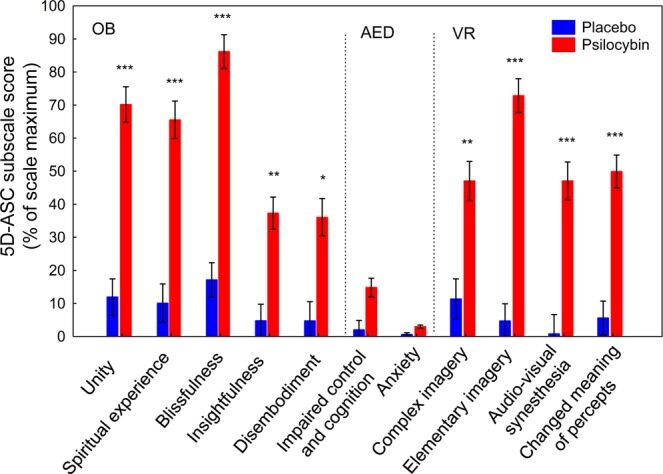
The Mysticism Scale told the same story. The psilocybin group scored higher on all three of its main dimensions and on every one of its eight facets. The researchers had set a threshold in advance for a “strong” mystical-type experience: 60% of the scale maximum. It was reached by 19 of the 20 people on psilocybin (95%) and by 3 of the 19 on placebo (16%). For the psilocybin group, the retreat day scored about as high as the strongest mystical experience of their lives, as they had rated it before the retreat.
The authors’ summary in the abstract goes further than “the drug had strong effects”:
Meditation seems to enhance psilocybin’s positive effects while counteracting possible dysphoric responses.
That is an interpretation rather than a direct result. Every participant in this study meditated, so the trial itself can’t show what meditation added to the drug. The authors base the claim on a comparison, described in the paper’s supplement, with 20 non-meditators who had been given the same dose of psilocybin in an earlier laboratory study by their group while doing simple tasks. Against that group, the retreat meditators scored higher on unity, spiritual experience and bliss. But those volunteers were tested at a different time, in a different setting, for a different purpose, and were not randomly assigned, so the comparison can’t separate meditation skill from the retreat, the group, the instructions or the kind of person who signs up.
Miscellaneous Interesting Takeaways
What the Retreat Did, and What the Drug Added
Across the five days, both groups’ ratings rose: state mindfulness from an average of 29.6 to 32.4, and meditation depth from 63.0 to 77.7. There was no comparison group that stayed home, so the rise can’t be credited to the retreat with certainty.
Psilocybin did not significantly change state mindfulness. It did raise meditation depth on day 4, the drug day, compared with placebo. The meditation-depth questionnaire includes items on bliss, feeling connected and experiencing the unity of all things, the same kinds of feelings the drug produced on the other scales. The authors read the result as showing that “experienced meditators were able to remain engaged in their usual meditation practice” during the drug’s effects.
On trait mindfulness, measured the day before and the day after the retreat, both groups rose overall (from 43.3 to 46.2), and afterward the psilocybin group scored higher than the placebo group. That post-retreat questionnaire asked about the previous five days, which included the drug day.
Three People on Placebo Had Strong Mystical-Type Experiences Too
The three placebo participants who crossed the threshold for a strong experience got there on meditation alone, on the fourth day of a silent retreat. Their Mysticism Scale profiles were very similar to those of the psilocybin group, which the authors call “the first experimental evidence” that meditation and psilocybin can bring on overlapping mystical-type experiences. The difference lay in what came with it. In the placebo participants, the experience came with virtually no anxiety, cognitive impairment, reduced alertness or sounds triggering images, and few simple visual images. In the psilocybin group, it came with vivid visual changes, marked synesthesia and moderate impairment of thinking and alertness. That fits a theme of the Millière review: states given the same label in meditation and on psychedelics may differ a great deal in how much else is in experience. Three people is a very small group to compare, though.
Who Had the Deepest Experiences
The researchers looked at which traits and states, measured before the drug, went with stronger experiences. Unsurprisingly, whether a person got psilocybin mattered most, accounting for between 35% and 74% of the variation in the six measures they analyzed. Beyond that:
- Optimism and
openness to experience
Openness to experience is one of the five broad personality traits in the widely used Big Five model. People high in openness tend to be imaginative, curious, attentive to their inner feelings, drawn to variety and new ideas, and sensitive to art and beauty. It is measured with personality questionnaires such as the NEO Five-Factor Inventory.
More on Wikipedia
Read more in the glossary went with more blissful self-dissolution and stronger mystical-type experience. - Reappraisal, the habit of rethinking a situation to change how one feels about it, went with less anxious ego dissolution.
- Acceptance, the non-judging side of trait mindfulness, went with more of the inward, self-loss dimension of mystical experience and with the positive, sacred feel of it.
- Meditation depth went with more blissful self-dissolution and with the positive, sacred feel of the mystical experience.
These analyses were exploratory: 13 possible predictors, plus the drug, tested on six outcomes in 39 people, so they suggest what to test next rather than settle anything. The paper is also inconsistent about when meditation depth was measured. The results say state mindfulness and meditation depth “were assessed the day before drug intake,” but the methods list “meditation depth on the day of pharmacological intervention,” and a note to the supplementary table marks both as from the “drug session.”
Four Months Later
At follow-up, the psilocybin group reported more change in their attitudes and behavior since the retreat than the placebo group did, an average of 0.75 against 0.19 on a scale running from −2 (strongly decreased) to +2 (strongly increased). The clearest differences were in appreciation of life, self-acceptance, a sense of meaning and purpose, and appreciation of death. Friends and relatives, rating the people they knew, saw a similar but weaker pattern, with clear group differences in self-acceptance and sense of purpose. The paper doesn’t say whether these observers knew which capsule their friend had taken.
Within the study, the intensity of particular parts of the experience went with later change. Loss of ego, together with having had psilocybin, went with more change overall, and a sense of unity went with greater self-acceptance. Across both groups, a sense of sacredness went with greater appreciation of life, and sacredness together with a sense that the experience was beyond words went with a stronger sense of meaning and purpose. These are associations from a regression; the paper’s conclusion says the dissolution of self “mediated” the lasting changes, but the analysis wasn’t designed to show that.
Asked how meaningful the experience in the study had been, half the psilocybin group (10 of 20) put it among the ten most meaningful experiences of their lives and 35% (7) among the five most; none called it the single most meaningful. Only one person on placebo put it in the top ten; most compared it with experiences that come once a month, once a year or once every five years. (The paper’s discussion gives slightly different figures for the psilocybin group, 47% and 37%.)
Safety and the Blinding Problem
The authors report no adverse events, during the drug session, for the rest of the retreat or at four months:
Two participants reported in the postacute psychiatric investigation that they felt transiently emotionally overwhelmed during the peak effect of the drug, but did not value this as negative.
Those results come from a heavily screened group of healthy, experienced meditators, in a supervised setting with medical and psychological staff on hand. The authors themselves warn that challenging experiences, from distress and disorientation to panic, psychotic episodes and
depersonalization
Depersonalization is a dissociative experience characterized by feelings of detachment from one’s self, body, or mental processes. Individuals experiencing depersonalization may feel like an outside observer of their thoughts, feelings, or body, or they may feel as if they’re in a dream. It can occur as a temporary response to stress, as a symptom of psychiatric disorders, or as a feature of certain meditation experiences.
More on Wikipedia
Read more in the glossary
, can follow both meditation and psychedelics (see this site’s theme on difficult experiences in meditation and Castillo’s discussion of depersonalization).
The authors also name the study’s main weakness themselves:
Therefore, a major limitation of this study was the use of an inert placebo and the possible recognition of the active and non-active conditions by participants.
A drug that brings vivid imagery and peaks within an hour or two is hard to mistake for an inactive capsule. The paper doesn’t report whether participants guessed which capsule they had received. The authors argue that recruiting mostly people with no psychedelic experience, and keeping the retreat silent and focused on individual practice, made the conditions harder to tell apart. Even so, knowing one had received the drug could shape how people rated the day, how meaningful they later found it and how much they felt they had changed, all of which were self-report.
Final Reflection
This is a careful, unusual experiment: a real Zen retreat, experienced practitioners and a double-blind dose of psilocybin on the fourth day. What it shows clearly is that, in this setting and in these people, psilocybin very reliably produced intense, largely positive experiences of unity and self-dissolution, with little anxiety, and that the people who took it rated the retreat as more meaningful and life-changing four months later.
What it can’t show is what meditation added. Every participant meditated, the comparison with non-meditators comes from a separate earlier study, and the drug’s effects were too obvious for the blinding to hold for certain. The finding most interesting for meditators may be the smallest one: three people on placebo reached a strong mystical-type experience on the fourth day of a retreat, and their reports looked much like the psilocybin group’s, without the visions and confusion. It echoes reports from long-term meditators elsewhere on this site, such as the meditator who let his sense of boundaries dissolve and the MEG study of “selfless” awareness, that such states can arise from practice alone, if rarely and unpredictably.
Citation
Smigielski, L., Kometer, M., Scheidegger, M., Krähenmann, R., Huber, T., & Vollenweider, F. X. (2019). Characterization and prediction of acute and sustained response to psychedelic psilocybin in a mindfulness group retreat. Scientific Reports, 9(1), 14914. 10.1038/s41598-019-50612-3
Get the next summary by email
One or two new paper summaries every couple of weeks, sent to your inbox when they go up.
No spam, and you can unsubscribe at any time. Prefer a feed reader? Use the RSS feed.